Joint-Loss Enhanced Self-Supervised Learning for Refinement-Coupled Object 6D Pose Estimation
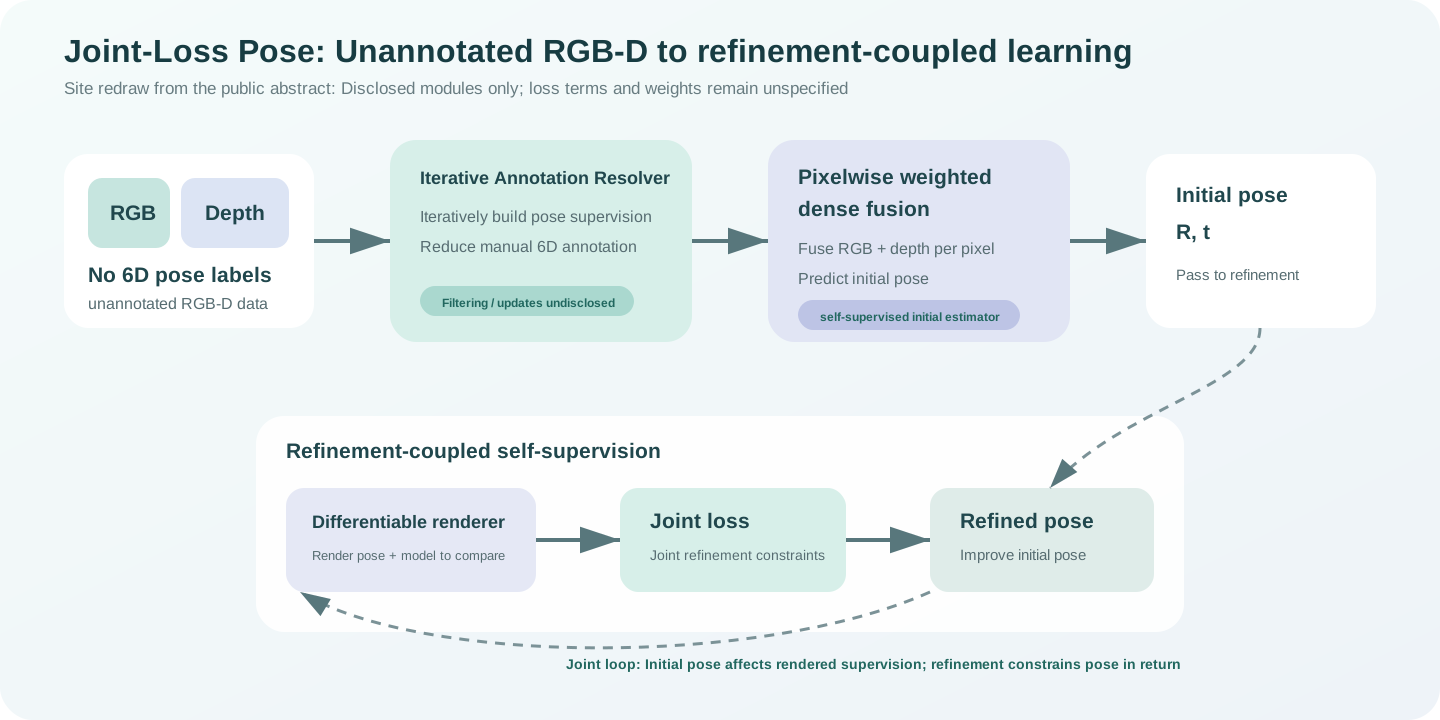
An Iterative Annotation Resolver builds supervision from RGB-D data without 6D annotations. Pixelwise weighted dense fusion initializes pose, followed by refinement trained with a differentiable renderer and joint loss. The authors' abstract claims accuracy close to supervised methods, without specifying datasets or numerical results.
Task: learn instance-level initial pose estimation and iterative refinement from RGB-D observations without 6D pose annotations
Availability: the full text is not open access; no author manuscript, code, or public model was found. This page limits factual claims to the authors’ public abstract.
2. One-sentence summary
This work aims to turn a supervised RGB-D pose pipeline requiring extensive real 6D annotations into a self-supervised loop: an Iterative Annotation Resolver constructs training targets from unannotated observations, pixelwise weighted dense fusion predicts an initial pose, and a differentiable renderer + joint loss trains refinement. The abstract says the resulting accuracy closely rivals supervised methods, but gives no datasets or absolute scores.
3. Method Overview
The public abstract confirms two coupled learning stages.
The first stage addresses initial pose estimation:
Take RGB-D observations without manual 6D pose labels;
Iteratively generate training supervision with the Iterative Annotation Resolver;
Fuse color and depth with pixelwise weighted dense fusion to predict the initial pose.
The second stage addresses refinement:
Feed the current pose and object model into a differentiable renderer;
Construct joint optimization constraints;
Train pose refinement through self-supervision with a joint loss;
Output a more accurate pose.
Redrawn by this site from the authors' public abstract; this is not an original paper figure. It shows only module relationships stated in the abstract. IAR rules, joint-loss terms, and renderer details were not disclosed. Paper content copyright belongs to the original authors; the redraw is for academic analysis. Source: Joint-Loss Self-Supervised Pose, ICRA 2024.
“Refinement-coupled” is the key idea: the initial pose also determines whether rendered supervision is reliable, while geometric consistency from the refiner constrains the initial estimate. Training stability therefore depends on pseudo-label quality, the initialization error range, and how the renderer handles occlusion and symmetry.
4. Results and Evidence
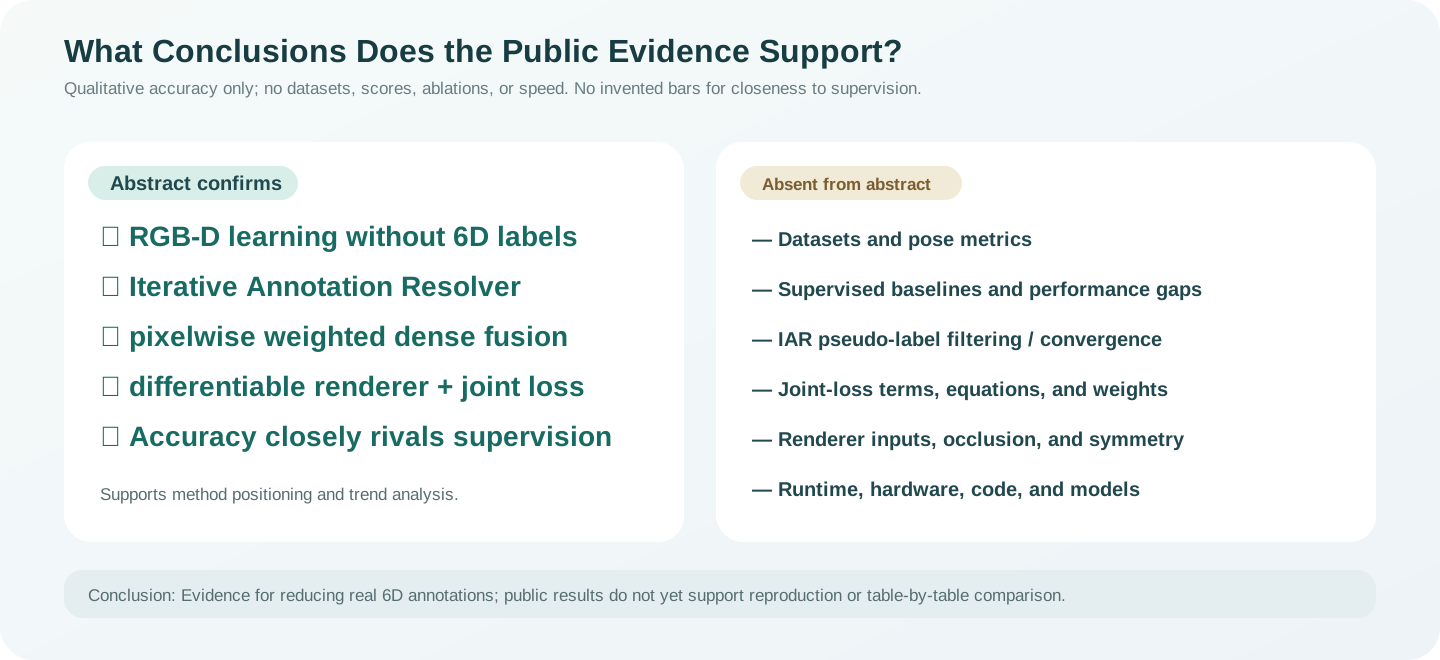
The abstract provides only one qualitative conclusion: pose estimation accuracy closely rivals supervised methods. The available public material does not specify:
Which dataset was used;
Whether evaluation used ADD(-S), AUC, 2D projection, or other metrics;
Which supervised baseline was compared;
Absolute scores or performance gaps;
Runtime, hardware, parameter counts, or ablations.
Compiled by this site from DOI metadata and the authors' public abstract. Because the abstract gives no numbers, this diagram shows supported conclusions and items requiring full-text verification instead of inventing performance bars. Source: Paper DOI.
Thus, “closely rivals supervised methods” supports the motivation that reducing real 6D annotations may retain competitive performance. It does not establish a particular state-of-the-art result or a gap of only a few percentage points.
5. Strengths and Risks
Points of interest:
Training data can come from real RGB-D captures without manual pose labels;
Dense fusion uses both appearance and metric geometry;
Differentiable rendering turns a known 3D model into an optimizable self-supervision signal;
Considering initial estimation and refinement together better reflects error propagation than training a refiner alone.
Main risks:
Incorrect initial poses can generate incorrect rendered supervision and cause confirmation bias;
Symmetric objects may admit several visually equivalent poses, making a single pseudo-label contradictory;
Missing depth, sensor noise, and occlusion can corrupt both dense fusion and the renderer loss;
Without public code or numerical results, reproducibility is currently limited.
6. Coarse Reading Assessment
This paper contributes to annotation efficiency rather than novel-object zero-shot estimation. It still requires RGB-D, object models, and renderable geometry, and targets known instances. Its direction is useful for adapting existing objects using large unannotated factory captures; it does not directly address unknown objects, RGB-only input, or general estimation without CAD.
Available src/paper-notes/joint-loss-self-supervised-icra2024/deep.md
In-depth paper notes
Support reproduction, comparison, related-work writing, and identifying opportunities for further research.
Paper Reading Notes (Deep): Joint-Loss Enhanced Self-Supervised Learning for Refinement-Coupled Object 6D Pose Estimation
1. Research Problem and Conclusions
Supervised instance-level 6D pose estimation usually requires real RGB-D images, known CAD / meshes, and accurate per-frame (R,t) labels. Models and RGB-D are relatively accessible; aligning real images with millimeter-scale object coordinates is harder. Manual annotation is slow, and robot / camera calibration errors directly become training-label noise.
The goal is to train an RGB-D pose pipeline with initial estimation and refinement without manually 6D-annotated data. The public abstract identifies these components:
Iterative Annotation Resolver (IAR);
pixelwise weighted dense fusion;
differentiable renderer;
joint loss;
refinement-coupled training.
The authors claim accuracy close to supervised methods. Because the public abstract provides no datasets, metrics, or absolute scores, this page examines method logic and evidence boundaries rather than reconstructing experimental tables.
2. Task Setting
The input consists of RGB-D observations without pose labels:
Du={(Ii,Di)}i=1N.
The output is an object-to-camera rigid transform:
Tco=[R0⊤t1]∈SE(3).
The differentiable renderer described in the abstract implies dependence on renderable object geometry. The initial-pose-plus-refinement formulation places the method in known-instance pose estimation rather than category-level shape generalization.
Two meanings of “unannotated” should be distinguished:
No manual 6D pose annotations: explicitly addressed here;
No priors or labels of any kind: not claimed. RGB-D, object models, camera conditions, and information needed to initialize IAR remain sources of supervision.
3. Role of the Iterative Annotation Resolver
At a high level, IAR converts unannotated RGB-D data into supervision for training the initial pose estimator. In abstract notation:
This illustrates a generic iterative pseudo-labeling loop; it is not an undisclosed paper equation. Success depends on:
Where the first pose estimates come from;
Which predictions are accepted as pseudo-labels;
How low confidence, occlusion, and symmetry are handled;
When iteration stops;
Whether the model avoids reinforcing its own errors.
These rules are absent from the public abstract, so IAR cannot currently be identified with a specific teacher–student, ICP, or multi-view label resolver.
4. Pixelwise weighted dense fusion
The abstract explicitly bases the initial estimator on a novel pixelwise weighted dense fusion architecture. Its role is to combine RGB appearance and depth geometry at pixel level to predict the initial pose.
In functional terms, this module must at least:
Associate RGB features with corresponding depth points at pixel level;
Assign different weights to foreground points, occluded points, missing depth, and background noise;
Aggregate local predictions into an object-level (R,t).
These are typical functions of dense-fusion architectures, not evidence that this paper uses the DenseFusion formulation. The abstract does not establish whether weights come from attention, a confidence head, depth validity, or geometric residuals, nor whether final estimation uses voting, direct regression, or a correspondence solver.
5. Differentiable Renderer and Joint Loss
After initial estimation, a differentiable renderer constructs joint optimization constraints for refinement. A generic render-and-compare structure can be written as:
I^r,D^r,M^r=R(M,T,K),
Here M is the object model and K denotes camera parameters. Differences between renderings and real RGB-D / masks / geometry can provide pose-refinement gradients.
“Joint loss” indicates supervision combining multiple constraints rather than a single photometric term. The abstract does not list those terms, so common RGB, depth, silhouette, point-matching, or pose-consistency losses cannot be stated as facts about this method.
The high-level coupling can be established:
The initial estimator provides the refiner’s starting point;
The renderer turns the current pose into signals comparable to observations;
The joint loss trains the refiner to correct poses;
The quality of initial and refined poses jointly affects the self-supervised loop.
Redrawn by this site from the authors' public abstract; not an original paper figure. IAR filtering, renderer outputs, and joint-loss terms were not disclosed in the abstract, so no speculative formulas are added. Paper content copyright belongs to the original authors; the redraw is for academic analysis. Source: Joint-Loss Self-Supervised Pose, ICRA 2024.
6. Why Is Refinement-Coupled Learning Harder Than an Independent Refiner?
A conventional supervised pipeline can perturb ground-truth poses to create many initial-error-to-correct-update training pairs. Without ground truth, the self-supervised refiner starts from predictions of an initial estimator that is still learning.
This creates three coupled problems:
6.1 Basin of convergence
Differentiable-rendering losses usually provide useful gradients only when the current pose is near the true pose. Large initialization errors misalign silhouettes, depth, and color, and gradients may lead to an incorrect local optimum.
6.2 Confirmation bias
If IAR generates wrong pseudo-labels, the initial estimator learns those errors. Rendering around the wrong pose then supplies supervision that encourages refinement to explain the incorrect alignment.
6.3 Symmetry
Symmetric objects admit a set of equivalent poses:
[R,t]∼[RS,t],S∈SM.
Forcing a model toward one pseudo-label can impose unnecessary rotation penalties even when rendering agrees with observation. Whether joint constraints account for symmetry is therefore a key reproduction question.
7. Results Evidence Audit
The abstract’s entire result-level conclusion is that experiments show pose accuracy closely rivals supervised methods.
Compiled by this site from DOI metadata and the authors' public abstract. Without public numbers, illustrative bar heights must not substitute for real scores; this diagram shows evidence coverage. Source: Paper DOI.
Supported Conclusions
The authors developed a self-supervised RGB-D pipeline without manual 6D pose labels;
The method includes both initial estimation and refinement;
Its experimental performance is reported to be competitive with supervised methods.
Unsupported Conclusions
A numerical gap of X% from supervised methods;
A specific state-of-the-art result on a particular benchmark;
Attribution of gains mainly to IAR, dense fusion, or the joint loss;
Separate effectiveness on real / synthetic, occluded / unoccluded, or symmetric / asymmetric objects;
Whether training actually costs less than a manually annotated approach.
8. Comparison with Related Self-Supervised Approaches
Approach
Source of self-supervision
Typical strength
Main risk
synthetic-only
Renderer-generated training data with GT
Free labels at scale
Sim-to-real gap
teacher–student pseudo labels
High-confidence predictions supervise a student
Easy use of real unannotated data
Confirmation bias
temporal / multi-view consistency
Adjacent frames or known camera motion
Real geometric constraints
Dynamic objects and calibration errors
render-and-compare refinement
CAD-rendering / observation consistency
Interpretable geometry
Local convergence and material mismatch
Publicly described approach here
IAR + dense fusion + differentiable renderer
Covers initial pose and refinement
Coupled errors across stages
The distinction is the unified learning problem combining a pseudo-label-based initial estimator with a rendering-based refiner, beyond using differentiable rendering alone.
9. Potential Failure Modes
Depth holes and outliers: RGB-D noise on reflective surfaces, transparent objects, and edges corrupts pixelwise fusion.
Occlusion: the renderer shows the full CAD model while observations show only part; residuals can mislead pose estimation without visibility masks.
Appearance-model mismatch: mismatched materials, lighting, and backgrounds can make photometric constraints unreliable.
Symmetry and repeated textures: multiple valid solutions are reduced to a single pseudo-label.
Poor initialization: a refiner works only within its local convergence basin.
Model errors: CAD dimensions, wear, or assembly states differ from the real workpiece.
Correlated-data leakage: generating and evaluating pseudo-labels on adjacent frames from the same sequence may overestimate generalization.
10. Reproduction Details Needed from the Full Text
IAR initialization, confidence, pseudo-label filtering, and stopping criteria;
Generation of pixelwise weights and RGB / depth encoders;
Rotation representation and pose aggregation;
Differentiable-renderer inputs, outputs, visibility, and material settings;
Every joint-loss term, its weight, and training stages;
Label / loss definitions for symmetric objects;
Training data, test benchmarks, splits, and all absolute scores;
Whether supervised baselines use the same backbone, training volume, and inputs;
Ablations for initial-only, refinement-only, IAR, and joint loss;
Training time, GPUs, inference speed, and open-source availability.
11. Research Ideas
This approach could be extended into a self-supervised loop with uncertainty:
Have IAR output covariance-bearing or multiple-hypothesis pseudo-labels instead of one pose;
Adapt joint-loss weights to renderer consistency so heavily occluded frames do not dominate training;
Minimize loss over equivalent poses for symmetric objects;
Use low-frequency multi-view / robot-kinematic constraints for global correction and a high-frequency refiner for local refinement;
Monitor calibration of the initial estimator and refiner separately to detect confirmation bias.
This work represents a practical direction in ICRA 2024 object pose research: moving from manually annotating every frame precisely to automatically constructing supervision from models and sensor geometry. Its research position is clear, but available public evidence does not support numerical state-of-the-art comparisons or a reproducibility assessment. Retaining that boundary on the detail page is more accurate than inventing a complete results table.