Learning Better Keypoints for Multi-Object 6DoF Pose Estimation
KeyGNet replaces fixed FPS / BBox keypoints with offline target design. EdgeConv learns shared 3D keypoints from visible colored object surfaces within a dataset. Wasserstein loss aligns voting distributions across keypoints, and dispersion loss prevents geometric collapse. Replacing keypoints in PVNet, PVN3D, and RCVPose raises MIMO mean AR across seven BOP core datasets by 11.3, 12.0, and 10.0 points; PVN3D LMO ADD(S) rises from 53.9 to 70.3. Benefits center on closing the SISO→MIMO gap, but ground-truth poses, intrinsics, known geometry, visible surfaces, and separate training per dataset / voting representation are required.
colored visible object-surface points for KeyGNet trainingRGB input for PVNetRGB-D / point-cloud input for PVN3D and RCVPose
Requirements
known object geometry during keypoint optimizationtraining images with ground-truth object poses and camera intrinsicsvisible object-surface segmentsthe detector / mask / depth dependencies of the selected downstream pose estimatorseparate KeyGNet optimization for each dataset and voting representation
Full paper metadataAuthors, affiliations, research area, datasets, metrics, method tags, and reading statusExpandCollapse
Original paper terminology:BOP Average Recall / VSD recall / MSSD recall / MSPD recall / ADD(S) / ADD(S) AUC / SISO-to-MIMO performance gap / training time
known object geometry during keypoint optimizationtraining images with ground-truth object poses and camera intrinsicsvisible object-surface segmentsthe detector / mask / depth dependencies of the selected downstream pose estimatorseparate KeyGNet optimization for each dataset and voting representation
Reading Notes
Overview / Deep Dive
Available src/paper-notes/keygnet-wacv2024/coarse.md
Paper overview notes
Quickly assess the paper's scope, problem setting, core method, experimental findings, and whether to read it in depth.
Paper Reading Notes (Coarse): Learning Better Keypoints for Multi-Object 6DoF Pose Estimation
1. Basic information
Title: Learning Better Keypoints for Multi-Object 6DoF Pose Estimation
KeyGNet replaces fixed FPS surface points or bounding-box corners with shared keypoints learned by a graph network from training objects’ visible colored surfaces. It makes keypoint vote distributions similar while keeping positions dispersed. Replacing heuristic keypoints in PVNet, PVN3D, and RCVPose substantially reduces the SISO→MIMO accuracy loss in multi-object training.
The paper revisits a design choice often treated as constant: which 3D keypoints should the downstream network regress? It does not introduce an entirely new pose pipeline.
2.1 Guide to the paper’s figures and tables
Figure / table
Reading focus
Figure 3
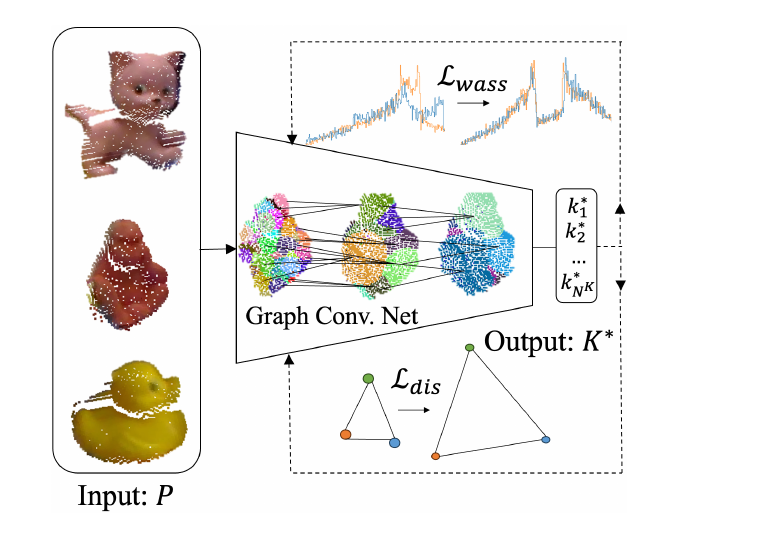
KeyGNet inputs, graph-network outputs, and two optimization objectives: the central method diagram.
Table 1
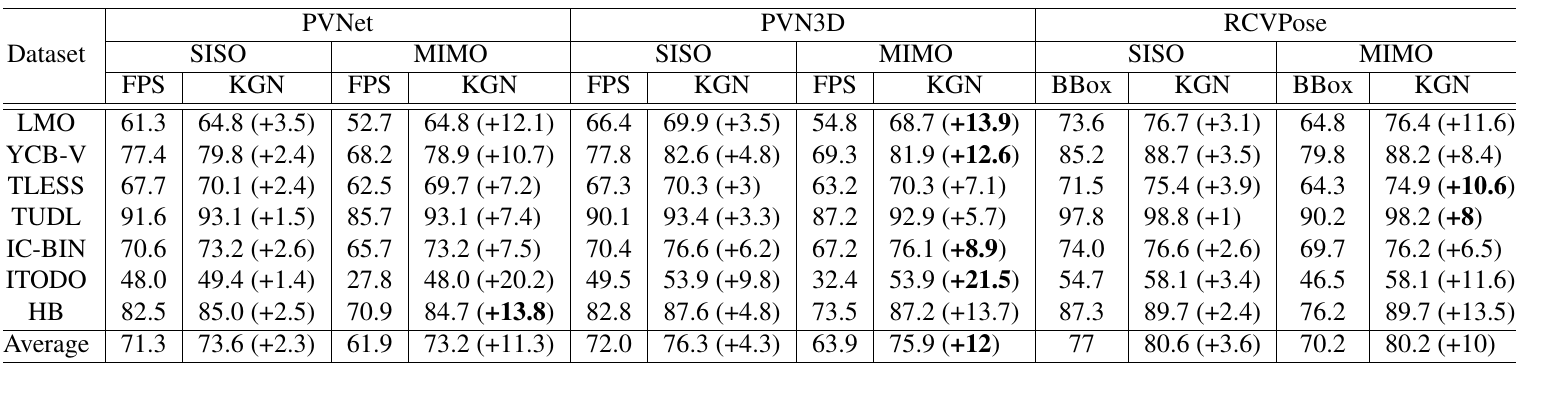
BOP AR for three voting methods, seven BOP core datasets, and SISO / MIMO training: test gains across methods and datasets.
Table 2
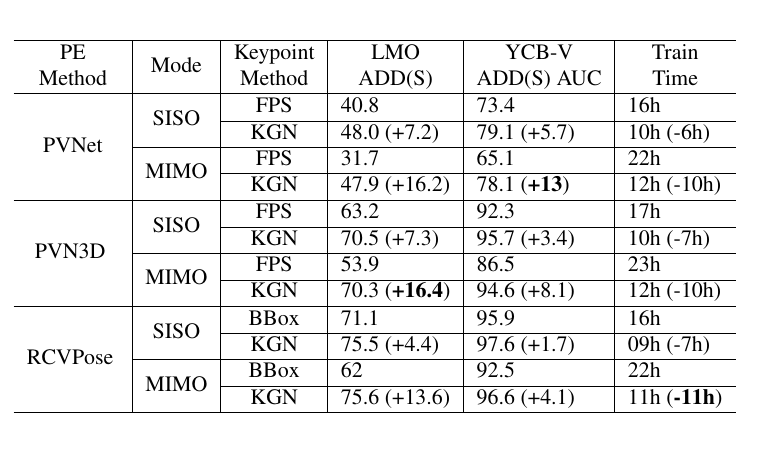
LMO ADD(S), YCB-V ADD(S) AUC, and training time: examine accuracy and convergence gains together.
Table 5
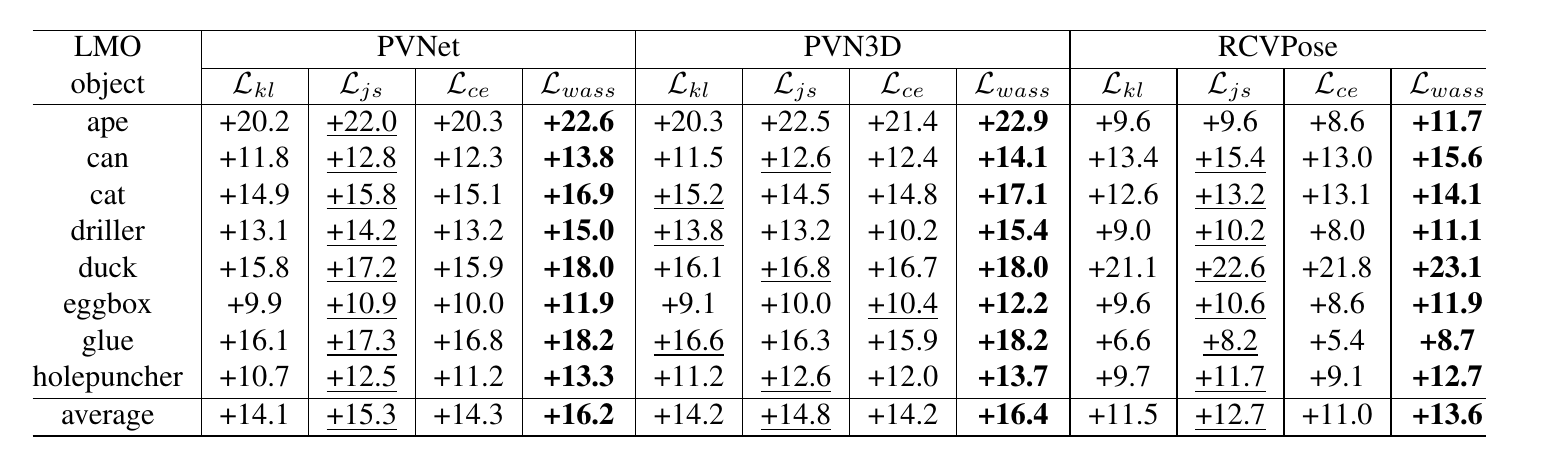
KL, JS, cross-entropy, and Wasserstein distribution-similarity losses: test the core loss choice.
Original Figure 3: visible colored surface points from training objects enter a graph network that outputs keypoints in normalized object coordinates. The Wasserstein term aligns their vote distributions, while dispersion prevents local collapse. Source: CVF Open Access. Image copyright belongs to the paper's authors and publisher; reproduced here for academic analysis.
3. Problem setting
3.1 Task Boundaries
Object setting: instance-level, seen-object; dataset objects are known during training.
KeyGNet training input: unoccluded visible colored surface points recovered from training images, intrinsics, GT object poses, and object geometry.
KeyGNet output: 3D keypoints in normalized object coordinates; multiple objects in a dataset share keypoint indices / layouts.
Downstream inputs: estimator-dependent. PVNet primarily uses RGB; PVN3D and RCVPose use RGB-D / point-cloud information.
Final output: the downstream method still estimates object 3D rotation and 3D translation; KeyGNet does not directly output pose.
Dependencies: training needs object surface geometry, GT poses, camera calibration, and visible-surface segmentation. Inference retains the downstream estimator’s original inputs, detection / segmentation, and geometric-solver requirements.
3.2 SISO and MIMO
SISO: Single Instance of a Single Object; train separate network parameters for each object.
MIMO: Multiple Instances of Multiple Objects; multiple objects share a network, closer to multi-object deployment.
Switching fixed FPS / BBox keypoints from SISO to MIMO increases vote-regression distribution heterogeneity; the paper observes substantial accuracy degradation.
KeyGNet aims to balance keypoint target distributions for the shared regressor and narrow this gap.
4. Core motivation
Traditional keypoint-based 6DoF methods typically use two fixed rules:
FPS: select mutually distant surface points;
BBox: select 3D bounding-box corners.
Both prioritize geometric dispersion without considering downstream regression-target distributions. PVNet regresses pixel-to-keypoint directions, PVN3D 3D offsets, and RCVPose radial distances. Large differences in target ranges create an optimization problem for a shared regressor analogous to class imbalance.
Using LINEMOD driller, the authors compare radial-vote histograms for three keypoints: smaller Wasserstein distances indicate more similar, jointly learnable distributions. This motivates two simultaneous objectives:
Distribution similarity: make keypoint vote distributions as similar as possible;
Geometric dispersion: keep keypoints sufficiently far apart to avoid degenerate pose geometry.
5. Method overview
5.1 What KeyGNet Does
KeyGNet uses EdgeConv / Dynamic Graph CNN. Training combines visible surface-point sets from all objects in a dataset and outputs NK normalized 3D keypoints:
K∗={kj∗}j=1NK.
These replace the downstream network’s FPS or BBox keypoints. Because voting representations induce different distributions, KeyGNet is trained separately for PVNet, PVN3D, and RCVPose; one keypoint set does not transfer unconditionally to every estimator.
5.2 Two Losses
The total loss is:
L=αLwass+βLdis.
Lwass: inspired by WGAN-GP, reduce Wasserstein distances between keypoint vote distributions with a gradient penalty.
Ldis: penalize overly close keypoints through an exponential function of pairwise distance to prevent local clustering.
The first training half uses α=0.7,β=0.3, emphasizing vote distributions; after epoch 50, weights are swapped to emphasize geometric dispersion.
5.3 Training Configuration
batch size: 32;
Optimizer: SGD;
Initial learning rate: 10−3;
Multiply by 0.1 every 50 epochs;
Wasserstein gradient penalty: λ=10;
Dispersion hyperparameter: γ=0.5;
Parallel training on 6 RTX 6000 GPUs;
PVNet / PVN3D ultimately use 8 keypoints; RCVPose uses 3.
6. Experimental overview
6.1 Datasets and Metrics
The paper covers the seven BOP core datasets of its time: LMO, YCB-V, T-LESS, TUD-L, IC-BIN, ITODD, and HB. Main measures include:
BOP AR, aggregating VSD, MSSD, and MSPD;
LMO ADD(S);
YCB-V ADD(S) AUC;
Performance changes from SISO to MIMO;
Downstream pose-network training time.
Original Table 1: replacing FPS / BBox with KeyGNet (KGN) improves AR across three downstream networks, seven BOP core datasets, and SISO / MIMO settings. The largest individual gain is +21.5 points for PVN3D-MIMO on ITODD; mean MIMO gains across seven datasets are +11.3 for PVNet, +12.0 for PVN3D, and +10.0 for RCVPose. Source: CVF Open Access. Image copyright belongs to the paper's authors and publisher; reproduced here for academic analysis.
6.2 Main results
Setting
Heuristic keypoints
KeyGNet
Change
PVN3D, LMO, MIMO, ADD(S)
53.9
70.3
+16.4
PVNet, YCB-V, MIMO, ADD(S) AUC
65.1
78.1
+13.0
PVNet, mean MIMO AR over seven BOP datasets
61.9
73.2
+11.3
PVN3D, mean MIMO AR over seven BOP datasets
63.9
75.9
+12.0
RCVPose, mean MIMO AR over seven BOP datasets
70.2
80.2
+10.0
The abstract’s +1% to +21.5% refers to absolute AR percentage-point differences across Table 1 datasets / methods / modes, not relative error reductions.
Original Table 2: KeyGNet improves accuracy and shortens downstream training under the paper's configuration. In MIMO, PVNet / PVN3D / RCVPose decrease from 22 / 23 / 22 hours to 12 / 12 / 11 hours. This compares convergence in a specific six-GPU environment, not a universal wall-clock guarantee. Source: CVF Open Access. Image copyright belongs to the paper's authors and publisher; reproduced here for academic analysis.
6.3 SISO→MIMO Gap
Mean LMO ADD(S) gap: PVNet shrinks from -9.1 to -0.1, PVN3D from -9.3 to -0.2, and RCVPose changes from -6.3 to +0.1.
Mean YCB-V ADD(S) AUC gaps shrink from -6.3 / -6.7 / -3.4 to -1.0 / -1.2 / -1.0.
This matters more than SISO gains alone: KeyGNet brings a shared multi-object regressor closer to separately trained per-object performance.
7. Strengths and limitations
Strengths
Identifies a performance variable hidden by fixed rules: keypoint positions can themselves be learned.
Consistently positive gains across three voting representations, seven BOP datasets, and both SISO / MIMO modes provide broad evidence.
Replaces 3D keypoint supervision without changing downstream backbones, making it a modular data / geometry design component.
Reports accuracy, training time, keypoint counts, losses, and initialization, providing a relatively complete evidence chain.
Limitations / risks
KeyGNet inputs are recovered using GT poses, intrinsics, and object geometry; training-data preparation is costly.
Keypoints must be reoptimized for each dataset and voting representation; generalization as a universal keypoint generator is untested.
Independent robustness tests for detection errors, noisy masks, missing depth, reflective / transparent objects, and real deployment domain shifts are insufficient.
Comparisons retrain complete downstream networks, so layout, optimization difficulty, and early stopping may all contribute; these factors are not fully isolated.
Training uses 6 RTX 6000 GPUs, without complete KeyGNet training-time, memory, or random-seed variance reports.
Baseline suitability: useful for keypoint voting, shared multi-object networks, or SISO→MIMO scaling; not a direct baseline for methods without predefined keypoints.
Most useful reproduction: fix all pose-backbone training conditions, vary only FPS / BBox / KeyGNet, and report multiple seeds, convergence curves, and final accuracy.
Worth deep reading: yes; the value lies in problem formulation and cross-method validation beyond one WACV benchmark gain.
Further questions: can keypoints be conditioned on object instances, directly optimize symmetry-aware pose uncertainty, or jointly model foundation features, visibility, and occlusion risk?
9. Coarse Reading Conclusion
KeyGNet shows that keypoint-based pose accuracy depends both on how keypoints are predicted and on which keypoints the network is asked to predict. Extensive experiments support this within the studied known-object, offline-training, voting-based pipelines. It is not yet a keypoint generator for unknown objects, CAD-free use, or direct cross-dataset generalization.
Available src/paper-notes/keygnet-wacv2024/deep.md
In-depth paper notes
Support reproduction, comparison, related-work writing, and identifying opportunities for further research.
Paper Reading Notes (Deep): Learning Better Keypoints for Multi-Object 6DoF Pose Estimation
1. Basic information
Short name: KeyGNet
Authors: Yangzheng Wu, Michael Greenspan
Affiliation: RCV Lab, Department of Electrical and Computer Engineering, Ingenuity Labs, Queen’s University
KeyGNet turns predefined 6DoF keypoint layouts, usually fixed by FPS or 3D bounding boxes, into an offline learning problem. EdgeConv generates 3D keypoints from a dataset’s visible object surfaces, making vote-target distributions similar while keeping points dispersed. These replace PVNet, PVN3D, and RCVPose supervision; the largest gains occur in MIMO, where multiple objects share one regressor.
The central question is: for a given voting-based pose network, which 3D keypoints are easier for the same network to regress jointly?
2.1 Guide to the paper’s figures and tables
Figure / table
Associated claim
Use on this page
Figure 3
A graph network converts visible surface points into keypoints; distribution similarity and dispersion constrain each other.
Explain inputs / outputs, losses, and the boundary between KeyGNet and downstream estimators.
Table 1
Keypoint-learning gains extend across datasets and voting representations.
Check full results for seven BOP core datasets, three backbones, and SISO / MIMO.
Table 2
Optimized keypoints improve ADD(S) and shorten downstream training.
Separate accuracy, convergence, and engineering conditions that do not automatically generalize.
Table 5
Wasserstein loss better compares potentially non-overlapping vote distributions than KL / JS / cross-entropy.
Assess ablation support for the core loss.
Original Figure 3: KeyGNet takes visible surface-point sets from training objects and outputs keypoints in normalized object coordinates. The upper Wasserstein term aligns vote distributions; the lower dispersion term separates spatial positions. Source: CVF Open Access. Image copyright belongs to the paper's authors and publisher; reproduced here for academic analysis.
3. Problem setting and task boundaries
3.1 The Optimization Target Is Not a Scene Keypoint Detector
Two keypoint levels are easily confused:
Predefined 3D keypoints in object coordinates: chosen before training, such as FPS surface points or BBox corners;
Keypoint estimates in images / point clouds: downstream networks recover scene keypoint positions from pixel or point votes.
KeyGNet learns the first level. It does not directly detect test-image interest points or replace downstream voting, RANSAC, PnP, or rigid-transform estimation.
3.2 Inputs, Outputs, and Priors
Stage
Input
Output
Required priors
KeyGNet training
Unoccluded visible colored object surfaces within one dataset, recovered from training images, intrinsics, GT poses, and geometry
NK normalized object-coordinate keypoints
Known models, GT poses, camera calibration, visible surfaces / segments
Downstream pose-network training
Original RGB or RGB-D inputs, with FPS / BBox labels replaced by KeyGNet outputs
Vote-regressor parameters
Object identity, keypoint coordinates, and original supervision
Downstream inference
RGB for PVNet, or RGB-D / point clouds required by PVN3D / RCVPose
Object rotation and translation
Original detector / mask, intrinsics, depth, and other dependencies remain
3.3 Instance-Level Known Objects
The task is instance-level, seen-object 6DoF pose.
KeyGNet sees target-dataset object surfaces during training; direct usable keypoint generation on novel objects is untested.
Multi-object means known objects sharing a network, not open-world detection without category labels.
MIMO shares a keypoint layout across dataset objects, but different datasets and voting representations still train KeyGNet separately.
3.4 SISO / MIMO Definitions
SISO: Single Instance of a Single Object. Train a separate downstream network per object.
MIMO: Multiple Instances of Multiple Objects. One downstream network regresses multiple objects and keypoints together.
MIMO reduces the number of deployed models and better reflects complex scenes, but the shared regressor faces more heterogeneous targets. Heuristic keypoints amplify this heterogeneity; KeyGNet substantially narrows the SISO→MIMO gap.
4. Research context
4.1 Typical Keypoint-Based 6DoF Pipeline
Keypoint methods typically:
Define several 3D keypoints in object coordinates;
Predict each scene pixel’s or 3D point’s relationship to those keypoints from RGB / RGB-D;
Aggregate votes into scene keypoint positions;
Solve pose with 2D–3D PnP or 3D–3D rigid alignment.
The paper selects three representative vote types:
Downstream method
Input modality (summary)
Regressed vote
Original keypoint rule
PVNet
RGB
pixel-to-keypoint direction vector
FPS
PVN3D
RGB-D / point cloud fusion
point-to-keypoint 3D offset
FPS
RCVPose
RGB-D / point cloud
point-to-keypoint radial distance
BBox
Different regression quantities imply different easy-to-learn keypoints. The paper explicitly makes Wasserstein-loss distribution D(⋅) depend on the voting representation, generating a separate keypoint set per pose method.
Whether keypoint supervision distributions are easy to regress jointly;
Whether combining objects in one network magnifies distribution differences;
How layout affects training convergence.
KeyGNet retains geometric dispersion while adding vote-distribution similarity as an objective.
4.3 Is This the First Work of Its Kind?
The authors claim the first learned, non-heuristic predefined keypoint positions for 6DoF pose. A more careful interpretation is applying learned keypoint / landmark ideas explicitly to 3D target design for voting-based rigid pose, with systematic multi-backbone, multi-dataset validation. It should not be read as the first learned-keypoint work in every sense.
5. Motivation: Why Might Similar Vote Distributions Help?
5.1 Unified Vote Representation
Let the visible object surface cloud be:
S={pi}i=1NS,
Let object-coordinate keypoints be:
K={kj}j=1NK.
For surface point pi and keypoint kj, the downstream method defines vote vij:
RCVPose: scalar radial distance;
PVNet: 2D direction vector;
PVN3D: 3D offset vector.
Fix keypoint j and collect all surface-point votes:
Vj={vij∣pi∈S}.
KeyGNet aims for any two keypoint vote distributions to satisfy:
Vj∼Vi,∀i,j∈[1,NK].
5.2 Analogy with Class Imbalance
A shared downstream backbone usually predicts all keypoints. If some targets are concentrated while others span large ranges, the optimizer must fit regression targets with different scales and shapes, analogous to class imbalance or multi-task gradient imbalance.
Radial-distance histograms on LINEMOD driller illustrate that suitable selection of three BBox corners can reduce Wasserstein distance from 36.8M to 6.4M. Similar histograms suggest easier joint regression. This motivates the design rather than directly proving a pose-error improvement.
5.3 Why Dispersion Is Also Necessary
Optimizing similarity alone may cluster keypoints locally or nearly collapse them. Their votes then become similar while PnP / rigid-alignment geometry becomes ill-conditioned.
Therefore also require:
argmaxi=1∑NKj=i+1∑NK∥ki∗−kj∗∥.
The core tension is statistical similarity of targets alongside geometric separation of observation baselines.
6. Method details
6.1 Overall pipeline
Recover unoccluded colored object-surface points from training images using GT poses, intrinsics, and models.
Feed the multi-object surface union P={S1,S2,…,SNP} from one dataset into KeyGNet.
Build dynamic KNN graphs with EdgeConv to encode local geometry and color.
Replace the DGCNN classification head’s 3×C output with NK normalized 3D keypoints.
Compute pairwise keypoint distribution similarity according to downstream vote definitions.
Jointly optimize Wasserstein and dispersion losses.
D(Vi) and D(Vj) are histogram distributions of the corresponding votes;
V is their joint distribution;
The gradient penalty applies to all votes, not only a generator imitating GT;
λ=10 follows the default WGAN-GP recommendation.
Wasserstein distance is chosen because KL / JS may not provide smooth, effective optimization signals when distribution supports do not overlap, whereas Wasserstein still measures transport distance.
6.4 Dispersion loss
The paper uses:
Ldis=e−γ∥ki−kj∥,
Minimizing this term increases keypoint separation. γ=0.5 is chosen according to dataset object diameters, the authors state, to keep the loss in (0,1].
Total loss:
L=αLwass+βLdis.
Fixed balanced weights can produce local clustering. The dynamic schedule is:
First 50 epochs: α=0.7,β=0.3, emphasizing distribution similarity;
After epoch 50: α=0.3,β=0.7, emphasizing geometric dispersion.
Figure 6 shows faster convergence and lower final loss than consistently favoring either term. However, only an RCVPose / LMO / 3-keypoint curve is shown, limiting cross-method evidence.
6.5 Training Details
Normalization: LayerNorm rather than BatchNorm, to accommodate the Wasserstein gradient penalty;
batch size: 32;
hardware: 6 × RTX 6000;
optimizer: SGD;
initial learning rate: 10−3;
Learning-rate decay: multiply by 0.1 every 50 epochs;
PVNet / PVN3D: 8 keypoints;
RCVPose: 3 keypoints.
6.6 Inference and engineering complexity
KeyGNet designs keypoints offline. After generating K∗, the graph network is unnecessary at test time. Therefore:
SISO downstream inference speed should theoretically be independent of the keypoint source;
MIMO lets multiple objects share one keypoint set and network, reducing per-object model calls;
Reduced downstream training time does not prove lower total KeyGNet training cost: the table does not fully include keypoint generation.
7. Experimental Design
7.1 Datasets
The paper uses seven BOP core datasets:
Dataset
Scene properties relevant to the analysis
LMO
LINEMOD Occlusion; heavy occlusion and eight commonly used objects
YCB-V
Cluttered multi-object tabletops with symmetric and weakly textured objects
T-LESS
Industrial, weakly textured, similarly shaped, and often symmetric objects
TUD-L
Multi-view known objects with generally high baselines
IC-BIN
Industrial bin picking with substantial clutter and occlusion
ITODD
Industrial depth / geometry challenges; lowest heuristic MIMO baseline in the table
HB
HomebrewedDB: real cluttered multi-object environments
ADD(S) or ADD(S) AUC is also reported under traditional LM, LMO, and YCB-V protocols for comparison with existing keypoint pose literature.
7.2 Metrics
Metric
Meaning
Caution
VSD recall
Visible-surface discrepancy under estimated / GT poses
Accounts for visibility and occlusion
MSSD recall
Symmetry-aware maximum surface distance
Explicitly handles equivalent symmetric poses
MSPD recall
Symmetry-aware maximum projection distance
Closer to image-plane error
BOP AR
Aggregate VSD, MSSD, and MSPD recalls
Table 1 uses a 0–100 scale
ADD(S)
Mean corresponding-point distance for asymmetric objects; nearest-point distance for symmetric objects
Threshold protocols vary by dataset / paper
ADD(S) AUC
Normalized area over multiple thresholds
Not interchangeable with single-threshold ADD(S)
7.3 Fairness of Comparison Controls
The authors use public implementations of three downstream methods and state that losses, hyperparameters, network depth, and keypoint counts remain fixed within comparisons. Only output shapes change to support SISO→MIMO, alongside the keypoint source.
This is a relatively controlled replacement of target geometry within the same backbone, with three limits:
KGN points are optimized separately per voting representation, so transfer across methods is not cost-free after one training run;
Downstream networks train from scratch on new labels; benefits from simply replacing points in an existing checkpoint are unknown;
No multi-seed means / variances are reported, so stability of small 1–3-point gains needs verification.
8. Main Results: Accuracy, MIMO, and Training Time
Original Table 1: all seven BOP core datasets are covered. Every KGN entry exceeds its corresponding FPS / BBox value. MIMO gains generally exceed SISO gains, supporting the shared-regressor motivation. Source: CVF Open Access. Image copyright belongs to the paper's authors and publisher; reproduced here for academic analysis.
8.1 Overall Trends across Seven BOP Datasets
Key Table 1 values:
Downstream method
Mean SISO AR: heuristic→KGN
SISO gain
Mean MIMO AR: heuristic→KGN
MIMO gain
PVNet
71.3→73.6
+2.3
61.9→73.2
+11.3
PVN3D
72.0→76.3
+4.3
63.9→75.9
+12.0
RCVPose
77.0→80.6
+3.6
70.2→80.2
+10.0
Observations:
Consistent SISO gains indicate that KeyGNet addresses more than multi-object model capacity;
MIMO gains are about 2.8–4.9 times SISO gains, supporting the aim of balancing shared regression-target distributions;
The largest individual gain is PVN3D-MIMO on ITODD: 32.4→53.9, or +21.5 AR points;
The smallest gains occur in high-baseline SISO entries, such as RCVPose on TUD-L: 97.8→98.8, or +1.0 point;
The abstract’s +1% to +21.5% should be read as absolute percentage points on the 0–100 AR scale, not relative percentages.
8.2 Conventional LMO / YCB-V Metrics
Original Table 2: conventional LMO / YCB-V metrics and training times. The largest accuracy gain is PVN3D-MIMO on LMO, from 53.9 to 70.3 (+16.4 points). Times reflect the paper's hardware and convergence settings, not fixed speedups for arbitrary implementations. Source: CVF Open Access. Image copyright belongs to the paper's authors and publisher; reproduced here for academic analysis.
Method / mode
LMO metric change
YCB-V metric change
Downstream training-time change
PVNet SISO
ADD(S) 40.8→48.0
AUC 73.4→79.1
16h→10h
PVNet MIMO
31.7→47.9
65.1→78.1
22h→12h
PVN3D SISO
63.2→70.5
92.3→95.7
17h→10h
PVN3D MIMO
53.9→70.3
86.5→94.6
23h→12h
RCVPose SISO
71.1→75.5
95.9→97.6
16h→9h
RCVPose MIMO
62.0→75.6
92.5→96.6
22h→11h
Author claim: more similar regression-target distributions are easier to learn, making downstream networks more accurate and faster to converge.
My analysis: simultaneous accuracy and time gains are consistent with this explanation. However, Table 2 gives no shared early-stopping criterion or per-epoch throughput control and excludes KeyGNet overhead from the end-to-end budget. Evidence for easier optimization is stronger than evidence for necessarily lower total training cost.
8.3 SISO→MIMO gap
Tables 3 / 4 directly measure degradation from single-object to multi-object training:
Dataset / metric
PVNet FPS→KGN
PVN3D FPS→KGN
RCVPose BBox→KGN
Mean LMO ADD(S) gap
-9.1→-0.1
-9.3→-0.2
-6.3→+0.1
Mean YCB-V ADD(S) AUC gap
-6.3→-1.0
-6.7→-1.2
-3.4→-1.0
On LMO, nearly all per-object KGN gaps fall between 0 and -0.4; RCVPose even gains +0.2 to +0.4 on driller / duck / eggbox / glue. Without multiple seeds, small positive values should not be overinterpreted. The robust conclusion is a mean gap reduction from about 6–9 points to about 0–1.2 points.
9. Ablations and Tuning
9.1 Distribution-Similarity Measure
Original Table 5: KL, JS, cross-entropy, and Wasserstein on LMO-MIMO. Values are ADD(S) gains over heuristic keypoints; Wasserstein is highest for every object and all three downstream methods. Source: CVF Open Access. Image copyright belongs to the paper's authors and publisher; reproduced here for academic analysis.
Mean gains over eight LMO objects in Table 5:
Loss
PVNet
PVN3D
RCVPose
KL divergence
+14.1
+14.2
+11.5
JS divergence
+15.3
+14.8
+12.7
Cross entropy
+14.3
+14.2
+11.0
Wasserstein
+16.2
+16.4
+13.6
Wasserstein leads for every object and estimator, showing consistent ablation results. All four losses yield large gains, however, suggesting that learning keypoints is the main factor; Wasserstein adds about 1–2 points rather than accounting for the whole benefit.
PVNet and PVN3D improve substantially from 3 to 8 points and saturate beyond 8;
RCVPose is largely stable from 3 points onward;
Final settings use 8 for PVNet / PVN3D and 3 for RCVPose.
This depends on the voting representation: direction / offset voting benefits from keypoint redundancy, whereas radial-voting combinations gain little beyond 3 points.
9.3 Dynamic Loss Weights
Figure 6 compares three strategies:
Fixed α=0.7,β=0.3: fast convergence, but higher final loss;
Fixed α=0.3,β=0.7: better final loss, but slow convergence;
Swap weights at epoch 50: balance convergence speed and final loss.
This demonstrates competition between distribution similarity and geometric dispersion, but only one training curve is shown, without an independent multi-setting downstream pose-metric table. Evidence is weaker than Table 5.
9.4 KeyGNet Input Initialization
Table 6 compares LMO / RCVPose settings:
KeyGNet input / mode
Mean ADD(S)
FPS-keypoint initialization, SISO
74.7
BBox-keypoint initialization, SISO
75.0
visible surface segments, MIMO
75.6
Full-surface input slightly exceeds initialization from a few heuristic points, but only by 0.6–0.9 points, while the mode also changes from SISO to MIMO. The variables are not fully isolated, making this more an engineering choice than a strong causal conclusion.
10. Robustness, Failures, and Untested Settings
10.1 Occlusion
LMO and IC-BIN results support effectiveness on occluded benchmarks, but KeyGNet training explicitly uses non-occluded visible surfaces. No independent visibility-rate sweep or failure threshold under extreme occlusion is shown.
10.2 Symmetric Objects
MSSD / MSPD in BOP AR and ADD(S) account for symmetry to some extent, so aggregate results include symmetric objects. KeyGNet’s loss does not directly optimize symmetry-aware pose uncertainty or constrain points to symmetry equivalence classes. Similar vote distributions do not eliminate rotation ambiguity.
10.3 RGB and RGB-D
Validation across PVNet and RGB-D methods supports modality-independent concepts. However, keypoints are learned separately per estimator, so one KGN point set is not shown to transfer directly between RGB and RGB-D.
10.4 Masks, Depth, and Domain Gaps
Not separately tested:
Detector / segmentation-mask errors;
Depth holes and edge outliers;
Transparent, reflective, or low-signal industrial surfaces;
synthetic-to-real / cross-camera domain shift;
Training calibration and GT-pose noise;
Unseen objects or online addition of new objects.
10.5 Potential Failure Modes
Large shifts between training surface distributions and test visibility may make offline keypoints overfit common viewpoints;
On strongly symmetric objects, similar numeric vote distributions may still have ambiguous semantic / geometric correspondences;
New objects may make the original dataset-level shared layout suboptimal, requiring reoptimization and downstream retraining;
Points outside the object surface or in poorly visible regions may balance statistics while reducing physical observability; no explicit visibility-aware constraint is included.
11. Do the Experiments Support the Contributions?
Author claim
Evidence
Sufficiency
My assessment
Learned keypoints beat FPS / BBox
Tables 1, 2; three methods and seven datasets
Relatively strong
Broad, consistent gains; no multi-seed confidence intervals
Narrows SISO–MIMO gap
Tables 3, 4
Strong
About 6–9 points down to 0–1.2, a large effect across three methods
Wasserstein suits the task better than other measures
Table 5
Relatively strong
Best for every object, but only about 1–2 points above JS
Faster training convergence
Table 2, Figure 6
Partial
Downstream training saves 6–11h; KeyGNet cost excluded and stopping criteria limited
More efficient inference
Qualitative text
Insufficient
No standardized FPS / latency / memory table
Learned keypoints are a general plugin
PVNet / PVN3D / RCVPose
Partial
Modular concept, but KGN trains separately per voting method
12. Critical analysis
12.1 Strengths
Valuable problem formulation: turns fixed geometric labels into optimization variables, a clear pattern for learning templates, anchors, and correspondence targets.
Broad experimental matrix: three vote types × seven datasets × SISO / MIMO, beyond a chance gain on one benchmark.
Focused, interpretable gains: larger MIMO gains match the motivation of conflicting target distributions in shared regressors.
Low integration cost: no rewrite of downstream backbones or inference solvers is needed.
Ablations beyond final accuracy: losses, keypoint counts, weight schedules, initialization, and training time are examined.
12.2 Weaknesses
Strong offline dependencies: GT poses, intrinsics, object surfaces, and visible regions prevent direct use for CAD-free / unseen objects.
Retraining per estimator / dataset: narrower generalization than the name keypoint generator might suggest.
Opaque total cost: Table 2 lists only downstream time, excluding KeyGNet preprocessing and training.
Limited statistics: no multiple seeds, variance, or confidence intervals; high-baseline 1–2-point gains need caution.
Incomplete observability objective: vote distribution and dispersion are surrogates, not direct PnP conditioning, pose covariance, visibility, or symmetry-ambiguity objectives.
No real-robot evidence: benchmarks only, without closed-loop grasping, cross-camera, or incremental deployment tests.
12.3 Implicit Assumptions
Training visible surfaces represent test-time observations;
A shared normalized keypoint layout is reasonable for all objects;
More similar vote targets improve downstream learnability and pose accuracy;
Detection / segmentation quality does not cancel keypoint-design gains;
Original solvers use new coordinates without bias or new symmetry-mapping problems.
12.4 Practical Feasibility
For fixed industrial object sets with offline training, KeyGNet is practical: keypoints are generated once, inference cost barely increases, and one MIMO model can replace multiple SISO models.
Open-world use remains harder: new SKUs, CAD-free objects, transparent / reflective surfaces, dynamic occlusion, calibration errors, and detector failures need stronger conditioning and uncertainty modeling.
13. Reproduction Guide
13.1 Minimal Reproduction Path
Choose a stable public downstream implementation and LMO, such as PVN3D or PVNet.
Reproduce heuristic-keypoint SISO / MIMO metrics and confirm the paper’s data protocol.
Construct visible colored surface segments in object coordinates using GT poses + intrinsics + CAD meshes.
Implement an EdgeConv head producing 8 points for PVNet / PVN3D or 3 for RCVPose.
Generate Vj from downstream vote definitions and implement a Wasserstein critic, gradient penalty, and dispersion loss.
Train KGN with the epoch-50 weight-swap schedule.
Regenerate downstream keypoint labels while fixing backbone, augmentation, optimizer, and epochs.
Run at least 3 seeds and report final metrics, best metrics, time-to-threshold, and total training GPU-hours separately.
Whether keypoints are constrained to object interiors, surfaces, or bounding volumes;
Whether symmetric objects have fixed GT keypoint mappings;
Whether SISO / MIMO object sampling is balanced.
13.3 More Rigorous Reproduction Experiments
Suggested additions:
Experiment
Purpose
3–5 seeds, mean ± std
Test stability of 1–3-point gains
KGN + downstream training costs
Check whether total GPU-hours actually decrease
Geometry only, no color
Isolate color’s contribution
Only Lwass / only Ldis
Separate absolute contributions of the two losses
PnP condition number / pose covariance
Test the relation between dispersion and geometric identifiability
Visibility-aware keypoints
Test stability under common occlusion
Training objects→new objects
Test generalization of the shared layout beyond seen categories
Noisy GT / intrinsics / depth
Measure sensitivity to training-data construction errors
14. Improvement Directions
14.1 Direct Pose-Aware Geometry Objectives
Replace or augment Ldis with:
PnP Jacobian condition number;
Fisher information / pose covariance;
symmetry-aware ADD(S) surrogate;
visibility-weighted reprojection uncertainty.
This moves from distant keypoints to keypoints that actually make the final 6DoF pose identifiable.
14.2 Conditional Keypoint Generation
The current output is one dataset-level point set. Condition the generator on:
object geometry / category embedding;
Current camera viewpoint;
visible mask / occlusion pattern;
downstream estimator type;
RGB / depth reliability map.
Then select visible, stable keypoints dynamically for each object or observation.
14.3 Combining Foundation Features
KeyGNet uses surface color and geometry. DINO / CLIP-style dense features could measure cross-view matchability, selecting keypoints with both good geometric baselines and domain-stable semantic / local-appearance support.
14.4 Symmetry and Uncertainty
Optimize equivalent keypoint sets over symmetry groups;
Output distributions rather than single points;
Propagate keypoint covariance through PnP / rigid alignment;
Output multimodal pose hypotheses for unidentifiable axes.
14.5 Incremental Multi-Object Systems
Industrial systems continuously add objects. Ideally, without retraining every old object, they should:
Generate compatible keypoints for new objects;
Preserve old-object performance;
Expand MIMO heads dynamically;
Avoid catastrophic forgetting with rehearsal / parameter-efficient tuning.
15. Research Lessons
Directly Reusable Ideas
Study supervision-target definitions separately from network prediction;
Align distributions to reduce target conflicts in shared multi-object regression heads;
Use geometric constraints to prevent statistically attractive degenerate solutions;
Test generality across backbones and modalities.
When to Include It as a Baseline
The method still uses predefined 3D keypoints;
The study concerns shared multi-object backbones;
A new voting representation is claimed to be easier to learn;
FPS / BBox / learned anchors are compared;
The study addresses keypoint uncertainty or pose-conditioned target design.
Potential New Research Direction
Learn per-view adaptive 3D keypoints jointly from visibility, foundation-correspondence confidence, and symmetry-aware pose covariance, combining MIMO efficiency with unseen-object generalization without reoptimizing a fixed layout per dataset.
16. Open questions
Conceptual Questions
How can one normalized coordinate set maintain shared semantics across geometrically different objects?
Does distribution similarity reduce gradient conflict or merely change target scales?
Do colors create object-identity shortcuts instead of genuine observability?
Mathematical Questions
How do the histogram distributions described in the text correspond to the discrete WGAN-critic implementation?
Does the code fully specify the joint distribution of D(V) and gradient-penalty sampling?
What exactly relates γ=0.5 to object-diameter normalization?
Experimental Questions
Which convergence / stopping criterion determines Table 2 training times?
Do total GPU-hours still decrease after including KeyGNet training?
Are 1–3-point SISO gains significant across seeds?
How do KGN points transfer across datasets, cameras, or new objects?
Reproduction Questions
Can public code reproduce all seven BOP datasets and three downstream methods?
How does preprocessing obtain the stated non-occluded visible surfaces?
Does imbalanced object sampling in MIMO require additional reweighting?
17. Final Assessment
Author Claims
Learned keypoints improve three voting-based 6DoF methods across seven BOP core datasets, shorten convergence, and nearly eliminate the LMO SISO–MIMO gap.
My Analysis
The main conclusion is well supported within the paper’s setting. Mean MIMO AR gains of +10.0 to +12.0 points and LMO mean gaps narrowing from about -6.3~-9.3 to -0.2~+0.1 are large, consistent effects across three voting representations. KeyGNet remains a known-object, offline target-design module customized per dataset and estimator. It is not a CAD-free online keypoint discoverer that directly generalizes to arbitrary objects; training costs, randomness, and real-system robustness need stronger validation.