KeyPose: Category-Level 6D Object Pose Estimation with Self-Adaptive Keypoints
KeyPose generates keypoints adaptively from object geometry, aggregates keypoint–keypoint and keypoint–point-cloud graphs, and regresses canonical keypoints through NOCS voxelization to address within-category shape variation structurally.
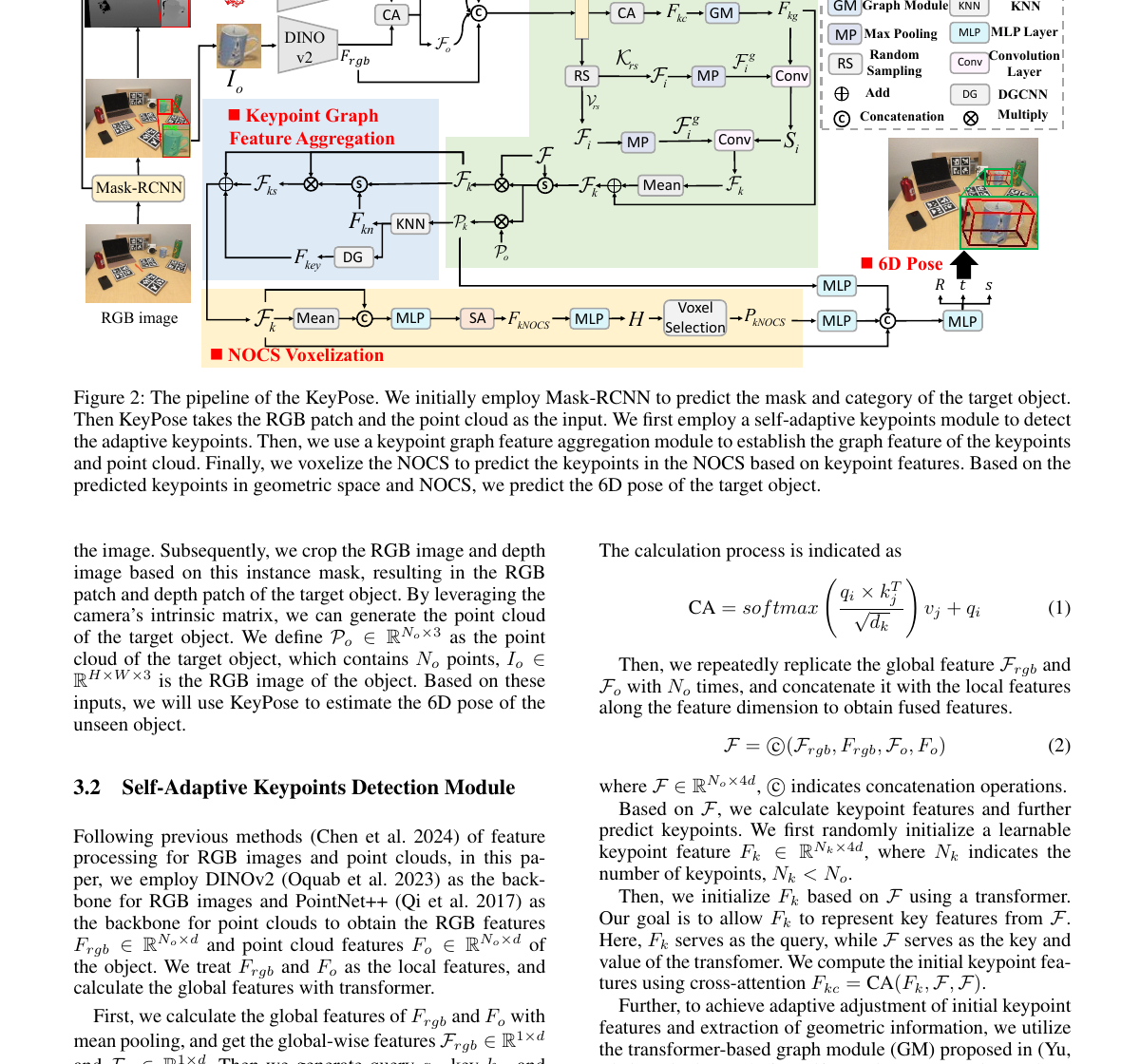
object maskdepth-derived object point cloudcategory labelcamera intrinsics
Reading Notes
Overview / Deep Dive
Available src/paper-notes/keypose-aaai2025/coarse.md
Paper overview notes
Quickly assess the paper's scope, problem setting, core method, experimental findings, and whether to read it in depth.
Overview: KeyPose
In One Sentence
KeyPose predicts self-adaptive keypoints that vary with object geometry, replacing fixed semantic category anchors, and then performs pose fitting through graph aggregation and NOCS voxelization.
Problem, Inputs, and Outputs
Inputs: RGB, a depth-derived object point cloud, an object mask, and category.
Output: category-level 6D pose; canonical keypoints mediate between RGB / point clouds and NOCS space.
Targets unseen instances within known categories, rather than zero-shot novel categories.
Aggregate structural features through keypoint-to-keypoint and keypoint-to-cloud graphs.
Improve canonical-keypoint localization with NOCS voxelization, then recover the similarity transform and pose.
Experimental Evidence
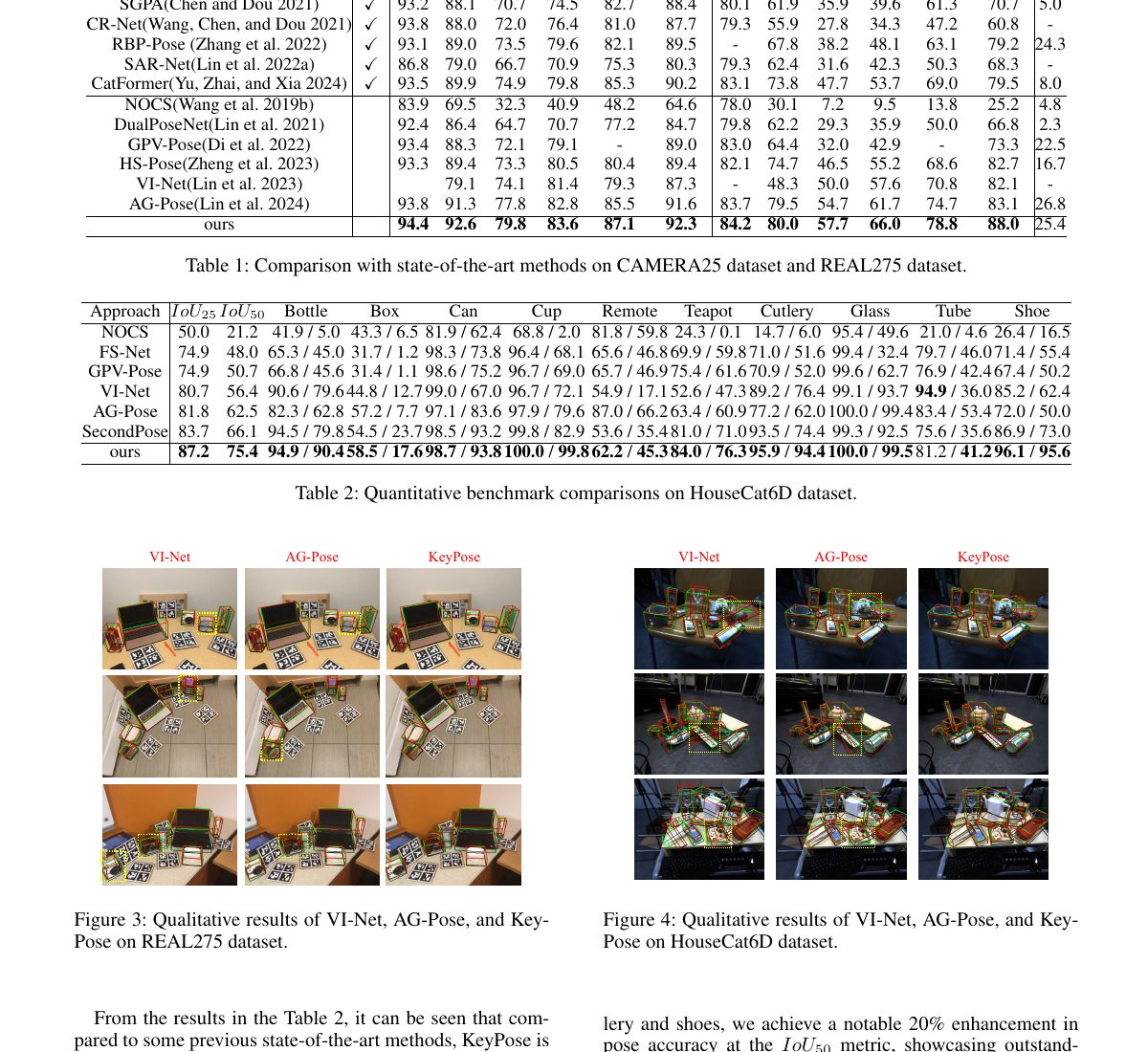
The CAMERA25 / REAL275 main tables report overall mAP of 94.4 / 92.6 in their 3D IoU metric columns.
HouseCat6D: IoU25 / IoU50 of 87.2 / 75.4.
Transparent glass, cutlery, shoes, and other fine-grained categories remain challenging; averages do not guarantee stable performance on every instance.
KeyPose takes a structured approach to RGB-D category-level pose: it adapts keypoints to the current object point cloud instead of fixing canonical keypoints, and explicitly models their relationships with local geometry.
2.1 Guide to the paper’s figures and tables
Figure / table
Reading focus
Figure 2
Confirm that inputs include RGB, depth, and masks; this is not an RGB-only method
Tables 1–2
Compare CAMERA25 / REAL275 and HouseCat6D distributions rather than relying on one synthetic benchmark
Table 3
Contributions of keypoint detection, graph aggregation, and voxelization to final fitting
Crop of the page containing original Figure 2: KeyPose's RGB-D, keypoint, and graph aggregation pipeline. Source: Official AAAI PDF. Image copyright belongs to the paper's authors and publisher; reproduced here for academic analysis.Crop of the original qualitative results page: comparison with VI-Net and AG-Pose. Source: Official AAAI PDF. Image copyright belongs to the paper's authors and publisher; reproduced here for academic analysis.
3. Task and Motivation
Local shape and visible surfaces vary substantially within a category; fixed semantic keypoints may fall on meaningless or invisible locations.
Fitting from point clouds alone or RGB alone omits information from the other modality. The paper uses structured cross-modal fusion at keypoint level.
Detection / segmentation, depth, and category labels are prerequisites. Outputs target unseen instances of known categories, not zero-shot novel categories.
4. Pipeline
Mask R-CNN predicts the target mask and category; RGB and object-point-cloud branches extract appearance / geometry features.
The Keypoint Detection Module predicts self-adaptive keypoints from instance geometry instead of applying a fixed template.
Graph Feature Aggregation aggregates keypoint-to-keypoint and keypoint-to-cloud relations to constrain local and global structure.
NOCS voxelization discretizes canonical-keypoint predictions for finer spatial localization, producing correspondences for pose fitting.
The central idea changes keypoints from category-defined points to instance-conditioned geometric anchors. This improves adaptation within a category, although interpretability depends on whether adaptive points retain sufficiently consistent canonical correspondences across instances.
5. Interpreting the Experiments
Benchmark
Reported results
Interpretation
CAMERA25 / REAL275
Overall mAP of 94.4 / 92.6 in Table 1’s 3D IoU columns
A synthetic-to-real gap remains; CAMERA25 alone cannot establish generalization
HouseCat6D
IoU25 87.2, IoU50 75.4
The stricter IoU50 deserves attention across broader household categories
HouseCat6D glass
100.0 / 99.5 (IoU25 / IoU50)
High transparent-object scores should be interpreted with category sample size and mask quality
The discussion highlights gains on strict metrics for cutlery, shoes, and similar categories, consistent with adaptive anchors handling slender / heterogeneous structures. Runtime and detector-quality effects receive less emphasis in the main tables and should be measured during engineering reproduction.
6. Critical Assessment
Strengths: clear roles for keypoints, graph relations, and canonical space; evaluation on both NOCS and HouseCat6D; an intuitive model of within-category variation.
Limitations: depth, masks, and category predictions are crucial prerequisites. Cross-instance consistency of dynamic keypoints is not separately reported as an observable quantity, and graph aggregation can propagate errors when occlusion or reflections corrupt the input cloud.
Ideas: pass adaptive-keypoint confidence explicitly to RANSAC / weighted fitting. Foundation-feature pose methods could likewise replace global dense correspondences with instance-conditioned anchors and geometric confidence.