LocPoseNet: Robust Location Prior for Unseen Object Pose Estimation
LocPoseNet combines bidirectional multiscale reference kernels with decoupled scale-robust and scale-aware heads to predict unseen-object centers and scales, providing robust location priors for translation and subsequent rotation refinement.
posed reference templatescamera intrinsicsobject scale priorexternal rotation refiner for final 6D pose
Reading Notes
Overview / Deep Dive
Available src/paper-notes/locposenet-3dv2024/coarse.md
Paper overview notes
Quickly assess the paper's scope, problem setting, core method, experimental findings, and whether to read it in depth.
LocPoseNet: Coarse Reading
One-sentence conclusion
LocPoseNet highlights the often-hidden use of ground-truth target boxes in unseen-object pose research. It makes reliable query localization and scale / center estimation a separately evaluable module, then supplies the predicted location to an existing rotation refiner.
Method
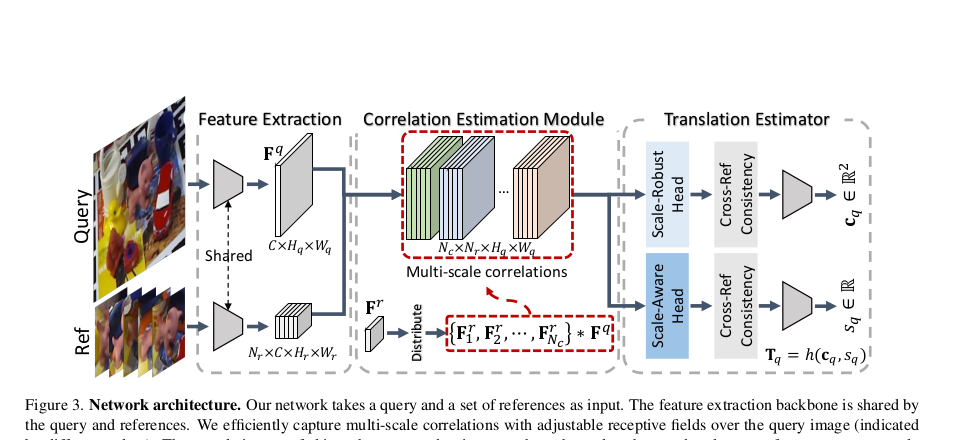
Reference features become multi-scale kernels that shrink and expand, producing correlation maps against query features. Because scale affects center and size estimation differently, two heads decouple them: a scale-robust head weights correlation-distribution reliability to predict the center, while a scale-aware head retains scale cues to predict object size. Camera intrinsics then recover translation.
Center prediction should resist scale changes, while size prediction must detect them; a shared ordinary regression head mixes opposing requirements. Source: original Figure 3. Copyright belongs to the original authors and 3DV 2024 publisher; reproduced here for academic analysis.
Results
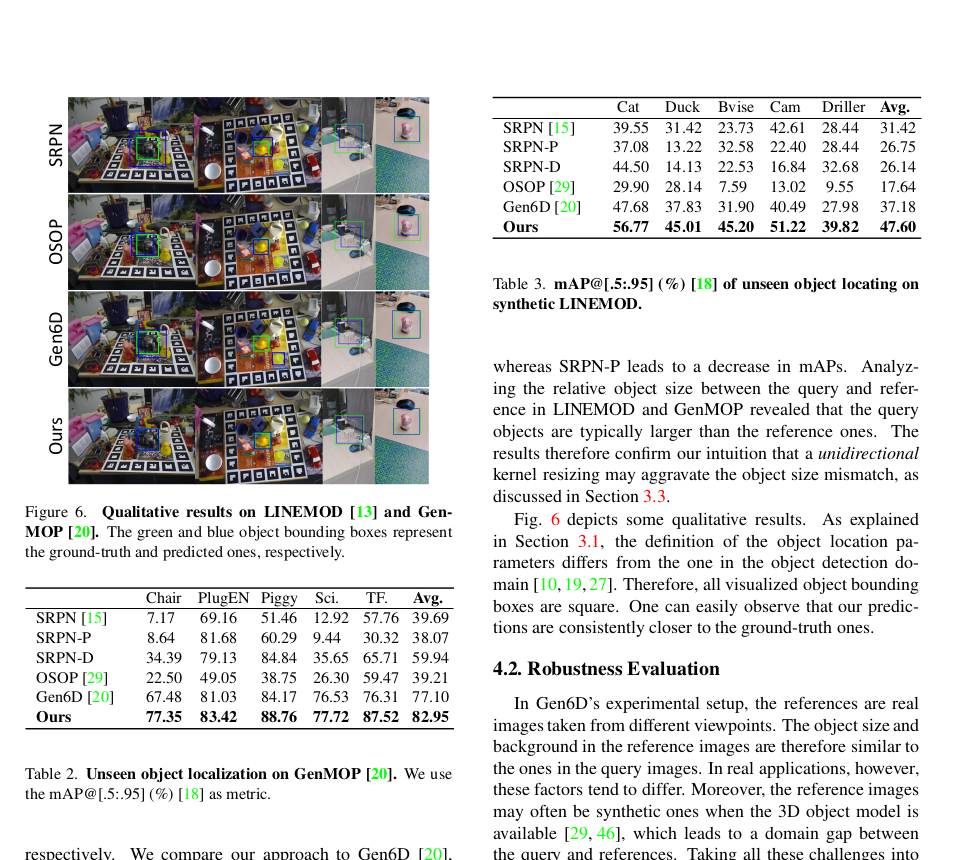
On LINEMOD unseen-object localization, mAP@[.5:.95] is 74.35, exceeding Gen6D’s 60.84 by 13.51 points. With the same Volume refiner, ADD-0.1d is 68.58 versus Gen6D’s 62.45. On GenMOP, scores of 23.32 without refinement and 53.61 with the same refinement also exceed Gen6D.
Crop containing original Figure 6 and Tables 2–3: qualitative boxes on LINEMOD / GenMOP, with localization tables for GenMOP and synthetic LINEMOD, respectively. This crop does not include the final 6D pose tables. Source: original Figure 6 and Tables 1–2. Copyright belongs to the original authors and 3DV 2024 publisher; reproduced here for academic analysis.
Scope
LocPoseNet does not independently solve full rotation estimation; final 6D pose depends on Gen6D’s Volume refiner. Testing still needs object reference images and camera intrinsics. It is a modular novel-object localization / translation frontend rather than a wholly new end-to-end pose pipeline.
Available src/paper-notes/locposenet-3dv2024/deep.md
In-depth paper notes
Support reproduction, comparison, related-work writing, and identifying opportunities for further research.
LocPoseNet: Deep Reading
1. Why Study Target Location Separately?
Many generalizable pose systems receive a query crop or ground-truth object center. Comparisons then focus on rotation / refinement while excluding detection and translation, common deployment failure points. Fixed-category detectors also do not solve unseen categories. LocPoseNet makes this hidden assumption explicit and tests location noise: with only 32 references and changing query scale / background, can it produce a sufficiently good location prior?
2. Network Design
2.1 Reference kernel distribution
After extracting local features from multiple references, the method scales small reference kernels in both directions instead of simply resizing the query. One query-backbone pass yields multi-scale correlations, costing less than repeatedly encoding the entire 480×640 query at every scale.
Both directions matter: expanding the receptive field helps large-query / small-reference pairs but worsens small-query / large-reference pairs. Shrinking and expanding kernels cover both scale mismatches.
2.2 Cross-reference consistency
Correlation maps from different references should support the same query location. The network aggregates cross-reference evidence to suppress background regions that accidentally match just one template.
2.3 Decoupling Center and Size
Center prediction favors sharp, unimodal, position-stable correlation maps, so the scale-robust head weights distribution reliability. Size prediction needs to identify the best kernel scale, so the scale-aware head retains scale channels. After predicting 2D center cq and scale sq, the method recovers 3D translation from reference object scale, focal length, and projection geometry.
Shared query / reference features produce multi-scale correlations that feed a scale-robust center head and a scale-aware size head. Source: original Figure 3. Copyright belongs to the original authors and 3DV 2024 publisher; reproduced here for academic analysis.
3. Experiments and Evidence
3.1 Localization
Mean mAP@[.5:.95] on LINEMOD with 32 references:
SRPN: 12.23
OSOP: 27.86
Gen6D: 60.84
LocPoseNet: 74.35
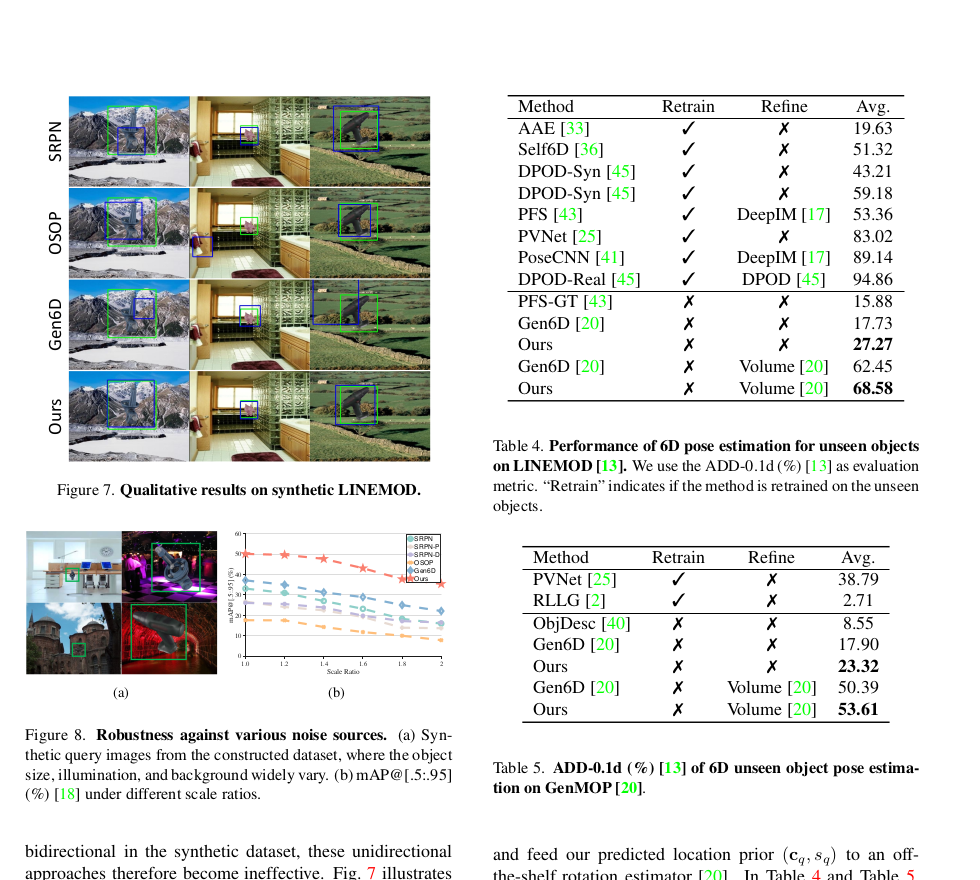
A test-only robustness set keeps real references and renders synthetic queries with varying scales, lighting, and backgrounds. All methods decline, but LocPoseNet leads by at least 10.42 points and retains a higher curve as the scale ratio rises from 1.0 to 2.0. This tests scale robustness more directly than ordinary LINEMOD.
Crop containing original Figure 6 and Tables 2–3: qualitative boxes on LINEMOD / GenMOP, with localization tables for GenMOP and synthetic LINEMOD, respectively. This crop does not include the final 6D pose tables. Source: original Figure 6 and Tables 1–2. Copyright belongs to the original authors and 3DV 2024 publisher; reproduced here for academic analysis.
3.2 Final 6D Pose
LocPoseNet replaces only Gen6D’s localization / translation frontend, sharing the rotation and final-refinement backend:
LINEMOD: 27.27 without refinement versus Gen6D 17.73; with the same Volume refiner, 68.58 versus 62.45.
GenMOP: 23.32 without refinement versus 17.90; with the same Volume refiner, 53.61 versus 50.39.
Sharing the backend makes this comparison more informative than mixing arbitrary state-of-the-art systems: differences can mainly be attributed to the location prior.
Original Figures 7–8 and Tables 4–5: synthetic LINEMOD qualitative examples and scale-perturbation tests on the left; LINEMOD and GenMOP ADD-0.1d tables on the right, distinguishing no refinement from a shared Volume refiner. Source: original Figures 7–8 and Tables 4–5. Copyright belongs to the original authors and 3DV 2024 publisher; reproduced here for academic analysis.
3.3 Ablations
The single-scale baseline without consistency and with an ordinary estimator reaches 34.98 mAP. Cross-reference consistency raises this to 38.41; multi-scale + max gives 52.43, convolutional fusion 70.10, and the full decoupled estimator 74.35. Multi-scale representation supplies most of the gain; the decoupled heads add about 4.25 final points.
4. Limitations and Reproduction Notes
References still require known pose / scale information, and 32 templates are not truly one-shot.
An external refiner supplies final rotation; ADD gains do not mean this network directly predicts all of 6D pose.
The synthetic robustness set uses LINEMOD CAD renders, controlling variables without fully representing real sensor domain gaps.
Strong occlusion, multiple identical instances, or large reference-to-query deformation can still produce ambiguous correlation peaks.
5. Engineering Lessons
Translation is determined jointly by 2D center, apparent scale, physical dimensions, and camera intrinsics. Modeling center and scale separately and evaluating the frontend independently often reveals bottlenecks more effectively than tuning a refiner against final ADD alone.