Visuo-Tactile Object Pose Estimation for a Multi-Finger Robot Hand with Low-Resolution In-Hand Tactile Sensing
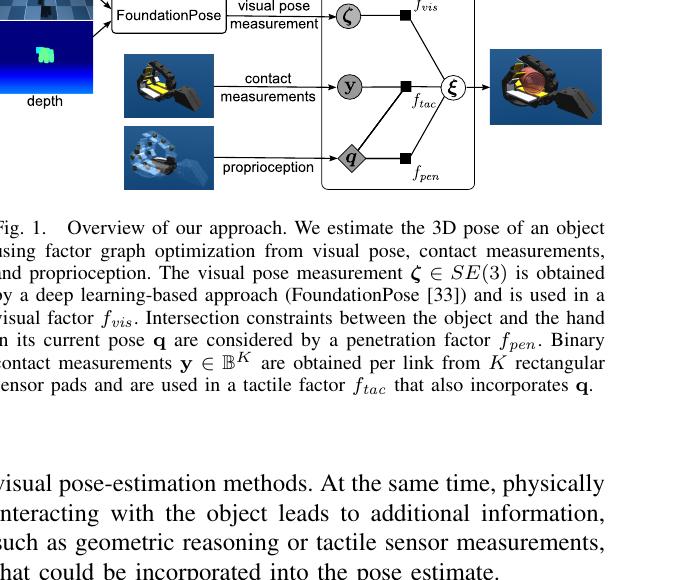
The method combines visual pose, hand proprioception, binary contact at each finger link, and nonpenetration priors in a factor graph. Robust costs optimize held-object pose under severe hand occlusion or visual noise.
Instead of high-resolution tactile images, this method combines binary contact / no-contact signals at finger links with hand kinematics, visual pose, and non-penetration priors to continuously optimize held-object pose in a factor graph.
2.1 Guide to the paper’s figures and tables
Original Figure 1: visual pose observations, hand proprioception, low-resolution contact, and geometric non-penetration constraints enter a per-step factor graph. Source: Author-provided PDF. Image copyright belongs to the paper's authors and publisher; reproduced here for academic analysis.
FoundationPose initializes pose once, then provides visual observations through its pose-refinement component at subsequent time steps.
Hand kinematics place tactile pads in a common frame.
Contact factors keep the object surface near activated pads.
Non-penetration factors penalize object intrusion into non-contacting finger geometry.
Joint angles determine current contact / penetration geometry; the previous pose only initializes the next optimization, without a temporal smoothing residual.
A Welsh robust cost suppresses false contacts and visual outliers.
5. Evaluation
Simulation: 17 YCB objects.
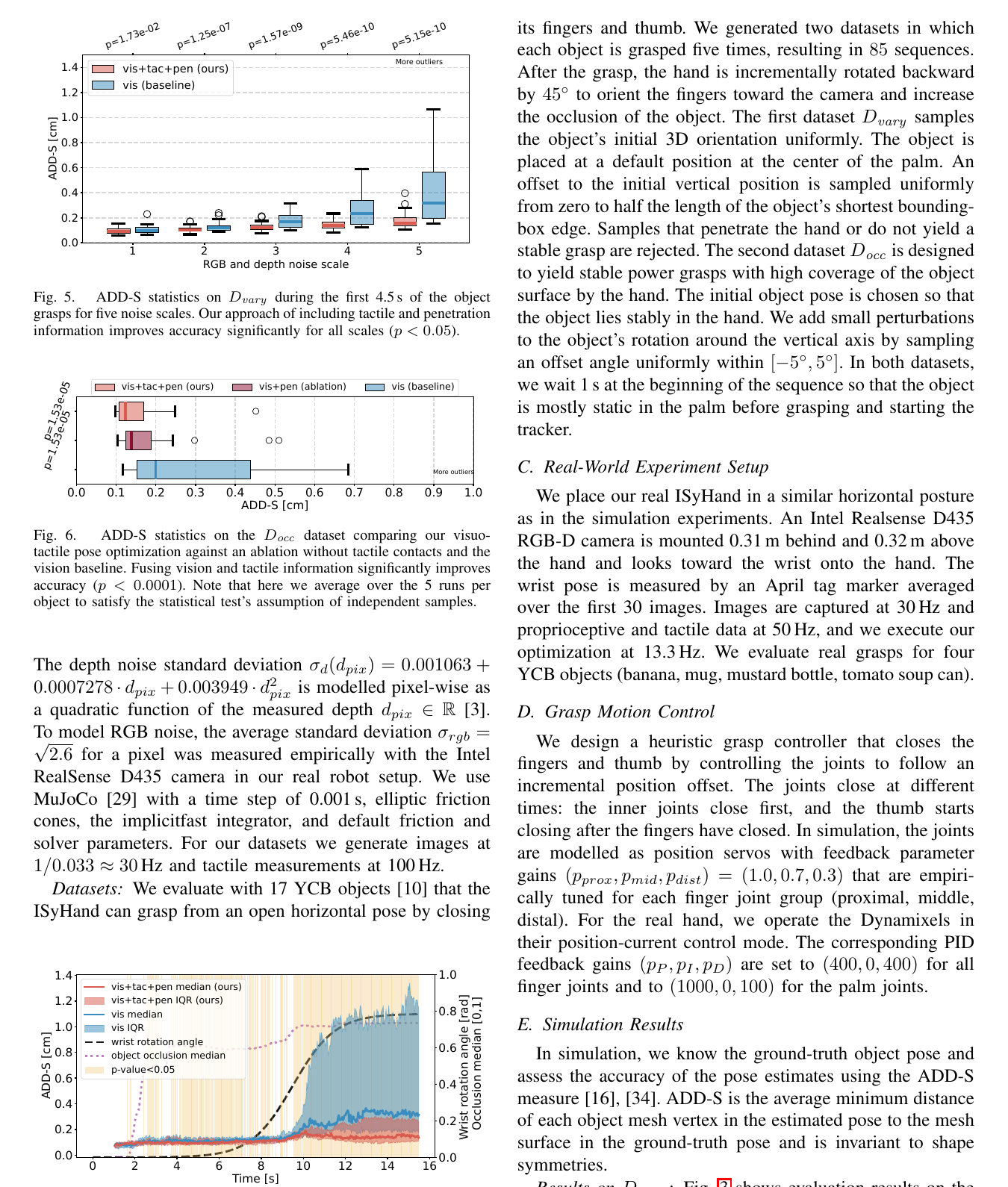
Dvary: large variation in occlusion and visual noise.
Docc: stable power grasps with high contact coverage.
Real data: grasping sequences on the custom multi-finger ISyHand.
Optimization updates at about 13.3 Hz.
6. Coarse Reading Conclusion
The paper shows that low-bandwidth touch can still constrain pose through known hand geometry and per-step optimization, without directly regressing 6D pose from touch. It is especially suitable for tracking after grasping occludes vision, at the cost of accurate kinematics, object CAD, and tactile-pad calibration.
Available src/paper-notes/lowres-inhand-visuotactile-icra2025/deep.md
In-depth paper notes
Support reproduction, comparison, related-work writing, and identifying opportunities for further research.
Paper Reading Notes (Deep): Visuo-Tactile Object Pose Estimation for a Multi-Finger Robot Hand with Low-Resolution In-Hand Tactile Sensing
1. Core Problem
Vision often sees an object clearly before grasping, then loses visibility behind fingers. High-resolution tactile images estimate contact geometry, but cost, wiring, and durability may be unsuitable for multi-finger hands. Can one bit per pad still improve 6D pose?
The key transformation is geometric: one bit contains little information, but with known pad positions, hand kinematics, and an object mesh, contact at that location defines a concrete feasible region.
2. Factor-Graph Formulation
At each time step, only the current object pose Tt is optimized. An explanatory shorthand for the three factor types is (not a cross-time smoothing objective):
ec: contact residual between activated pads and object surface;
en: object / finger-link penetration residual;
State transitions use a uniform model; the previous pose initializes optimization without adding a temporal motion-smoothing residual.
qt: joint angles; zt: binary contacts.
The Welsh robust cost saturates for large residuals, limiting false contacts or visual jumps so they do not dominate optimization.
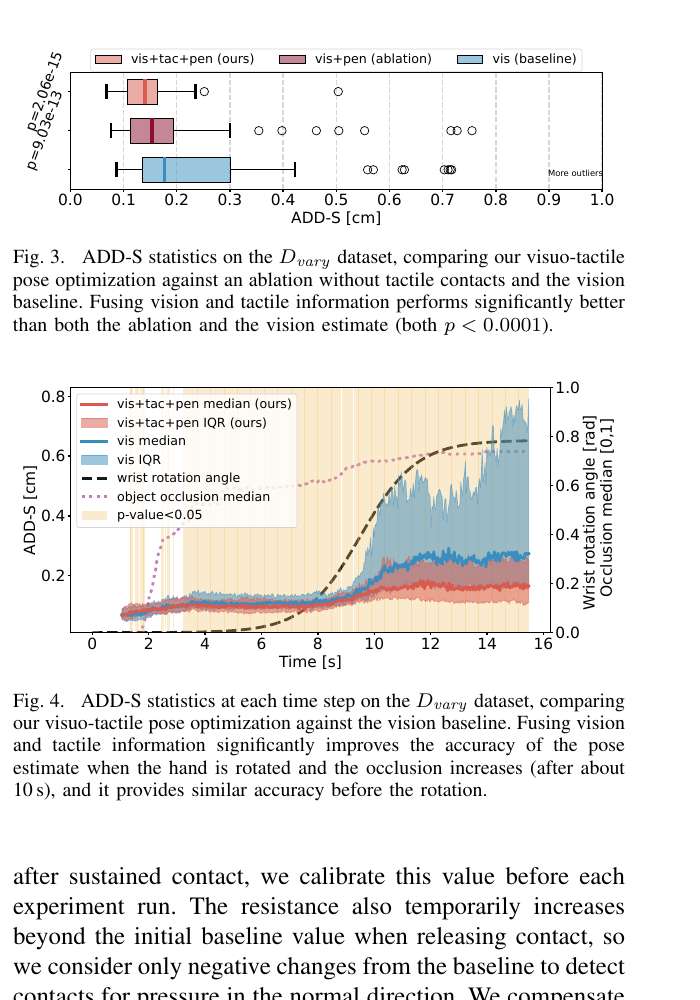
Original Figures 3–4: ADD-S distributions and changes over time on simulated Dvary, compared with vision alone and an ablation without touch. Figure 4 shows changes as the wrist rotates and occlusion increases. Source: Author-provided PDF. Image copyright belongs to the paper's authors and publisher; reproduced here for academic analysis.
3. Complementary Contact and Non-Penetration Constraints
Contact says only that the surface passes near a pad, leaving many feasible poses for one contact. Contacts from fingers in different directions intersect these feasible sets and progressively narrow pose.
Non-penetration also uses non-contacting hand geometry: candidate objects cannot pass through finger links. This negative evidence excludes geometrically impossible poses that satisfy only a few contacts.
Symmetric objects may retain rotational freedom; binary contact cannot create observability along inherently unobservable directions.
4. Simulation Protocol
17 YCB objects;
Dvary: visual occlusion / noise varies over time, approximating visual degradation during grasping;
Docc: stable power grasps with more complete contact coverage;
Compare vision alone, different tactile / geometry factors, and full fusion;
Evaluate with symmetry-tolerant pose metrics such as ADD-S.
Dvary tests whether touch can compensate for visual failures; Docc more closely tests geometric constraints under high contact coverage. These conditions should be distinguished.
5. Real System
Crop containing original Figures 5–7: Figure 5 sweeps RGB-D noise on Dvary; Figures 6–7 show Docc simulation statistics. The right-hand text describes the real ISyHand setup. Figure 8 real-robot visualizations are not in this crop. Source: Author-provided PDF. Image copyright belongs to the paper's authors and publisher; reproduced here for academic analysis.
Custom 15-DoF multi-finger hand;
Four fingers with multiple low-resolution tactile pads;
RGB-D at about 30 Hz, touch / proprioception at about 50 Hz;
Factor-graph output at about 13.3 Hz.
The 13.3 Hz rate reflects effective complete-optimization updates, more useful for engineering than visual-network forward time alone. It may be low for fast in-hand manipulation but supports slower post-grasp closed-loop correction.
6. Uncertainty and Weights
The paper uses fixed measurement covariance. This is simple, but sensor quality varies between stages:
Vision is reliable before occlusion and degrades rapidly as the hand closes;
Binary pads may flicker as contact area and pressure vary;
Kinematic errors vary with joint configuration.
Future systems could learn or estimate factor covariances online, allowing graph optimization to adapt visual / tactile weights.
7. Limitations
Requires object meshes, initial visual poses, and accurate hand geometry.
Pad-position / threshold calibration errors can be interpreted as object-pose errors.
Rigid-object and rigid-contact assumptions do not fit substantial deformation.
Low-resolution contact improves observability but cannot fully replace external vision.
8. Deep Reading Conclusion
Low tactile resolution need not imply weak geometric information: combined with known hand kinematics, object meshes, and non-penetration, multiple binary contacts provide strong constraints. This offers a more transparent, debuggable tracking approach for low-cost multi-finger hands than end-to-end tactile regression.