MatchU: Matching Unseen Objects for 6D Pose Estimation from RGB-D Images
MatchU fuses CAD geometry, observed depth, and RGB texture into color-aware rotation-invariant 3D descriptors, then uses matching, RANSAC, and optional ICP for 6D poses of objects unseen in training. Single-hypothesis BOP-5 mean AR without refinement is 50.5 at 0.07 s; multiple hypotheses reach 57.8, and refinement reaches 64.7. RGB disambiguation improves correspondences, while multiple hypotheses improve global robustness.
metric CAD model for each test objectcamera intrinsics and valid depthobject detection or segmentationGSO synthetic pretrainingoptional multi-hypothesis verification and ICP refinement
Full paper metadataAuthors, affiliations, research area, datasets, metrics, method tags, and reading statusExpandCollapse
metric CAD model for each test objectcamera intrinsics and valid depthobject detection or segmentationGSO synthetic pretrainingoptional multi-hypothesis verification and ICP refinement
Reading Notes
Overview / Deep Dive
Available src/paper-notes/matchu-cvpr2024/coarse.md
Paper overview notes
Quickly assess the paper's scope, problem setting, core method, experimental findings, and whether to read it in depth.
Paper Reading Notes (Coarse): MatchU
1. Basic information
Title: MatchU: Matching Unseen Objects for 6D Pose Estimation from RGB-D Images
MatchU targets objects unseen during training but supplied as CAD at test time. It fuses model clouds, observed depth, and RGB texture into rotation-invariant local 3D descriptors, then solves 6D pose from correspondences, addressing ambiguity in symmetric, repeated, and weakly geometric regions.
3. Guide to figures and tables
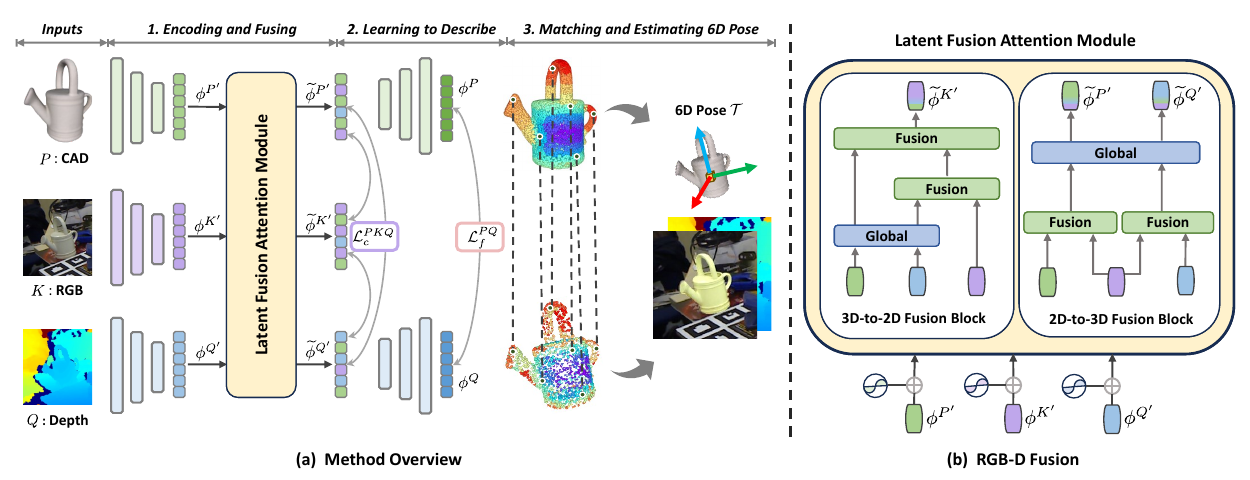
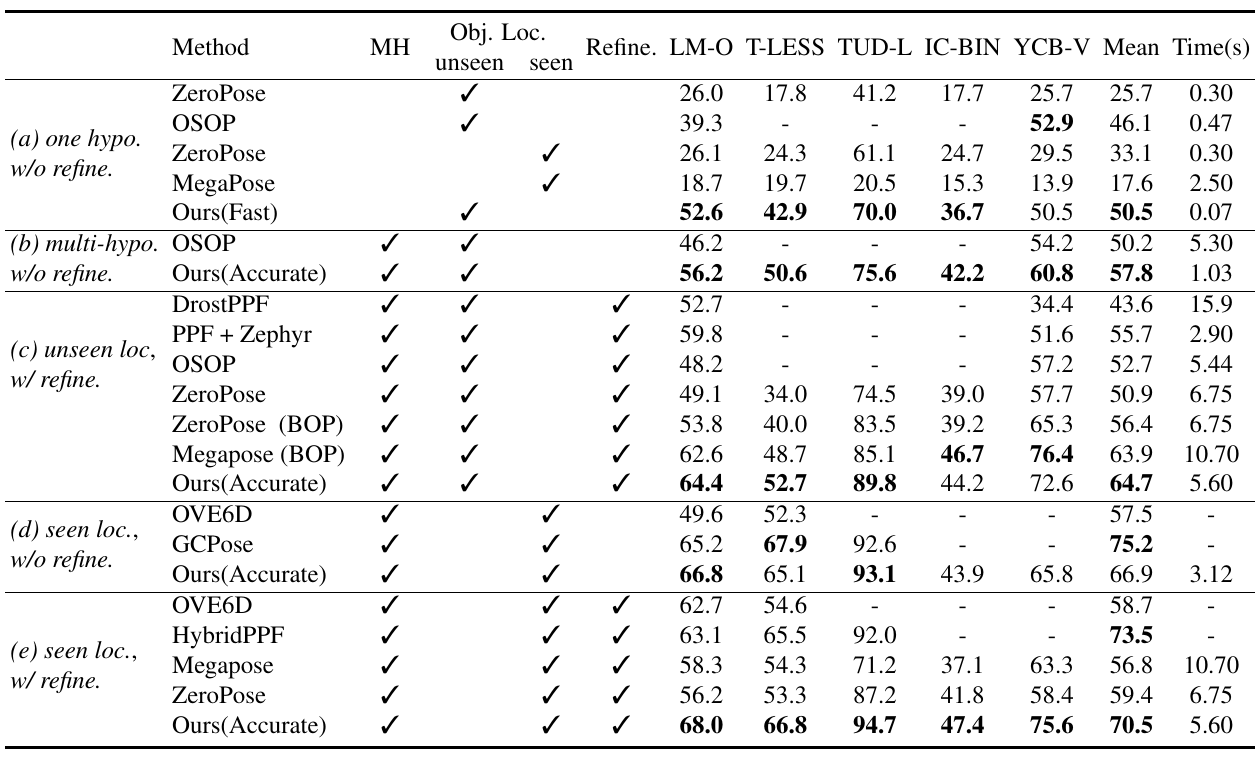
Original Figure 2: CAD, RGB, and depth branches encode inputs, then bidirectional Latent Fusion Attention exchanges 2D texture and 3D geometry. CAD-to-scene-cloud correspondences recover pose. Source: CVPR 2024 official paper. Image copyright belongs to the paper's authors and IEEE/CVF; reproduced here for academic analysis.Original Table 1: single-hypothesis Fast without refinement reaches mean AR 50.5 in 0.07 s. The 20-hypothesis Accurate variant reaches 57.8 / 1.03 s, or 64.7 / 5.60 s with ICP. Groups differ in whether their localizers have seen test objects; bold values alone are insufficient. Source: CVPR 2024 official paper. Table copyright belongs to the paper's authors and IEEE/CVF; reproduced here for academic analysis.
4. Problem setting
Inputs: one RGB-D frame, intrinsics, target CAD / point cloud, and detection or segmentation.
Output: absolute CAD-to-camera SE(3) pose.
Test objects are absent from training, potentially new instances or categories.
Training: 850 Google Scanned Objects and about 800k synthetic images; validation: 94 separate objects and about 200k images.
Evaluation: five BOP core datasets, LM-O, T-LESS, TUD-L, IC-BIN, YCB-V.
5. Method overview
Extract rotation-invariant local geometry from CAD / depth clouds and 2D texture from RGB crops.
Exchange information through 3D→2D and 2D→3D latent fusion blocks without forcing raw-coordinate alignment.
Bridged Coarse-level Matching loss uses RGB latent space to guide CAD–depth coarse matching; fine-level loss supervises decoded point descriptors.
Nearest neighbors yield CAD–scene 3D correspondences and RANSAC solves pose. Multiple hypotheses are ranked with 3D distances and RGB render verification.
Optional ICP refines pose, making Fast, Accurate, and Accurate+refinement distinct speed tiers.
6. Experiments at a glance
Fast: BOP-5 mean AR 50.5, 0.07 s; LM-O / T-LESS / TUD-L / IC-BIN / YCB-V scores are 52.6 / 42.9 / 70.0 / 36.7 / 50.5.
20 hypotheses: mean AR 57.8, 1.03 s.
Unseen-object localization + ICP: mean AR 64.7, versus MegaPose BOP 63.9, with 5.60 s versus 10.70 s.
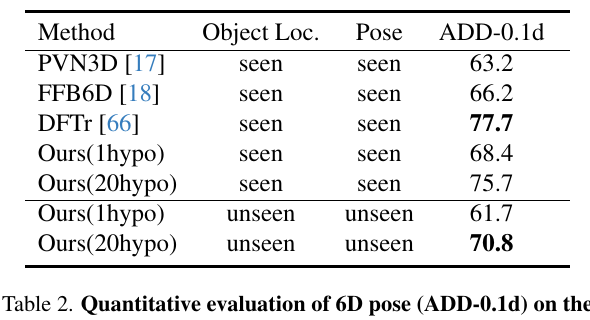
LM-O ADD-0.1d: 1 / 20 hypotheses under unseen-object training give 61.7 / 70.8.
Removing BCM loss changes mean AR 50.5→48.1; removing RGB gives 39.6. RGB-initialized RoITr reaches only 42.6.
Increasing hypotheses from 1 to 20 changes AR 52.6→56.2, with rapidly diminishing further gains.
7. Quick assessment
Strengths: RGB enters descriptor learning, resolving same-geometry ambiguities from rotational invariance; the single-hypothesis variant is fast.
Main limits: metric CAD, depth, intrinsics, and object localization remain required. Rendering-free mainly describes core matching, not cost-free Accurate verification / ICP.
Table caution: Table 1 mixes five protocols involving unseen / seen localizers, multiple hypotheses, and refinement; cross-group comparisons can mislead.
Intended readers: unseen-object pose, RGB-D fusion, 3D descriptors, cloud registration, and symmetric-object matching.
Available src/paper-notes/matchu-cvpr2024/deep.md
In-depth paper notes
Support reproduction, comparison, related-work writing, and identifying opportunities for further research.
Paper Reading Notes (Deep): MatchU
1. Key assessment
MatchU addresses a conflict in unseen-object 3D matching:
Generalization to new objects and poses favors rotation-invariant local 3D descriptors;
Rotational invariance makes geometrically similar points hard to distinguish, especially on planes, cylinders, symmetric parts, and repeated structures;
RGB can disambiguate texture, but image samples, CAD points, and scene-depth points have no natural pointwise correspondence.
MatchU fuses CAD geometry, scene geometry, and texture bidirectionally in coarse latent space, using RGB latent matching to guide 3D descriptors. Explicit correspondences, RANSAC, and optional ICP still solve pose. Single-hypothesis BOP-5 mean AR is 50.5 at 0.07 s; removing RGB drops AR to 39.6, showing texture is substantive.
2. Task Boundaries
Input:
Target CAD cloud P;
RGB crop K;
Scene cloud Q back-projected from the depth crop;
Intrinsics and object-localization results.
The output is absolute CAD-to-camera transform T=[R∣t]∈SE(3). Unseen means test CAD and images are absent from training; the task is neither CAD-free nor category-canonical-space pose.
Training uses MegaPose’s GSO synthetic set:
850 objects and about 800k rendered training images;
94 disjoint objects and about 200k validation images.
Test CAD models in LM-O, T-LESS, TUD-L, IC-BIN, and YCB-V do not overlap training objects.
3. Fuse–Describe–Match
Original Figure 2. The left shows the full Fuse–Describe–Match pipeline; the right expands 3D→2D and 2D→3D latent fusion blocks. Source: CVPR 2024 official paper. Image copyright belongs to the paper's authors and IEEE/CVF; reproduced here for academic analysis.
3.1 Three Encoders
Farthest-point sampling forms superpoints from CAD P and depth cloud Q. Pose-agnostic Point Pair Features encode position, producing rotation-invariant local geometry rather than canonical coordinates.
RGB K uses a modified FPN / LoFTR-style encoder, downsampling crops to H/8×W/8. 2D features provide color, edges, and texture; 3D features supply metric scale and local structure.
3.2 Latent Fusion Attention
Two fusion directions:
3D→2D: inject CAD / depth geometry into image features;
2D→3D: inject image texture into CAD / depth descriptors.
Blocks alternate latent-fusion and global transformers. Fusion occurs in pose-agnostic latent space, enabling information exchange before pose is known without prealigning raw CAD points and pixels.
3.3 Two-Level Matching Supervision
Bridged Coarse-level Matching loss LcPKQ uses RGB latent features to bridge coarse CAD P and depth Q matches. A decoder raises descriptor resolution, and fine matching loss LfPQ directly attracts GT 3D correspondences and separates negatives.
Bridging makes color help determine which invariant geometric features should remain distinguishable, beyond late feature concatenation.
4. Descriptors to Pose
Inference matches CAD descriptors ϕP with scene descriptors ϕQ by nearest neighbors, selects κ=128 candidates by correlation, and retains s=64 correspondences for solving.
Single-hypothesis Fast solves T directly through RANSAC. Accurate defaults to 20 hypotheses ranked by two scores:
3D verification: pointwise distances between transformed CAD and lifted depth;
RGB verification: render each hypothesis and evaluate appearance agreement.
The highest mean score wins; optional ICP uses depth for further refinement. Without expensive rendering mainly describes descriptor matching. Accurate verification still renders, and ICP adds another optimization stage.
5. BOP Results and Protocols
Original Table 1. MH, Obj. Loc. unseen / seen, and Refine jointly define protocols. Fair direct comparisons stay within groups. Source: CVPR 2024 official paper. Table copyright belongs to the paper's authors and IEEE/CVF; reproduced here for academic analysis.
Setting
LM-O
T-LESS
TUD-L
IC-BIN
YCB-V
Mean
Time
Fast, 1 hypothesis, no refinement, unseen localizer
52.6
42.9
70.0
36.7
50.5
50.5
0.07 s
Accurate, 20 hypotheses, no refinement, unseen localizer
56.2
50.6
75.6
42.2
60.8
57.8
1.03 s
Accurate, unseen locator + ICP
64.4
52.7
89.8
44.2
72.6
64.7
5.60 s
Accurate, seen locator + ICP
68.0
66.8
94.7
47.4
75.6
70.5
5.60 s
Interpretation:
Moving 1→20 hypotheses adds 7.3 AR but about 15× runtime; hypothesis count is the main accuracy / speed control.
ICP raises unseen-localizer AR 57.8→64.7, showing substantial remaining depth-alignment residuals after descriptor matching.
Seen localization plus ICP reaches 70.5; that gain is not attributable to MatchU descriptors alone.
IC-BIN remains weak at 44.2 in the full unseen setting, combining few objects, occlusion, and local geometry degeneracy.
6. Symmetry, Texture, and ADD
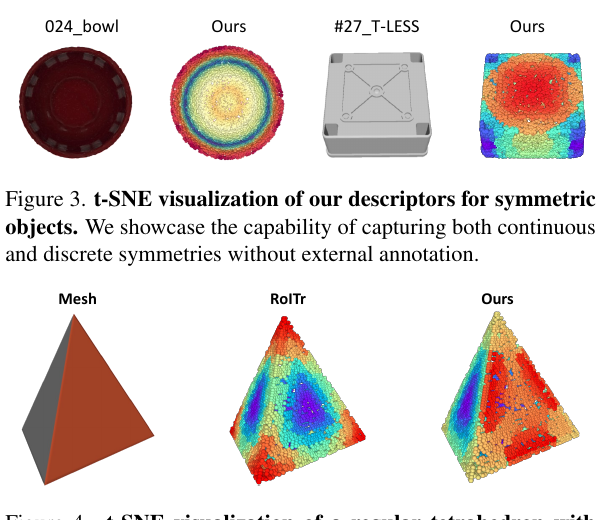
Original Figures 3–4: invariant descriptors represent continuous / discrete symmetry, while RGB distinguishes a colored face on an otherwise geometrically symmetric tetrahedron. Source: CVPR 2024 official paper. Image copyright belongs to the paper's authors and IEEE/CVF; reproduced here for academic analysis.
Maximal rotation invariance is not always desirable. Identical descriptors are appropriate for textureless symmetric surfaces, but discard information when texture breaks geometric symmetry. MatchU lets content determine when to preserve symmetry and when color should break it.
Original Table 2: with test objects unseen in training, 1 / 20 hypotheses give ADD-0.1d of 61.7 / 70.8; the latter approaches seen-object DFTr at 77.7. Source: CVPR 2024 official paper. Table copyright belongs to the paper's authors and IEEE/CVF; reproduced here for academic analysis.
seen object / seen locator: 1 hypothesis 68.4, 20 hypotheses 75.7;
DFTr seen-object baseline: 77.7.
With 20 hypotheses, the gap between MatchU’s unseen and seen settings is 4.9 points. CAD, RGB-D, and object crops remain required; this is not fully open-world zero-shot pose.
7. Ablations and Causal Evidence
BOP-5 ablations:
Variant
Mean AR
No BCM loss
48.1
No RGB input
39.6
RoITr + RGB initialization
42.6
Full Fast
50.5
The strongest evidence is -10.9 AR without RGB: purely invariant geometry is seriously ambiguous on test objects. RGB-initialized RoITr recovers only 42.6, supporting joint cross-modal descriptor learning over extra color channels alone.
AR rises 52.6→56.2 as hypotheses increase from 1 to 20, reaching about 58.2 at 100 before saturating. More correspondence samples improve hypothesis recall without linear final-AR gains; correspondence quality matters more than count.
8. Related Approaches
MegaPose / GenFlow search or refine in pose space through render-and-compare. MatchU solves descriptor correspondences first and renders for Accurate verification.
GigaPose also accepts new CAD, using RGB template retrieval + one-patch correspondence; MatchU uses depth and 3D–3D matching.
HiPose uses seen-object, object-specific binary surface codes; MatchU learns shared descriptors across objects for unseen CAD.
Oryon estimates text-specified relative pose across two scenes without CAD; MatchU uses CAD and one scene for absolute pose.
9. Limitations and Reproduction Checks
Requires metric CAD, reliable depth, and intrinsics;
Full pipelines need localization; descriptors cannot absorb all unseen-localizer errors;
Fast is one speed tier: 0.07 s and 64.7 AR do not describe one configuration;
Multi-hypothesis RGB verification needs a renderer; ICP adds depth-noise sensitivity;
About 1M GSO renders shift large-scale training costs into general pretraining;
BOP symmetry-aware metrics and ADD-0.1d differ for continuous symmetry;
Fix κ=128, s=64, hypothesis count, localizer, and refinement for comparable results;
Report descriptor-only, multi-hypothesis, and ICP runtimes separately.
10. Overall assessment
The key lesson is that unseen-object 3D descriptors should allow observed texture to break geometric equivalence when needed, alongside geometric invariance. The 50.5→39.6 RGB ablation, 0.07 s single-hypothesis runtime, and 57.8 AR multi-hypothesis result support this.
CAD, depth, localization, and synthetic pretraining remain explicit dependencies. For the engineering problem of fast, reliable RGB-D pose from new CAD without per-object retraining, MatchU offers a clear architecture, configurable deployment tiers, and substantial ablation support.