MegaPose: 6D Pose Estimation of Novel Objects via Render & Compare
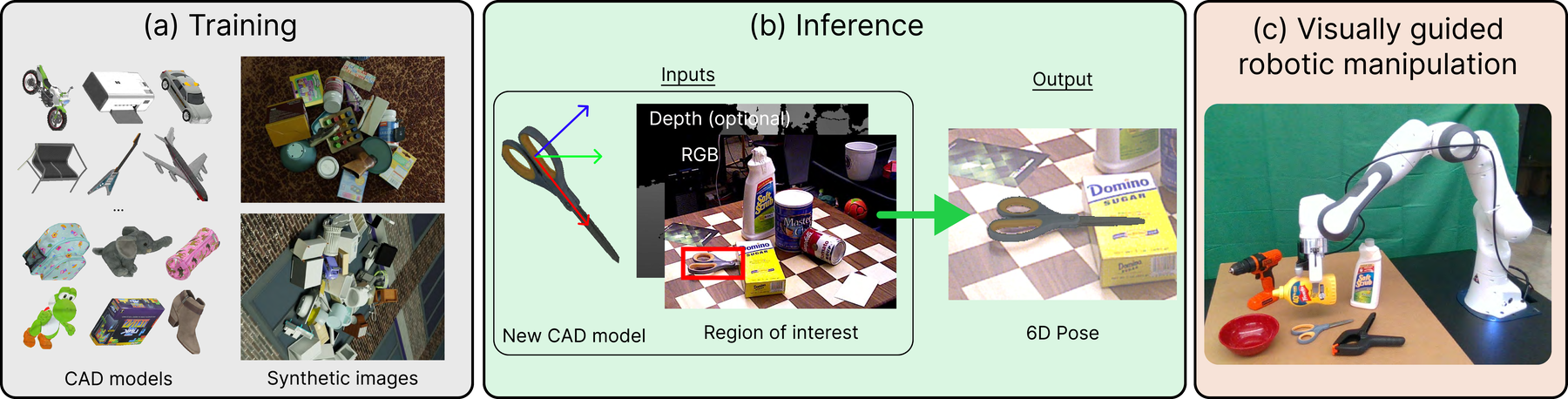
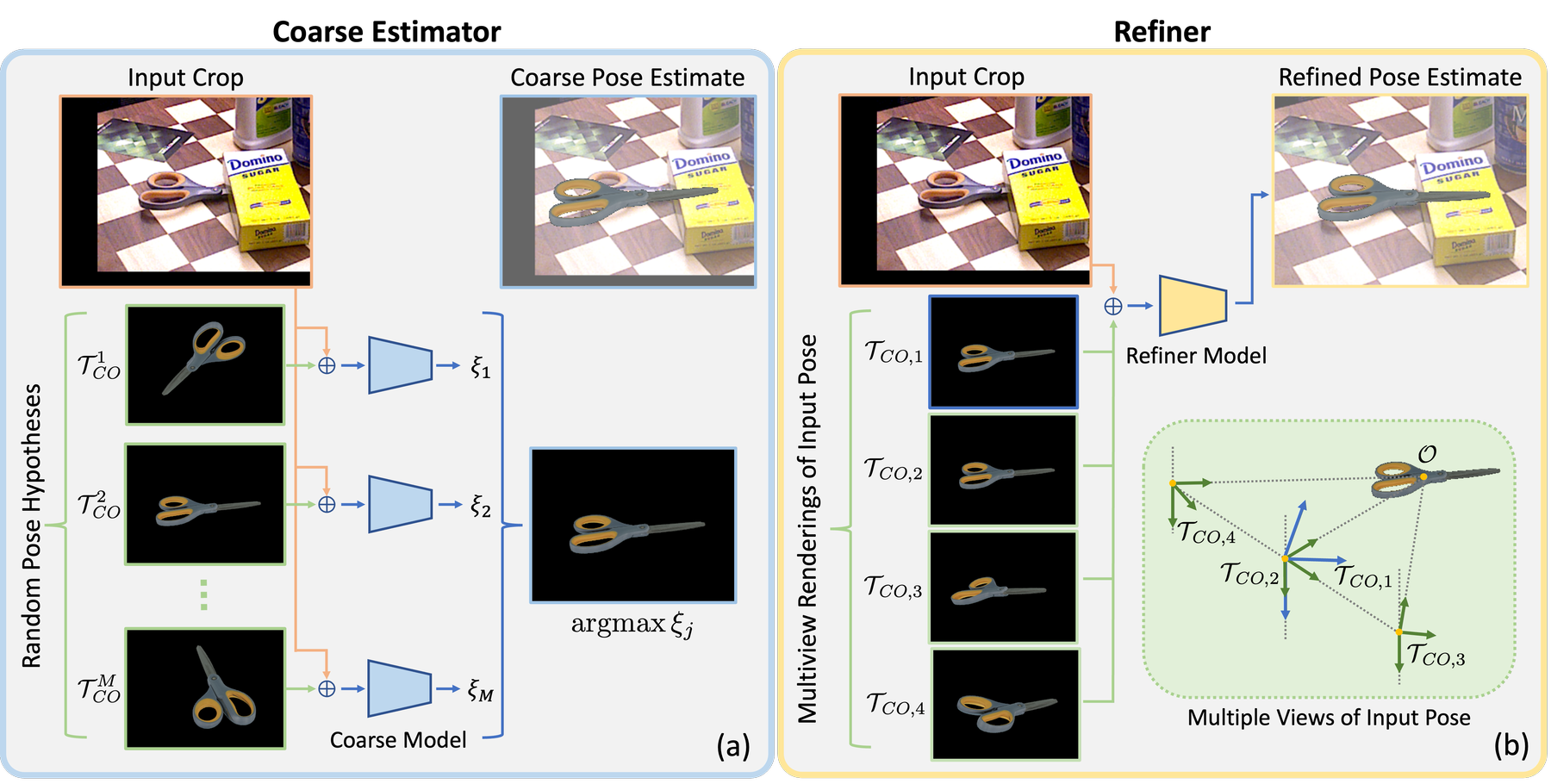
MegaPose learns category-agnostic render-and-compare from 2M synthetic images with over 20K training objects. Its coarse network tests whether 520 CAD pose hypotheses lie within the refiner's convergence basin; the refiner iteratively updates unseen-instance 6D poses using four-view RGB / depth / normal renderings. Target-specific retraining is unnecessary at test time, but metric CAD, camera intrinsics, and a target ROI are required.
camera intrinsicsCAD model with metric scaleobject bounding box / region of interestrendererexternal detector for end-to-end use
Full paper metadataAuthors, affiliations, research area, datasets, metrics, method tags, and reading statusExpandCollapse
Authors
Yann Labbé, Lucas Manuelli, Arsalan Mousavian, Stephen Tyree, Stan Birchfield, Jonathan Tremblay, Justin Carpentier, Mathieu Aubry, Dieter Fox, Josef Sivic
Affiliations
ENS / Inria / NVIDIA / LIGM / Ecole des Ponts / University of Washington / CIIRC CTU
camera intrinsicsCAD model with metric scaleobject bounding box / region of interestrendererexternal detector for end-to-end use
Reading Notes
Overview / Deep Dive
Available src/paper-notes/megapose/coarse.md
Paper overview notes
Quickly assess the paper's scope, problem setting, core method, experimental findings, and whether to read it in depth.
Paper Reading Notes (Coarse): MegaPose: 6D Pose Estimation of Novel Objects via Render & Compare
1. Basic information
Method: MegaPose
Authors: Yann Labbé, Lucas Manuelli, Arsalan Mousavian, Stephen Tyree, Stan Birchfield, Jonathan Tremblay, Justin Carpentier, Mathieu Aubry, Dieter Fox, Josef Sivic
Affiliations: ENS / Inria, NVIDIA, LIGM / Ecole des Ponts, University of Washington, CIIRC CTU
MegaPose turns test-time novel-object CAD into multi-view renderings for comparison. It classifies many hypotheses by whether its refiner can correct them, then repeatedly compares observations with multi-view renders to recover poses of object instances unseen in training.
Method inputs and outputs
Item
Content (compiled for this site)
Inference inputs
One RGB image, intrinsics, target metric CAD mesh, and supplied bbox / ROI; RGB-D additionally uses depth.
Final output
Rigid CAD-to-camera transform TCO∈SE(3), comprising rotation R and translation t.
Requirements
CAD and ROI required, depth optional, mask not central. Multiple views primarily come from CAD rendering, not real reference captures; detection is external.
2.1 Guide to the paper’s figures and tables
Figure / table
Content
Reading focus
Figure 1
Training, inference, and robotic grasping
Novel objects are unseen in training but need CAD and ROI at test time
Figure 2
Coarse estimator and refiner
Coarse learns correctability; four rendered views explicitly encode shape, coordinates, and anchor point
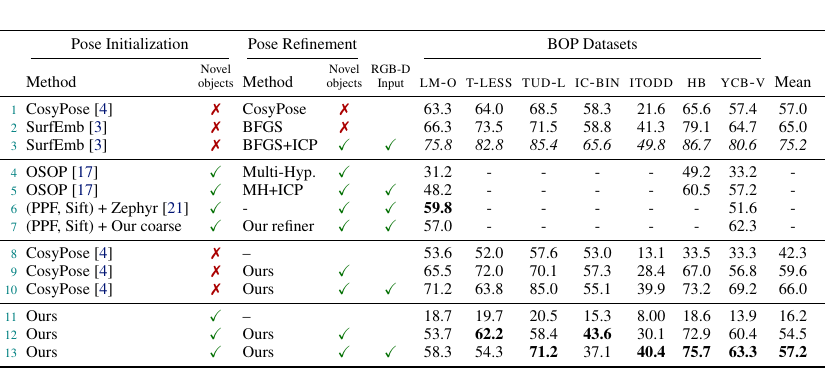
Table 1
7 BOP core datasets
Separate novel-object ability, depth use, and detector exposure to target objects
Generalization comes mainly from multi-view geometry and diverse large-scale CAD training
Figure 7
Failure modes
View ambiguity, subtle asymmetry, and wrong CAD scale can align silhouettes while pose remains wrong
Original Figure 1: MegaPose trains on large CAD collections and synthetic scenes. Test inputs are new CAD, target ROI, RGB, and optional depth; outputs are 6D poses for downstream manipulation. Source: Official project page. Image copyright belongs to the paper's authors and publisher; reproduced here for academic analysis.Original Figure 2: left, score random CAD-pose hypotheses and select a coarse pose; right, render the current pose and three additional views, concatenate with the observed crop, and predict an update. Source: Official project page. Image copyright belongs to the paper's authors and publisher; reproduced here for academic analysis.
Inputs: one RGB or RGB-D image, intrinsics, target metric CAD mesh, and object bbox / ROI.
Output: object-to-camera TCO∈SE(3).
Not required: target-specific pose-network training, real reference images, explicit category labels.
Still required: object identity, correctly scaled CAD, ROI, and RGB / depth / surface-normal rendering.
Outside scope: novel-object detection. Main experiments use external Mask R-CNN detections; the full BOP detector trains on target-object PBR synthetic data.
No retraining for new objects describes the pose backend, not automatic discovery of arbitrary CAD-matched objects in an open scene.
4. Method overview
Construct candidate 3D translations from bbox center / size, intrinsics, and CAD projections.
Generate 520 hypotheses over random orientations.
Compare the observation crop with each rendering and classify whether it lies in the refiner’s attraction basin.
Select the highest-scoring initial pose.
Render the current pose and three additional views, all centering the projected anchor point.
ResNet-34 compares observations and renders, predicting decoupled xy translation, relative depth, and rotation updates.
Repeat refinement: commonly 5 iterations in main experiments, with 1 per later frame in video tracking.
The coarse network classifies rather than directly regresses. Multiple symmetry-equivalent poses can be correctable, avoiding predefined symmetry at the coarse stage without eliminating every visual / symmetry ambiguity.
5. Training Data
Synthetic-only training, without real BOP test images.
About 2M photorealistic images generated by BlenderProc.
Over 20K CAD models from ShapeNet and Google Scanned Objects.
Coarse / refiner training takes about 32 / 48 hours on 32 V100 GPUs each, a one-time shared-model cost.
6. Experiments at a glance
Seven BOP Datasets
Setting
Mean BOP AR
Interpretation
MegaPose coarse only
16.2
520 candidates provide initialization for refinement
MegaPose RGB coarse + refiner
54.5
No depth; test objects unseen
MegaPose RGB-D coarse + refiner
57.2
Refinement adds 41.0 AR over coarse
CosyPose known-object pipeline
57.0
Similar score, but trained on target objects
SurfEmb + BFGS + ICP
75.2
Higher, with target-object training and depth
The 57.2 score is not end-to-end zero-shot: the pose model has not seen targets, but the main detector uses target-object synthetic training.
ModelNet refiner
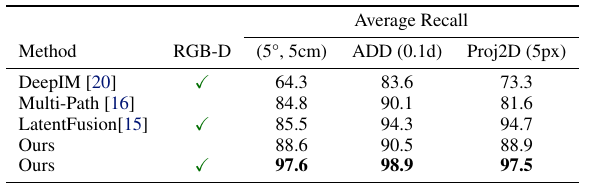
With noisy initialization and refinement-only evaluation, MegaPose RGB-D reaches:
5°/5cm recall: 97.6
ADD-0.1d: 98.9
Proj2D-5px: 97.5
These results show strong refinement given initialization within its convergence basin. They do not establish near-99% global coarse localization.
7. Strengths and Boundaries
Strengths
Test-time renders encode object-specific information instead of network weights, yielding a reusable novel-object backend.
The coarse objective matches refiner capability, selecting likely-correctable hypotheses rather than minimal geometric error alone.
RGB and RGB-D both work; about 50 ms per refinement iteration supports warm-start tracking.
2M synthetic images and over 20K CAD models demonstrate the importance of object diversity.
Public models, code, and synthetic data make it a system baseline for later work such as FoundationPose and SAM-6D.
Limitations / Risks
Initial coarse estimation over 520 hypotheses takes about 2.5 seconds / object in the paper, so initialization is not real-time.
Local refinement can converge incorrectly when coarse error exceeds its basin.
Textureless near-symmetric objects and subtle appearance asymmetries still cause orientation confusion.
CAD scale and depth are coupled in RGB; wrong metric scale can align silhouettes while translation is wrong.
Transparency, strong reflections, CAD geometry / texture mismatch, and bad boxes lack systematic quantification.
8. Coarse Reading Conclusion
MegaPose established that a shared render-and-compare network trained on many objects can replace per-object pose training. It is a key baseline when CAD and ROI are available and new instances must be added quickly. CAD-free estimation, open-vocabulary detection, and category-level 9D pose have different input contracts.
Available src/paper-notes/megapose/deep.md
In-depth paper notes
Support reproduction, comparison, related-work writing, and identifying opportunities for further research.
Paper Reading Notes (Deep): MegaPose: 6D Pose Estimation of Novel Objects via Render & Compare
1. Basic information
Method: MegaPose
Authors: Yann Labbé, Lucas Manuelli, Arsalan Mousavian, Stephen Tyree, Stan Birchfield, Jonathan Tremblay, Justin Carpentier, Mathieu Aubry, Dieter Fox, Josef Sivic
Affiliations: ENS / Inria, NVIDIA, LIGM / Ecole des Ponts, University of Washington, CIIRC CTU
MegaPose asks whether candidate CAD renders match real observations and can be corrected by a local refiner. This interface supplies shape, texture, coordinates, and metric scale as test-time visual evidence to shared networks. One coarse scorer and iterative refiner can therefore estimate new CAD-known objects without target-instance retraining.
Method inputs and outputs
Item
Content (compiled for this site)
Inference input
Observed RGB, intrinsics, target CAD, bbox / ROI, and optional depth. Coarse compares candidate renders; refinement compares observations with multi-view RGB / normal renders around the candidate.
Synthetic observations from many CAD objects, GT poses, candidate / perturbed poses and corresponding renders; RGB-D configurations also use depth.
Training objective
Coarse classifies candidate correctability; refinement predicts rotation, image-plane displacement, and relative-depth updates to recover a new pose.
Output details
TCO contains a 3×3 rotation and 3D translation in a 4×4 homogeneous matrix, with xC=RCOxO+tCO. Translation follows CAD length units, consistent with depth when used; internal depth ratios are not final metric translation.
Requirements
Targets may be unseen, but CAD, calibration, ROI, and rendering remain required. Real multi-view references and target masks are not core inputs. No pose fine-tuning does not imply zero-shot detection.
2.1 Guide to the paper’s figures and tables
Figure / table
Content
Reading focus
Figure 1
Synthetic training to novel-object inference
Novelty concerns pose-network training objects, not CAD-free or detector-free operation
Figure 2
Coarse / refinement architecture
Coarse predicts correctability; four renders encode anchor points and geometry
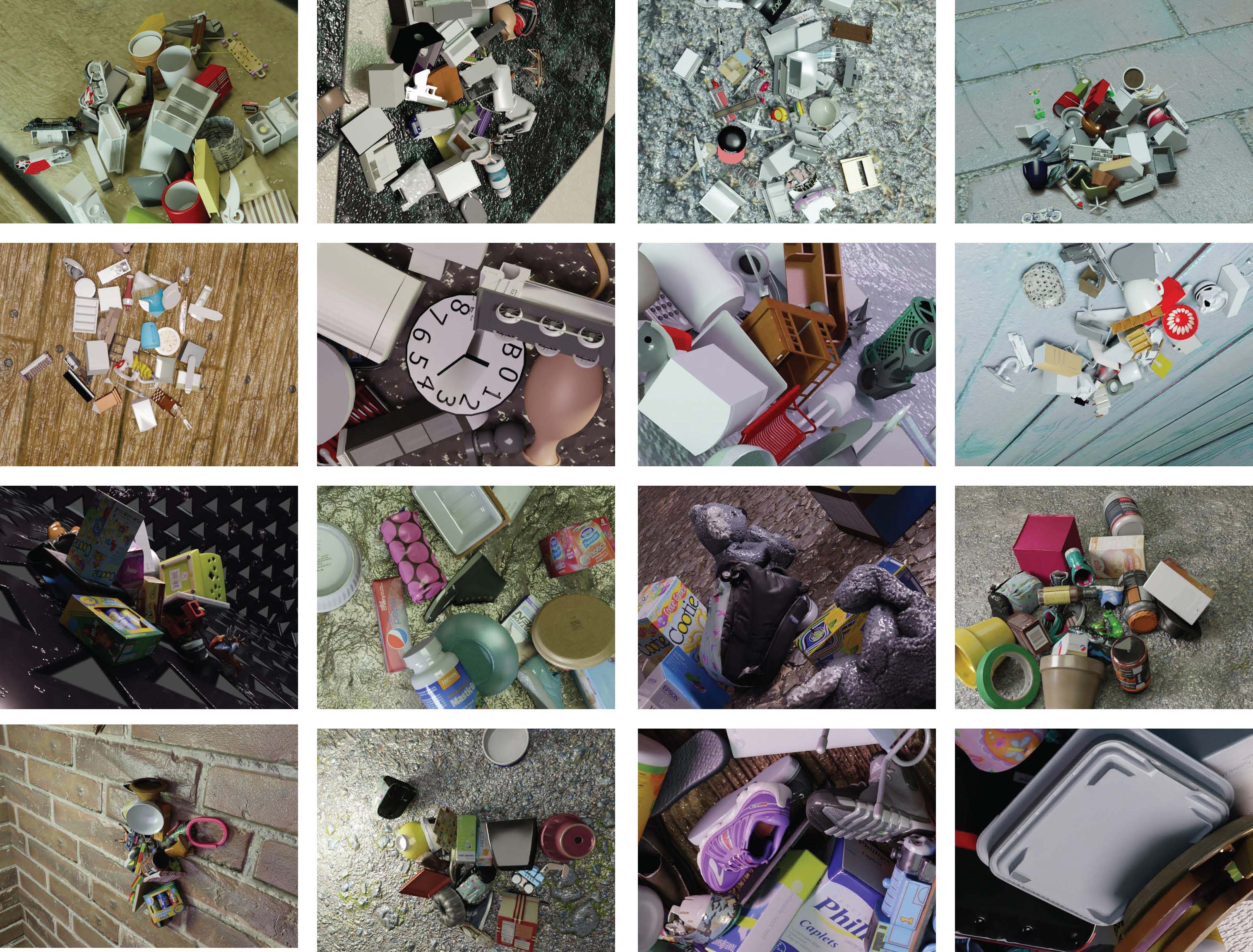
Figure 4
BlenderProc synthetic scenes
Sim-to-real combines object count, scanned textures, physics, and strong augmentation
Table 1
Seven BOP datasets
Compare novelty, RGB/RGB-D, initialization source, and detector protocols
Table 2
ModelNet refiner
Local refinement only, distinct from full coarse + refiner success
Figure 3
Coarse / refined examples
Iterations tighten silhouettes when initialization lies in the convergence basin
Table 3
Architecture and data ablations
Four views, normals, and diverse large CAD collections matter
Figure 7
Failure cases
Silhouette agreement does not establish correct pose
Original Figure 1: shared networks train on many synthetic objects; new CAD and ROI provide test-time instance information. Depth is optional. Source: Official project page. Image copyright belongs to the paper's authors and publisher; reproduced here for academic analysis.Original Figure 2: coarse scores candidate renders; refinement uses the current pose and three additional rendered views with the observation crop. All four virtual cameras point toward the object anchor. Source: Official project page. Image copyright belongs to the paper's authors and publisher; reproduced here for academic analysis.
3. Problem setting and task boundaries
The goal is the rigid object-frame O to camera-frame C transform:
Coordinates, metric scale, shape, texture, and rendering
Object bbox / ROI
Yes
Locate target and initialize candidate translation
Depth
No
Additional RGB-D refiner input for geometry and scale
Object mask
No
Not a core input; detector boxes suffice
What Novel-Object Means
Target instances and categories may be unseen during training.
Target identity and its CAD are known at test time.
Coarse / refiner weights are not fine-tuned for the target.
This is not category-level pose, model-free estimation, one-reference estimation, or open-vocabulary detection.
Detection Protocol
Novel-object detection is explicitly outside scope. Full BOP experiments use official Mask R-CNN detections, trained per BOP dataset on target-object PBR synthetic data. Therefore:
Author claim: the MegaPose pose estimator supports novel objects.
My analysis: the full BOP system is not zero-shot detection + pose. Deployment still needs template detection, a zero-shot detector, manual ROI, or another frontend.
4. Context and Core Design
DeepIM and CosyPose iteratively refine known objects, whose shapes, textures, coordinates, and anchors can be stored implicitly in weights. For unseen CAD, one render does not fully specify 3D geometry and coordinate conventions.
MegaPose changes three elements:
Explicit object geometry from multiple CAD views;
Candidate classification rather than direct coarse-pose regression;
Shared comparison learned from 2M synthetic images and over 20K CAD models.
It retains CosyPose’s detect → coarse → refine structure while moving object-specific knowledge from weights to renders.
5. Coarse pose estimation
5.1 Learning Correctability
For observation crop Io, candidate poses {TCOj}j=1M, and renders Ir(TCOj), the coarse network outputs:
ξj=s(Io,Ir(TCOj)).
Labels indicate membership in the refiner’s attraction basin. Initialization is:
j⋆=argjmaxξj,TCO,coarse=TCOj⋆.
A slightly larger-error hypothesis can be preferable if its appearance residual gives a clear correction direction, whereas a smaller-error but ambiguous candidate may be harder to refine.
5.2 Classification and Symmetry
Direct canonical-rotation regression needs symmetry knowledge to avoid conflicting equivalent labels. Classification can label multiple visually equivalent, correctable candidates positive without complete ShapeNet / GSO symmetry annotations.
Coarse classification implicitly accommodates equivalent-looking renders; refiner losses do not explicitly minimize over symmetry. BOP VSD / MSSD / MSPD handle equivalence at evaluation. Training objectives, visual ambiguity, and evaluation symmetry are distinct.
5.3 The 520 Test Hypotheses
The appendix generates candidates as follows:
Project the anchor at the bbox center;
Guess depth and project randomly rotated CAD;
Update depth by comparing CAD-projection and detection-box sizes;
Place 26 viewpoints around one seed orientation and add 0°, 90°, 180°, 270° in-plane rotations, producing 104 candidates;
Repeat for 5 random seeds, totaling M=5×104=520.
Increasing 104 to 520 adds 11.4 BOP5 AR in the appendix; 4608 adds only another 0.9 AR. Candidate count controls speed and coverage.
6. Multi-view pose refiner
6.1 Why an Anchor Point Is Needed
The DeepIM / CosyPose-style decoupled update predicts:
vx,vy: image-plane anchor translation;
vz: relative-depth scaling;
Two 3-vectors, orthogonalized into a rotation update.
Rotation correction can remain consistent across coordinate conventions, but changing the anchor changes xy and depth updates. Known-object models can memorize anchors; new-object models cannot.
MegaPose renders N=4 views:
The current estimated pose;
Three additional virtual-camera views;
Every optical axis passes through the same anchor;
The anchor is centered in every render.
Intersecting virtual camera rays reveal the 3D anchor, while multiple views provide more complete shape / coordinate information.
6.2 Channels and Networks
observed RGB crop;
Optional observed depth;
Rendered RGB for each candidate;
Rendered depth and surface normals;
ResNet-34 + global spatial average pooling for coarse and refinement;
One classification logit from the coarse head;
9 update parameters from the refinement head.
Depth is normalized by current anchor depth to reduce absolute shifts across object scales and distances. Normals encode material-independent local orientation.
6.3 Iterative Updates and Loss
Uniformly sample 2000 surface points XO and define:
DO(T1,T2)=∣XO∣1x∈XO∑∥T1x−T2x∥1.
The loss isolates xy translation, relative depth, and rotation effects, summing over K=3 training refinement iterations. Gradients do not propagate end-to-end through rendering and iterations.
Initialization uses translation standard deviations (0.02,0.02,0.05) and rotation 15° per axis. This defines the local training-error range; coarse poses outside it are more likely to fail.
7. Synthetic Training and Sim-to-Real
Original Figure 4: ShapeNet and Google Scanned Objects CAD rendered with BlenderProc, including physics-based piles, occlusion, randomized backgrounds, materials, lighting, and cameras. Source: Official project page. Image copyright belongs to the paper's authors and publisher; reproduced here for academic analysis.
Total: about 2M images.
Objects: over 20K models, mainly ShapeNet and GSO.
Original Table 1: BOP AR across initialization, refiners, novel-object support, and RGB-D input. Red crosses denote modules trained on targets; green checks denote support for unseen objects. Source: arXiv PDF. Image copyright belongs to the paper's authors and publisher; reproduced here for academic analysis.
8.1 Full MegaPose
Pipeline
Input
Mean AR
Key comparison
MegaPose coarse only
RGB
16.2
Initialization for local refinement, not a final result
MegaPose coarse + refiner
RGB
54.5
Refinement adds +38.3
MegaPose coarse + refiner
RGB-D
57.2
Adds 41.0 over coarse
CosyPose known-object
RGB
57.0
Trained on targets; similar score to MegaPose RGB-D
SurfEmb + BFGS + ICP
RGB-D
75.2
Higher, but target-trained and uses ICP
MegaPose RGB-D AR is LM-O 58.3, T-LESS 54.3, TUD-L 71.2, IC-BIN 37.1, ITODD 40.4, HB 75.7, YCB-V 63.3. Variation shows remaining sensitivity to textureless / symmetric industrial objects and detection quality.
8.2 As a General Refiner
Give CosyPose coarse poses to MegaPose:
RGB refiner mean AR: 59.6;
RGB-D refiner mean AR: 66.0;
Original CosyPose coarse only: 42.3;
Full CosyPose pipeline: 57.0.
This demonstrates refinement more directly than full MegaPose at 57.2: with the same initialization, the shared novel-object refiner can exceed the object-specific CosyPose refiner. Training-data scale differs, so four-view architecture alone cannot explain the gain.
8.3 Reranking PPF Hypotheses
On identical PPF hypotheses:
scorer
YCB-V AR
LM-O AR
PPF
52.7
34.4
PPF + Zephyr
59.8
45.8
PPF + MegaPose coarse
61.6
52.1
Controlling candidate generation supports the coarse network’s ranking / classification advantage over the baseline scorer.
9. ModelNet Refinement Results
Original Table 2: RGB / RGB-D refinement recall at 5°/5cm, ADD-0.1d, and Proj2D-5px under DeepIM's noisy-initialization ModelNet protocol. Source: arXiv PDF. Image copyright belongs to the paper's authors and publisher; reproduced here for academic analysis.
Method
RGB-D
5°/5cm
ADD-0.1d
Proj2D-5px
DeepIM
Yes
64.3
83.6
73.3
LatentFusion
Yes
85.5
94.3
94.7
MegaPose
No
88.6
90.5
88.9
MegaPose
Yes
97.6
98.9
97.5
ShapeNet training categories overlapping ModelNet test categories are removed for novel-category comparison. These results test convergence from noisy poses, excluding detection and global coarse cost.
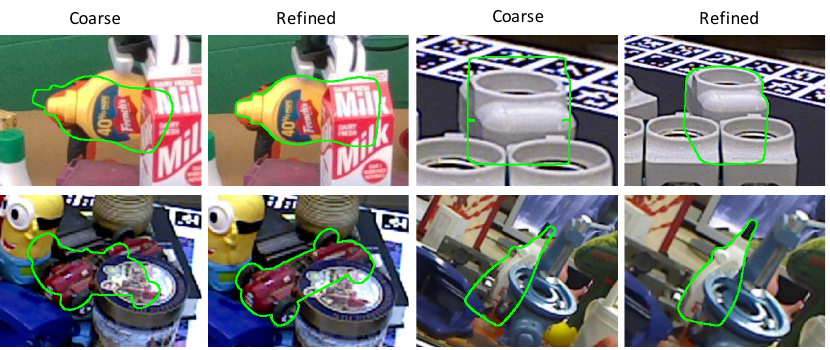
Original Figure 3: training-unseen objects from YCB-V, LM-O, HB, and T-LESS. Each pair shows coarse on the left and 5-step refinement on the right, tightening silhouettes under occlusion and weak texture. Source: arXiv PDF. Image copyright belongs to the paper's authors and publisher; reproduced here for academic analysis.
10. Architecture and Data-Scale Ablations
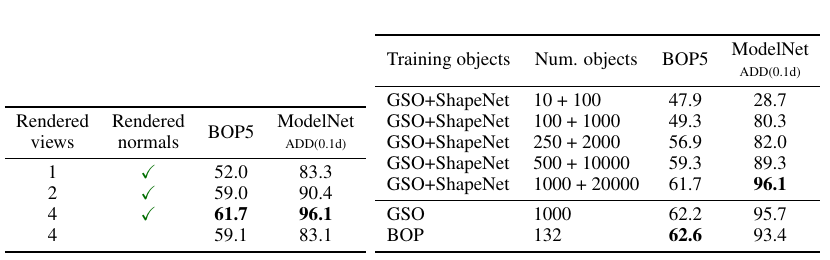
Original Table 3: left, rendered-view and normal-map ablations; right, increasing GSO / ShapeNet object counts and comparison with GSO-only / BOP-only objects. BOP5 averages LM-O, T-LESS, TUD-L, IC-BIN, and YCB-V AR. Source: arXiv PDF. Image copyright belongs to the paper's authors and publisher; reproduced here for academic analysis.
10.1 Multiple Views and Normals
Rendered views
Normals
BOP5
ModelNet ADD-0.1d
1
Yes
52.0
83.3
2
Yes
59.0
90.4
4
Yes
61.7
96.1
4
No
59.1
83.1
Four views reveal both anchors and more shape. Normals particularly help ModelNet, providing geometric orientation when materials are unreliable.
Only 1000 high-quality GSO objects already yield BOP5 62.2 / ModelNet 95.7; only 132 BOP targets yield 62.6 / 93.4. More precisely:
Object count matters, especially for cross-category coverage;
Scanned textures and model quality matter too: 1000 GSO objects approach the 20K+ combination;
Seeing BOP objects offers no larger advantage than high-quality multi-object pretraining here, but this is a refiner ablation, not detector evaluation.
11. Speed and Engineering Complexity
Coarse: main text reports about 2.5 s / object for rendering and scoring 520 hypotheses; appendix code optimization reaches about 1.6 s.
Refiner: about 50 ms / iteration on RTX 2080.
Full single frames commonly use 5 iterations, about 250 ms refinement, excluding detection / rendering scheduling overhead.
Tracking: detection + coarse + multiple refinements on the first frame; later frames warm-start from prior poses and use one refinement, about 20 Hz.
Memory / throughput: hypothesis and object counts directly affect rendering and batch memory.
This suits costly initialization with fast local tracking, not repeated 520-hypothesis global search per object per frame.
12. Failure Modes and Evidence Boundaries
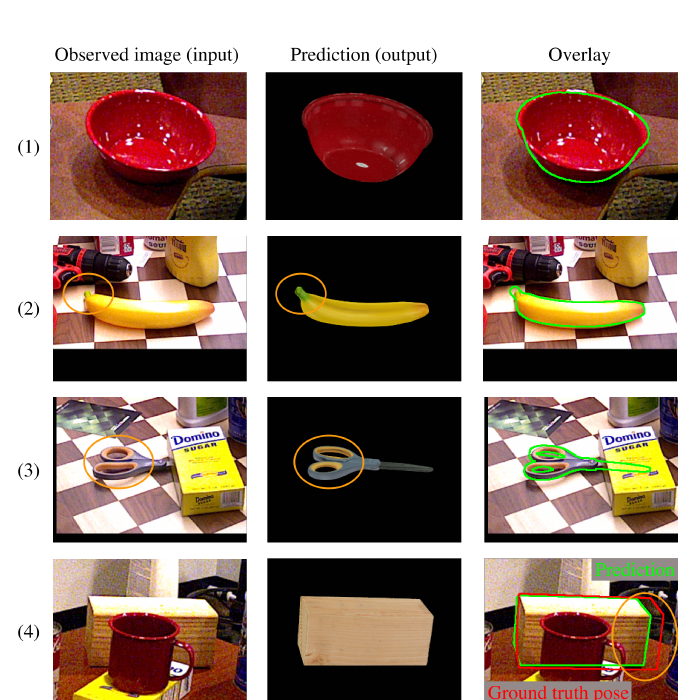
Original Figure 7: red bowls and bananas look similar across orientations; scissors require subtle handle differences; incorrect wood-block CAD scale yields plausible silhouettes but poses inconsistent with GT. Source: arXiv PDF. Image copyright belongs to the paper's authors and publisher; reproduced here for academic analysis.
12.1 Similar Appearance, Different Poses
Flipped red bowls and some banana views look alike. Visible evidence limits render-and-compare; a wrong coarse mode can trap refinement in the wrong basin.
12.2 Detail Resolution
Scissors can align globally while small left / right handle differences determine orientation. Crop resolution, occlusion, and synthetic-to-real texture mismatch weaken this evidence.
12.3 CAD metric scale
Monocular scale and depth are coupled. Wrong CAD size can be compensated by wrong depth while preserving silhouettes, so precise overlays do not guarantee correct translation or GT agreement.
12.4 Insufficiently Covered Properties
Transparency / strong reflections;
Large nonrigid or articulated changes;
Scale drift in rough reconstructed meshes;
Bad boxes or incorrect identities;
Association among identical-looking instances;
Tracking recovery after long occlusion.
Some low-quality CAD successes are shown, without separate quantitative curves for mesh quality, texture quality, and scale error.
Competitive RGB: novel-object generalization does not depend entirely on depth / ICP.
Broad subsequent use: FoundationPose, SAM-6D, HRDexDB annotation, and many novel-object pipelines reuse or compare MegaPose-style refinement.
Weaknesses
Slow global initialization; 520-candidate cost scales linearly with object count.
Detector and pose-backend novelty differ, easily obscured by broad claims.
Refinement’s local basin depends on training perturbations; missed coarse modes are hard to recover.
No explicit symmetry annotations in refiner loss; visual and evaluation equivalence differ.
RGB translation is highly scale-sensitive; real asset management is a bottleneck.
Qualitative robot demos do not establish reliable end-to-end manipulation.
15. Reproduction and Use
Check mesh units, origin, orientation, normals, textures, and watertightness.
Report detector recall, bbox IoU, and conditional pose AR separately.
Retain several coarse hypotheses at initialization rather than top-1 alone; defer decisions for ambiguous objects.
Reproduce RGB-D depth normalization and simulate real missing data / noise.
Trigger reinitialization during tracking; one refinement step cannot handle large jumps after long occlusion.
Use BOP symmetry-aware metrics and retain equivalent hypotheses when appropriate.
Separate detector, rendering, coarse scoring, per-step refinement, and multi-object batching times.
16. Research Directions
Retrieval / foundation coarse features: improve ranking with DINOv2 / foundation matching and reduce 520 hypotheses.
Wider-basin refinement: multi-scale features, uncertainty, diffusion, or flow matching for multimodal updates.
CAD-quality awareness: jointly estimate scale correction, geometry mismatch, and pose.
Open-vocabulary frontend: use CAD / renders directly for detection and segmentation.
Joint multi-object inference: scene constraints, collisions, and relative positions reduce single-ROI ambiguity.
Cross-frame hypothesis distributions: propagate multimodal symmetry / occlusion posteriors rather than one pose.
17. Summary
MegaPose systematically externalizes object-specific knowledge as test-time renders:
Coarse classifies whether candidates fall in the refiner’s correction basin;
Four views sharing an anchor reveal geometry and coordinates;
Large-scale synthetic training enables cross-instance comparison.
It demonstrates a shift from per-object training to a shared pose engine with new CAD prompts. Metric CAD, intrinsics, and ROI remain required; initialization is costly, refinement local, and the detection chain not zero-shot. These conditions define a useful system baseline rather than unconditional open-world pose.