Improving 6D Object Pose Estimation of Metallic Household and Industry Objects
The paper releases IGD, a BOP-compatible synthetic dataset of 60 metal cans, household objects, and industrial parts. One GDRNPP extension predicts curvature-keypoint heatmaps and fuses them with BAM; another learns difference maps that suppress metallic / specular effects before a second GeoHead pass. Both separately improve synthetic-test AR, without joint training or real-image validation.
single RGB cropknown object CAD during synthetic trainingPBR keypoint and material-paired supervision
Requirements
known object identity and per-object trainingGDRNPP detector / GeoHead / Patch-PnPobject CAD with metric geometryBlenderProc PBR training dataBOP-format pose and symmetry annotations
Full paper metadataAuthors, affiliations, research area, datasets, metrics, method tags, and reading statusExpandCollapse
Authors
Thomas Pöllabauer, Michael Gasser, Tristan Wirth, Sarah Berkei, Volker Knauthe, Arjan Kuijper
Affiliations
Technical University Darmstadt / Fraunhofer IGD / Threedy GmbH
known object identity and per-object trainingGDRNPP detector / GeoHead / Patch-PnPobject CAD with metric geometryBlenderProc PBR training dataBOP-format pose and symmetry annotations
Reading Notes
Overview / Deep Dive
Available src/paper-notes/metallic-object-pose-iros2025/coarse.md
Paper overview notes
Quickly assess the paper's scope, problem setting, core method, experimental findings, and whether to read it in depth.
Paper Reading Notes (Coarse): Improving 6D Object Pose Estimation of Metallic Household and Industry Objects
1. Basic information
Title: Improving 6D Object Pose Estimation of Metallic Household and Industry Objects
Authors: Thomas Pöllabauer, Michael Gasser, Tristan Wirth, Sarah Berkei, Volker Knauthe, Arjan Kuijper
Affiliations: Technical University Darmstadt; Fraunhofer IGD; Threedy GmbH
The paper releases a BOP-compatible synthetic dataset of 60 metallic cans, household items, and industrial parts. Separate curvature-keypoint-heatmap and ideal-material-image auxiliary branches extend GDRNPP. Both improve AR on the same synthetic test set, without real-image validation or joint branch training.
3. Guide to figures and tables
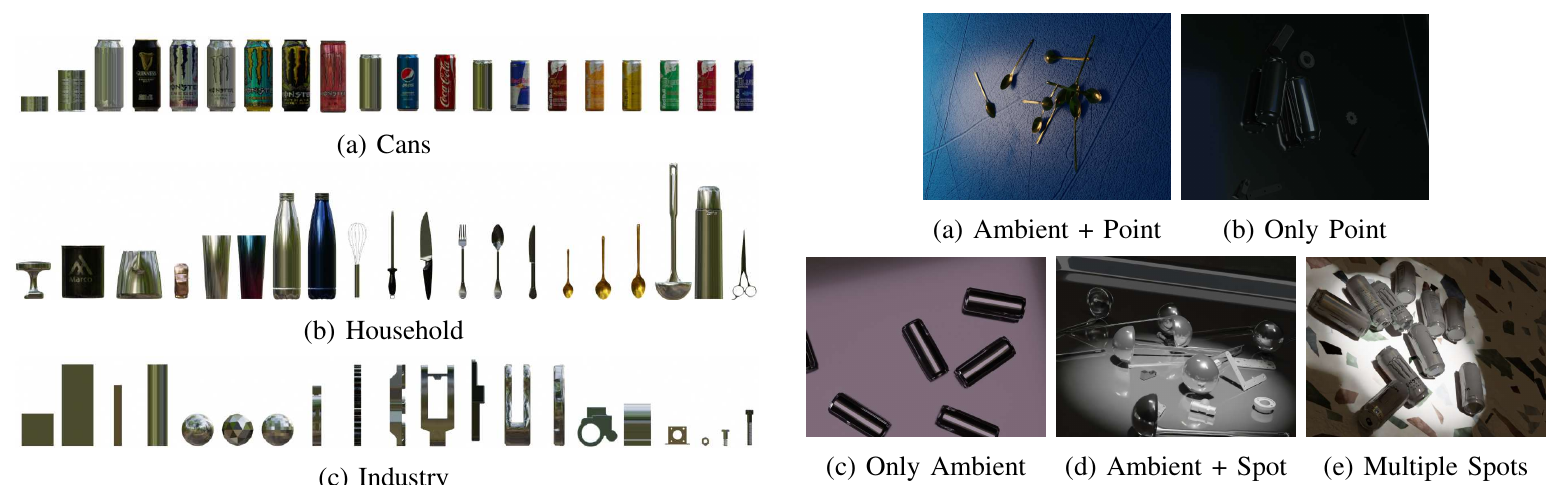
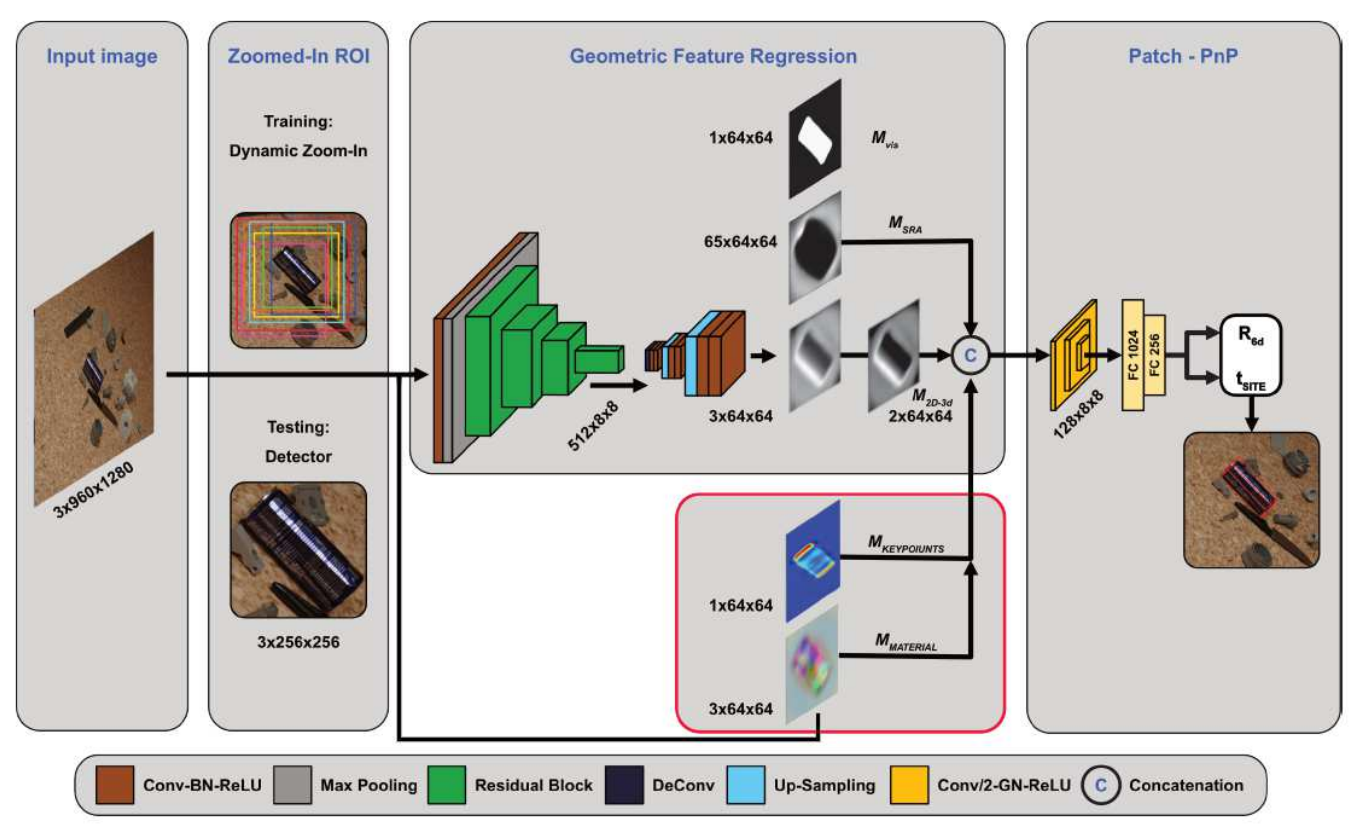
Original Figures 1 / 2: 60 objects in Can, Household, and Industry groups; ambient, point, and spot combinations vary reflections and highlights. Source: Author-provided paper. Image copyright belongs to the paper's authors and IEEE; reproduced here for academic analysis.Original Figure 4: GeoHead predicts a single-channel heatmap or three-channel material-normalized image / difference, combined with geometry for Patch-PnP. The two extensions are evaluated separately, not as one final model. Source: Author-provided paper. Image copyright belongs to the paper's authors and IEEE; reproduced here for academic analysis.
4. Dataset
Objects: 60 Sketchfab models in Can, Household, and Industry groups.
Layout: MiSo places 1–10 instances of one object; SiMo places 1–10 different objects.
Materials: randomized Blender BSDF metallic, specular, roughness, and related parameters.
Lighting: five ambient / point / spot combinations.
Backgrounds: black, CC Textures floor, Poly Haven HDR environments.
Challenges: some scenes add ITODD distractors / occluders and reflective support surfaces.
Training: 45,000 MiSo + 45,000 SiMo images, totaling 90,000.
Test: 1,800 images with unseen textures / HDR backgrounds, but the same objects and synthetic pipeline.
5. Two Method Extensions
Geometric Keypoint Heatmaps
Uniformly sample CAD surface points and remove self-occluded / externally occluded points for the current view.
Compute saliency from 3D Harris curvature and local point density.
Project salient points and form continuous heatmaps using saliency weights and Gaussian kernels.
Predict heatmaps with an extra GeoHead branch; compare addition (ADD), concatenation (CON), and Bottleneck Attention Module (BAM) fusion.
Material-Normalized Images
Render paired favorable-material targets with high roughness and low metallic / specular parameters. GeoHead variants:
Directly auto-encode target images;
Predict input-to-target pixelwise differences;
Add differences back to inputs and run GeoHead again (Reconstructed).
This learns pose-friendly appearance, not physical material parameters.
6. Experiments at a glance
Keypoint-branch AR:
Can: GDRNPP 30.66 → BAM 33.20;
Household: 17.59 → 23.20;
Industry: 6.97 → 14.24.
Material-reconstruction AR:
Can: GDRNPP 31.78 → Reconstructed 40.81;
Household: 20.56 → 25.31;
Industry: 16.63 → 20.92.
Auto-Encoder and Difference usually trail baseline: an auxiliary task alone does not guarantee gains. The effective variant reuses corrected images in GeoHead. GDRNPP baselines differ between tables, so compare within each table.
7. Quick assessment
Strength: decomposes metallic appearance into materials, lighting, environmental reflections, and geometry, with public BOP-format data.
Method evidence: BAM heatmaps and Reconstructed material views improve AR / MSPD / MSSD, especially Industry AR.
Caution: all images are BlenderProc synthetic; HDR real-world environments provide lighting backgrounds, not real camera data.
Metric conflict: symmetry-aware surface / projection recall improves while reS and teS often worsen. Better surface alignment need not mean more accurate absolute rotation / translation.
Main limits: no real-metal tests, other-method comparisons, joint-branch experiments, speed, or training-cost reports.
Availability: IGD is public on Hugging Face; no official extension-training code was found at this site’s ingestion time.
Available src/paper-notes/metallic-object-pose-iros2025/deep.md
In-depth paper notes
Support reproduction, comparison, related-work writing, and identifying opportunities for further research.
Paper Reading Notes (Deep): Improving 6D Object Pose Estimation of Metallic Household and Industry Objects
1. Key assessment
Metallic appearance violates fixed-albedo assumptions: highlights move with lighting and viewpoint, and surfaces reflect environments, creating nonrigid-looking RGB changes on one rigid CAD instance. Two complementary cues motivate the work:
Appearance can be normalized: paired renders with the same scene / pose but different BSDFs supervise rougher, less metallic / specular images for pose reestimation.
Both extend GDRNPP GeoHead + Patch-PnP. Figure 4 draws both heads together, but the conclusion leaves combination to future work. Tables I / II describe independent experiments, not one joint model.
2. What IGD Contains
Original Figures 1 / 2. Objects include symmetric cans, household utensils, and industrial parts of varying detail. Lighting combinations vary highlight position, count, and strength. Source: Author-provided paper. Image copyright belongs to the paper's authors and IEEE; reproduced here for academic analysis.
2.1 Objects and Scenes
The 60 Sketchfab models comprise:
Can: many axial-symmetric beer / energy-drink cans;
Household: bottles, cups, cutlery, scissors, and similar items;
Industry: nuts, brackets, connectors, gears, and low- / high-detail parts.
Two scene compositions:
Multiple Instances of the Same Object (MiSo): 1–10 identical instances;
Single Instance, Multiple Object (SiMo): 1–10 objects without repeating an instance.
Some scenes add ITODD occluders / distractors and reflective supports, introducing environmental reflections into object appearance.
2.2 Materials, Lighting, and Backgrounds
BlenderProc + Blender BSDF randomize metallic, specular, and roughness per object. Five lighting scenarios are:
ambient + point;
point only;
ambient only;
ambient + spot;
multiple spots.
Backgrounds are black, CC Textures floors, or Poly Haven HDR. Testing changes textures / HDR and balances lighting, but retains the same 60 instances: seen-object instance-level pose.
2.3 Size and Public Resources
For each object / lighting / background combination:
Generate 10 MiSo scenes with 5 camera angles each;
Generate 120 SiMo scenes with 25 camera angles each;
Aggregate 45,000 MiSo + 45,000 SiMo training images;
Test on 300 images per background / composition, totaling 1,800.
The public IGD dataset page provides BOP data, PLY models, and Blender scenes, listing about 56.3 GB, an MIT license, and individual Sketchfab credits. Check original asset terms for intended use; the aggregate license is not a complete redistribution statement for every model.
Both training and testing are synthetic. HDR backgrounds are not real camera captures; there is no real-metal pose GT or sim-to-real evaluation.
3. GDRNPP Baseline
GDRNPP starts from detected object RoIs:
ConvNeXt encodes RGB crops;
Multi-head GeoHead predicts visible masks, surface-region attention, 2D–3D correspondences, and related maps;
Patch-PnP directly regresses R6d and SITE translation;
Optional depth refinement exists, but inputs / main experiments here use RGB.
The authors choose a strong BOP model with extensible architecture. Only GDRNPP and its extensions are compared on IGD, so overall state-of-the-art status is not established.
4. Geometric Keypoint Head
Original Figure 4. Red-box single-channel \(M_{\text{keypoints}}\) or three-channel \(M_{\text{material}}\) joins original feature maps. Keypoints ultimately use BAM; materials use reconstructed images for a second GeoHead pass. Source: Author-provided paper. Image copyright belongs to the paper's authors and IEEE; reproduced here for academic analysis.
4.1 CAD-Derived Supervision
Uniformly interpolate surface points, then remove occlusion according to view and scene geometry. For visible point p with neighborhood N(p), compute covariance:
Cp=∣N(p)∣1xi∈N(p)∑(xi−p)(xi−p)T.
For eigenvalues λ1≥λ2≥λ3 and local candidate density ρ, saliency is
S(p)=ρλ1+λ2+λ3λ1.
Points exceeding τ become keypoints. Compared with Harris 3D response alone, ρ favors high-curvature regions with dense candidates.
4.2 Why Heatmaps?
Outputs are 64×64 features, where discrete projected keypoints are sensitive to scaling / pixel offsets. Normalized saliency and Gaussian kernels form continuous heatmaps. These do not independently solve pose through 2D keypoints + PnP; Patch-PnP combines them with other dense maps.
4.3 Three Fusion Methods
ADD: add to original feature maps;
CON: channel concatenation;
BAM: jointly model spatial / channel relevance with a Bottleneck Attention Module.
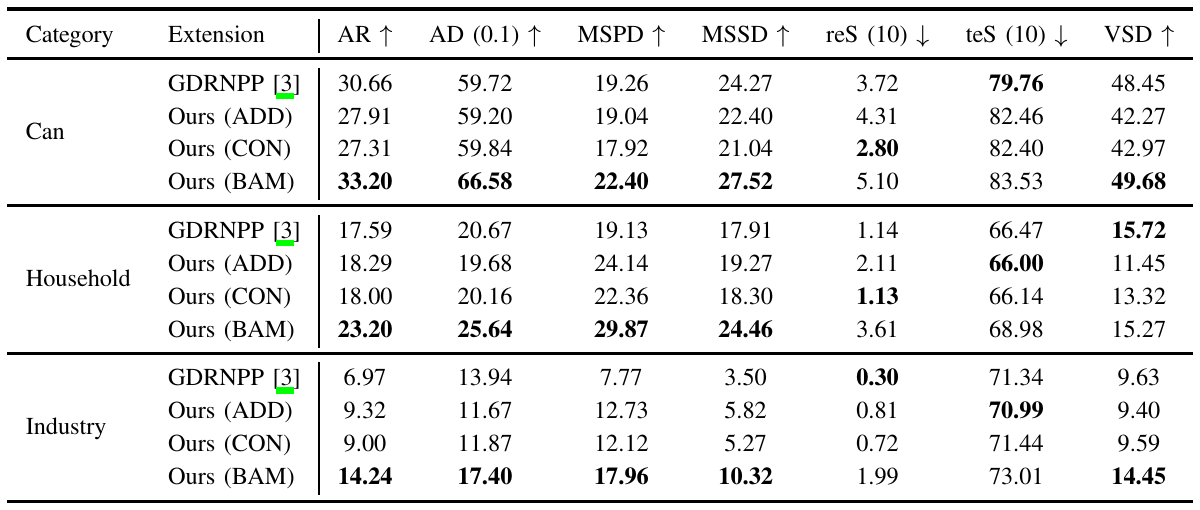
Original Table I. BAM generally leads AR, AD, MSPD, and MSSD across groups, but reS / teS do not improve with AR. Source: Author-provided paper. Table copyright belongs to the paper's authors and IEEE; reproduced here for academic analysis.
Absolute AR changes:
Group
GDRNPP
ADD
CON
BAM
Can
30.66
27.91
27.31
33.20
Household
17.59
18.29
18.00
23.20
Industry
6.97
9.32
9.00
14.24
Industry has the largest BAM gain, +7.27 AR and over double relatively. Detailed contours / geometry benefit more than smooth cans. ADD / CON reduce Can AR, highlighting feature selection and fusion rather than extra features alone.
5. Material-Normalization Branch
For every metallic render, paired targets share camera, pose, lighting, and background, changing only object BSDF:
high roughness;
low / no metallic;
low / no specular;
Or combine all three.
The target is pose-friendly appearance with weaker highlights and stable texture, not the true physical material parameters.
Reconstructed: add the difference to the original crop and run GeoHead again.
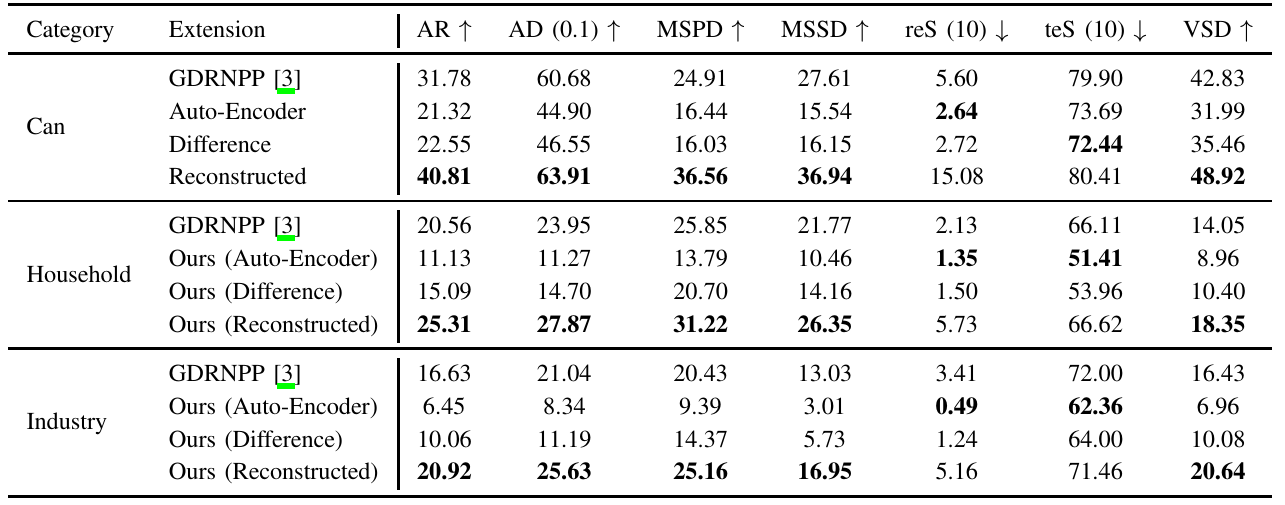
Original Table II. Only Reconstructed consistently improves AR by adding differences back and rerunning GeoHead. Auto-Encoder / Difference mostly trail baseline. Source: Author-provided paper. Table copyright belongs to the paper's authors and IEEE; reproduced here for academic analysis.
Group
GDRNPP AR
Auto-Encoder
Difference
Reconstructed
Can
31.78
21.32
22.55
40.81
Household
20.56
11.13
15.09
25.31
Industry
16.63
6.45
10.06
20.92
Reconstructed gains +9.03 / +4.75 / +4.29 AR. Target-image learning alone can harm pose, perhaps through competing losses or residual structural errors. A second pass lets normalized pixels produce pose-useful backbone / GeoHead features.
No corrected-image fidelity metric or real-metal visualization is reported. Paired synthetic supervision helps same-distribution synthetic tests, not proven real-world intrinsic material removal.
6. Why Metrics Conflict
Reported metrics:
VSD: visible-surface discrepancy;
MSSD: maximum symmetry-aware surface distance;
MSPD: maximum symmetry-aware projection distance;
AR: average of the three multi-threshold recalls above;
AD(0.1);
reS: rotation symmetry error;
teS: translation symmetry error.
For Can, BAM changes AR 30.66→33.20 but reS 3.72→5.10 and teS 79.76→83.53 worsen according to table arrows. Material Reconstructed changes Can AR 31.78→40.81, while reS 5.60→15.08 and teS 79.90→80.41 also conflict.
Symmetry-aware surface / projection metrics can accept equivalent poses and emphasize aligned geometry; reS / teS more directly constrain absolute parameters. The authors cite depth ambiguity, symmetry, or alignment-biased learning. Robot tasks needing a specific canonical rotation require more than AR.
7. Do Not Combine Results across Tables
Table I GDRNPP AR is 30.66 / 17.59 / 6.97; Table II is 31.78 / 20.56 / 16.63. Seeds, configurations, or data versions are not identified as the cause, and no error bars are provided.
Therefore:
Compare keypoint BAM only with Table I baseline;
Compare material Reconstructed only with Table II baseline;
Do not claim cumulative gains from both;
Without joint ablations, complementarity versus redundant synthetic cues remains unknown.
8. Reproduction and Availability
IGD releases scenes, models, custom data, material variants, and tests in BOP-compatible structure for pose, detection, and segmentation. The card lists about 56.3 GB.
No official extension code was found at ingestion time. The paper also omits:
optimizer, learning rate, batch size, epochs;
GDRNPP checkpoints and detector configurations;
BSDF sampling ranges;
Harris neighborhoods, τ, Gaussian sigma;
Exact BAM insertion tensors / loss weights;
Material-reconstruction loss and weights;
training hardware, runtime, parameter / FLOP overhead;
Multi-seed means and standard deviations.
Downloadable data alone does not make the method directly reproducible, especially paired material rendering and second-pass GeoHead training.
9. Limitations
Synthetic training and testing, without real-metal evaluation;
The same 60 objects in both splits, not unseen-object generalization;
No speed, training cost, memory, or second-pass latency;
Material prediction supervises normalized images, not interpretable BSDF estimation.
10. Overall assessment
The work operationalizes metallic appearance through controlled object groups, BSDFs, five lighting types, three backgrounds, occluders, and reflective surfaces, releasing BOP data. BAM and reconstruction show how PBR supplies paired geometry / appearance supervision difficult to capture in real data.
This is a synthetic benchmark and feasibility study rather than a validated real deployment. Key next tests are real-metal sim-to-real, joint branches, and whether AR gains persist in canonical rotation / translation and robot success.