Reading Notes
Overview / Deep Dive
Available src/paper-notes/mixri-iccv2025/coarse.md
Paper overview notes
Quickly assess the paper's scope, problem setting, core method, experimental findings, and whether to read it in depth.
Paper Reading Notes (Coarse): MixRI: Mixing Features of Reference Images for Novel Object Pose Estimation
1. Basic information
- Year / venue: 2025 / ICCV; reading mode: coarse.
- Task: CAD-based novel-object 6D pose from RGB and multiple rendered references.
- Paper: ICCV Open Access; project: MixRI.
2. Positioning in one sentence
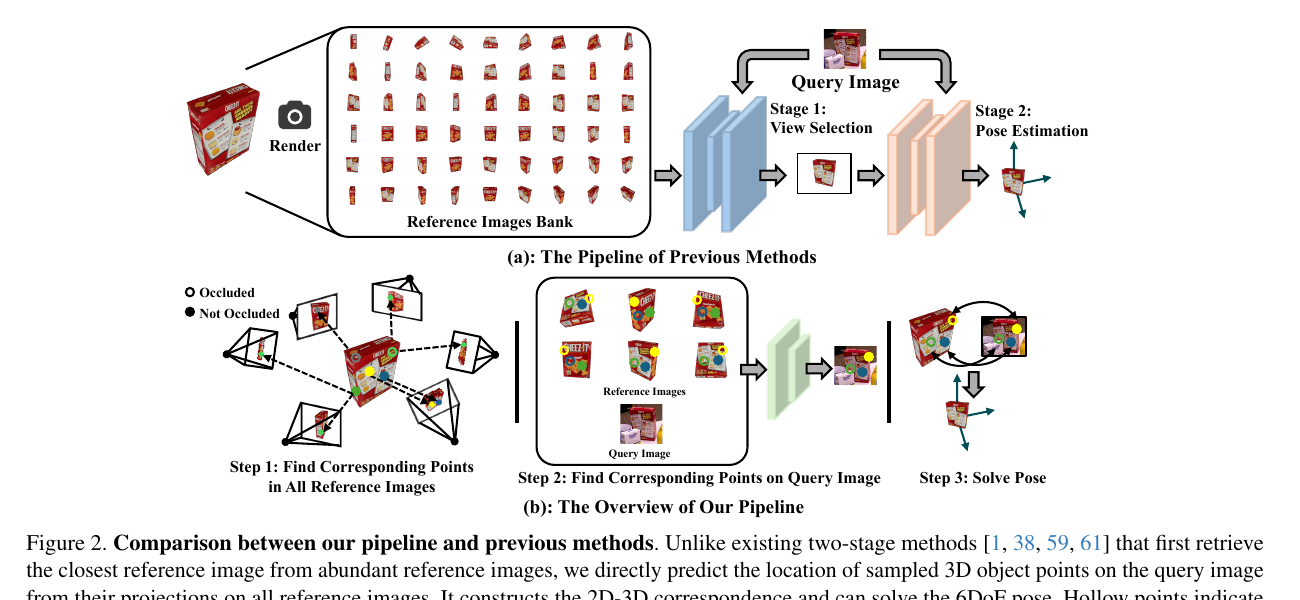
Instead of retrieving one nearest template, MixRI aggregates each 3D point’s evidence across reference views and directly localizes it in the query. RANSAC-PnP then solves novel-object pose with fewer references and lower caching costs.
2.1 Guide to the paper’s figures and tables
| Figure / table | Focus |
|---|---|
| Figure 2 | Top: retrieval-then-pose baseline; bottom: all-reference point matching. |
3. Method overview
- Sample known 3D points across reference views, aggregate per-point multi-view features, and explicitly predict query occlusion.
- View-Aggregated Point Matching predicts query 2D points; 2D–3D correspondences and RANSAC-PnP recover pose.
- Train on synthetic GSO; new objects need rendered CAD references, without object-specific fine-tuning.
4. Experimental overview
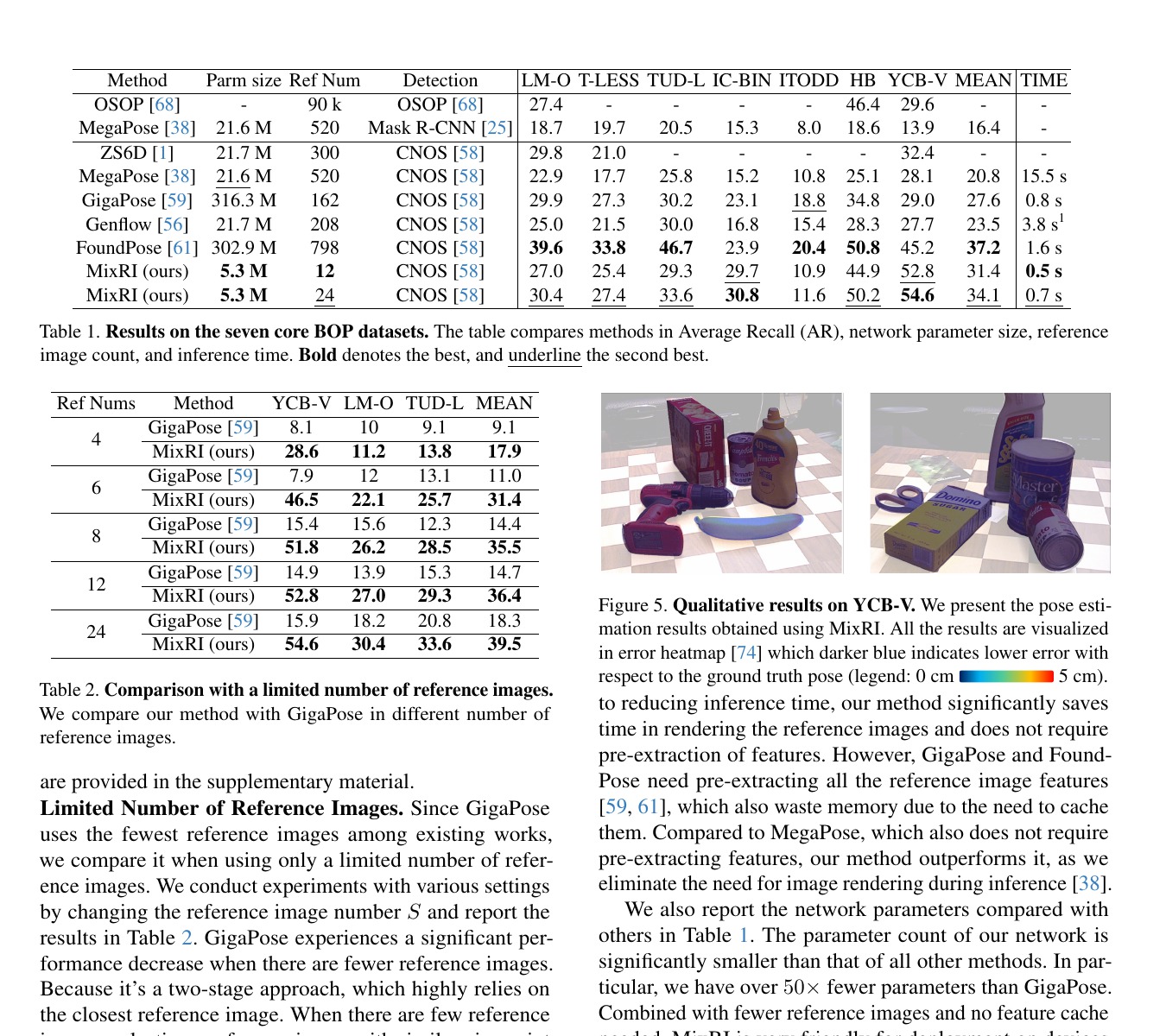
- Report AR, network size, reference count, and speed over seven BOP core datasets.
- Author claim: 12 or 24 references retain competitive AR against large-template methods while reducing memory and inference time.
- My analysis: explicitly optimizing reference count suits edge budgets, though CAD, detection, and rendering costs remain.
5. Strengths, Risks, and Ideas
- Strengths: avoids single-template retrieval failures, retains interpretable PnP, and uses multi-view evidence.
- Risks: CAD, intrinsics, and crops remain required; occlusion-label / simulation quality affects matching.
- Idea: use a 3D point’s visibility set as the matching unit instead of retrieving a reference view first.