MK-Pose: Category-Level Object Pose Estimation via Multimodal-Based Keypoint Learning
MK-Pose fuses frozen DINOv2 RGB features, PointNet++ point cloud features, and CLIP text features from GPT-4o shape descriptions. Soft heatmaps and a GAT discover 96 3D keypoints without manually specified keypoint coordinates. KNN local geometry and global context are aggregated, and NOCS, reconstruction, and finite / continuous-symmetry losses jointly supervise category-level pose and size.
known or supplied object categorydepth and camera intrinsicsMask R-CNN instance maskGPT-4o-generated category descriptionsfinite / infinite symmetry definitionspose, size and NOCS supervision
Full paper metadataAuthors, affiliations, research area, datasets, metrics, method tags, and reading statusExpandCollapse
Authors
Yifan Yang, Peili Song, Enfan Lan, Dong Liu, Jingtai Liu
known or supplied object categorydepth and camera intrinsicsMask R-CNN instance maskGPT-4o-generated category descriptionsfinite / infinite symmetry definitionspose, size and NOCS supervision
Reading Notes
Overview / Deep Dive
Available src/paper-notes/mk-pose-iros2025/coarse.md
Paper overview notes
Quickly assess the paper's scope, problem setting, core method, experimental findings, and whether to read it in depth.
Paper Reading Notes (Coarse): MK-Pose
1. Basic information
Title: MK-Pose: Category-Level Object Pose Estimation via Multimodal-Based Keypoint Learning
MK-Pose fuses DINOv2 RGB features, PointNet++ depth-cloud features, and CLIP text features from category names plus GPT-4o shape descriptions. Soft heatmaps and a GAT learn 96 3D keypoints without keypoint annotations. Local KNN geometry and global context are fused, and NOCS, reconstruction, and finite / infinite symmetry losses jointly supervise category-level pose and size regression.
3. Guide to figures and tables
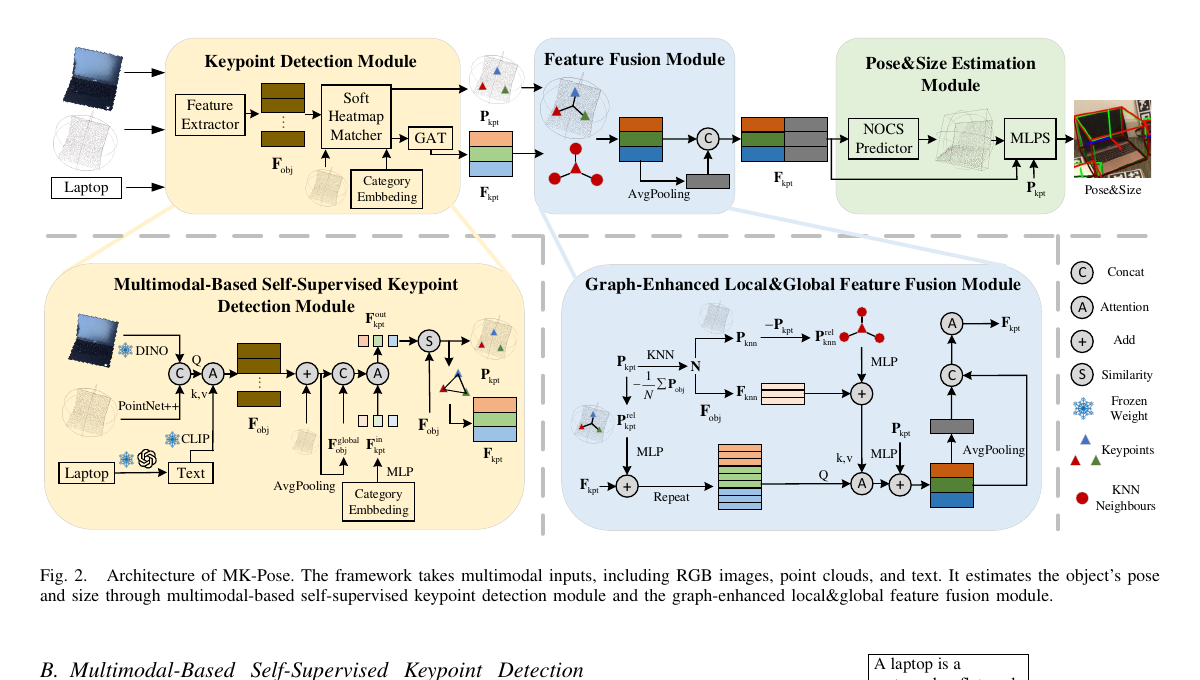
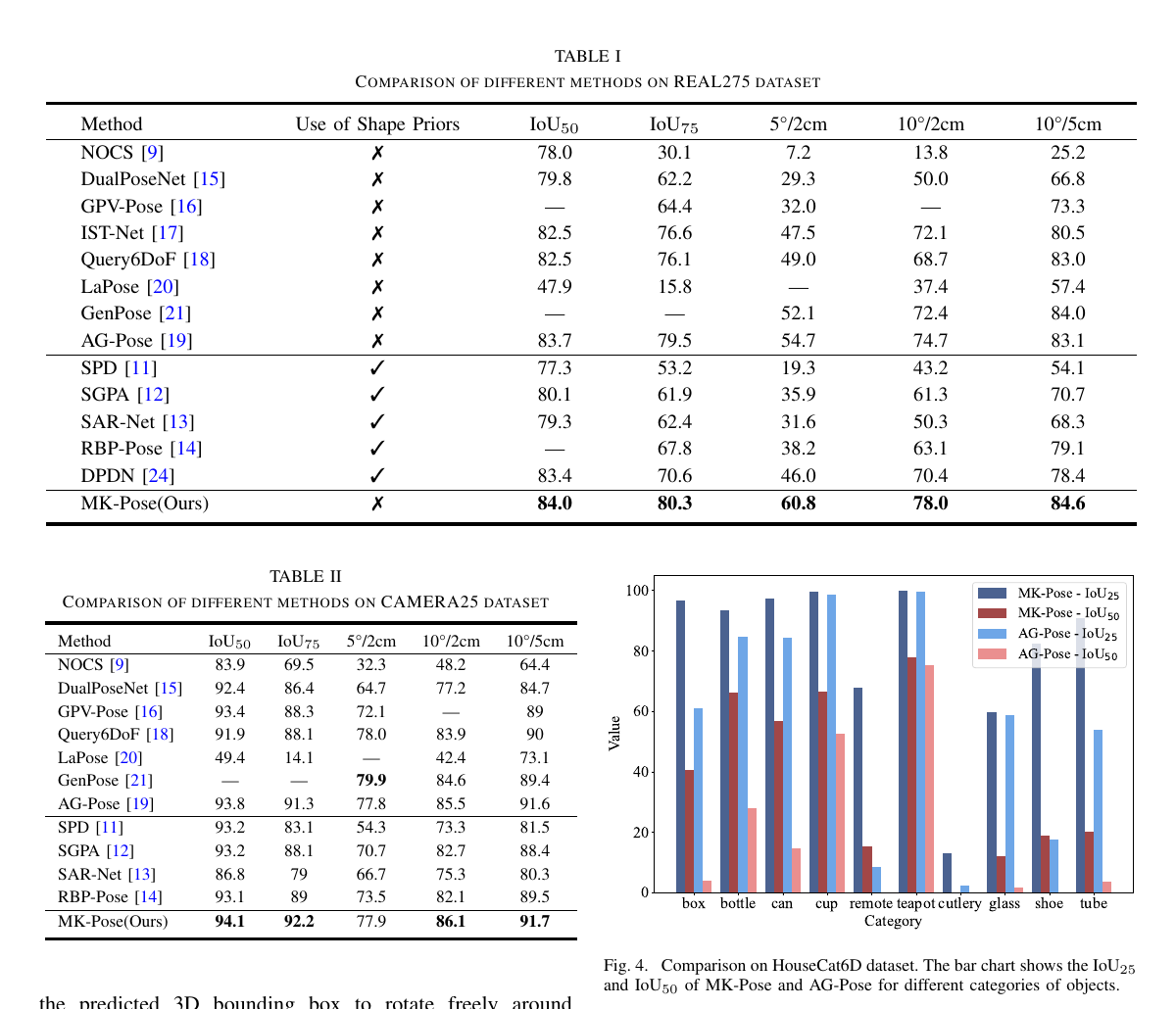
Original Figure 2: RGB, point clouds, and category text enter a self-supervised keypoint module. Local KNN and global pooled features further update keypoint representations for NOCS, pose, and size prediction. Source: authors' public manuscript. Image copyright belongs to the authors and IEEE; reproduced here for academic analysis.Original Tables I–II and Figure 4: REAL275 5°/2cm is 60.8 and CAMERA25 IoU75 is 92.2. HouseCat6D cross-dataset experiments report only IoU25 / IoU50, which do not establish rotation or translation error. Source: authors' public manuscript. Figure / table copyright belongs to the authors and IEEE; reproduced here for academic analysis.
4. Problem setting
Task: 6D pose + 3D size of unseen instances within known categories.
Query inputs: RGB crop, 1,024 points back-projected from depth and intrinsics, category name, and offline category-shape description.
Outputs: rotation R, translation t, and size s.
External front end: Mask R-CNN first supplies instance masks at test time.
Prior boundary: no instance CAD / deformable shape prior, but depth geometry, category labels, GPT-4o text, and finite / infinite symmetry definitions are used.
Cross-attention uses RGB-D features as queries and text as keys / values to form unified object representations.
Category-conditioned learnable queries match object-point features; soft heatmaps weight coordinates to produce 96 keypoints without manual keypoint coordinates.
A GAT models keypoint relations, while KNN aggregates relative geometry from 16 neighboring points per keypoint.
Absolute keypoint positions and global average features combine local shape with whole-object context.
Predict keypoint NOCS and regress pose / size; Chamfer, keypoint dispersion, local reconstruction, and offset losses geometrically constrain keypoints.
Enumerate equivalent rotations for finite symmetry and use a vector to mask unobservable rotation components for infinite axial symmetry.
Versus AG-Pose on REAL275: 5°/2cm 54.7→60.8, +6.1; IoU75 79.5→80.3, +0.8.
HouseCat6D: the authors emphasize unseen box / shoe / tube categories. Aggregate example scores are IoU25 80.1 and IoU50 37.5 versus AG-Pose’s 63.6 / 19.7, without pose AP.
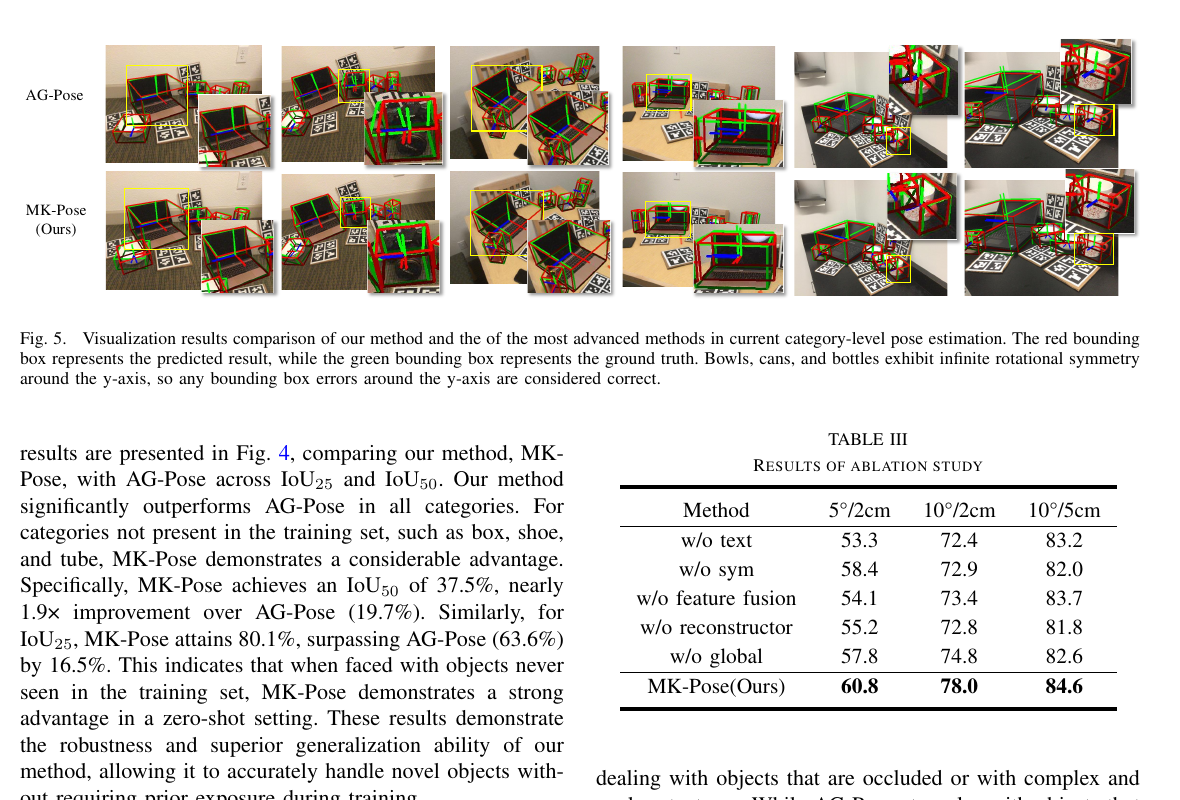
Ablations: removing text / feature fusion / reconstruction gives 5°/2cm 53.3 / 54.1 / 55.2 versus the full model’s 60.8.
7. Quick assessment
Strengths: no manual keypoints or instance shape priors; finite and infinite symmetry unified in training losses; key modules ablated.
Interpret carefully: “shape-prior-free” still requires RGB-D clouds; “self-supervised keypoints” means unlabeled keypoint locations, while pose, size, NOCS, and other supervision train the full network.
Main risks: no speed / parameter count; insufficient text-prompt and unseen-category HouseCat6D query details; cross-dataset comparisons only use IoU.
Available src/paper-notes/mk-pose-iros2025/deep.md
In-depth paper notes
Support reproduction, comparison, related-work writing, and identifying opportunities for further research.
Paper Reading Notes (Deep): MK-Pose
1. Key assessment
MK-Pose addresses three weaknesses in category-level pose:
Occlusion makes local RGB-D observations incomplete.
Manual keypoints cannot cover novel instances within a category.
Local neighborhoods alone or global pooling alone cannot capture both detail and whole-object shape.
Its answer combines stable category semantics, 3D keypoints without manual labels, and local / global graph fusion. Keypoint and fusion modules provide the main measurable contributions: REAL275 full-model 5°/2cm is 60.8, falling to 53.3, 54.1, and 55.2 without text, feature fusion, and reconstruction, respectively.
The paper’s terminology needs qualification:
Shape-prior-free: no instance CAD or deformable category shape prior; geometry is still present, with depth clouds explicitly supplied at inference.
Self-supervised keypoints: the 96 keypoints lack manual coordinate labels, but pose, size, NOCS, and reconstruction objectives supervise the overall network.
Zero-shot: HouseCat6D tests cross-dataset / partly unseen-category transfer, reporting only 3D box IoU rather than complete pose thresholds.
2. Inputs, outputs, and front-end dependencies
Original Figure 2. The top shows the full data flow; the bottom details multimodal keypoint detection and graph-enhanced local / global fusion. Source: authors' public manuscript. Image copyright belongs to the authors and IEEE; reproduced here for academic analysis.
Inputs:
A 224×224 object RGB crop.
N=1024 points sampled from depth back-projected with intrinsics.
Object category name.
A category-shape description generated offline by GPT-4o.
Outputs are rotation matrix R, translation t, and 3D size s. Mask R-CNN supplies instance masks at test time, so pose scores reflect external segmentation quality; GT-mask and predicted-mask results are not reported separately.
This is category-level, seen-category / unseen-instance pose. HouseCat6D adds cross-dataset and partly unseen-category tests, but category names remain required for training and inference.
3. How the three modalities are fused
3.1 RGB and point clouds
Frozen DINOv2-ViT-S/14 produces FRGB∈RN×128.
PointNet++ produces FPC∈RN×128.
Their concatenation serves as the cross-attention query.
Depth clouds and RGB crops are already aligned by camera geometry. The paper calls them multimodal, but provides no RGB-only or depth-only ablations to separate visual-backbone and cloud-geometry contributions.
3.2 Category text is not online vision-language reasoning
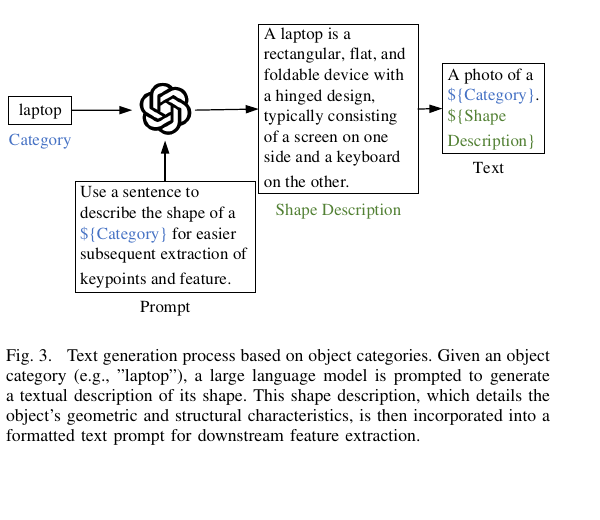
Original Figure 3: GPT-4o generates a category-shape description once, combined as “A photo of a [Category]. [Shape Description]” for CLIP encoding. This is an offline category prior, not per-image vision-language reasoning. Source: authors' public manuscript. Image copyright belongs to the authors and IEEE; reproduced here for academic analysis.
The paper prompts GPT-4o to describe a category’s shape for subsequent keypoint and feature extraction. For laptops, the description includes rectangular, flat, foldable, and hinged structure; a template plus description is encoded by frozen CLIP text to obtain Ftext.
RGB + clouds supply queries, while text supplies keys / values:
Fobj=softmax(dQK⊤)V.
Text is fixed across all instances of a category. It supplies category semantics but cannot recover the actual shape of an occluded instance. The paper’s claim about recovering occluded objects is more precisely interpreted as stable category conditioning for features, rather than generation of unseen geometry.
4. Keypoints without manual annotations
Object-point features first receive coordinate positional encoding and global average features. Nkpt=96 category-conditioned learnable queries attend to these points, producing keypoint queries.
Cosine similarity between keypoint queries and each object point passes through softmax with temperature τ=0.1 to yield heatmap H:
Pkpt=HP,Fkpt=HFobj.
Keypoints are thus soft weighted combinations of input coordinates and need not coincide with sampled surface points. A fully connected GAT then updates relationships among keypoints.
Without GT keypoint positions, supervision comes from:
Lcd: place each keypoint near at least one observed point.
Ldiv: penalize keypoint distances below T=0.01 to prevent collapse.
Lrec: predict local offsets at each keypoint, form a dense point set, and apply bidirectional nearest-neighbor distances against the observed cloud.
LΔ: limit excessive reconstruction offsets.
Lnocs: use DPDN-style NOCS supervision.
Lps: pose / size and symmetry-aware error.
This is task-supervised keypoint discovery: no manual keypoints, but not learning from unlabeled data alone.
5. Local and global fusion
Find k=16 nearest input-cloud neighbors for each keypoint:
Add positional encoding relative to the object center to each keypoint.
Add positional encoding relative to that keypoint to neighboring points.
Cross-attention uses keypoint features as queries and neighbor features as keys / values to aggregate local geometry.
Add absolute-coordinate encoding for keypoints.
Average all keypoints into a global keypoint feature and broadcast it back to each point.
An MLP + self-attention produce the final Fkpt.
This combines neighborhood surfaces and whole-object context, but KNN uses observed clouds, whose neighborhoods may be incomplete under heavy occlusion. Text and global features provide statistical priors, without guaranteeing the true rear shape of a novel instance.
6. Symmetry and pose / size losses
After predicting keypoint NOCS, MK-Pose follows DPDN’s MLP to estimate R,t,s. Its symmetry loss handles:
No symmetry: the equivalent-rotation set contains only the identity.
Finite symmetry: choose the minimum-error member of a predefined RS set.
Infinite axial symmetry: use v∈{0,1}3 to mask unobservable rotation components around the symmetry axis.
Weights are 0.3, 2, 10, 15, 1, and 2 in order. Symmetry information is a manually defined category / object prior. It resolves supervision conflicts among equivalent poses; it does not mean the network discovers symmetry groups from images.
REAL275: 13 instances, 7,000 real images, 2,750 validation images; 3 unseen test instances per category.
HouseCat6D: 5 test scenes, about 3K frames, 10 household categories, used for cross-dataset testing.
Training mixes CAMERA synthetic and REAL data, with batch 32 on one RTX 3090 Ti. Epochs / total steps, convergence time, inference speed, parameter count, and GPU memory are not reported.
Metrics:
IoU25 / IoU50 / IoU75: intersection-over-union between predicted and GT 3D boxes.
n∘/mcm: instance AP with rotation error below n∘ and translation error below m cm.
Bottle / bowl / can boxes may rotate freely around the vertical axis; mugs are treated as symmetric when handles are invisible.
8. Main REAL275 and CAMERA25 results
Original Tables I–II and Figure 4. Main tables include shape-prior-free and shape-prior-based methods; the HouseCat6D bars show only IoU. Source: authors' public manuscript. Figure / table copyright belongs to the authors and IEEE; reproduced here for academic analysis.
REAL275
Method
IoU50
IoU75
5°/2cm
10°/2cm
10°/5cm
GenPose
—
—
52.1
72.4
84.0
AG-Pose
83.7
79.5
54.7
74.7
83.1
DPDN (shape prior)
83.4
70.6
46.0
70.4
78.4
MK-Pose
84.0
80.3
60.8
78.0
84.6
Against the closest AG-Pose baseline, strict pose AP improves by 6.1 while IoU75 rises only 0.8, placing the main advantage in pose accuracy rather than box overlap.
CAMERA25
MK-Pose reports 94.1 / 92.2 / 77.9 / 86.1 / 91.7. Its 5°/2cm does not exceed GenPose’s 79.9 and exceeds AG-Pose’s 77.8 by only 0.1; advantages mainly concern IoU and looser 10° thresholds. Broad superiority claims must be read column by column.
9. HouseCat6D cross-dataset experiments
Train on CAMERA25 + REAL275, then test directly on HouseCat6D. The authors highlight box, shoe, and tube, absent from training categories, and report:
MK-Pose: IoU25 80.1, IoU50 37.5;
AG-Pose: IoU25 63.6, IoU50 19.7.
This is positive evidence for cross-dataset 3D-box generalization, with four gaps:
No pose metrics such as 5°/2cm.
Only bar charts, without numerical tables for all categories.
The method uses learnable category embeddings / category-conditioned queries but insufficiently explains initialization for unseen categories.
Whether the HouseCat6D detector / masks also receive no adaptation is unspecified.
A safer conclusion is improved cross-dataset IoU generalization, rather than validated zero-shot 6D pose.
10. Ablations and qualitative results
Original Figure 5 and Table III. Red boxes are predictions and green boxes are GT; REAL275 ablations remove text, symmetry loss, local / global fusion, reconstruction, and global features individually. Source: authors' public manuscript. Image / table copyright belongs to the authors and IEEE; reproduced here for academic analysis.
Configuration
5°/2cm
10°/2cm
10°/5cm
w/o text
53.3
72.4
83.2
w/o symmetry loss
58.4
72.9
82.0
w/o feature fusion
54.1
73.4
83.7
w/o reconstructor
55.2
72.8
81.8
w/o global
57.8
74.8
82.6
full
60.8
78.0
84.6
Text adds +7.5 at the strict threshold, a large individual gap. Without alternative descriptions, random descriptions, or category-name-only controls, however, gains cannot be attributed specifically to natural-language shape semantics rather than CLIP category embeddings or added parameters / conditioning.
Qualitative examples include occluded and cluttered scenes, with several MK-Pose boxes closer to GT. Failures and breakdowns by visibility, transparency, or missing depth are absent.
11. Open source and reproduction risks
At this site’s review time, the authors’ repository contained train.py, test.py, models, REAL configurations, and checkpoint / log links, rather than merely an empty “code coming soon” link.
Reproduction should check:
Exact GPT-4o version, system prompt, temperature, and final text for each category.
Whether DINOv2 / CLIP are fully frozen and PointNet++ starts from scratch.
RGB-feature correspondence to 1,024 points and intrinsics corrections after crop / resize.
Generation of the 96 category queries for unseen HouseCat6D categories.
Coordinate-normalization scale for T=0.01.
Sources of finite-symmetry matrices and infinite-axis vectors.
Separation of predicted Mask R-CNN masks and GT masks.
The paper’s validation / test terminology and official NOCS splits.
Training duration, separate network / detector latency, and GPU memory.
12. Overall assessment
MK-Pose’s strength is a complete RGB-D category-level pose pipeline combining category text, keypoints without manual labels, local geometry, and global context, with clear REAL275 gains at strict 5°/2cm. Its supervision design and symmetry loss are more reusable than broad claims of language recovering occlusion. For open-world value, remember that HouseCat6D tests only IoU and that unseen-category queries and detector reproduction remain insufficiently specified.