MonoDiff9D: Monocular Category-Level 9D Object Pose Estimation via Diffusion Model
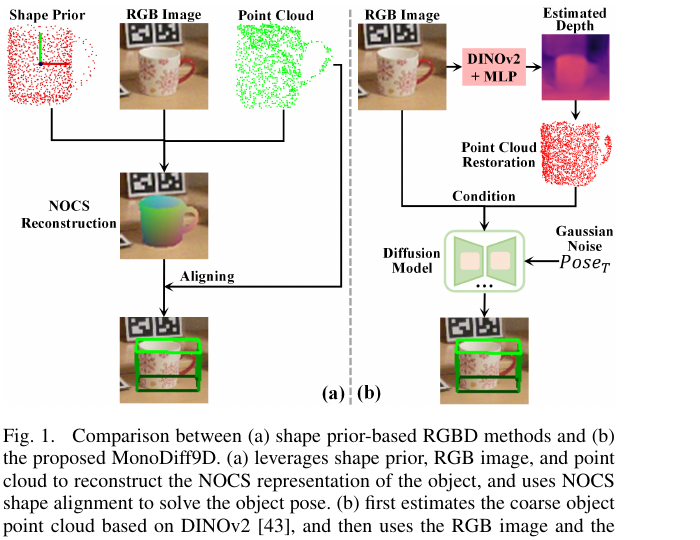
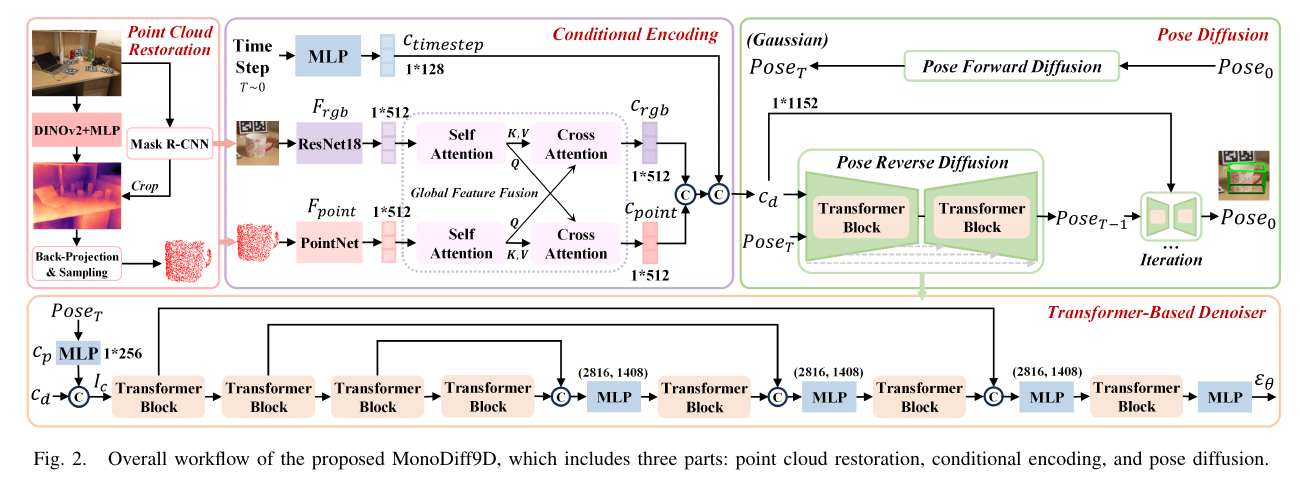
MonoDiff9D reconstructs a coarse point cloud from one RGB image using DINOv2. Conditioned on global image / point cloud features and timestep encodings, a Transformer denoiser generates rotation, translation, and scale from Gaussian noise.
MonoDiff9D estimates coarse depth from one RGB image and back-projects a point cloud. Conditioned on global image / cloud features, a diffusion Transformer gradually generates category-level rotation, translation, and metric size from noise.
2.1 Guide to the paper’s figures and tables
Original Figure 1: unlike methods requiring measured depth, MonoDiff9D uses only RGB and derives geometric conditioning from monocular depth. Source: authors' public PDF. Image copyright belongs to the paper's authors and publisher; reproduced here for academic analysis.
3. Inputs and outputs
Inputs: one RGB image, 2D mask / ROI, and camera intrinsics.
Intermediate outputs: DINOv2-estimated coarse depth and a back-projected cloud.
Outputs: 3D rotation, 3D translation, and 3D metric size, totaling 9D.
Task: category-level; test instances may be unseen, but categories belong to training.
4. Method pipeline
Mask R-CNN extracts object crops / masks.
A DINOv2 depth head predicts monocular depth.
Camera intrinsics back-project an object-local cloud.
ResNet-18 and PointNet extract RGB / cloud global features, respectively.
Self / cross-attention fuse both features and the diffusion timestep.
DDPM training and DDIM inference denoise Gaussian noise into 9D pose.
5. Results at a glance
Dataset
3D IoU50
3D IoU75
10 cm
10°
10° 10 cm
CAMERA25
35.2
6.7
33.6
80.1
28.2
REAL275
31.5
6.3
41.0
56.3
25.7
The authors report about 26.3 FPS on one RTX 3090. Strict 3D IoU75 and joint 10° 10 cm scores remain low, leaving RGB-only metric pose far from solved.
6. Coarse-reading conclusion
MonoDiff9D models multimodal pose distributions with diffusion and supplements RGB geometry with estimated depth. Monocular input still depends on geometric priors: intrinsics, masks, the depth model, and category training data all matter. Coarse-depth scale and boundary quality are also the central bottleneck.
Available src/paper-notes/monodiff9d-icra2025/deep.md
In-depth paper notes
Support reproduction, comparison, related-work writing, and identifying opportunities for further research.
Paper Reading Notes (Deep): MonoDiff9D: Monocular Category-Level 9D Object Pose Estimation via Diffusion Model
1. Task definition
Given one RGB image, camera intrinsics K, and an object mask, predict:
y=(R,t,s),
Here R∈SO(3), t∈R3, and s∈R3 is metric size. Category-level means an unseen target instance belongs to a training category. Beyond 6D pose alone, 9D additionally predicts size along three axes.
Original Figure 2: RGB crops and estimated-depth clouds are encoded separately, fused by attention, and used to condition a Transformer denoiser that iteratively denoises random poses. Source: authors' public PDF. Image copyright belongs to the paper's authors and publisher; reproduced here for academic analysis.
2. Constructing geometric conditions from RGB
For a masked pixel (u,v) and estimated depth d(u,v):
X=d(u,v)K−1[u,v,1]⊤.
This converts monocular depth to a cloud for PointNet to encode 3D structure. With relative-scale depth alone, translation and object size drift together, making metric training supervision and the depth model’s scale generalization crucial.
The RGB branch uses ResNet-18 for texture / contours, while the global point branch encodes estimated geometry. Cross-attention does not recover true depth: it learns pose-denoising conditions from the available noisy geometry.
3. Diffusion pose generation
The forward process gradually adds noise to the ground-truth pose vector:
q(yt∣y0)=N(αˉty0,(1−αˉt)I).
The Transformer denoiser receives yt, a timestep embedding, and visual conditions to predict noise or clean pose. Inference begins at yT∼N(0,I) and uses DDIM to progressively obtain y^0.
Potential diffusion benefits:
Represent multiple modes caused by symmetry / occlusion.
Iterative denoising may correct coupling among components more easily than single-pass regression.
Sample and rank multiple candidates.
If the final output is only one sample without reliable ranking, however, the system-level benefit of multimodal modeling still needs experimental validation.
4. Coupling rotation, translation, and size
The 9D components have substantially different numerical ranges. An effective denoiser must handle:
Valid rotation representations.
Scale coupling between translation depth and size.
Different canonical coordinates across categories.
Multiple symmetry-equivalent rotations.
Diffusion in Euclidean vectors does not automatically keep every step on SO(3); valid rotation representation or decoding is needed. Reading and reproduction should inspect normalization, rotation projection, and symmetry-aware losses in code, beyond the fact that diffusion is used.
5. Experimental results
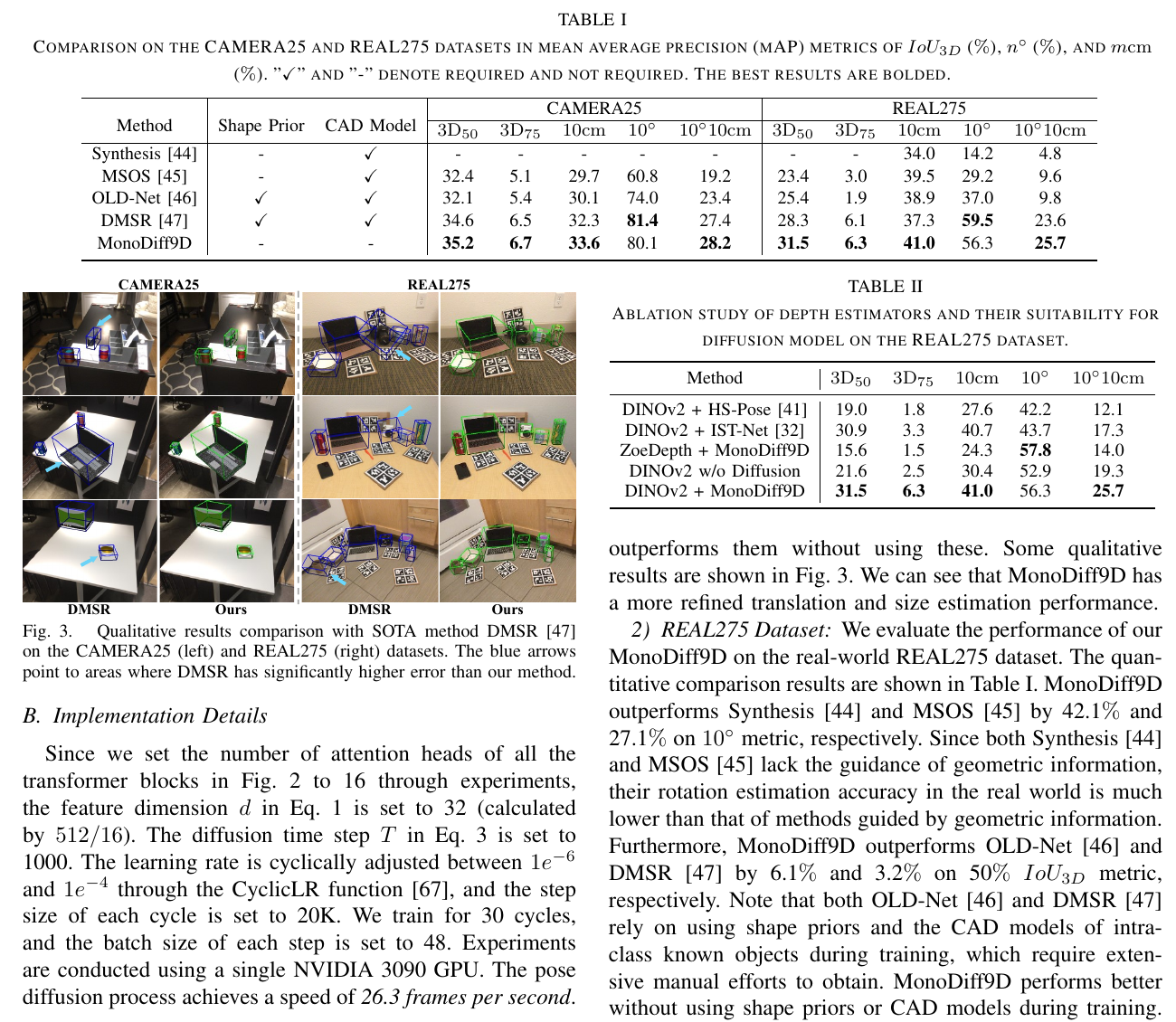
Original Tables I-II and qualitative examples: category-level 9D pose metrics on CAMERA25 and REAL275, plus predicted boxes in complex real scenes. Source: authors' public PDF. Image copyright belongs to the paper's authors and publisher; reproduced here for academic analysis.
Dataset
IoU50
IoU75
10 cm
10°
10° 10 cm
CAMERA25
35.2
6.7
33.6
80.1
28.2
REAL275
31.5
6.3
41.0
56.3
25.7
Three observations:
Rotation-only 10° is much higher than joint 10° 10 cm, identifying translation as a major bottleneck.
IoU75 is only around 6–7, leaving strict scale / position alignment difficult.
Wild6D tests cross-domain generalization without training on that dataset. This supports some cross-dataset transfer, rather than transfer to arbitrary novel categories.
6. Speed and deployment
The paper reports about 26.3 FPS on an RTX 3090. Interpret this alongside:
Whether instance masks are included.
Whether DINOv2 depth estimation is included.
DDIM step count.
Objects per image.
Whether multiple hypotheses are sampled.
Reducing diffusion steps improves speed but may sacrifice denoising quality, making this the most direct engineering adjustment.
7. Limitations and improvements
Depth quality is an explicit bottleneck; object boundaries, transparent surfaces, and reflections produce erroneous clouds.
Masks and intrinsics remain required; this is not an end-to-end open-scene system.
Category canonical frames still need definition, with complex cross-category symmetry rules.
Monocular metric scale cannot be recovered reliably from arbitrary images without data priors.
Extensions include multi-hypothesis ranking, uncertainty calibration, and test-time geometric consistency.
8. Deep-reading conclusion
MonoDiff9D goes beyond replacing a regression head with diffusion: it first converts RGB into noisy 3D conditions, then learns a conditional distribution over 9D pose. Competitive rotation but low strict IoU and joint translation scores point to monocular metric geometry as the system’s limiting factor.