MRC-Net: 6-DoF Pose Estimation with MultiScale Residual Correlation
MRC-Net quantizes rotations into 4,608 prototypes for coarse pose prediction, then renders CAD and regresses residuals from three-scale real–render correlations. Symmetry-aware soft labels handle multiple solutions. PBR-only training yields mean AR 63.3 on four BOP datasets. The T-LESS ablation improves from parallel MultiTask's 64.9 to 77.1, with around 61 ms per object.
single RGB object cropbinary bounding-box mapon-the-fly CAD rendering
Requirements
known metric CAD model and renderercamera intrinsicsobject detection / cropper-dataset trainingfour-way test-time rotation augmentation in the reported protocol
Full paper metadataAuthors, affiliations, research area, datasets, metrics, method tags, and reading statusExpandCollapse
known metric CAD model and renderercamera intrinsicsobject detection / cropper-dataset trainingfour-way test-time rotation augmentation in the reported protocol
Reading Notes
Overview / Deep Dive
Available src/paper-notes/mrc-net-cvpr2024/coarse.md
Paper overview notes
Quickly assess the paper's scope, problem setting, core method, experimental findings, and whether to read it in depth.
Paper Reading Notes (Coarse): MRC-Net
1. Basic information
Title: MRC-Net: 6-DoF Pose Estimation with MultiScale Residual Correlation
Authors: Yuelong Li, Yafei Mao, Raja Bala, Sunil Hadap
MRC-Net formulates known-CAD 6DoF pose from one RGB image as coarse classification → pose-conditioned rendering → multiscale real–render correlation → residual regression, in a single-shot pipeline. Symmetry-aware soft labels allow each sample to belong to several reasonable pose bins.
3. Guide to figures and tables
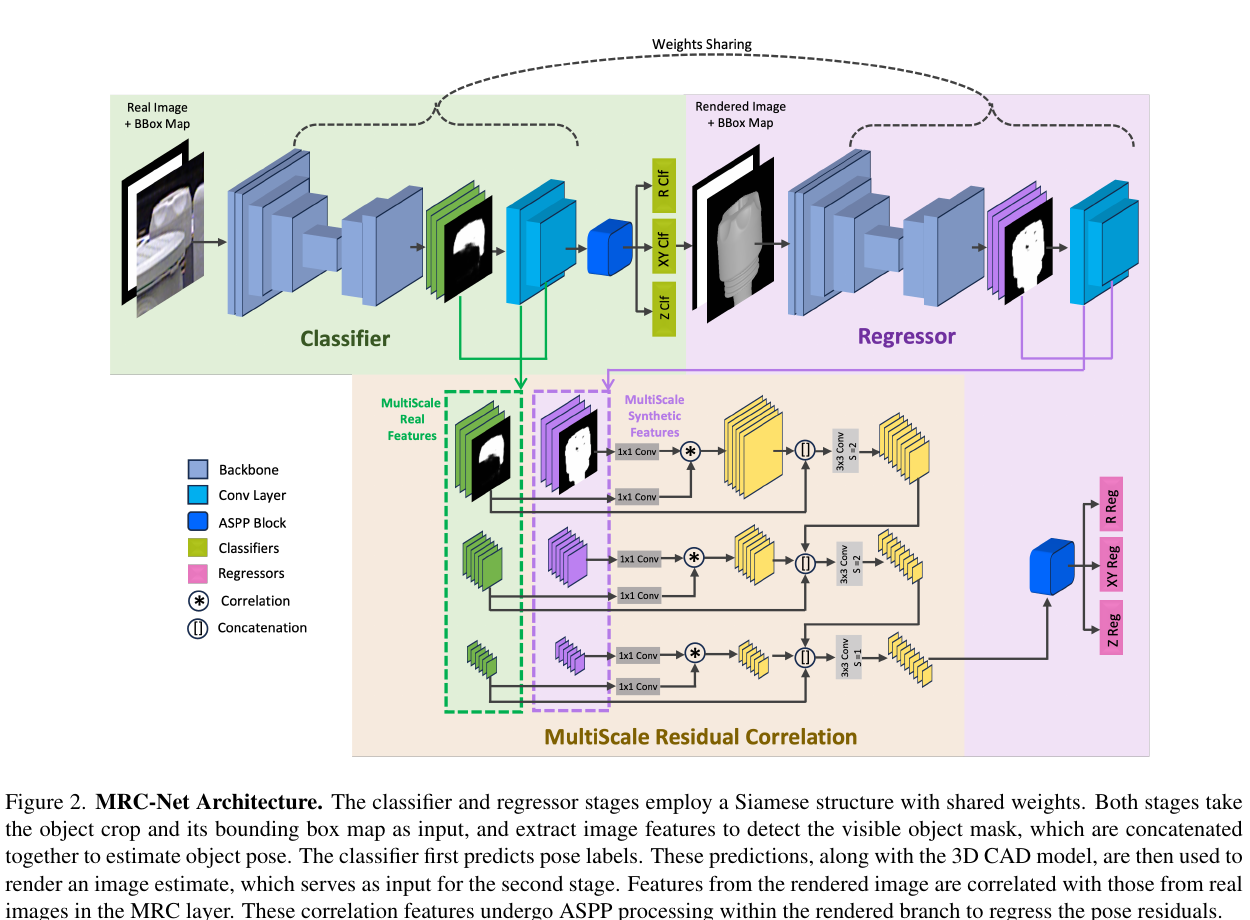
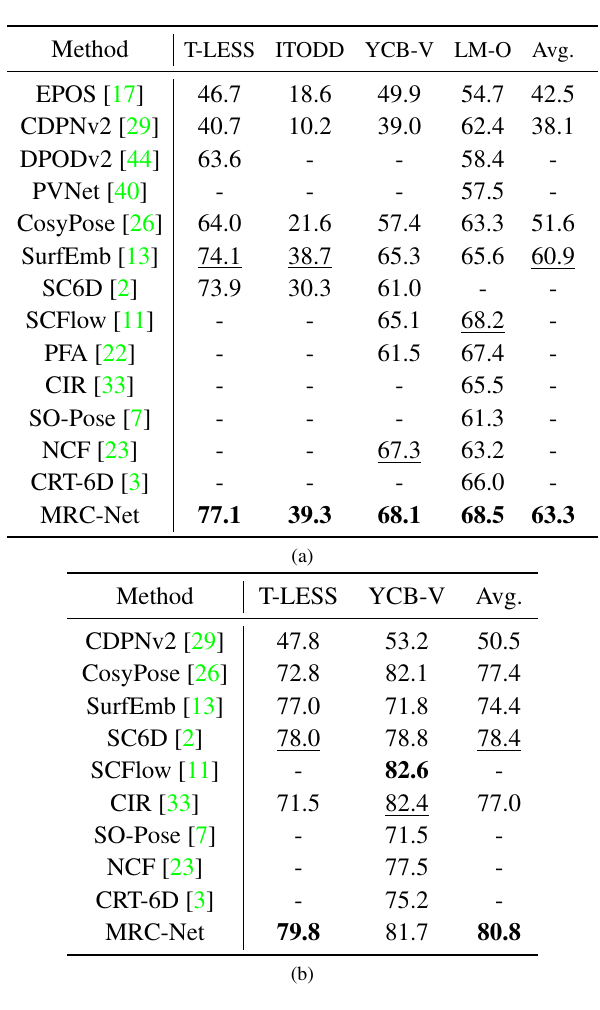
Original Figure 2: the first stage classifies coarse rotation and translation from a real crop, then renders CAD at that pose. The second correlates real and rendered features at three resolutions and regresses rotation / translation residuals. Source: published CVPR 2024 paper. Image copyright belongs to the authors and IEEE/CVF; reproduced here for academic analysis.Original Table 2: PBR-only MRC-Net AR is 77.1, 39.3, 68.1, and 68.5 on T-LESS, ITODD, YCB-V, and LM-O, averaging 63.3; real-image fine-tuning gives a T-LESS / YCB-V mean of 80.8. Source: published CVPR 2024 paper. Table copyright belongs to the authors and IEEE/CVF; reproduced here for academic analysis.
4. Problem setting
Input: RGB object crop, binary detection-box map, and camera intrinsics.
Known: metric CAD of the target instance, renderable at candidate poses.
Output: camera-frame rotation R and translation t.
Training: one model per BOP dataset; ITODD / LM-O use PBR only, while T-LESS / YCB-V additionally report real-image fine-tuning.
Evaluation: BOP VSD, MSSD, and MSPD Average Recall; additional ADD(-S) metrics on YCB-V.
5. Method overview
A ResNet34–UNet Siamese classifier uses 4,608 rotation prototypes and separately quantizes in-plane translation and depth.
Symmetry-aware pose distances produce continuous soft labels instead of one hard class per pose.
Render CAD at the highest-confidence coarse pose; shared encoders process real and rendered images.
MRC computes local correlation volumes at three scales and feeds residual correspondence evidence directly to regression.
Regress ΔR,Δτx,Δτy,Δτz and combine with coarse classifications for final pose, without PnP, RANSAC, or iterative refinement.
About 61 ms per 256×256 single-object crop, approximately 16 FPS, including on-demand rendering and both network stages.
7. Quick assessment
Strength: classification genuinely conditions regression, with MRC exposing render-and-compare correspondence evidence to the residual head.
Strongest evidence: parallel MultiTask 64.9 → sequential design 76.2 exceeds the 0.6 gain from single- to multiscale correlation; task organization is central.
Main costs: accurate CAD, detection crops, intrinsics, and per-dataset training; four-direction TTA also entails multiple crop passes.
Intended readers: RGB-only known-instance pose, render-and-compare, symmetry-aware labels, and direct 6DoF regression without PnP.
Available src/paper-notes/mrc-net-cvpr2024/deep.md
In-depth paper notes
Support reproduction, comparison, related-work writing, and identifying opportunities for further research.
Paper Reading Notes (Deep): MRC-Net
1. Key assessment
MRC-Net changes the causal relationship between classification and regression rather than merely placing both in one network. Coarse classification first produces a renderable pose, explicitly conditioning residual regression. Three-scale correlations turn differences between real images and coarse-pose renders into learnable residual evidence.
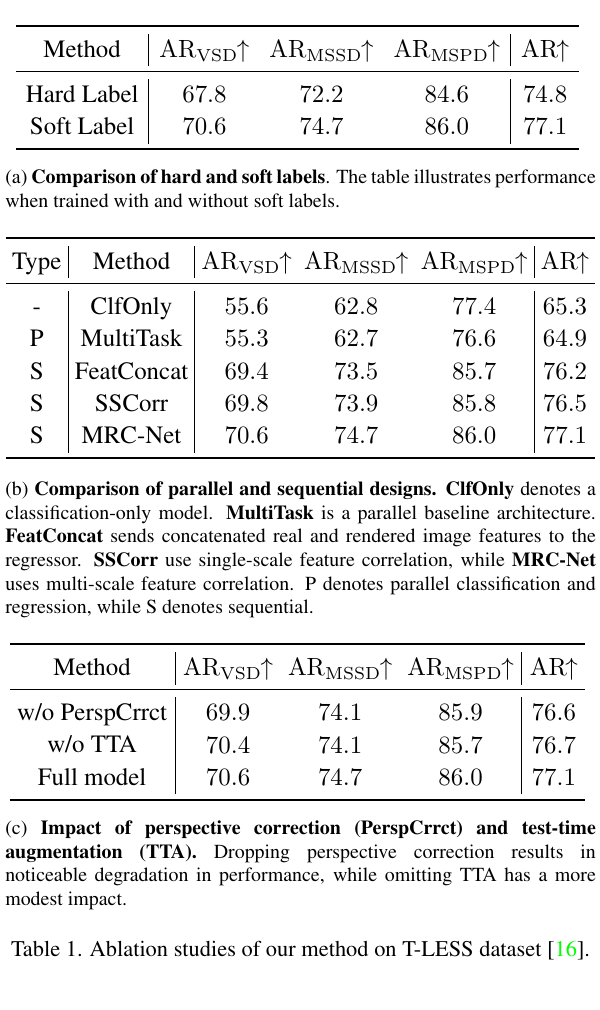
T-LESS ablations reveal the relative contributions:
Classification only: 65.3 AR.
Parallel classification + regression: 64.9, almost no benefit.
Sequential classification → regression with feature concatenation: 76.2.
Single-scale correlation: 76.5.
Multiscale correlation: 77.1.
The large gain comes from telling regression which pose classification selected; multiscale correlation adds 0.9 along this effective route. Attributing every gain to MRC obscures the most valuable design decision.
2. Task boundaries and inputs / outputs
Inputs:
A detected RGB object crop.
A binary detection-box map, dilated in training to simulate detection errors.
Camera intrinsics.
Target metric CAD and a renderer.
Output is a full instance-level pose:
R^=ΔRRc,τ^i=τic+Δτi,i∈{x,y,z}.
Here τ is the SITE scale-invariant translation parameter, decoded into metric translation using intrinsics and crop geometry. This is seen-object, CAD-based, RGB-only pose: training and test objects come from the same dataset, without evidence for novel-object generalization.
3. Why coarse classification is not the endpoint
Discretize SO(3) uniformly into K=4608 prototypes {Rk}. In-plane translation (τx,τy) uses a 64×64 grid; depth τz uses 1,000 bins. Classification offers global robustness but leaves quantization errors, while residual regression recovers continuous within-bin poses.
Conventional parallel multitask heads share a backbone, but regression does not know the selected bin and still faces the full pose space. MRC-Net first selects Rc,τc, renders CAD there, and asks its second stage how this render differs from the real image, localizing the residual task.
Original Figure 2. Classifier and regressor each have shared-weight real / render Siamese branches. MRC correlates three-scale real / synthetic features; ASPP precedes pose-residual regression. Source: published CVPR 2024 paper. Image copyright belongs to the authors and IEEE/CVF; reproduced here for academic analysis.
4. Symmetry-aware soft labels
Hard nearest-prototype labels have two problems:
GT near a Voronoi boundary has two almost equivalent prototypes but only one positive label.
Symmetric objects may have several physically or visually equivalent rotations.
The paper defines rotation label k from symmetry-aware pose distance:
Rather than a categorical distribution summing to one, this is pairwise binary membership: multiple prototypes may simultaneously have high probability. Focal loss with positive weight w+=100 addresses severe imbalance across 4,608 dimensions.
Translation soft labels are Gaussian weights centered on GT in quantized coordinates. Inference still selects the highest-confidence class for each component; multimodality shapes training representations and smooths decision boundaries rather than yielding a calibrated multi-hypothesis distribution.
Original Table 1: soft labels raise T-LESS AR from 74.8 to 77.1. Parallel MultiTask scores only 64.9, sequential concatenation 76.2, and single- / multiscale correlations 76.5 / 77.1. Source: published CVPR 2024 paper. Table copyright belongs to the authors and IEEE/CVF; reproduced here for academic analysis.
5. MultiScale Residual Correlation
At each scale, real features fr and rendered features fs pass through shared 1×1 projections. Correlation at local displacement v is:
c(v,x)=d1fs(x)⊤fr(x+v),∥v∥∞≤P.
The correlation volume has shape P2×H×W. Search is local because classification already places the render near the target, a computational benefit of class-conditioned residuals. Three scales provide:
High resolution: edges, silhouettes, and local occlusion.
Medium scale: part-level deviations.
Low resolution: overall orientation and global shape.
Unlike explicit optical-flow methods, MRC needs neither flow supervision followed by RANSAC / PnP nor recurrent pose updates. Correlation features directly enter regression for end-to-end training, at the cost of explicit correspondences that can be visualized and diagnosed.
6. Training and inference protocols
Backbone: ResNet34–UNet; classification and regression stages each use a shared-weight Siamese encoder.
T-LESS / YCB-V allow real-image fine-tuning; ITODD / LM-O use synthetic data only.
Inference TTA: rotate crops by 90°, 180°, 270°, and 360°, run four times, and choose the highest classification score.
Perspective correction: construct SITE targets from the actual projected object center rather than box center.
“Single-shot” denotes no pose-refinement loop, PnP, or postprocessing, rather than one network computation: the reported setting includes four-direction TTA and two stages of classification, on-demand rendering, and regression.
7. Main BOP results
Original Table 2. The upper table uses PBR-only synthetic training; the lower adds real training images on T-LESS / YCB-V. Source: published CVPR 2024 paper. Table copyright belongs to the authors and IEEE/CVF; reproduced here for academic analysis.
Training protocol
T-LESS
ITODD
YCB-V
LM-O
Mean
PBR only
77.1
39.3
68.1
68.5
63.3
Real-image fine-tuning where available
79.8
—
81.7
—
80.8
Under PBR-only training, SurfEmb averages 60.9 across four datasets versus MRC-Net’s 63.3, a 2.4-point gain. Strong T-LESS results support soft classification plus local residuals for textureless, symmetric objects. With real images, YCB-V reaches 81.7, below SCFlow’s 82.6 and CIR’s 82.4; explicit dense correspondence and iterative methods retain advantages with rich texture.
Non-BOP YCB-V metrics:
Configuration
ADD(-S)
AUC ADD-S
AUC ADD(-S)
MRC-Net
81.2
95.0
92.3
MRC-Net + FCOS detector
83.6
97.0
94.3
Papers use different front ends, often CosyPose or FCOS detections; these scores should not be directly mixed with methods evaluated only on GT crops.
8. Qualitative occlusion results and efficiency
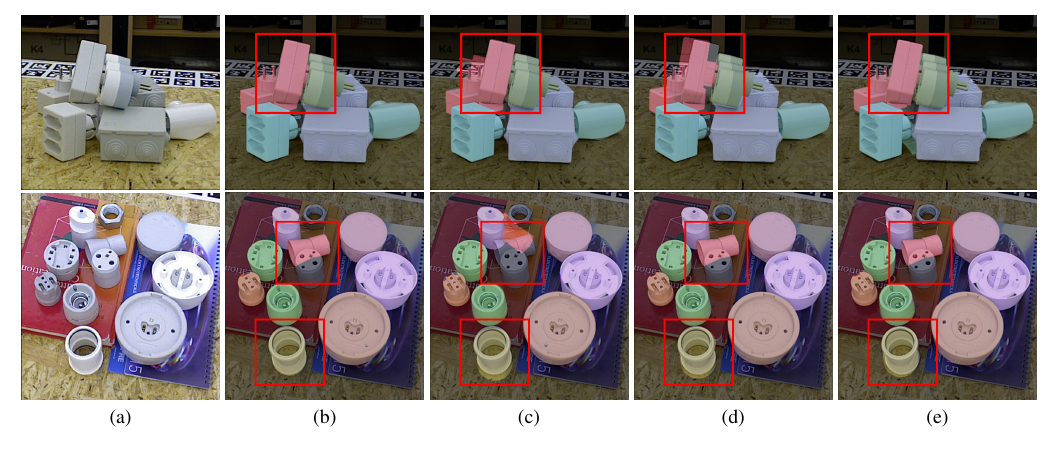
Main image area of original Figure 4: input, MRC-Net, PFA, SC6D, and ZebraPose from left to right. Red frames highlight differing pose projections under heavy occlusion or neighboring instances of the same object. Source: published CVPR 2024 paper. Image copyright belongs to the authors and IEEE/CVF; reproduced here for academic analysis.
On the same AWS EC2 P3.2xlarge, per 256×256 single-object crop:
CIR 2542 ms;
SurfEmb 1121 ms;
PFA: 88 ms, excluding initialization.
GDR-Net 26 ms;
SC6D 25 ms;
MRC-Net 61 ms.
MRC-Net is not fastest but is much faster than iterative render-and-compare; the paper reports about 16 FPS. This is per crop and excludes the detector; multi-object scene cost grows with detections.
9. Limitations and reproduction checks
Accurate metric CAD is required; the authors explicitly note that CAD errors undermine render-and-compare.
Per-dataset training lacks FoundationPose / MegaPose-style novel-object onboarding.
Four-direction TTA is part of main results; disabling it lowers AR from 77.1 to 76.7.
4,608 rotation classes and 1,000 depth bins increase GPU memory and class imbalance.
Only the highest-scoring bin and one residual are output; soft labels do not yield calibrated uncertainty.
Large classification errors can place correct matches outside local correlation windows, beyond residual-head recovery.
Runtime includes rendering and both stages but excludes detection initialization; align timing scope when comparing.
10. Overall assessment
MRC-Net is a clearly structured coarse-to-fine direct-pose paper. The key evidence is not multiscale correlation’s 0.6 AR over single-scale, but sequential conditioning’s 12.2 AR over parallel multitask: residual regression becomes local correction only when it knows the current coarse solution.
For known-CAD RGB systems avoiding PnP / RANSAC / iterative refinement, the design combines accuracy with about 61 ms per object. Novel objects, inaccurate CAD, or explicit multimodal posteriors call for alternatives such as FoundationPose, GenFlow, or SE(3) distribution modeling.