Perception Through Cognitive Emulation: A Second Iteration of NaivPhys4RP for Learningless and Safe Recognition and 6D-Pose Estimation of (Transparent) Objects
NaivPhys4RP generates possible worlds from context, ontology, and naive physics, predicts their evolution in a simulator, and filters belief particles with limited observations to explain transparent-object identity and pose in a white-box system. It is a system proof of concept without a quantitative BOP ranking.
Rather than directly regressing object poses from data, NaivPhys4RP generates possible worlds from language, ontologies, robot state, and naive physics. Simulation advances belief particles, and limited sensor observations select scenes that best explain reality, recognizing and locating transparent objects.
3. Core pipeline
Context understanding converts narratives and ontologies into socio-physical graphs.
Scene imagination compiles graphs into simulated worlds with meshes, materials, textures, and poses.
Physics transitions predict world evolution across probabilistic particles.
Observation explanation weights particles by Gestalt-style fitting error and computational effort.
Final beliefs supply object identity, 6D pose, and an explanation chain.
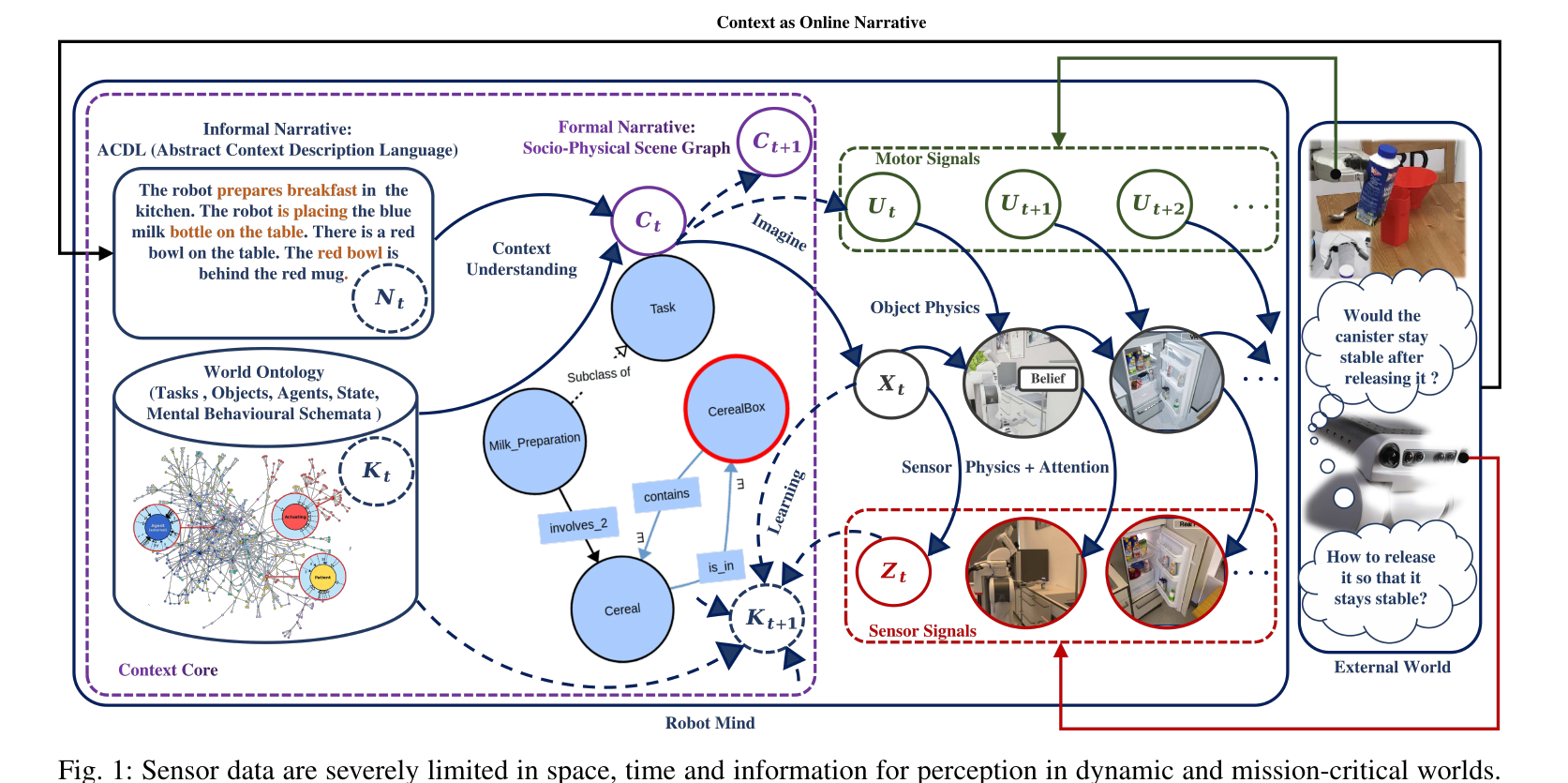
Original Figure 1: cognitive emulation recovers interpretable world states from limited observations. Source: authors' public PDF. Image copyright belongs to the paper's authors and publisher; reproduced here for academic analysis.
4. Evidence boundaries
The paper presents a system prototype and transparent-object demonstrations, without standard BOP evaluation, ADD(-S) / VSD numbers, or matched quantitative comparisons against modern transparent-object pose networks. It supports a learningless, white-box system producing recognition + pose in demonstrations, but not superior accuracy over learning methods.
5. Coarse-reading assessment
This cognitive-robotics approach differs substantially from mainstream deep pose estimation. Auditable causal explanations, physical predictions, and prior knowledge are advantages; knowledge engineering, scene generation, and multiparticle simulation are costly and depend strongly on correct ontologies, meshes, materials, and physics.
Available src/paper-notes/naivphys4rp-icra2024/deep.md
In-depth paper notes
Support reproduction, comparison, related-work writing, and identifying opportunities for further research.
Paper Reading Notes (Deep): Perception Through Cognitive Emulation — A Second Iteration of NaivPhys4RP
1. Basic information
Authors / affiliation: Franklin Kenghagho Kenfack, Michael Neumann, Patrick Mania, Michael Beetz; University of Bremen
NaivPhys4RP frames perception as generative explanation: which simulatable world could best cause current observations? It combines ontologies, linguistic context, robot state, naive physics, and limited sensor data, inferring object recognition and 6D pose as parts of hidden world state.
This is not a standard feedforward pose estimator. The paper focuses on interpretability and safety in transparent / occluded / poor-depth scenes, explicitly targeting a learningless white-box system.
3. Formal perspective
The authors model the world as a situated partially observable hidden Markov process. Variables include:
Xt: socio-physical world state, including object properties and poses.
Ut: robot / agent actions.
Zt: sensor observations.
Ct: context.
Kt: dynamically updatable ontology.
Nt: narrative cognition.
The system jointly handles context understanding, state prediction, scene imagination, and observation explanation. Unlike a discriminative pose network’s Zt→T, it approximately infers P(Xt∣Z0:t,C,K,U).
Original Figure 1: variable dependencies, imagination, physics transitions, and observation explanation form a loop, beyond pose regression from a single sensor frame. Source: authors' public PDF. Image copyright belongs to the paper's authors and publisher; reproduced here for academic analysis.
4. System pipeline
4.1 Context understanding
Controlled natural language and the SOMA ontology are parsed into a socio-physical graph. Causality, purpose, intention, and common sense exclude implausible narratives such as a robot inside a refrigerator and complete unstated relations. Explanations come from explicit knowledge structures rather than implicit large-model representations.
4.2 Scene imagination
Graph objects, materials, textures, poses, and actions compile into simulator-executable descriptions. Multiple scene particles represent possible worlds. A game-engine-agnostic compiler feeds specific interpreters that instantiate scenes in environments such as Unreal Engine.
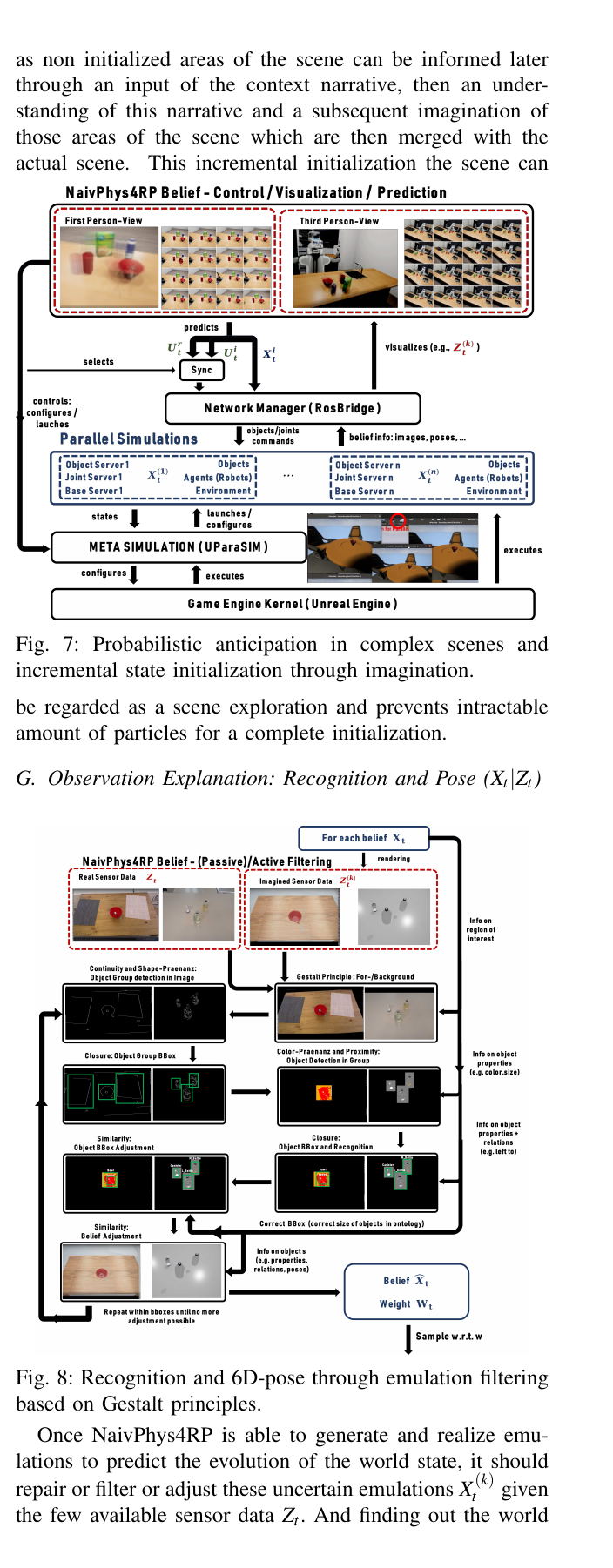
Original Figures 7–8: multiparticle predictions form pose beliefs, then real observations drive Gestalt-style fitting and resampling of imagined scenes. Source: authors' public PDF. Image copyright belongs to the paper's authors and publisher; reproduced here for academic analysis.
4.3 Physics transitions and anticipation
Actions advance each particle in a physics engine to future scene states. Incremental belief initialization avoids enumerating every large-scene combination initially. Beyond explaining current poses, the system predicts falling, tipping, or collisions: the paper’s safety / anticipation goal.
4.4 Observation explanation
Limited sensor data Zt is fitted to each simulated scene Xt(k); mismatch error and fitting effort determine weights and resampling. Transparent objects may lack reliable depth, but edges, context, known meshes / materials, and physically feasible locations still constrain beliefs.
5. Demonstrations and evidence strength
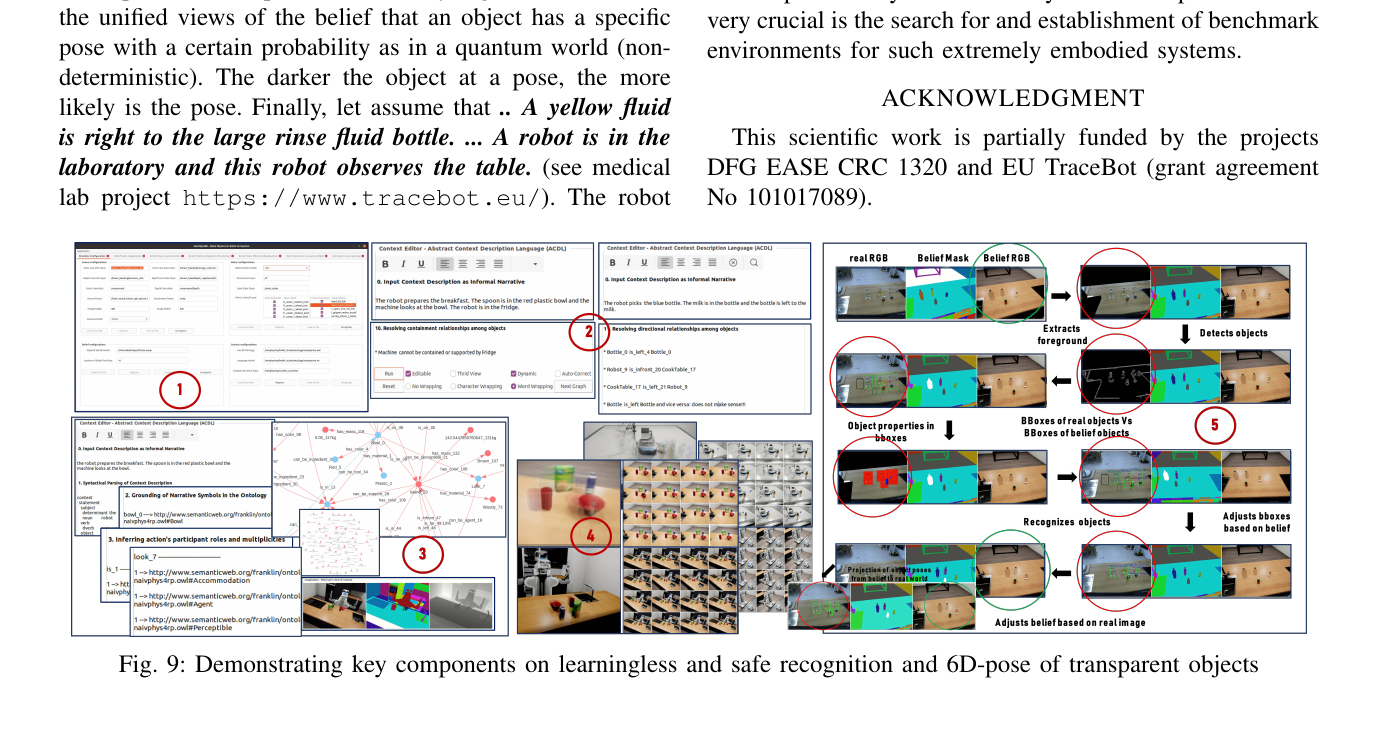
Demonstrations include breakfast / laboratory narrative understanding, scene imagination, belief visualization, and learningless recognition / 6D pose for transparent bottles. Figure 9 connects configuration, contradictory-narrative detection, scene graphs, particle imagination, and transparent-object pose filtering.
Original Figure 9: a system demonstration from context understanding to belief particles and transparent-object recognition / 6D pose. This is proof of concept rather than benchmark error curves. Source: authors' public PDF. Image copyright belongs to the paper's authors and publisher; reproduced here for academic analysis.
Evidence availability
The paper reports no ADD(-S), VSD, or translation / rotation errors on BOP, ClearPose, or TOD, and no matched quantitative comparison against transparent-object pose baselines. Therefore:
It demonstrates transparent-object recognition and 6D pose inference.
Its inference chain is inspectable and requires no data-driven training.
It does not establish pose precision, speed, or generalization matching / exceeding modern learning methods.
“Safe” mainly denotes a causal / physical consistency design objective rather than formal safety certification.
6. Strengths and limitations
Strengths
Outputs include ontology-, context-, and physics-based explanations alongside poses.
Hidden states, future risks, and current observations share one belief representation.
Nonvisual constraints reasonably complement sensors that struggle with transparency.
More particles and scene combinations increase computational complexity substantially.
Without standardized quantitative experiments, individual module contributions are hard to assess.
“Learningless” does not eliminate prior costs; substantial knowledge enters through manual structures and model assets.
Incorrect knowledge or physics producing confidently wrong explanations is not systematically studied.
7. Implications for pose research
NaivPhys4RP offers a research agenda: when RGB-D fails on transparent objects, pose can be jointly constrained by expected location, previous location, applied forces, and task-consistent state alongside current pixels. A practical hybrid would use deep networks for pose proposals / uncertainty and differentiable physics, relation graphs, and temporal beliefs for verification, rather than replacing data-driven perception entirely.