NeRF-Feat: 6D Object Pose Estimation using Feature Rendering
NeRF-Feat uses a NeRF density field to establish a CAD-free instance reference frame. Bidirectional contrastive learning aligns 3D surface features with query CNN features, and 2D–3D correspondences with PnP recover pose.
relative camera posesobject bounding box or maskcamera intrinsicsper-object NeRF training
Reading Notes
Overview / Deep Dive
Available src/paper-notes/nerf-feat-3dv2024/coarse.md
Paper overview notes
Quickly assess the paper's scope, problem setting, core method, experimental findings, and whether to read it in depth.
NeRF-Feat: Coarse Reading
One-sentence conclusion
Beyond novel-view rendering, NeRF-Feat uses the object surface defined by NeRF density as a carrier for 3D features. Query CNN features match surface descriptors for 2D–3D correspondences and PnP, supporting symmetric objects without CAD.
Two-stage training
First, train NeRF on real object images with relative poses for color, density, and implicit geometry. Then freeze geometry, generate surface descriptors with a feature MLP, and jointly train the image CNN. Bidirectional contrastive constraints bring correct pixel–surface pairs together and separate incorrect pairs. Inference extracts a featured cloud from density, then uses nearest-neighbor matching and PnP-RANSAC.
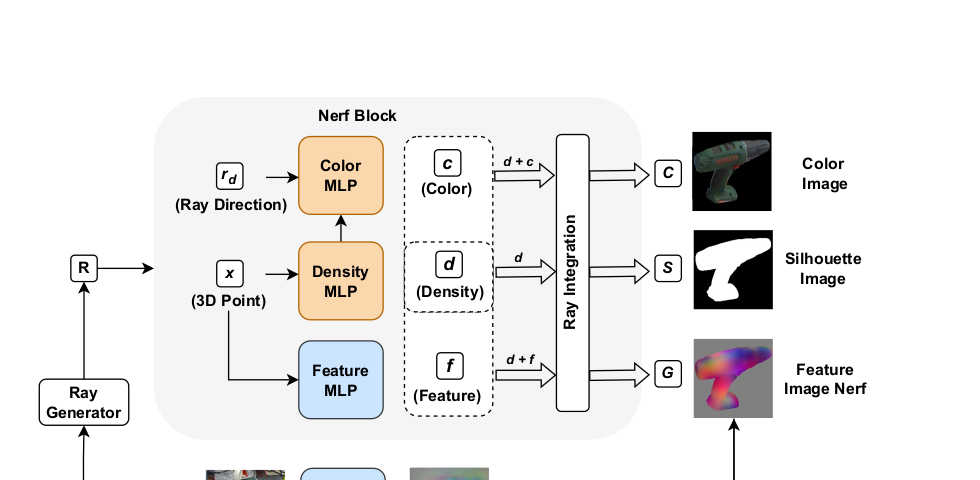
One neural field provides renderable appearance, object silhouettes, and 3D feature fields; the CNN maps query pixels into the same descriptor space. Source: original Figure 1. Copyright belongs to the authors and 3DV 2024 publisher; reproduced here for academic analysis.
Key results
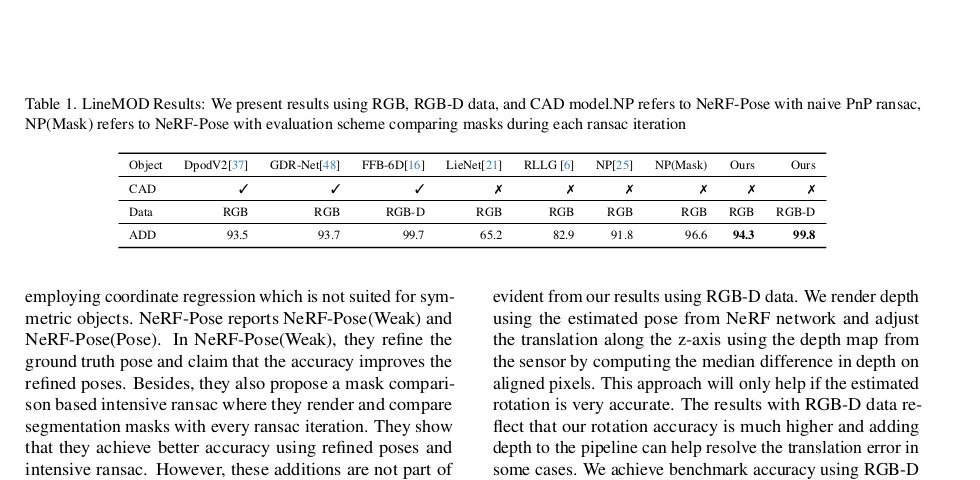
LINEMOD: RGB-only, CAD-free ADD 94.3; one depth-based z-translation correction raises it to 99.8.
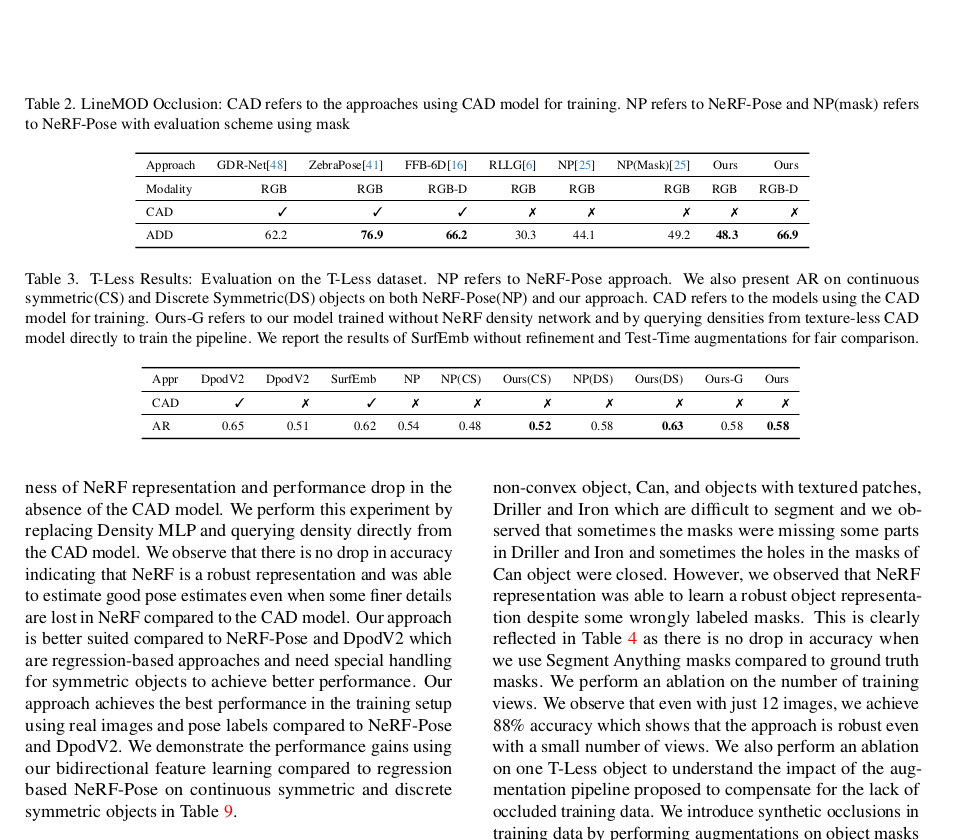
LM-O: RGB-only 48.3, above NeRF-Pose’s 44.1 with the same naive PnP; RGB-D 66.9.
T-LESS: Average Recall AR 0.58, exceeding NeRF-Pose in both continuous- and discrete-symmetry groups.
With only 12 training views, three-object mean ADD remains 88.2, versus 98.7 with 150 views.
LM-O highlights correspondence and translation under occlusion as bottlenecks; T-LESS tests bidirectional features on symmetric objects. Source: original Tables 2–3. Copyright belongs to the authors and 3DV 2024 publisher; reproduced here for academic analysis.
Reading caveats
“Weak supervision” still requires relative training-image poses and bounding boxes / SAM masks in clutter. It removes precise CAD and pointwise correspondence labels, not every instance-acquisition cost. Relevant to NeRF object representations, weak pose labels, and symmetry-aware correspondence.
Available src/paper-notes/nerf-feat-3dv2024/deep.md
In-depth paper notes
Support reproduction, comparison, related-work writing, and identifying opportunities for further research.
NeRF-Feat: Deep Reading
1. Learn a reference frame, then correspondence
Classical instance-level pose takes the CAD frame as given. Without CAD, the challenge is both missing geometry and defining the 3D frame relative to which outputs are predicted. NeRF-Feat uses its first-stage NeRF frame: density defines surfaces, training camera poses bind images to shared space, and the second stage learns surface features that match across views.
Direct object-coordinate regression forces visually identical symmetric regions toward unique coordinates, creating conflicting supervision. NeRF-Feat instead lets contrastive learning form symmetry-equivalent feature structures; correspondences can favor a consistent symmetric configuration before PnP.
2. Two-stage method
2.1 NeRF geometry stage
A ray generator samples from camera parameters; NeRF density / color MLPs reconstruct RGB and masks through volume rendering. After training, density isosurfaces support marching-cubes meshes or surface clouds. The key output is an implicit object frame consistent with training poses, beyond attractive renders.
2.2 Feature stage
A feature MLP maps 3D surface points into vectors; a CNN predicts per-pixel descriptors for query / training images. Known-camera projection constructs positive matches. Bidirectional contrastive loss constrains both pixel-to-point and point-to-pixel matching, reducing forced separation of symmetric regions under unidirectional coordinate regression.
Density fixes geometry and reference frames; the feature MLP and CNN learn shared descriptors. Inference does not reoptimize NeRF. Source: original Figure 1. Copyright belongs to the authors and 3DV 2024 publisher; reproduced here for academic analysis.
2.3 Inference
SAM / existing masks first restrict query regions; cosine nearest neighbors against the featured 3D cloud yield 2D–3D correspondences for ordinary PnP-RANSAC. RGB-D does not use full ICP: the median difference between observed and rendered depth makes one camera-z translation correction.
3. Interpreting experiments
RGB-only 94.3 is close to CAD-based GDR-Net's 93.7; RGB-D 99.8 mainly shows that sufficiently accurate rotation lets one depth correction remove substantial z error. Source: original Table 1. Copyright belongs to the authors and 3DV 2024 publisher; reproduced here for academic analysis.
High LINEMOD scores alone do not establish heavy-occlusion robustness. On LM-O, NeRF-Feat RGB reaches 48.3 versus NeRF-Pose naive PnP’s 44.1; depth raises it to 66.9, close to FFB-6D’s 66.2. The feature field improves correspondence and rotation, while occluded translation remains a major bottleneck.
T-LESS contains many continuously / discretely symmetric objects. NeRF-Feat AR is 0.58; continuous-symmetry groups rise from NeRF-Pose’s 0.48 to 0.52, and discrete groups from 0.58 to 0.63. Modest gains support bidirectional features over coordinate regression for symmetry.
Datasets use ADD or BOP AR, so scores should not be mixed directly. Compare gaps within the same table under equal inputs and CAD conditions. Source: original Tables 2–3. Copyright belongs to the authors and 3DV 2024 publisher; reproduced here for academic analysis.
4. Useful ablations
With 12/50/150 training views, three-object mean ADD is 88.2/94.4/98.7. Few-view operation is possible, but accuracy still increases with coverage.
SAM and GT masks both average 98.7 with 150 views, suggesting small mask errors are not the main bottleneck in this three-object LINEMOD subset.
Textureless-CAD density in Ours-G and NeRF both give 0.58 AR. NeRF geometry is adequate for this benchmark, without proving geometric precision equal to CAD.
5. Limitations and engineering assessment
Instance training still needs posed multi-view images; field training and marching cubes / surface sampling add onboarding time. Nearest-neighbor matches lack explicit confidence calibration; repeated textures, severe occlusion, and mask leakage may create many outliers. Favoring one symmetric configuration may benefit ADD-S / AR but not manipulation requiring a specific physical orientation.
The most reusable idea is representation separation: renderable geometry establishes an instance frame, while an independent feature field serves pose correspondence. This is easier to explain, replace, and debug than end-to-end NeRF pose regression.