NeuSurfEmb: A Complete Pipeline for Dense Correspondence-Based 6D Object Pose Estimation without CAD Models
NeuSurfEmb builds renderable object surfaces from a few real RGB images using SfM, general segmentation, and NeuS2. Automatically generated cut-and-paste training images train a SurfEmb dense-correspondence network. Exact CAD and a manually built PBR pipeline are unnecessary, but per-object reconstruction and training remain required.
NeuSurfEmb replaces precise CAD with RGB video captured around a real object. SfM, generic segmentation, and NeuS2 reconstruct a renderable surface, automatically generate training images, and train SurfEmb dense correspondences. PnP+RANSAC then estimates instance-level 6D pose from a single query RGB image.
3. Guide to the paper’s figures and tables
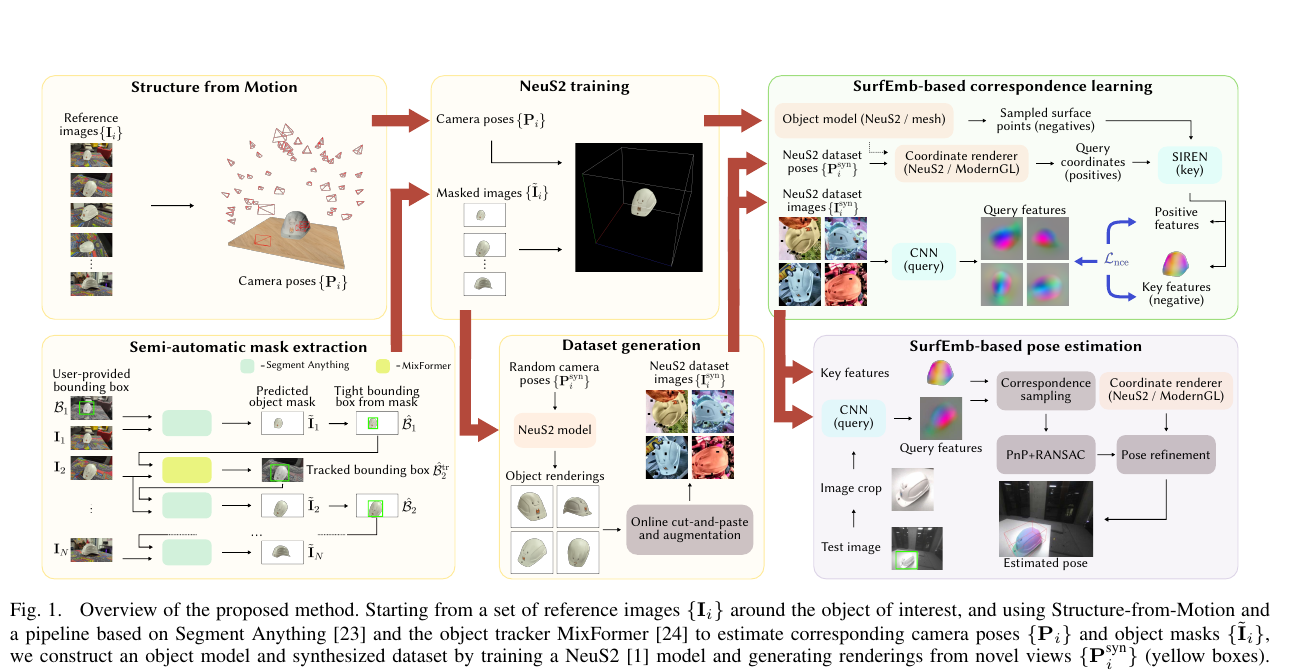
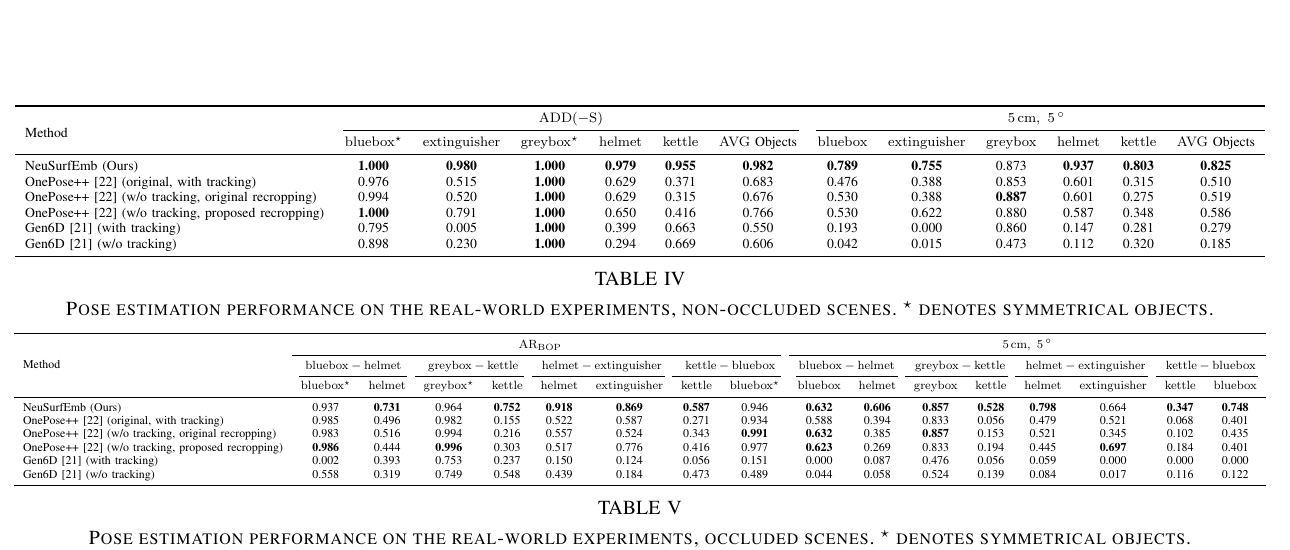
Original Figure 1: SfM and semiautomatic masks on the left, NeuS2 modeling / training-image synthesis in the middle, and SurfEmb dense correspondence with PnP+RANSAC on the right. Source: authors' public manuscript. Image copyright belongs to the authors and IEEE; reproduced here for academic analysis.Original Tables IV–V: CAD-free experiments on five custom objects. Unoccluded mean ADD(-S) is 0.982; occluded ARBOP and 5 cm, 5° are reported per object and scene. Source: authors' public manuscript. Table copyright belongs to the authors and IEEE; reproduced here for academic analysis.
4. Problem setting
Onboarding needs only real reference RGB images and a user-drawn first-frame box, without manufacturer CAD, 3D scanning equipment, or a manually built PBR pipeline.
Query inputs are one RGB image and an external detection box; output is instance-level 6D pose of the onboarded object.
Optional query depth adds final refinement, while the main correspondence estimator supports RGB-only inference.
5. Method overview
SfM recovers reference-camera trajectories; SAM segments objects and MixFormer tracks the user’s first-frame box.
Train instance NeuS2 from poses / masks, recenter and rescale, then retrain for a renderable neural surface.
Render RGB / coordinates from random views; cut-and-paste, color, and affine augmentation produce 10,000 training images per object.
PBR-trained SurfEmb gives 0.656 / 0.758, attributing the main gap to training images rather than NeuS2 geometry itself.
Five custom unoccluded objects: mean ADD(-S) 0.982, 5 cm, 5° recall 0.825; original OnePose++ gives 0.683 / 0.510.
NeuS2 training takes about 10 minutes; 10,000-image generation 20–30 minutes. Correspondence training still takes 1–1.5 days per object on one RTX 2080 Ti.
7. Quick assessment
Value: a complete CAD-free onboarding process rather than an isolated pose network.
Strengths: interpretable correspondence solving; more stable on low texture and mild occlusion than OnePose++ / Gen6D; public code.
Main limits: object-specific reconstruction / training remains; 1–1.5 days is far from instant onboarding, and unseen surfaces cannot be reconstructed.
Available src/paper-notes/neusurfemb-iros2024/deep.md
In-depth paper notes
Support reproduction, comparison, related-work writing, and identifying opportunities for further research.
Paper Reading Notes (Deep): NeuSurfEmb
1. Key assessment
NeuSurfEmb contributes object-onboarding engineering rather than one network module. It connects reference-camera localization, object masking, 3D modeling, and training-image generation into a semiautomatic pipeline, enabling methods such as SurfEmb that need object surfaces and abundant synthetic data to operate without CAD.
The authors claim that few real RGB images suffice to train accurate estimators, exceeding CAD-free Gen6D and OnePose++ on custom objects. Experiments support this, while revealing costs: modeling takes tens of minutes, but per-object dense-correspondence training still takes 1–1.5 days. It removes specialist CAD / PBR production, not instance-specific training.
2. Task setting and inputs / outputs
Object onboarding
Capture RGB video or reference images around a stationary object.
A user supplies only the first-frame bounding box.
Intrinsics are known or recovered by the SfM pipeline.
Outputs are reference poses, per-frame masks, instance NeuS2, and a trained SurfEmb model.
Query stage
One RGB image and an external detector’s object box.
Instance-level 6D pose from object frame to query-camera frame.
Metric CAD is unnecessary, but monocular SfM / NeuS2 has scale ambiguity. In custom evaluation, ICP between two NeuS2 point clouds supplies scale and frame transforms from the modeling scene to the Vicon scene. Robot deployment still needs an additional metric-scale calibration source.
3. Complete pipeline
Original Figure 1. The upper section establishes camera trajectories, neural surfaces, and correspondence networks; the lower generates training data and recovers query 2D–3D correspondences. Source: authors' public manuscript. Image copyright belongs to the authors and IEEE; reproduced here for academic analysis.
3.1 SfM and semiautomatic masks
SfM recovers reference poses. After the first-frame box is supplied:
Segment Anything generates the object mask within the box.
MixFormer propagates the box to later frames.
Segment each frame again and tighten its bounding box.
Obtain masked images aligned with SfM poses.
One user input is sufficient, but tracking drift or SAM leakage contaminates subsequent NeuS2 views. Mask errors are not systematically isolated experimentally; save per-frame masks for visual inspection during reproduction.
3.2 NeuS2 object representation
Train NeuS2 once with reference poses / masks, extract a surface cloud, and fit an oriented bounding box. Recenter the object frame, align principal axes, transform camera poses, and retrain NeuS2.
Reframing:
Concentrates surfaces in a stable canonical range.
Centers random-view sampling on objects rather than arbitrary SfM origins.
Establishes consistent coordinates for SurfEmb 3D key features.
NeuS2 exports Marching Cubes meshes or directly renders coordinates. Ablations find that NeuS2 versus CAD geometry and NeuS2 versus GL rendering affect pose less than training-image domain differences.
3.3 Automatic training-data generation
Random camera poses render NeuS2 RGB, masks, and 3D surface coordinates together. Isolated neural-rendered foregrounds receive online:
Random-noise or PASCAL-VOC backgrounds.
Cut-and-paste with random foreground coverage.
Color, white-balance, and affine augmentation.
Simulated occlusion and background changes.
Each object gets 10,000 images at 224×224. This avoids materials, lighting setup, and BlenderProc PBR configuration, while leaving a substantial gap to complex real illumination.
3.4 SurfEmb dense correspondence and pose
SurfEmb learns two feature fields:
Query CNN features fq(p) for each foreground pixel.
A SIREN key network maps arbitrary surface point x to fk(x).
InfoNCE attracts true 2D / 3D pairs and separates other surface points.
The query network also predicts masks with cross-entropy supervision.
Uniform surface keys and query pixels form a similarity matrix for probabilistic 2D–3D sampling. PnP+RANSAC generates pose candidates; coordinate-renderer refinement improves the best. Optional depth adds further refinement.
4. Experimental protocol
4.1 LINEMOD-Occlusion
8 known objects with substantial occlusion.
BOP Average Recall (ARBOP), combining symmetry- and occlusion-related errors.
Separate NeuS2 and correspondence models per object.
CosyPose query boxes, aligned with SurfEmb evaluation.
Resources on one RTX 2080 Ti:
Stage
Setting / duration
NeuS2
20,000 steps, about 10 minutes
Data generation
10,000 images at 224×224, about 20–30 minutes
SurfEmb correspondence learning
50 epochs, about 1–1.5 days / object
4.2 Custom real objects
Bluebox, extinguisher, greybox, helmet, and kettle cover symmetric boxes, low texture, complex geometry, and elongated structures. Ordinary phones capture modeling video; a FLIR Firefly S captures evaluation, with Vicon camera-motion GT.
Each object appears alone in unoccluded scenes and with another object in occluded scenes. Modeling and evaluation differ substantially in background, lighting, camera color, and occlusion.
5. Results and ablations
5.1 Main LINEMOD-Occlusion results
Configuration
RGB ARBOP
RGB-D ARBOP
NeuSurfEmb: NeuS2 renderer + NeuS2 model + NeuS2 images
0.554
0.666
NeuSurfEmb: GL renderer + NeuS2 model + NeuS2 images
0.570
0.681
NeuSurfEmb: GL renderer + NeuS2 model + PBR images
0.646
0.752
SurfEmb: GL renderer + CAD + PBR
0.656
0.758
CosyPose
0.633
0.714
The key ablations go beyond whether NeuS2 replaces CAD:
Switching the training object model from NeuS2 to CAD changes little.
Switching pose-estimation coordinate rendering from NeuS2 to CAD also changes little.
Replacing NeuS2 images with PBR raises RGB ARBOP from about 0.57 to 0.646.
NeuS2 geometry thus supports correspondence / PnP adequately; neural-rendering versus real-query appearance / occlusion domains are the main bottleneck.
For 5 of 8 LM-O objects, NeuS2 forward Chamfer distance is about 1.2 mm or less. Can, eggbox, and holepuncher fare worse, including failures from internal holes and bottom structures absent from reference views.
5.2 Custom-object results
Original Tables IV–V. Unoccluded scenes are above and paired occluded scenes below. Symmetric objects report both ADD(-S) and orientation-sensitive 5 cm, 5°. Source: authors' public manuscript. Table copyright belongs to the authors and IEEE; reproduced here for academic analysis.
Unoccluded scenes:
Method
Mean ADD(-S)
Mean 5 cm, 5°
NeuSurfEmb
0.982
0.825
OnePose++, original tracking
0.683
0.510
OnePose++, no tracking + improved recrop
0.766
0.586
Gen6D, original tracking
0.550
0.279
Gen6D, no tracking
0.606
0.185
NeuSurfEmb clearly benefits low-texture helmet, extinguisher, and kettle under occlusion. Gen6D sometimes tracks foreground occluders; OnePose++ recropping can remove important elongated-extinguisher regions. For fairness, all methods receive GT boxes, with original baseline tracking reported separately.
Treat symmetric boxes carefully: ADD-S accepts wrong symmetry-equivalent orientations, so 5 cm, 5° is also reported. Greybox ADD-S is near perfect while systematic rotation errors remain from some viewpoints.
6. Authors’ claims and site assessment
Level
Conclusion
Authors’ claim
Few real RGB images and a semiautomatic process replace CAD / manual PBR and train accurate 6D estimators
Stronger evidence
NeuS2 / CAD swaps isolate geometry from the main bottleneck; five custom objects demonstrate operation under substantial domain shifts
Qualification
Few input images do not mean low total cost: 1–1.5 days of correspondence training per object and external real-scale registration remain
More precise positioning
CAD-free, PBR-pipeline-free instance-specific onboarding, rather than training-free novel-object pose
Mask contamination: initial segmentation or subsequent tracking errors enter surfaces and rendered training sets.
Appearance gap: cut-and-paste does not fully replace material / illumination PBR; this is the largest experimental performance gap.
Per-object training: fast object representations do not imply fast SurfEmb training.
Scale / frames: monocular reconstruction has relative scale; robotics needs known dimensions, markers, depth, or external registration.
Detection dependence: supplied boxes exclude actual detector failures from pose scores.
8. Reproduction and engineering checklist
Save SfM clouds, trajectories, and per-frame masks to inspect drift.
Check bounding-box principal axes after first NeuS2 training, avoiding arbitrary flips on near-symmetric objects.
Save meshes and coordinate renders separately; measure surface completeness.
Fix viewpoint distribution, foreground size, backgrounds, and augmentation for the 10,000 images.
Reproduce SurfEmb surface sampling, InfoNCE temperature, RANSAC iterations, and refinement.
Calibrate metric scale and object-to-grasp transforms separately before robot deployment.
Report symmetry-aware ARBOP and orientation-sensitive angular thresholds together.
9. Future directions
Shared foundation correspondence models instead of 1–1.5 days per-object training.
More realistic rendering through Gaussian Splatting or editable materials.
Reconstruction uncertainty to guide active recapture of unseen surfaces.
Joint scale estimation and reconstruction, connecting phone onboarding directly to robot frames.
Propagate SfM, mask, NeuS2, and pose-residual uncertainty to final pose confidence.
10. Overall assessment
NeuSurfEmb makes CAD-free onboarding executable and uses ablations to locate engineering bottlenecks. NeuS2 geometry is adequate; image domains and per-object correspondence learning are the next targets. It is a strong CAD-free instance-pose baseline and a reminder to distinguish model-free, training-free, and scale-free claims.