Occlusion-Aware 6D Pose Estimation with Depth-Guided Graph Encoding and Cross-Semantic Fusion for Robotic Grasping
An ICRA 2025 Best Conference Paper Finalist. A depth-guided GNN models relationships between nonadjacent surface points under occlusion, adaptively fusing masks and binary codes to strengthen RGB-D 2D–3D correspondences. The abstract reports relative gains of 1.2% / 1.9% on LM-O / YCB-V and up to 30% for individual objects.
Task: known-instance 6D pose in occluded RGB-D scenes for robotic grasping
Datasets: LM-Occlusion (LM-O), YCB-Video (YCB-V), and real-robot pose tests
Availability: full text is not open access; paper facts here come from the DOI, authors’ abstract, and official ICRA award materials
2. One-sentence summary
Instead of directly regressing poses from fragmented visible features, a depth-guided GNN models latent relationships among nonadjacent surface points under occlusion. Adaptive object-mask / binary-surface-code fusion strengthens 2D–3D correspondence. The abstract reports LM-O / YCB-V improvements of 1.2% / 1.9%, up to 30% for individual objects.
3. Why graphs for occlusion?
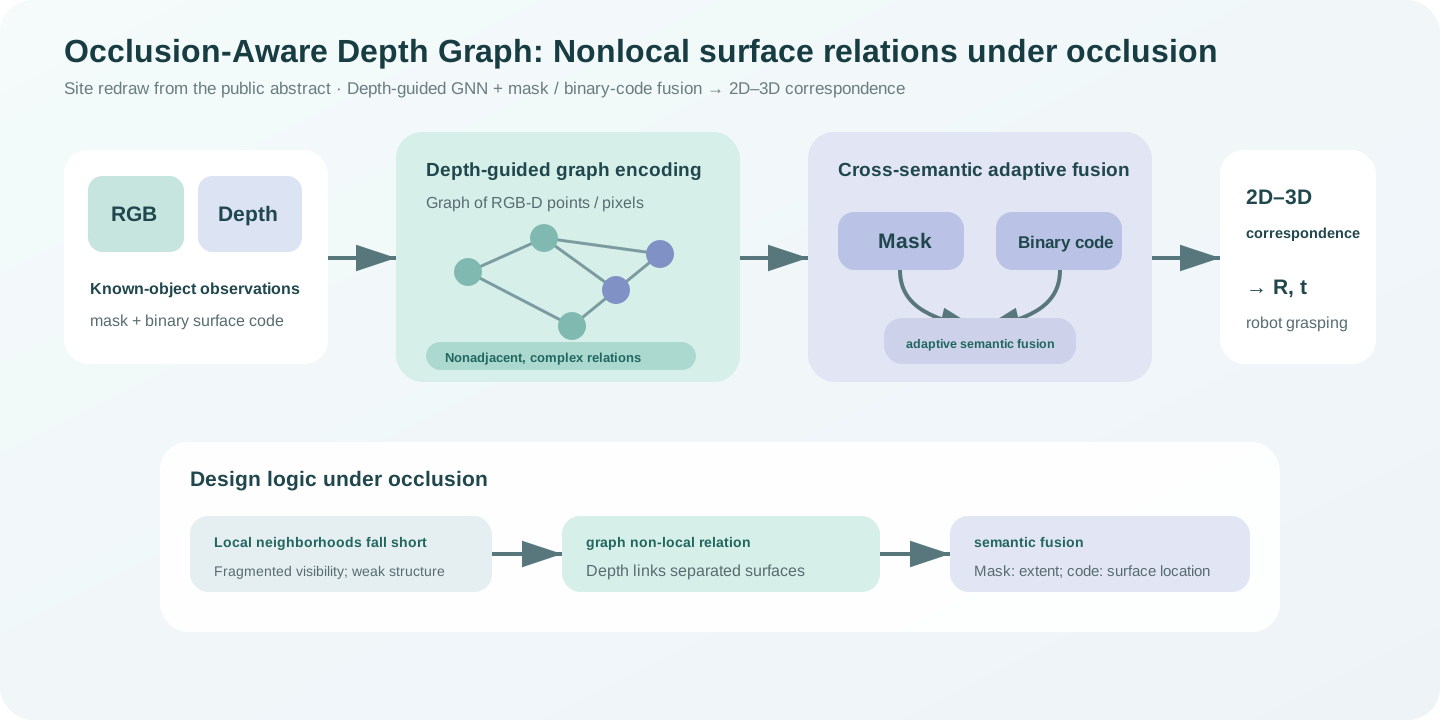
Severe occlusion splits visible object regions into disconnected pieces. Local convolutions or point neighborhoods capture nearby texture / geometry but struggle to link separated patches as parts of one surface structure.
Redrawn by this site from the authors' public abstract, not an original paper figure. Nodes, edges, and fusion arrows illustrate disclosed high-level relations, not undisclosed graph topology or layers. Paper content copyright belongs to the authors; redrawn for academic analysis. Source: paper DOI.
4. Interpreting results
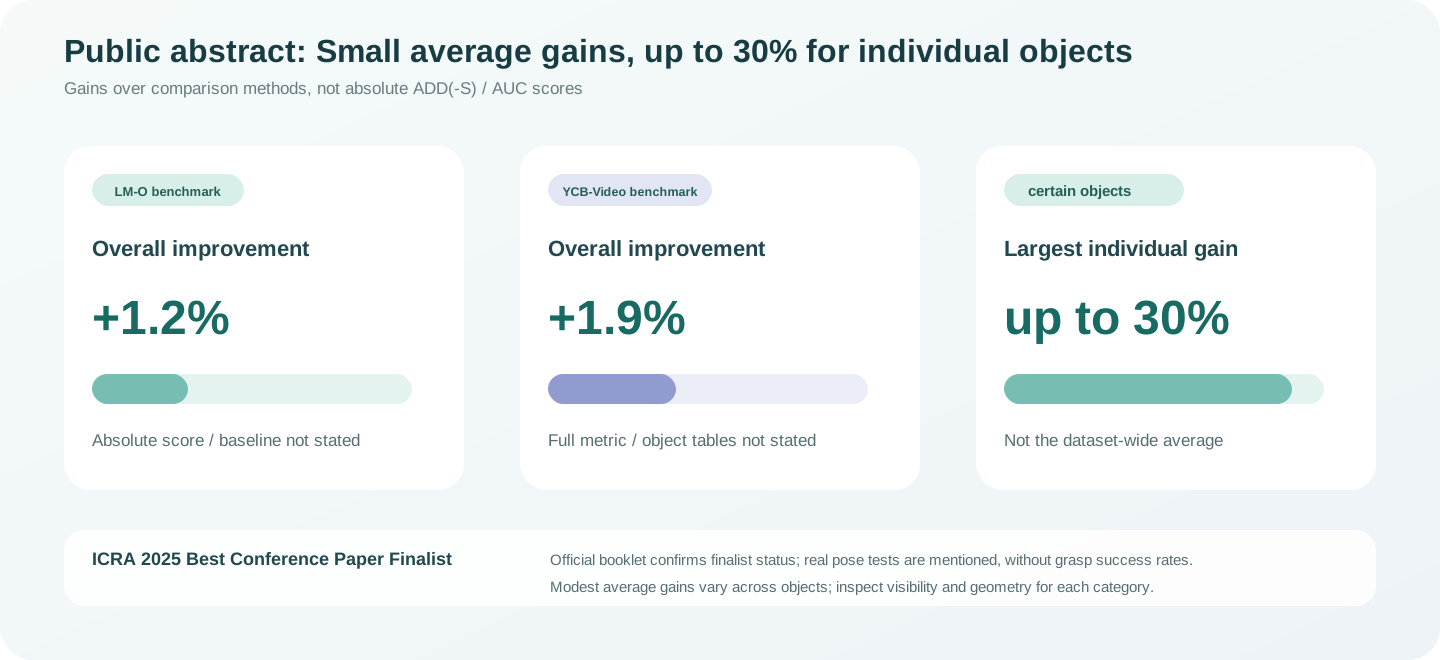
The authors’ abstract reports gains over comparison methods:
LM-O: 1.2% improvement.
YCB-V: 1.9% improvement.
Individual objects: up to 30% improvement.
Real pose-estimation tests also demonstrate effectiveness.
Redrawn by this site from the authors' public abstract. The 1.2%, 1.9%, and up to 30% figures are improvements, not absolute ADD(-S) / AUC; an individual-object maximum does not represent dataset averages. Source: paper DOI; finalist status confirmed by the official ICRA awards booklet.
Small average gains with large individual gains suggest concentrated benefits for certain severely occluded, geometrically ambiguous, or locally misdecoded objects. Without full per-object tables, specific categories remain unknown and 30% cannot be treated as overall performance.
5. Inputs, outputs, and dependencies
The abstract and metadata support or reasonably bound:
Inputs: RGB-D, object masks, and binary-code predictions.
Priors: known CAD / surface-code definitions and camera intrinsics.
Scenes: multi-object occlusion and robotic grasping.
Masks and binary codes are not free inputs: deployment still needs detection / segmentation and code prediction. Missed masks, depth holes, and code errors jointly affect system accuracy.
6. Coarse-reading assessment
The focus is structured occlusion priors, combining geometric relationships and two semantic types. This suits known-CAD RGB-D industrial / robot scenes; official Best Paper Finalist status signals recognition of its perception contribution.
Unavailable full text prevents verification of graph construction, fusion equations, absolute scores, runtime, or grasping success. This page therefore plots only disclosed abstract figures rather than inventing complete result tables.
Available src/paper-notes/occlusion-aware-depth-graph-icra2025/deep.md
In-depth paper notes
Support reproduction, comparison, related-work writing, and identifying opportunities for further research.
Paper Reading Notes (Deep): Occlusion-Aware 6D Pose Estimation with Depth-Guided Graph Encoding and Cross-Semantic Fusion for Robotic Grasping
1. Positioning and reading assessment
This instance-level 6D framework targets known objects, RGB-D, 2D–3D correspondence, and severe occlusion, and was an ICRA 2025 Best Conference Paper Finalist.
The authors argue that direct deep pose regression insufficiently models nonadjacent, complex surface-point relationships under occlusion. They propose:
depth-guided graph neural network;
Adaptive cross-semantic fusion of object masks and binary codes.
Enhanced graph features and fused semantics for correspondence and final pose.
The abstract reports LM-O and YCB-V gains of 1.2% and 1.9%, up to 30% on some objects, plus real pose tests. Full text is not open access, so graph construction, losses, and solver remain unverified here.
2. How occlusion disrupts 2D–3D correspondence
For known-CAD point Xj, ideal corresponding pixels satisfy:
λujvj1=K(RXj+t).
Sufficient correspondences with controlled outliers support PnP / RANSAC or geometric fitting for (R,t). Occlusion disrupts three conditions:
Fewer visible correspondences.
Locally concentrated points with poorer geometric conditioning.
Neighboring pixels from occluders / other objects add semantic outliers.
Disconnected visible patches further complicate matters. Local convolutions or kNN features capture patch interiors but may miss shared physical structure across distant image regions. Depth-guided graphs target these nonlocal relationships.
3. Depth-guided graph encoding
The public abstract confirms depth-guided GNN modeling of latent surface relationships. Its high-level role can be expressed as:
hi′=ϕ(hi,j∈N(i)AGGψ(hi,hj,Δpij)),
Here pi may be back-projected using depth and intrinsics, and N(i) is a graph neighborhood. This explains generic graph message passing, not an undisclosed paper equation.
Unlike 2D pixel adjacency alone, depth-guided edges can connect separated but structurally related points using 3D distance, surface relations, or other geometry. The abstract emphasizes nonadjacent, complex relationships but does not disclose:
Whether nodes are pixels, cloud points, patches, or code tokens.
Whether edges use 3D kNN, learned affinity, or mesh topology.
Whether depth enters edges, node features, or attention biases.
Graph depth and complexity.
Only functionality is analyzed here; common implementations are not attributed to this paper as facts.
4. Mask / binary-code cross-semantic fusion
4.1 What each semantic type contributes
Object masks provide low-frequency semantics: target membership. They exclude background and adjacent instances but do not identify internal surface locations.
Binary surface codes provide high-frequency semantics, usually encoding discrete CAD regions as multibit labels. Correct codes locate pixels on model surfaces for 2D–3D correspondences, but occlusion, boundaries, and similar patches cause bit errors.
Adaptive fusion, beyond concatenation, implies observation-dependent contributions. The abstract gives no gating / attention equations, leaving fusion at logits, features, or correspondence confidence unresolved.
4.2 Why cross-semantic fusion helps under occlusion
Masks suppress wrong occluder codes.
Codes distinguish similarly appearing CAD regions within masks.
Depth-graph features can correct local code ambiguity.
Together, these improve correspondence inlier ratios.
Redrawn by this site from the authors' public abstract, not an original paper figure. Nodes and arrows explain depth-guided nonlocal relations plus adaptive cross-semantic fusion, not the paper's exact network topology. Paper content copyright belongs to the authors; redrawn for academic analysis. Source: paper DOI.
5. From correspondence to pose
The abstract describes 2D–3D correspondence-related features from masks / binary codes, without a final solver. Common possibilities include:
Decode model points, then use PnP / RANSAC.
Pass dense correspondences into a differentiable geometric solver.
Directly regress (R,t) from correspondence features.
A correspondence-based metadata classification is reasonable, but the detail page specifies no solver. Full-text review should verify outlier rejection, confidence weighting, symmetry codes, and final refinement.
6. Experimental results
Disclosed abstract results:
Dataset / scope
Relative improvement
LM-O
1.2%
YCB-V
1.9%
certain objects
up to 30%
Real scenes
Pose-estimation tests demonstrate effectiveness
Redrawn by this site from the authors' public abstract. All values are relative improvements rather than absolute metrics; an individual-object 30% is not an average. Finalist status is confirmed by the official ICRA awards booklet. Paper: DOI.
7. Why analyze average +1.x% versus individual +30%?
This pattern usually suggests a specific failure regime rather than uniform benefits. Possible factors include:
Heavier LM-O occlusion for certain objects.
Repeated local geometry confusing local features.
Surface regions especially vulnerable to binary-code errors.
Critical depth-graph links among sparse visible patches.
Strong baselines leaving little headroom for most objects.
These are interpretive hypotheses, not per-object ablations. Testing requires complete tables and correlations with visibility, symmetry, and surface complexity.
8. Metrics and unknowns
Metadata lists ADD(-S) / AUC as common benchmark protocols, but the abstract does not identify which metric the 1.2% / 1.9% figures denote:
ADD(-S) accuracy;
ADD(-S) AUC;
BOP-style AR;
Or an author-defined aggregate.
Therefore these three gains are not assigned a definite metric here. Also undisclosed:
absolute scores;
compared methods;
Training splits and synthetic / real data.
GT versus predicted masks.
Joint training of the code predictor.
Runtime and parameter count.
Real-test objects, trials, and grasp success.
9. Critical analysis
9.1 Strengths
Clear module-problem alignment: nonlocal graphs for fragmented visibility, cross-semantic fusion for complementary masks / codes.
RGB-D and known CAD suit robotic grasping.
Both LM-O and YCB-V, beyond one benchmark.
Official Best Paper Finalist recognition signals importance.
Real tests extend beyond offline tables.
9.2 Limitations
Front-end masks remain required; missing visible fragments leave no nodes for graphs to recover.
Reflective / transparent surfaces and boundaries undermine depth precisely where graph construction depends on it.
Bit errors in discrete surface codes propagate according to encoding and solver design.
Graph compute / memory increases have unknown real-time grasping feasibility.
Undisclosed absolute gains and real grasping metrics prevent engineering-benefit assessment.
10. Reproduction checklist
Once full text is available, prioritize:
Graph nodes / edges, neighborhoods, and depth guidance equations.
RGB / depth backbones and feature resolution.
Mask / code sources and supervision.
Adaptive cross-semantic fusion structure.
Correspondence decoding, confidence, and pose solver.
symmetry handling;
Exact LM-O / YCB-V metrics and absolute tables.
Objects and baselines underlying per-object +30%.
Individual module ablations.
Real robot setup, detector, trials, and success criteria.
FPS, hardware, parameters, and GPU memory.
11. Research implications
Occluded pose needs explicit relationships among visible fragments, beyond stronger local features. Extensions include:
Probabilistic depth edges with uncertainty.
Visibility-aware pruning against cross-instance occluder connections.
Bitwise code confidence propagated into PnP.
Code equivalence classes for symmetry rather than unique surface IDs.
Report graph benefits by visibility / geometry regimes as well as averages.
This paper represents structured occlusion reasoning in ICRA 2025 pose research: graph relations supplement local visibility, while cross-semantic fusion improves correspondence reliability. Public abstracts establish positioning, gains, and awards, but do not yet support equation-level reproduction or complete leaderboard comparisons.