ONDA-Pose first fits CAD-like radiance fields from unlabeled real images. A global pose refiner generates pseudo-labels, which are combined with rendered synthetic images for occlusion-aware self-supervised domain adaptation.
Authors / affiliations: Tao Tan, Qiulei Dong; University of Chinese Academy of Sciences, CASIA.
Task: synthetic-to-real 6D adaptation with CAD but no real pose labels.
Reading mode: Overview.
2. Positioning in one sentence
ONDA-Pose builds CAD-like radiance fields from unlabeled real images, rather than translating synthetic images to real style. It renders synthetic observations with real textures, refines their poses, and retrains estimators.
3. Problem and motivation
Synthetic-to-real image translation leaves domain gaps and usually lacks real occlusion patterns.
Unlabeled real images need both appearance and reliable poses to become training samples.
4. Method overview
Fit CAD-like radiance fields from real training images and CAD.
Render synthetic-domain images, predict initial poses with a backbone, and generate pseudo-labels with a global refiner.
Jointly train final estimators with real images / pseudo-labels and rendered samples.
5. Experiments at a glance
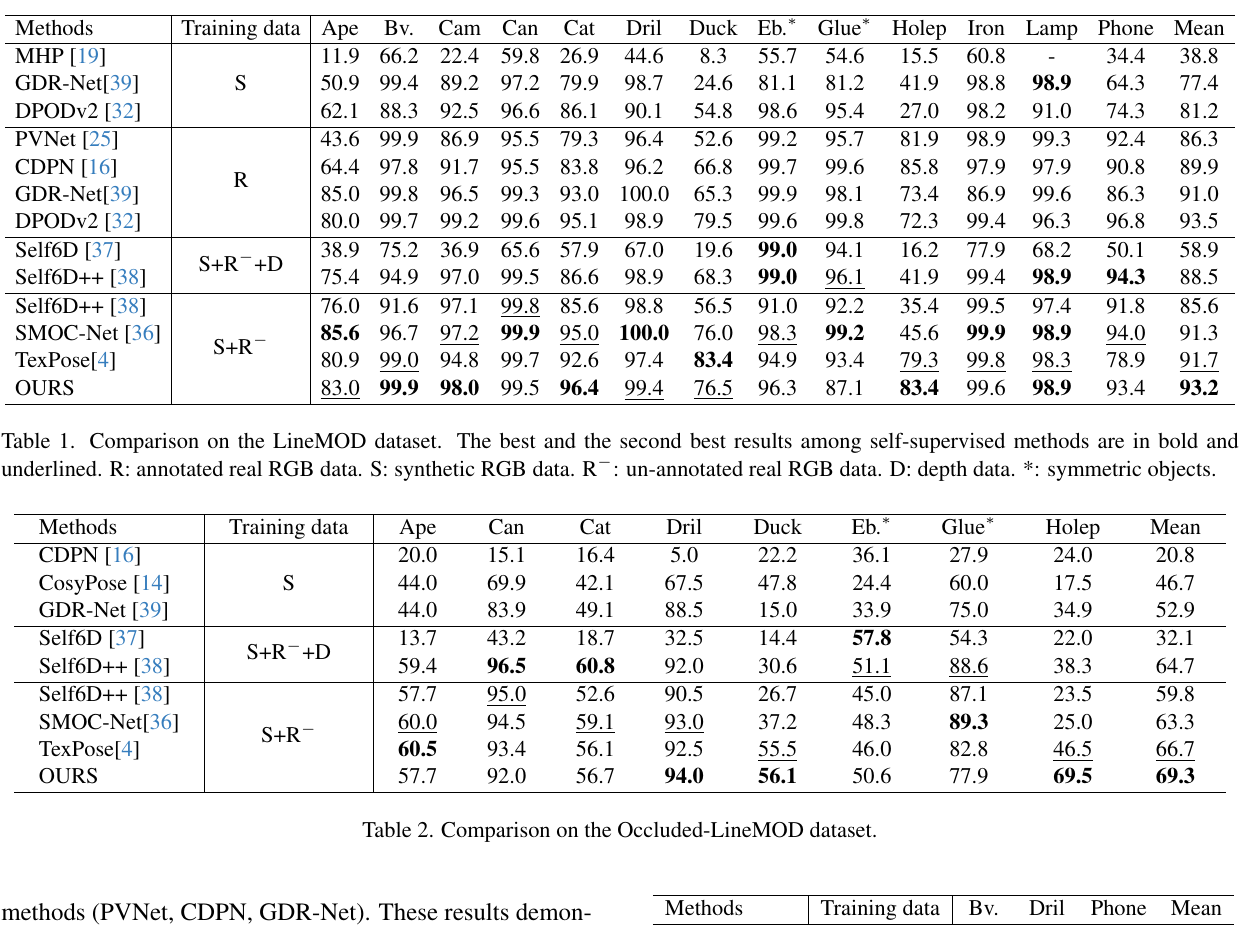
Compare self-supervised methods on LINEMOD, Occluded-LINEMOD, and HomebrewedDB, with occlusion ablations.
Inspect both standard and Occluded-LINEMOD; the former alone cannot validate occlusion awareness.
Crop of original results: complete LINEMOD / Occluded-LINEMOD tables with means 93.2 / 69.3; only the HomebrewedDB header appears at the bottom. The paper separately reports three-object HomebrewedDB mean 95.8. Training columns S, R−, D denote synthetic RGB, unlabeled real RGB, and depth. Source: CVPR 2025 paper. Image copyright belongs to the paper's authors and publisher; reproduced here for academic analysis.
Occluded-LINEMOD better tests the title’s claim: ONDA-Pose mean 69.3 exceeds TexPose 66.7 and SMOC-Net 63.3 under synthetic + unlabeled real RGB. LINEMOD 93.2 approaches real-labeled DPODv2 93.5, but unequal supervision prevents unconditional claims of exceeding full supervision.
6. Quick assessment
Value: radiance fields connect real appearance with supervisable geometry.
Boundary: CAD, unlabeled target data, and additional fitting remain required; this is not open-world inference on unknown target instances.
Available src/paper-notes/onda-pose/deep.md
In-depth paper notes
Support reproduction, comparison, related-work writing, and identifying opportunities for further research.
Paper Reading Notes (Deep): ONDA-Pose: Occlusion-Aware Neural Domain Adaptation for Self-Supervised 6D Object Pose Estimation
Problem: real-style translation of labeled synthetic images does not jointly resolve real texture and occlusion, leaving correct labels on insufficiently realistic data.
Answer: learn CAD-like radiance fields backward from unlabeled real images, render controllable real appearance, and use pose refiners for pseudo-labels.
2. Positioning in one sentence
Rather than image-to-image preprocessing alone, ONDA-Pose connects real appearance, synthetic poses, and occlusion adaptation through CAD-constrained radiance fields.
2.1 Guide to the paper’s figures and tables
Figure / table
What to look for
Figure 1
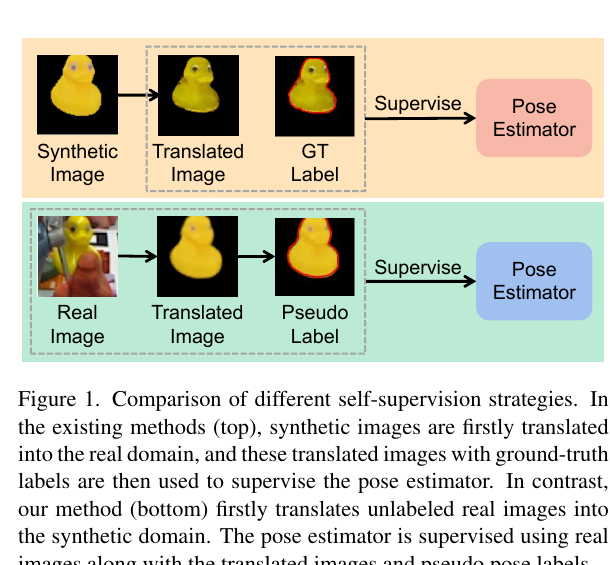
Why real→synthetic + pseudo poses instead of synthetic→real with GT pose supervision
Method figure
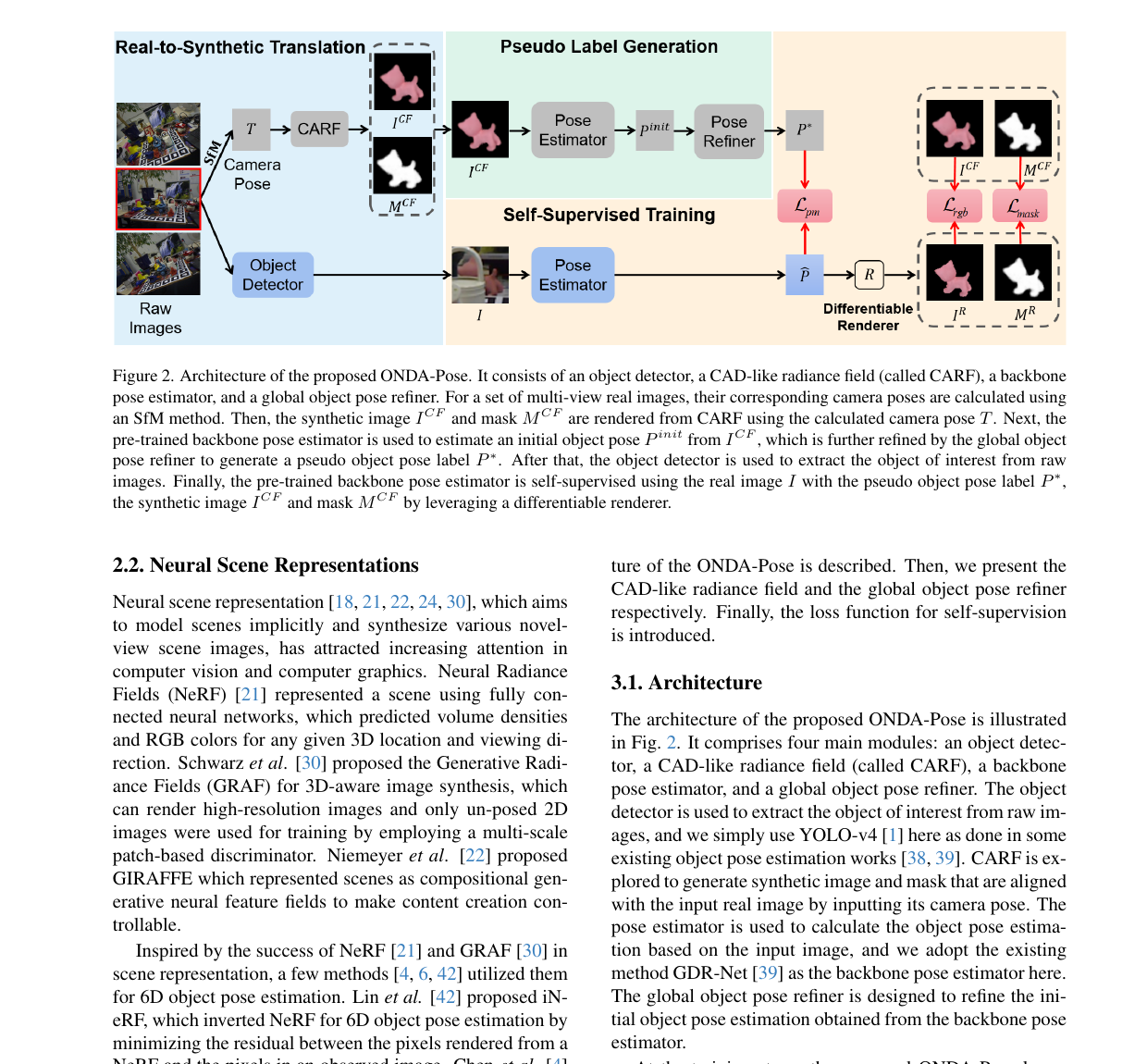
Training order for CAD-like fields, global refiners, and backbones
Tables 1–3
Matched self-supervision on LINEMOD, Occluded-LINEMOD, HomebrewedDB
Table 4 / Figure 4
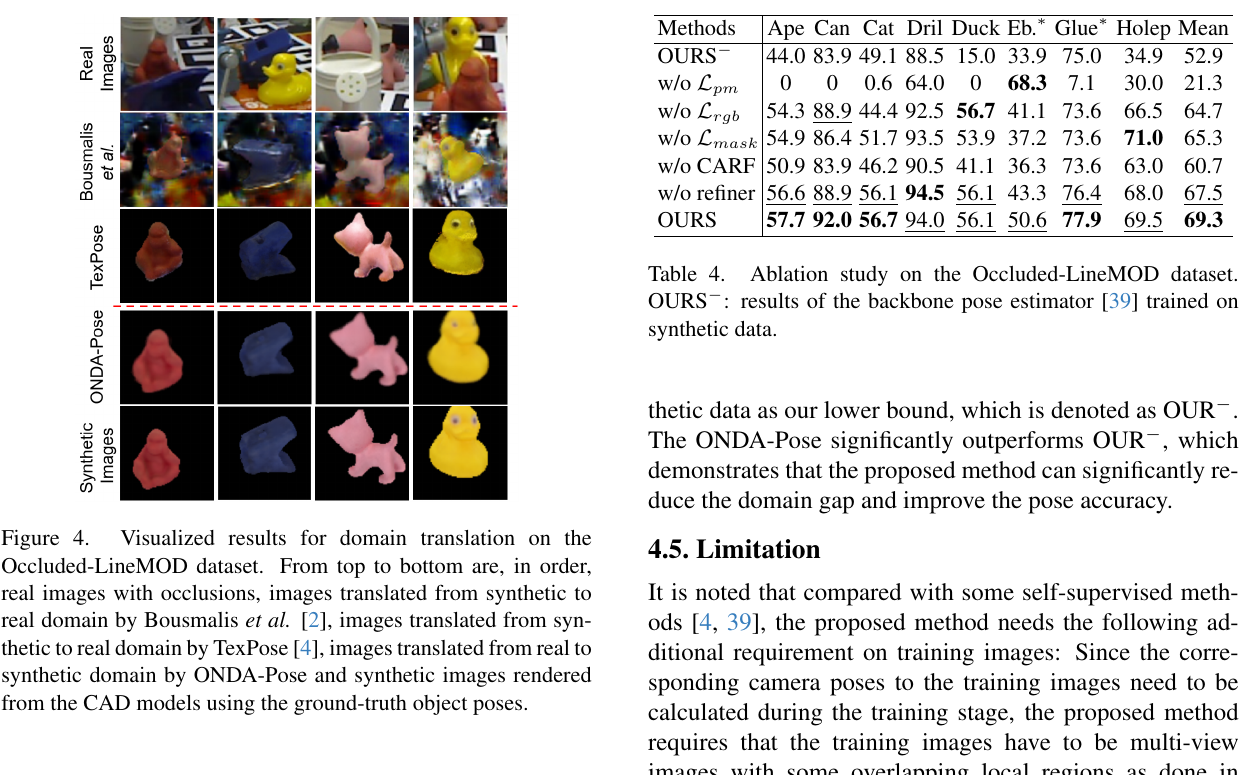
Actual contributions of occlusion awareness and translation
Original method-figure region: unlabeled real images construct CAD-like radiance fields, generate pseudo poses, and train final estimators. Source: CVF Open Access. Image copyright belongs to the paper's authors and publisher; reproduced here for academic analysis.
3. Problem setting and boundaries
Given target CAD, synthetic training data, and unlabeled real target images, output an instance-level 6D estimator.
This is sim-to-real adaptation, not direct generalization to entirely unknown test categories.
Real occlusion benchmarks are needed; standard lightly / unoccluded LINEMOD alone is insufficient.
4. Method details
CAD-like radiance field: fit real-image / CAD appearance into a renderable representation.
Pseudo-label generation: synthetic-trained backbones initialize rendered poses, corrected by a global object-pose refiner.
Joint self-supervision: real images / pseudo-labels and field renders train estimators with realistic occlusion / appearance.
5. Experimental analysis
Main tables cover LINEMOD, Occluded-LINEMOD, and HomebrewedDB with self-supervised rankings; check common detection / masks, CAD, and splits.
Supported extrapolation is improved pose under CAD + unlabeled target data, not CAD-free open-world inference.
Original Figure 1: conventional methods translate GT-labeled synthetic images to real style; ONDA-Pose maps unlabeled real observations into controlled synthetic domains and supervises with refined pseudo poses. Source: CVPR 2025 paper. Image copyright belongs to the paper's authors and publisher; reproduced here for academic analysis.
This changes label flow. Synthetic→real preserves rendering GT, but altered silhouettes / occlusion can break pixel-label alignment. Real→synthetic preserves observed occlusion / viewpoints, then fields / refiners estimate pseudo poses. Ground truth is not created for free; the difficulty shifts from post-translation alignment to pseudo-pose reliability.
Original Figure 4 / Table 4: real images, synthetic→real, real→synthetic, and CAD renders on the left; three self-supervised losses, CAD-like fields, and global refiners ablated on the right. Source: CVPR 2025 paper. Image copyright belongs to the paper's authors and publisher; reproduced here for academic analysis.
Occluded-LINEMOD synthetic-only backbone OURS− scores 52.9 versus full 69.3. Removing point matching drops to 21.3, making it central to stable self-supervision. Removing RGB / mask similarity gives 64.7 / 65.3; removing CAD-like fields gives 60.7 versus 67.5 without global refinement. Controlled real-appearance rendering matters more than the refiner’s individual 1.8-point gain.
Full-model drill / holepuncher scores are 94.0 / 69.5 versus duck / eggbox 56.1 / 50.6. Mean 69.3 does not imply uniform robustness; weak texture, symmetry, and occlusion remain object-dependent. HomebrewedDB benchvise / drill / phone scores 98.2 / 97.1 / 92.1 support transfer across capture environments but cover only three shared LINEMOD instances.
Occluded-LINEMOD and HomebrewedDB are central evidence; LINEMOD alone overstates support
7. Reproduction considerations and limitations
Save field training views, CAD scale, refiner initialization, and pseudo-label filtering rules.
Target data volume, visibility, and CAD-to-real shape gaps affect adaptation.
Field fitting, pseudo-labeling, and retraining costs cannot be summarized by per-frame network runtime.
The paper requires locally overlapping multi-view real training images for camera poses. Unlabeled means no object-pose labels, not arbitrary unrelated single images.