One2Any: One-Reference 6D Pose Estimation for Any Object
One2Any encodes a single reference RGB-D image into ROPE and decodes Reference Object Coordinates for a query, replacing multiview retrieval and CAD alignment with a continuous relative-coordinate representation.
Authors / affiliations: Mengya Liu et al.; ETH Zurich, INSAIT, Google, TUM.
Task: relative 6D pose for arbitrary objects from one reference RGB-D and one query RGB-D image.
Reading mode: Overview.
2. Positioning in one sentence
One2Any compresses reference shape, pose, and texture into ROPE, decodes query ROC maps without canonical NOCS, and solves relative pose with Umeyama.
3. Problem and motivation
CAD, many references, or category-specific training raise onboarding costs.
Single-reference estimation must preserve the reference frame, beyond matching features.
4. Method overview
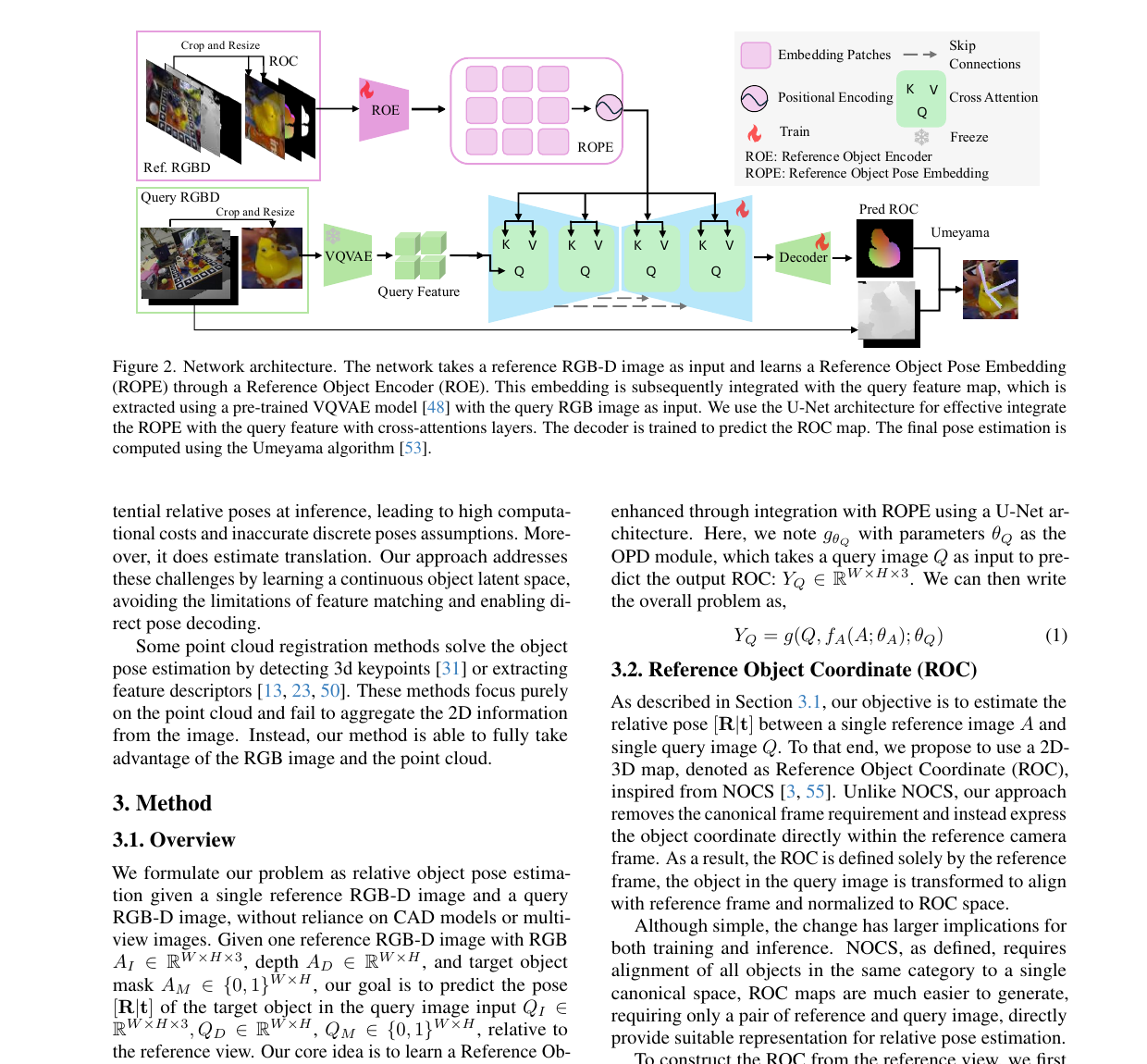
A Reference Object Encoder produces ROPE; pretrained VQ-VAE encodes queries.
Cross-attentive U-Net fuses ROPE / query features to output Reference Object Coordinates.
Align ROC with query depth through Umeyama for relative rigid transforms.
5. Experiments at a glance
REAL275, Toyota-Light, occluded YCB-Video, LINEMOD, and tracking compare one-reference with multi-view / CAD approaches.
Main tables report reference-relative pose, distinct from canonical absolute-pose outputs.
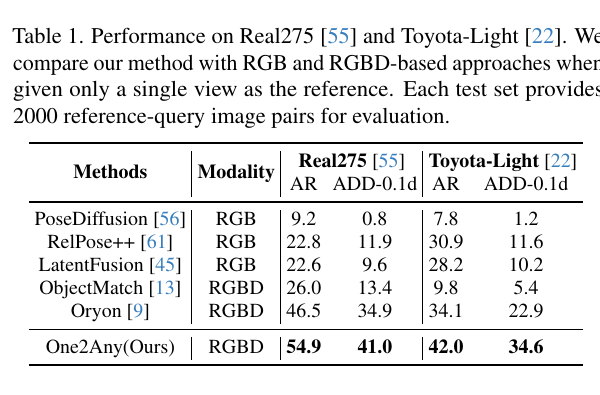
Original REAL275 / Toyota-Light tables: 2,000 reference-query pairs per test set. One2Any AR / ADD-0.1d is 54.9 / 41.0 and 42.0 / 34.6, respectively. Source: CVPR 2025 paper. Image copyright belongs to the paper's authors and publisher; reproduced here for academic analysis.
Single-reference RGB-D Oryon AR is 46.5 / 34.1 on REAL275 / Toyota-Light versus One2Any 54.9 / 42.0; ADD-0.1d rises from 34.9 / 22.9 to 41.0 / 34.6. This is more direct than cross-modality comparisons but still assumes GT masks and the prescribed 2,000 pairs.
Original Figure 2: Reference Object Pose Embedding encodes one RGB-D reference; query decoding predicts Reference Object Coordinates, followed by Umeyama pose fitting. Source: CVF Open Access. Image copyright belongs to the paper's authors and publisher; reproduced here for academic analysis.
3. Problem setting and boundaries
Both reference / query are RGB-D; no external reference-object pose annotation.
Output is the query-relative-to-reference rigid transform, with different frame freedoms from canonical CAD pose.
Masks and query-depth fitting are required; this is not RGB-only single-reference inference.
4. Method details
ROE / ROPE: encode reference shape, appearance, and orientation as latent conditions.
Query decoding: pretrained VQ-VAE features enter a ROPE-conditioned cross-attentive U-Net, predicting per-pixel reference-frame ROC.
Pose solving: ROC / depth-back-projected query pairs enter Umeyama for relative rotation, translation, and scale relationships.
5. Experimental analysis
REAL275, Toyota-Light, occluded YCB-Video, large-view LINEMOD, and tracking test categories, occlusion, and sequential use.
Group by reference conditions; one RGB-D reference cannot be declared unconditionally better than 8–200 views or CAD.
Embedding / decoding avoids per-query multi-view search or optimization for speed, depending on learned object-latent generalization.
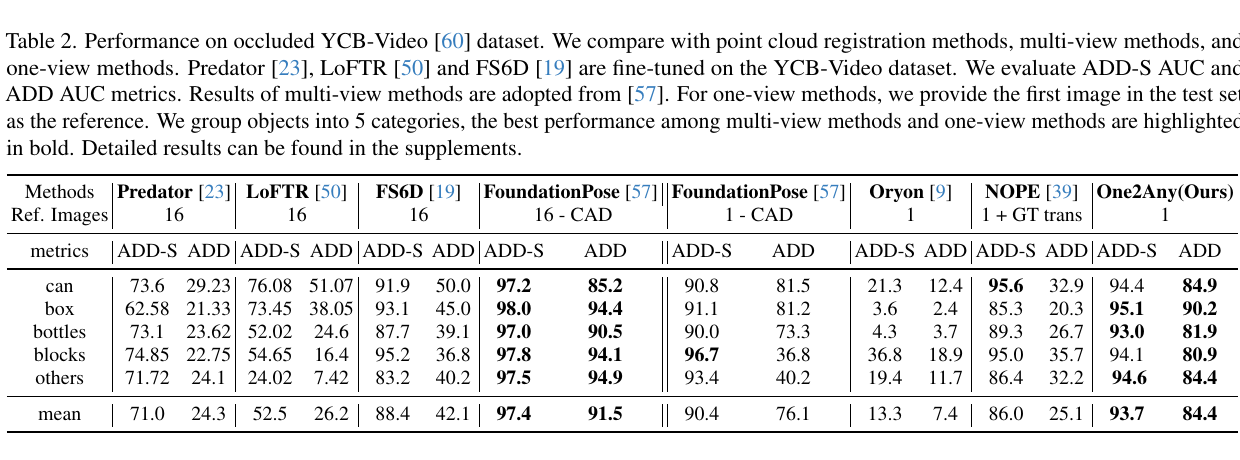
Original occluded YCB-Video results mix 16 views, CAD, single CAD, and single RGB-D references. Group reference budgets before comparing ADD-S / ADD. Source: CVPR 2025 paper. Image copyright belongs to the paper's authors and publisher; reproduced here for academic analysis.
One2Any’s one-reference occluded YCB-Video mean ADD-S / ADD AUC is 93.7 / 84.4; Oryon gives 13.3 / 7.4 and NOPE with GT translation 86.0 / 25.1. Single-CAD FoundationPose gives 90.4 / 76.1, versus 97.4 / 91.5 with CAD generated from 16 views. This supports competitive occluded single-reference estimation while acknowledging greater information in complete 16-view CAD.
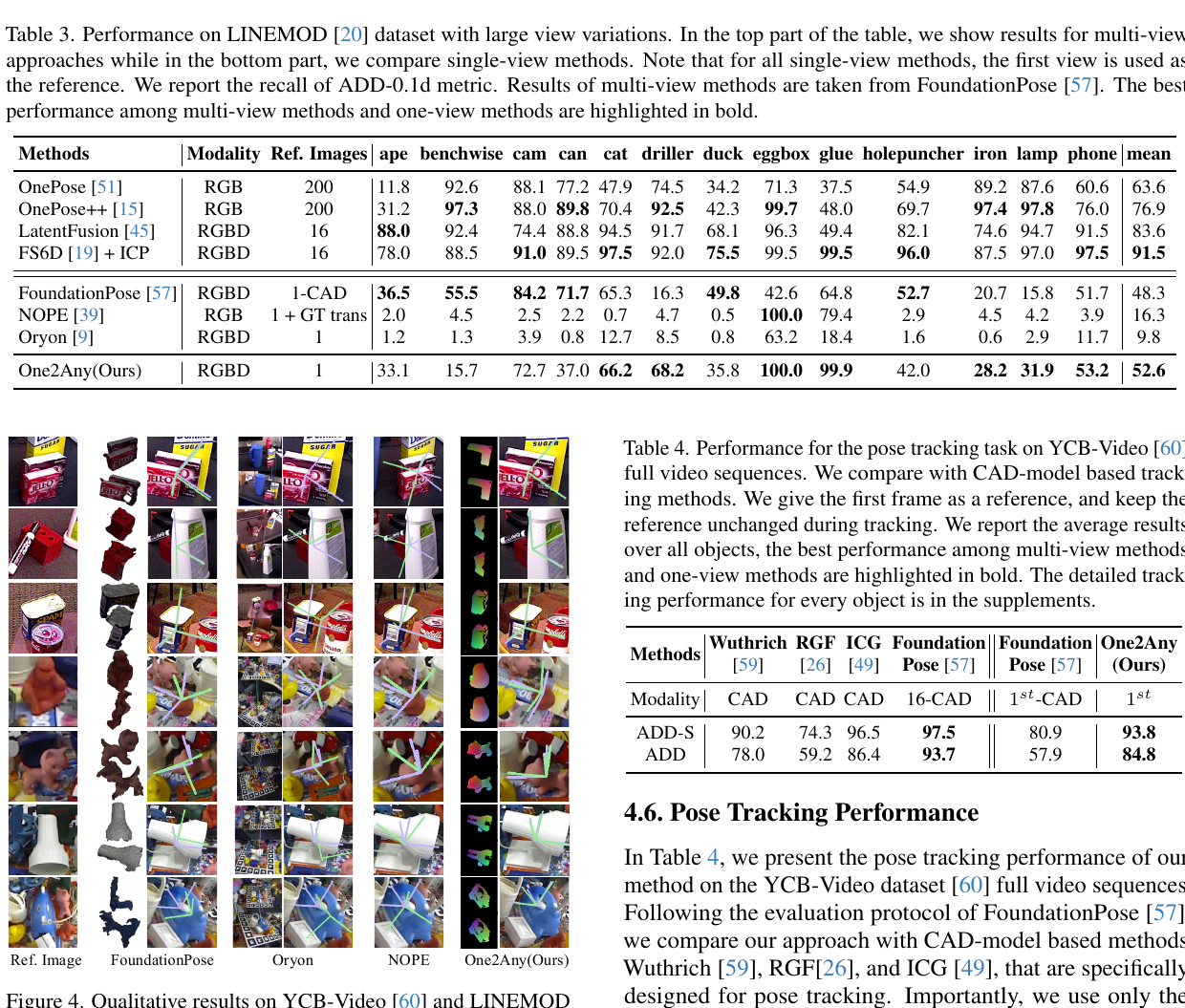
Original large-view LINEMOD table, YCB-Video / LINEMOD qualitative comparisons, and tracking results. Green predictions and pink GT are shown, with ROC maps at the right. Source: CVPR 2025 paper. Image copyright belongs to the paper's authors and publisher; reproduced here for academic analysis.
Large-view LINEMOD ADD-0.1d mean recall is 52.6, above one-reference FoundationPose 48.3, NOPE 16.3, and Oryon 9.8, below 16-RGB-D FS6D+ICP 91.5. Eggbox / glue reach 100.0 / 99.9, versus ape / benchwise 33.1 / 15.7, reflecting object-dependent symmetry, texture, and reference coverage. Fixed-first-frame YCB-Video tracking gives ADD-S / ADD 93.8 / 84.8; single-CAD FoundationPose 80.9 / 57.9 and 16-CAD 97.5 / 93.7.
Reported RTX 4090 runtime is 0.09 s, versus Oryon 0.90 s and FoundationPose 2.70 s. Feedforward latency benefits come with unequal GPU / rendering / onboarding conditions. ROC versus direct rotation-translation heads raises ADD-S / ADD from 84.7 / 59.4 to 91.2 / 78.6 and 5°5cm from 2.4 to 15.5, supporting correspondence decoding for generalization.
6. Authors’ claims and my assessment
Authors’ claims
My assessment
One reference rivals multi-view / CAD
Competitive across benchmarks, but check shared masks, depth, and protocols per row
ROC suits unknown objects better than NOCS
Reference frames avoid unknown canonicalization, while every query remains relative to that reference
Occluded / narrow references, no overlap, and inaccurate depth remove correspondence information, beyond a small correction problem.
Absolute world pose requires additional reference-to-robot / scene registration.
Training uses FoundationPose synthetic pairs and OO3D-9D multi-view data. Separate training object distributions from test instances; unseen instances do not imply independence from large-scale object priors.