For single-image novel-object view synthesis, OrienPose introduces Orientation-Aware Guidance and an Orientation Consistency Loss to constrain geometry across view changes. Matching against synthesized-view templates then estimates pose.
OrienPose injects reference orientation into novel-view synthesis for an unseen object from a single reference image. An orientation consistency loss constrains viewpoint changes geometrically, reducing distorted or blurred templates before pose is estimated by matching.
2.1 Guide to the paper’s figures and tables
Figure / table
Purpose
Overview reading tips
Figure 1
Ordinary versus orientation-guided NVS
First understand why pixel reconstruction alone cannot support pose estimation
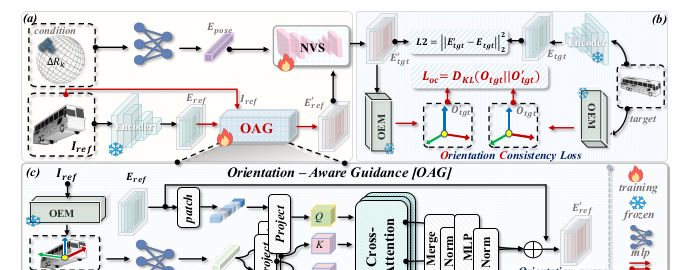
Crop of original Figure 2: candidate relative rotations and reference latents enter NVS; OAG injects reference orientation into the latent, while OCL compares generated and real target orientation distributions. Part of the OAG architecture appears below. Source: CVF Open Access. Image copyright belongs to the authors and publisher; reproduced here for paper analysis.
3. Problem setting
Inputs are one reference RGB image and one query RGB image of an object unseen during training.
No CAD model is required; NVS generates templates at target viewpoints.
Output is query-to-reference relative rotation, estimated by discrete rotation-template matching. The method does not recover metric translation and therefore does not provide complete 6D pose.
4. Method overview
Extract a latent object representation from the reference image.
Orientation-Aware Guidance injects reference object orientation into the latent.
Predict the viewpoint transformation and synthesize a view at the target orientation.
Orientation Consistency Loss constrains consistency across viewpoint rotation at the geometric level.
Retrieve the template most similar to the query among generated views to obtain pose.
5. Experimental overview
Training uses ShapeNet renders; testing covers 10 ShapeNet categories and 5 real NAVI instances.
Comparisons include novel-view / pose methods NOPE, GigaPose, and Free3D.
Results indicate that orientation guidance reduces flipped poses and geometric inconsistency for anisotropic shapes, blurred inputs, and transfer from simulation to reality.
6. Quick assessment
Value: pixel similarity in NVS does not imply correct pose; orientation geometry deserves explicit supervision.
Strengths: a single reference image, unseen objects, and no CAD; orientation constraints address template-generation degeneration directly.
Limitations: an RGB reference and reliable novel-view synthesis are needed; orientation ambiguity remains for approximately symmetric objects.
Recommended for readers studying unseen-object pose, NVS, 3D latents, and transfer from simulation to reality.
Available src/paper-notes/orienpose/deep.md
In-depth paper notes
Support reproduction, comparison, related-work writing, and identifying opportunities for further research.
Paper Reading Notes (Deep): OrienPose: Orientation-Guided Novel View Synthesis for Single-Image Unseen Object Pose Estimation
Key assessment: OrienPose turns synthesizing an image that resembles a target view into synthesizing a geometric template consistent with target orientation, making NVS more useful for pose matching.
2. Positioning in one sentence
Given a single reference image of an unseen object, OrienPose controls novel-view synthesis with orientation variables and uses an orientation consistency loss to constrain the geometric plausibility of viewpoint changes.
2.1 Guide to the paper’s figures and tables
Figure / table
Deep-dive questions
Figure 1
Where does ordinary NVS introduce distortion, and where in the latent does orientation guidance act?
Figure 2
How does orientation code enter the reference latent, and how do generated views support pose?
Table 1
Do anisotropic and nearly symmetric objects benefit differently?
Table 2
Does real-object generalization on NAVI retain the ShapeNet advantage?
Figure 6
Are OAG and OCL complementary, or is either alone sufficient?
Table 3
Does orientation loss mitigate degradation under input blur?
Relevant region of an original paper figure: orientation cues enter the reference latent to improve novel-view geometry and matchability. Source: code repository / CVF Open Access. Image copyright belongs to the authors and publisher; reproduced here for paper analysis.
3. Problem setting and task boundaries
The reference image supplies appearance and implicit geometry; the query supplies the pose to estimate.
No CAD model is needed: synthesized novel views serve as pose templates.
Training uses ShapeNet renders; testing includes ShapeNet objects from categories outside training and real NAVI instances.
Initial orientation in NVS is ambiguous: an unstable orientation definition can produce visually similar but geometrically flipped templates.
4. Research context
NVS pose methods typically match renders / generated images at discrete viewpoints against the query.
Ordinary pixel loss emphasizes color and local texture without guaranteeing object-level orientation; occlusion and weak texture amplify this issue.
By coupling orientation variables, supervision, and synthesis, OrienPose connects generative pose estimation with template matching.
5. Research motivation
Generating 3D structure from one image is underdetermined and needs an explicit orientation coordinate system.
Pixel reconstruction alone permits geometric distortion, blur, and inconsistent viewpoints.
Pose matching depends on orientation and structure rather than perfect reconstruction of every pixel.
OAG therefore injects an orientation prior, and OCL supervises consistency across rotation at the geometric level.
6. Method details
6.1 Orientation-Aware Guidance
The reference encoder produces object latents. OAG estimates an orientation distribution from the reference image and injects it into the reference embedding; NVS separately receives relative rotation ΔR as its target-view condition.
Guidance enters the reference latent so that the generator retains an explicit orientation condition while constructing the target view.
OAG uses discrete azimuth, in-plane rotation, and elevation probabilities as guidance, injecting them into reference embeddings through cross-attention. It should not be described as directly operating on a continuous SO(3) geometric variable.
6.2 Orientation Consistency Loss
The loss compares synthesized and real target orientation distributions, rather than directly establishing pointwise rotated correspondences between reference and target latents.
For a target view generated at ΔR, KL divergence along three angular dimensions constrains its orientation distribution to match the real target, jointly with pixel-level L2. This is different from an explicit 3D point-correspondence constraint.
This helps reduce flipped poses for anisotropic objects and improves template discrimination under blur / occlusion.
6.3 Pose matching
Synthesize novel-view candidates at multiple discrete relative rotations.
Compare each candidate with the query.
Select the best-matching viewpoint and convert its discrete orientation into the pose estimate.
Trade precision against inference time through candidate-sampling density.
7. Training and experiments
7.1 Data and baselines
ShapeNet training and testing use 10 categories, with separate test instances / categories.
NAVI supplies 5 real-world instances for zero-shot transfer from simulation.
Baselines include NVS-based NOPE, diffusion NVS Free3D, and GigaPose.
7.2 Interpreting results
ShapeNet Table 1 shows best or near-best performance in multiple categories, especially directionally distinctive bottle, bus, and guitar objects.
NAVI Table 2 demonstrates transfer from synthetic training to real objects. Performance drops in the real domain, but orientation constraints maintain relatively stable viewpoint judgments.
Blur and occlusion tests show that ordinary NVS more readily produces flipped or blurred templates, while OrienPose tends to retain more stable orientation cues.
7.3 Ablations
Removing OAG weakens orientation injection: useful direction should not be left entirely to spontaneous latent learning.
Removing OCL increases geometric inconsistency and pose ambiguity, indicating that pixel synthesis loss alone is insufficient.
Combining OAG and OCL performs best, supporting the combination of conditional injection and geometric supervision.
8. Critical analysis
Strength: directly connects NVS failures to pose geometry, with a clear problem analysis.
Limitation: single-image reconstruction leaves surfaces unobserved. Symmetric / nearly symmetric objects lack a unique orientation, and one discrete template may miss multiple solutions.
Deployment cost: multiple viewpoints must be synthesized; candidate count and resolution control speed. Real-time use may need caching or a coarse-to-fine strategy.
Data bias: ShapeNet-to-NAVI transfer is promising, but transparent, reflective, and nonrigid objects need broader evaluation.
9. Implications for my research
Extend pose supervision beyond pixels to geometry, normals, depth, and orientation consistency.
Explicitly maintain an object-orientation latent in generative pose methods alongside image conditioning.
Treat multiple NVS candidates as a pose posterior, rather than choosing only one argmax, to express symmetry and uncertainty.
10. Open questions
How can a stable canonical orientation be established automatically for a completely unseen object with no CAD and only RGB?
How can continuous SO(3) sampling be combined with generation to reduce viewpoint-candidate count?
How could OCL extend to articulated or deformable objects?
11. Further analysis: what do NVS pose constraints contribute?
11.1 Exact ShapeNet and NAVI results
Average results over 10 ShapeNet categories follow; higher ACC 30 and lower Median are better:
Method
ACC 30
Median
NOPE
52.3
27.7°
GigaPose (requires CAD; excluded from the CAD-free ranking)
61.6
23.57°
OrienPose
59.6
20.4°
For bottle / clock / bus / mug / washer / pistol / guitar / train / dishwasher / skateboard, ACC 30 is 66.1, 57.1, 58.7, 51.9, 65.5, 62.6, 59.6, 58.9, 53.2, and 62.1, respectively. Relative to NOPE, the authors report a mean ACC 30 gain of 7.3 percentage points and a Median reduction of 7.3°. Restrict this comparison to the same CAD-free, single-image unseen-object protocol.
Over five real NAVI instances, mean ACC 30 is 50.9 and Median is 35.7°: bull, bunny, sink, shark, and schoolBus. Transfer from simulation still incurs a substantial drop, but average performance exceeds RelPose / PIZZA / NOPE, indicating partial transfer of orientation-prior benefits across the rendering gap.
11.2 OAG / OCL mechanisms
OAG: estimate an object-orientation distribution from the reference image, embed discrete azimuth, in-plane rotation, and elevation probabilities into latents, and inject them into the reference embedding through cross-attention. This conditions viewpoint transformation in NVS rather than directly supplying the final pose.
OCL: compare synthesized and real target orientation distributions using KL divergence along three angular dimensions, jointly with pixel-level L2. This penalizes views that look plausible but have incorrect orientation statistics.
Pose estimation: define viewpoint / pose candidates, synthesize templates, and compare them with the query. The most similar template supplies the estimated pose, so NVS quality and candidate sampling jointly determine accuracy.
11.3 Robustness results
On ShapeNet bus, original ACC 30 is 58.7 and Median 18.3°. At 40% blur, ACC 30 remains 56.0 with Median 24.9°; at 40% occlusion, ACC 30 is 53.3 with Median 29.0°. This supports a more stable geometric cue from orientation priors than from pixel texture, but does not establish robustness to arbitrary occlusion.
11.4 Authors’ claims and my analysis
Level
Assessment
Authors’ claim
Orientation-aware NVS conditioning plus OCL reduces geometric misalignment and texture blur, improving pose.
Paper evidence
ShapeNet mean ACC 30 is 59.6 and NAVI 50.9, with relatively gradual degradation under blur / occlusion.
My reservation
Candidate count, NVS backbone, and orientation-estimator quality can all affect results; full OAG-only / OCL-only / baseline NVS tables are needed to isolate contributions.
Key failure
Symmetric or nearly symmetric objects lack a unique canonical orientation; synthesizing one plausible but nonunique view still leaves pose ambiguity.
12. Reproduction checklist
Fix the 10 ShapeNet categories, 5 NAVI instances, and train / test viewpoint splits.
Record orientation-candidate count, angular spacing, OAG bins, and OCL KL / pixel-loss weights.
Save generated-template contours, depth / normals where available, and final match scores; otherwise NVS failures are difficult to distinguish from matcher failures.
Report ACC 30 / Median separately for blur, occlusion, transparency, reflection, and symmetry; averages cannot replace failure analysis.