Oryon uses text prompts to jointly locate targets, learn local matches, and recover relative SE(3) from anchor / query RGB-D images of different scenes, without CAD or object video. With predicted masks, REAL275 / Toyota-Light BOP AR is 32.2 / 30.3; oracle masks give 46.5 / 34.1, showing that open-vocabulary segmentation remains a major performance limit.
text descriptionanchor RGB-D scenequery RGB-D scene
Requirements
the same target object visible in two scenesuser-provided object name or short visual descriptionvalid depth maps and camera intrinsicsShapeNet6D supervision during trainingPointDSC registration at inference
Full paper metadataAuthors, affiliations, research area, datasets, metrics, method tags, and reading statusExpandCollapse
Authors
Jaime Corsetti, Davide Boscaini, Changjae Oh, Andrea Cavallaro, Fabio Poiesi
Affiliations
Fondazione Bruno Kessler / University of Trento / Queen Mary University of London / Idiap Research Institute / EPFL
the same target object visible in two scenesuser-provided object name or short visual descriptionvalid depth maps and camera intrinsicsShapeNet6D supervision during trainingPointDSC registration at inference
Reading Notes
Overview / Deep Dive
Available src/paper-notes/oryon-cvpr2024/coarse.md
Paper overview notes
Quickly assess the paper's scope, problem setting, core method, experimental findings, and whether to read it in depth.
A text description locates targets, learns local matches, and estimates relative 6D pose across anchor / query RGB-D images from different scenes. No target CAD, object video, or supplied masks are needed, but depth and reliable linguistic reference are required.
3. Guide to figures and tables
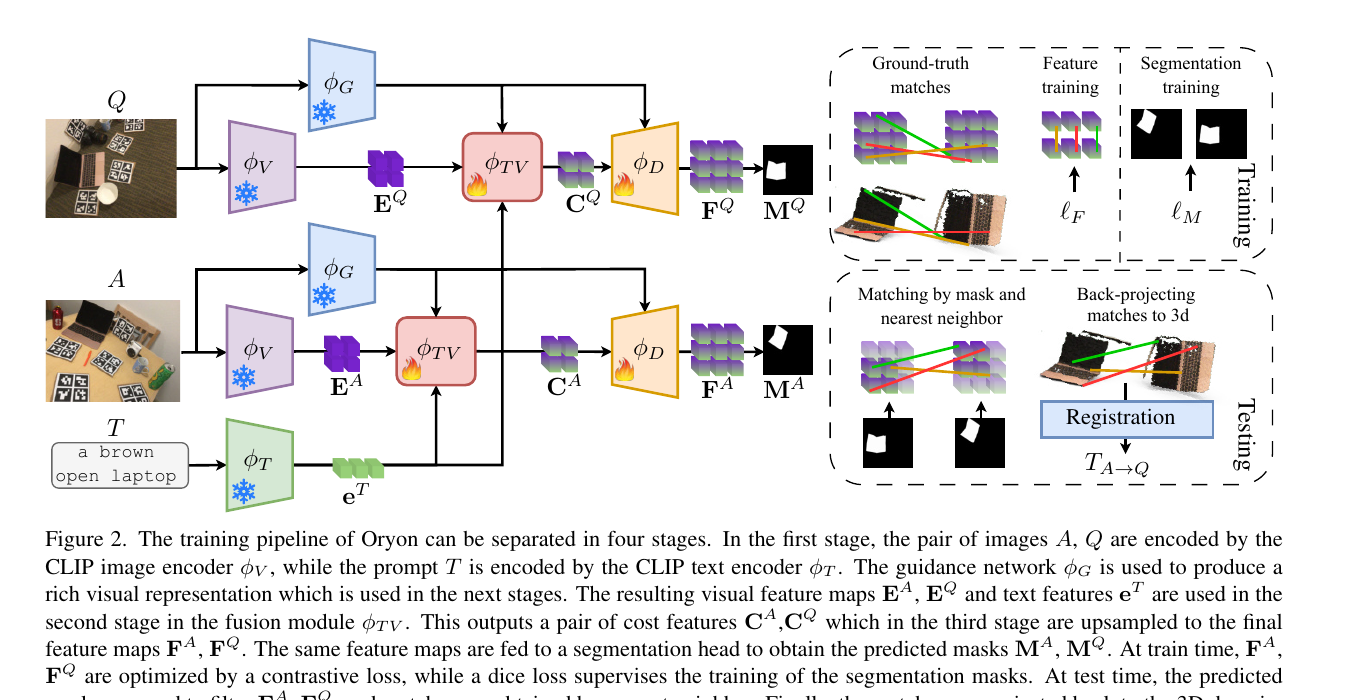
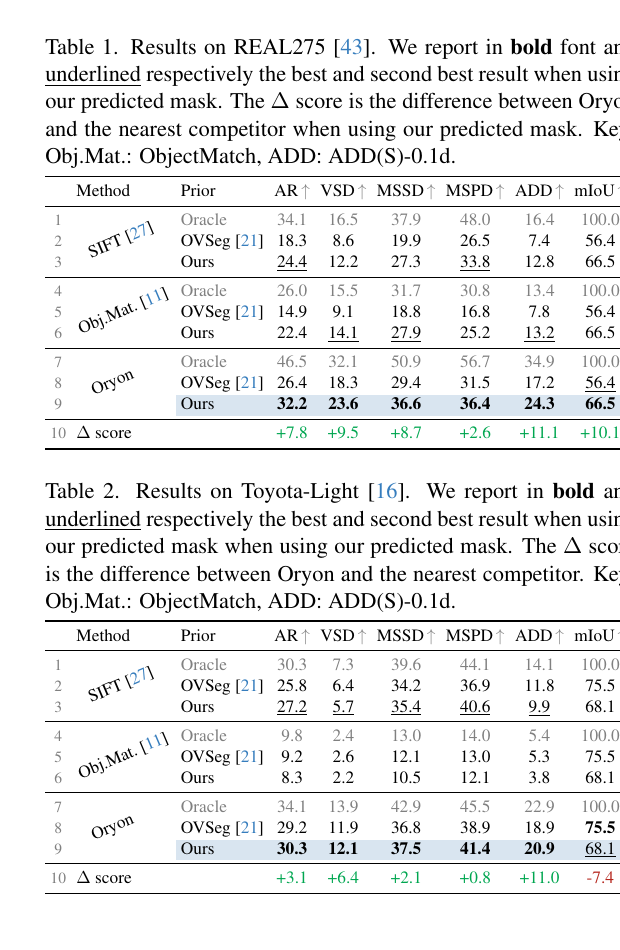
Original Figure 2: frozen CLIP image / text encoders supply semantics; guidance, cost aggregation, and decoding produce local features / masks. Test matches are filtered, back-projected, and registered. Source: published CVPR 2024 paper. Image copyright belongs to the authors and IEEE/CVF; reproduced here for academic analysis.Original Tables 1–2: predicted-mask BOP AR is 32.2 / 30.3 on REAL275 / Toyota-Light; oracle masks give 46.5 / 34.1. VSD, MSSD, MSPD, ADD(S)-0.1d, and mIoU are also reported. Source: published CVPR 2024 paper. Table copyright belongs to the authors and IEEE/CVF; reproduced here for academic analysis.
4. Problem setting
Inputs: text T, anchor RGB-D A, query RGB-D Q, and intrinsics.
Output: target-relative rigid transform TA→Q from anchor to query.
No test-time CAD, object-specific retraining, object videos, or GT masks.
Targets may be unseen categories but must appear in both images, with descriptions distinguishing same-named / similar objects.
This is open-vocabulary relative pose with a reference scene, not single-RGB absolute camera-frame pose.
5. Method overview
Frozen CLIP ViT-L/14 image and text encoders process RGB pairs and descriptions.
Visual guidance and text-visual cost aggregation condition local features on semantics.
Decoding upsamples to 192×192, sharing features for masks and correspondence.
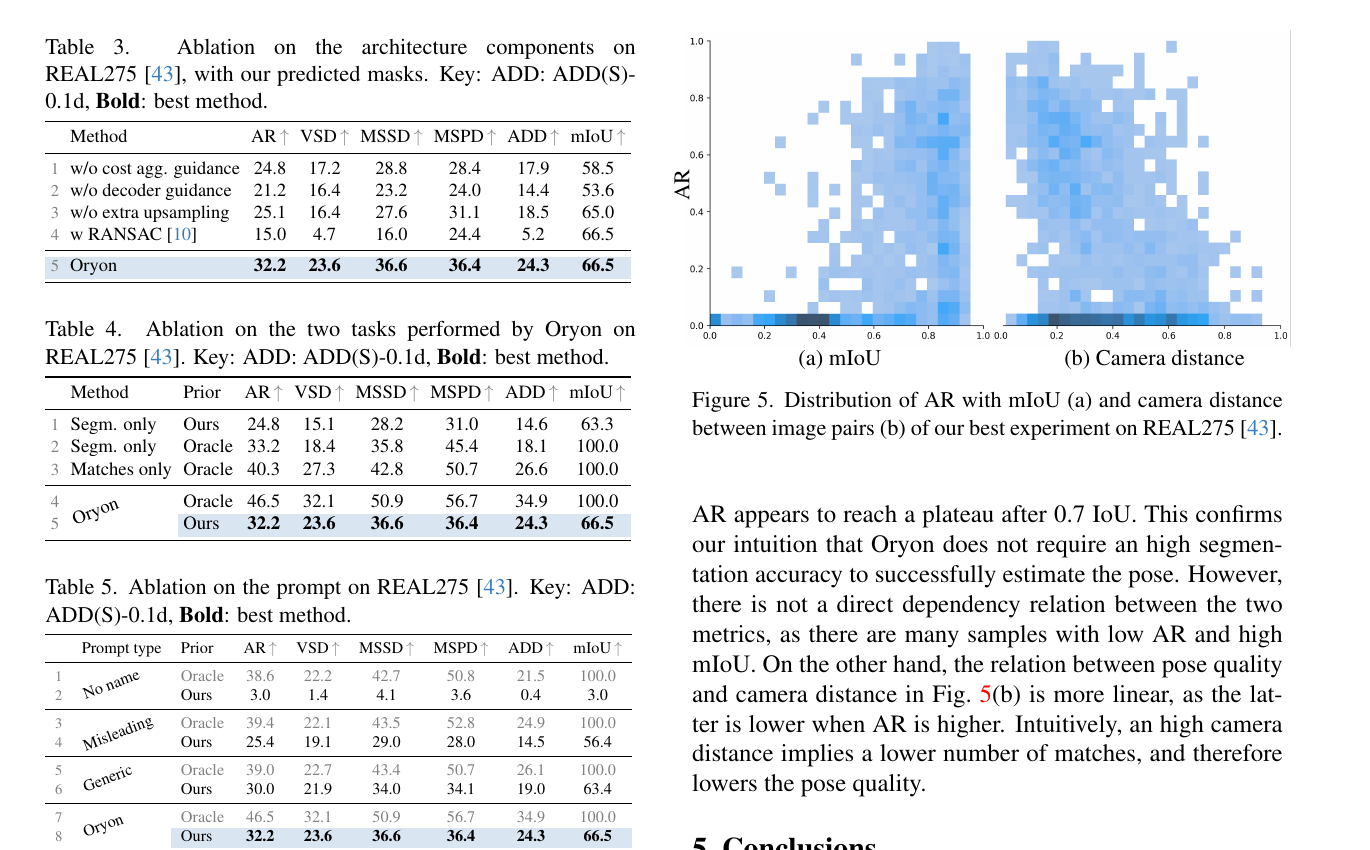
Without cost-aggregation guidance: AR 32.2→24.8; without decoder guidance: 21.2; PointDSC replaced by RANSAC: 15.0.
Prompting only “object” nearly fails segmentation, with AR / mIoU about 3.0; generic descriptions still reach AR 30.0.
7. Quick assessment
Strengths: unifies language reference, open-vocabulary masks, cross-scene local matching, and relative pose without object onboarding; clear geometric / semantic roles.
Main limits: two RGB-D images, mask / depth / repeated-structure limits, difficult descriptions for mechanical parts, and same-named-instance ambiguity.
Reading caveat: mIoU and AR are not equivalent; pose gains saturate above about 0.7 IoU. Robust registration tolerates some mask noise but cannot recover entirely missed targets.
Support reproduction, comparison, related-work writing, and identifying opportunities for further research.
Paper Reading Notes (Deep): Oryon
1. Key assessment
Oryon changes object onboarding from CAD, scans, or category IDs to language. It must jointly solve:
Which regions in two scenes match the text.
Which local positions correspond between those regions.
How noisy 2D correspondences yield reliable relative SE(3).
Shared feature learning handles the first two; explicit RGB-D geometry / PointDSC handles the third. Feasibility is supported, but predicted-mask REAL275 AR 32.2 versus oracle 46.5 exposes localization limits. This is a language-driven CAD-free relative-pose baseline, rather than a universal replacement for strong CAD-based absolute-pose systems.
2. Task and frame relations
Input:
Anchor scene A=(IA,DA,KA).
Query scene Q=(IQ,DQ,KQ).
Object description T, e.g. “a brown open laptop.”
Output:
TA→Q=[R0t1]∈SE(3),
aligning transformed anchor-target points with the same query object.
Model-free means no test-object CAD / video. Requirements remain:
The same rigid object in both images.
Back-projectable depth in both.
Camera intrinsics.
Sufficiently discriminative scene descriptions.
ShapeNet6D correspondence / segmentation supervision during training.
This differs from single-image category pose, CAD-based novel-object pose, and RGB-only relative rotation.
3. Shared text-visual local representations
Original Figure 2. Training jointly learns matching / segmentation; inference filters features by masks, matches nearest neighbors, back-projects, and registers. Source: published CVPR 2024 paper. Image copyright belongs to the authors and IEEE/CVF; reproduced here for academic analysis.
Three feature types:
Frozen CLIP ViT-L/14 ϕV extracts EA,EQ.
Frozen CLIP text ϕT extracts prompt tokens eT.
Frozen guidance backbone ϕG supplies local visual structure.
Core ϕTV modulates cost features with text and aggregates shifted-window Transformer context, preserving:
Object semantics: the concept being matched.
Local appearance: cross-scene pixel / patch correspondence.
Structure compatible with later depth-based geometry.
Decoder ϕD upsamples to 192×192, 32-channel FA,FQ. The same features yield masks MA,MQ, sharing representations / training instead of cascading independent boxes.
Joint Oryon: predicted-mask AR 32.2, oracle AR 46.5.
Matching improves segmentation and segmentation focuses features on targets, beyond a separate open-vocabulary frontend.
Inference:
Filter background using MA,MQ.
Match nearest neighbors in FA,FQ.
Sample up to 500 pairs.
Back-project with each depth map / intrinsics:
x=D(u,v)K−1[u,v,1]⊤;
PointDSC rejects outliers in {xiA,xiQ} and solves R,t.
Robust registration is central: replacing PointDSC with RANSAC lowers REAL275 AR from 32.2 to 15.0, a 17.2 drop. VLM features alone do not explain performance.
5. Data and evaluation
Training:
ShapeNet6D;
About 20k pairs.
Same models across different views / scenes.
20 epochs;
Generalizable text-visual correspondence, rather than memorized REAL275 classes.
Evaluation:
REAL275: 2k scene pairs derived from NOCS real splits.
Toyota-Light: 2k scene pairs;
34 instances, 4k pairs total.
Substantial differences in layout, background, and camera positions.
Metrics:
VSD: visible-surface discrepancy.
MSSD: symmetry-aware maximum surface distance.
MSPD: symmetry-aware maximum projection distance.
AR: mean recall across the three error-threshold ranges.
ADD(S)-0.1d;
segmentation mIoU.
Anchor→query GT composes poses from two scenes. Its AR is related to, but not identical with, standard BOP target-list / absolute-camera detection protocols.
6. REAL275 and Toyota-Light main results
Original Tables 1–2. Methods use oracle, OVSeg, and Oryon masks separately. Green Δ compares the closest competitor under the same mask, not oracle results. Source: published CVPR 2024 paper. Table copyright belongs to the authors and IEEE/CVF; reproduced here for academic analysis.
REAL275:
Method / mask
AR
VSD
MSSD
MSPD
ADD
mIoU
SIFT / Oryon mask
24.4
12.2
27.3
33.8
12.8
66.5
ObjectMatch / Oryon mask
22.4
14.1
27.9
25.2
13.2
66.5
Oryon / Oryon mask
32.2
23.6
36.6
36.4
24.3
66.5
Oryon / Oracle
46.5
32.1
50.9
56.7
34.9
100
With shared predicted masks, AR exceeds SIFT by 7.8 and ObjectMatch by 9.8. ADD exceeds the nearest competitor by 11.1, supporting semantic-local features beyond mask benefits.
Toyota-Light:
Method / mask
AR
VSD
MSSD
MSPD
ADD
mIoU
SIFT / Oryon mask
27.2
5.7
35.4
40.6
9.9
68.1
ObjectMatch / Oryon mask
8.3
2.2
10.5
12.1
3.8
68.1
Oryon / Oryon mask
30.3
12.1
37.5
41.4
20.9
68.1
Oryon / Oracle
34.1
13.9
42.9
45.5
22.9
100
Toyota-Light’s stronger lighting / domain shift narrows SIFT’s gap through scale invariance, while ObjectMatch fails substantially. Oracle-to-predicted AR differs by only 3.8 versus REAL275’s 14.3, suggesting more appearance / geometry error than mask error there.
7. Good masks do not guarantee good poses
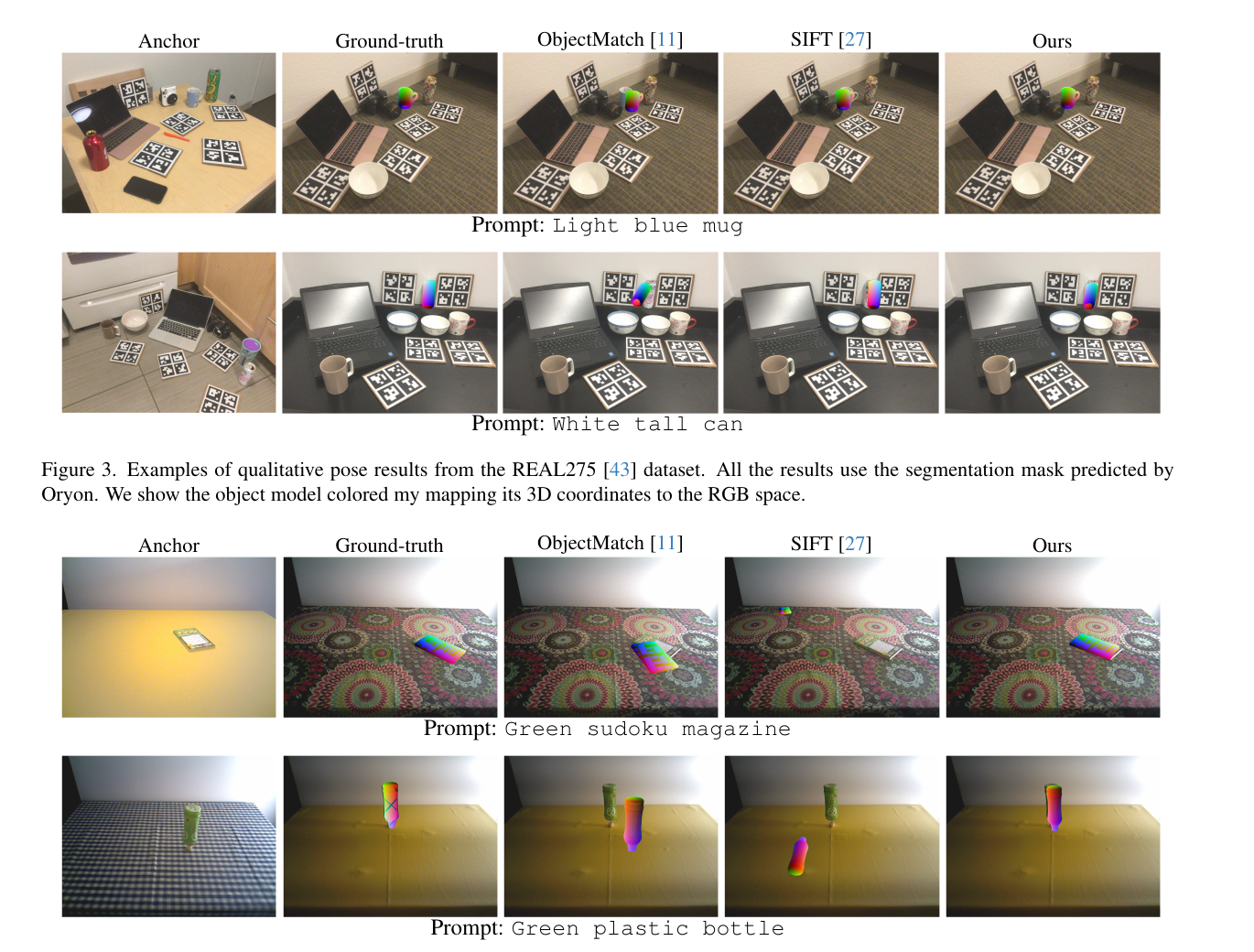
Original Figures 3–4. Colored coordinates project model points under predicted poses. Oryon usually aligns better than ObjectMatch / SIFT across scenes, scales, and lighting, but slender-object translations can drift. Source: published CVPR 2024 paper. Image copyright belongs to the authors and IEEE/CVF; reproduced here for academic analysis.
Two observations:
Reasonable target masks can coexist with ObjectMatch rotation / translation failures; localization and local geometry differ.
Small / slender objects offer few valid depth points, limiting PointDSC despite correct semantics.
Joint segmentation / matching reduces error coupling without eliminating degeneracy.
8. Architecture, prompts, and sensitivity
Original Tables 3–5 and Figure 5. Guidance, upsampling, registration, joint tasks, and prompts are ablated on the left; AR versus mask IoU / camera distance appears on the right. Source: published CVPR 2024 paper. Figure / table copyright belongs to the authors and IEEE/CVF; reproduced here for academic analysis.
Architecture:
No cost-aggregation guidance: AR 24.8.
No decoder guidance: 21.2.
One fewer upsampling layer, 96×96 features: 25.1.
RANSAC replacing PointDSC: 15.0.
Full model: 32.2.
prompt:
Prompt only “object”: predicted-mask mIoU 3.0, AR 3.0.
Misleading attributes with correct name: mIoU 56.4, AR 25.4.
Name only / generic description: mIoU 63.4, AR 30.0.
Full description: mIoU 66.5, AR 32.2.
Names drive category selection; attributes help same-class instance / state disambiguation. Arbitrary language is not uniformly robust, making prompts a measurable system variable.
Sensitivity:
AR rises rapidly as low IoU approaches 0.4.
It plateaus around 0.7.
High mIoU can still yield low AR; no deterministic equivalence.
Longer camera distances reduce matches and AR.
9. Related approaches
FoundationPose / GigaPose:
CAD / reconstructed models and absolute pose, usually higher accuracy.
Oryon substitutes text + anchor RGB-D for onboarding, opening the task.
NOPE / DVMNet:
All estimate relative pose.
NOPE uses one RGB reference, mainly relative rotation.
DVMNet solves RGB-pair pose through voxel matching.
Oryon additionally handles language reference / in-scene localization, requiring RGB-D.
Reproduce contrastive and Dice objectives separately.
Match nearest-neighbor, mask-filter, and 500-pair sampling order.
Use identical PointDSC checkpoints / parameters.
Report predicted / oracle masks to separate perception and geometry.
Report AR, VSD, MSSD, MSPD, ADD, and mIoU together.
Save prompts for matched reference conditions.
Isolate same-name instances, distance, small targets, and depth holes.
12. Overall assessment
Oryon brings linguistic target selection into local matching, beyond frontend selection alone. REAL275 gains over SIFT / ObjectMatch, substantial guidance / PointDSC ablations, and quantified prompt effects support the design.
The 32.2 predicted versus 46.5 oracle AR gap shows that VLMs do not remove pose difficulty. Reliable systems still need disambiguation, missed-mask recovery, valid depth, and low-overlap registration. Oryon establishes reproducible text-specified, CAD-free cross-scene RGB-D relative pose while exposing semantic and geometric error limits.