Pose Anything Anywhere: Model-free Object Poses from Arbitrary References
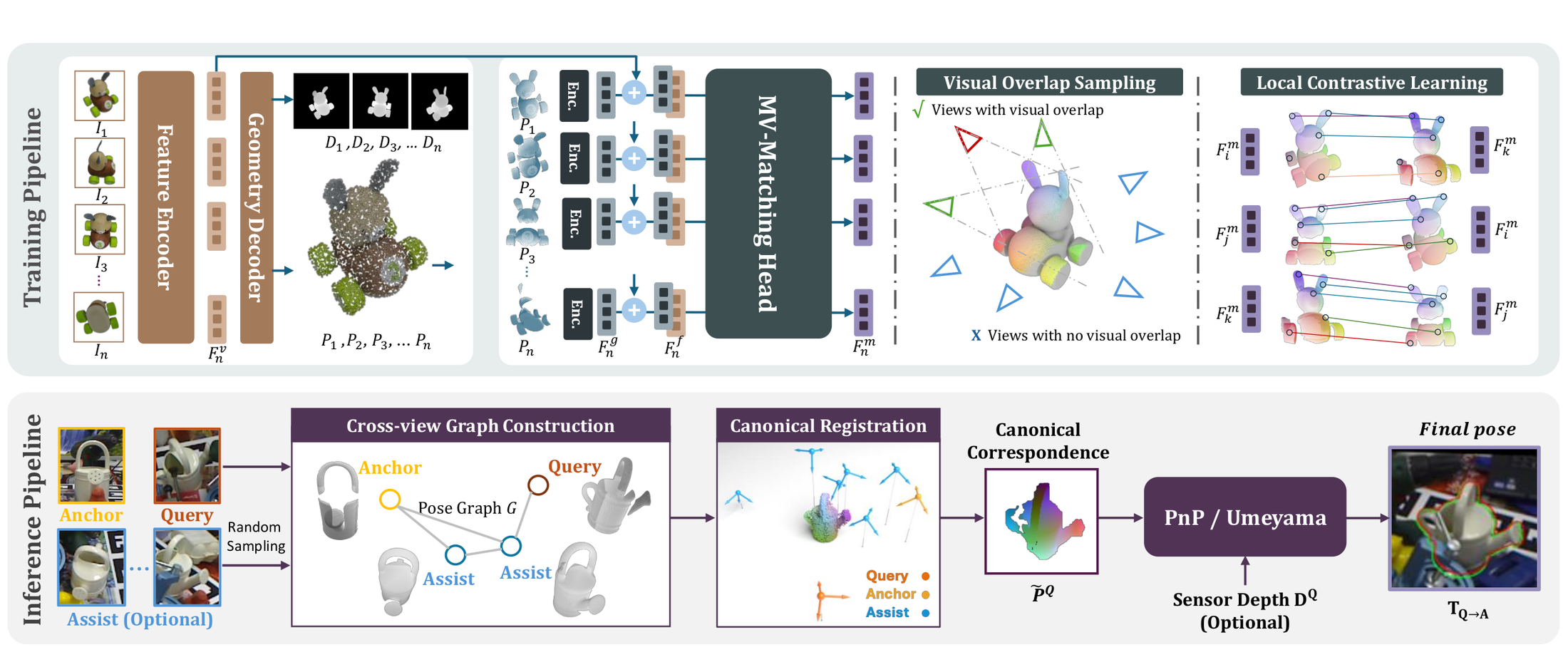
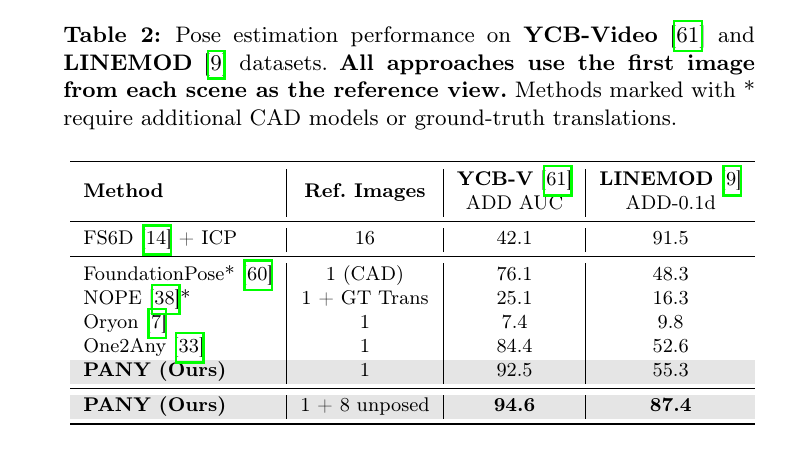
PANY estimates CAD-free unseen-object 6D pose using a canonically posed anchor and optional unposed assist views. LoRA-adapted VGGT predicts multiview geometry; fused geometric–visual descriptors, cross-view contrastive learning, and pose-graph registration recover query pose. RGB uses PnP, while RGB-D uses Umeyama. Single-reference YCB-V ADD AUC is 92.5, rising to 94.6 with 8 assist views; LINEMOD ADD-0.1d rises from 55.3 to 87.4. Arbitrary / pose-free references still assume an anchor with a defined canonical pose, object masks, and sufficient view connectivity.
one reference anchor with a predefined canonical posequery and reference object maskscamera intrinsics for RGB PnPoptional sensor depth for Umeyama alignmentsufficient cross-view appearance or geometric overlap
Full paper metadataAuthors, affiliations, research area, datasets, metrics, method tags, and reading statusExpandCollapse
Authors
Hongli Xu, Jiaqi Hu, Junwen Huang, Boyang Zhong, Peter KT Yu, Nassir Navab, Benjamin Busam, Slobodan Ilic
Affiliations
Technical University of Munich / Munich Center for Machine Learning / Siemens AG / XYZ Robotics / ROBOX
one reference anchor with a predefined canonical posequery and reference object maskscamera intrinsics for RGB PnPoptional sensor depth for Umeyama alignmentsufficient cross-view appearance or geometric overlap
Reading Notes
Overview / Deep Dive
Available src/paper-notes/pany-eccv2026/coarse.md
Paper overview notes
Quickly assess the paper's scope, problem setting, core method, experimental findings, and whether to read it in depth.
Paper Reading Notes (Coarse): Pose Anything Anywhere: Model-free Object Poses from Arbitrary References
1. Basic information
Abbreviation: PANY (Pose Anything Anywhere)
Authors: Hongli Xu, Jiaqi Hu, Junwen Huang, Boyang Zhong, Peter KT Yu, Nassir Navab, Benjamin Busam, Slobodan Ilic
Affiliations: Technical University of Munich, MCML, Siemens AG, XYZ Robotics, ROBOX
Year / venue: ECCV 2026; verified version: arXiv:2606.23634 v1 (2026-06-22)
An object-adapted multiview geometry Transformer jointly predicts dense geometry and cross-view 3D correspondences. A canonical anchor and unposed assist views form a pose graph for unseen-instance 6D pose, supporting CAD-free single / sparse references and RGB / RGB-D.
2.1 Guide to the paper’s figures and tables
Figure / table
Question
Reading focus
Figure 2
How does geometry / matching training lead to inference through a pose graph?
Distinguish anchor, query, and assist; RGB uses PnP, while RGB-D can use Umeyama.
Table 2
How much do unposed assists improve a single reference?
Single-reference YCB-V is already strong; wider-view LINEMOD benefits more.
Figure 4
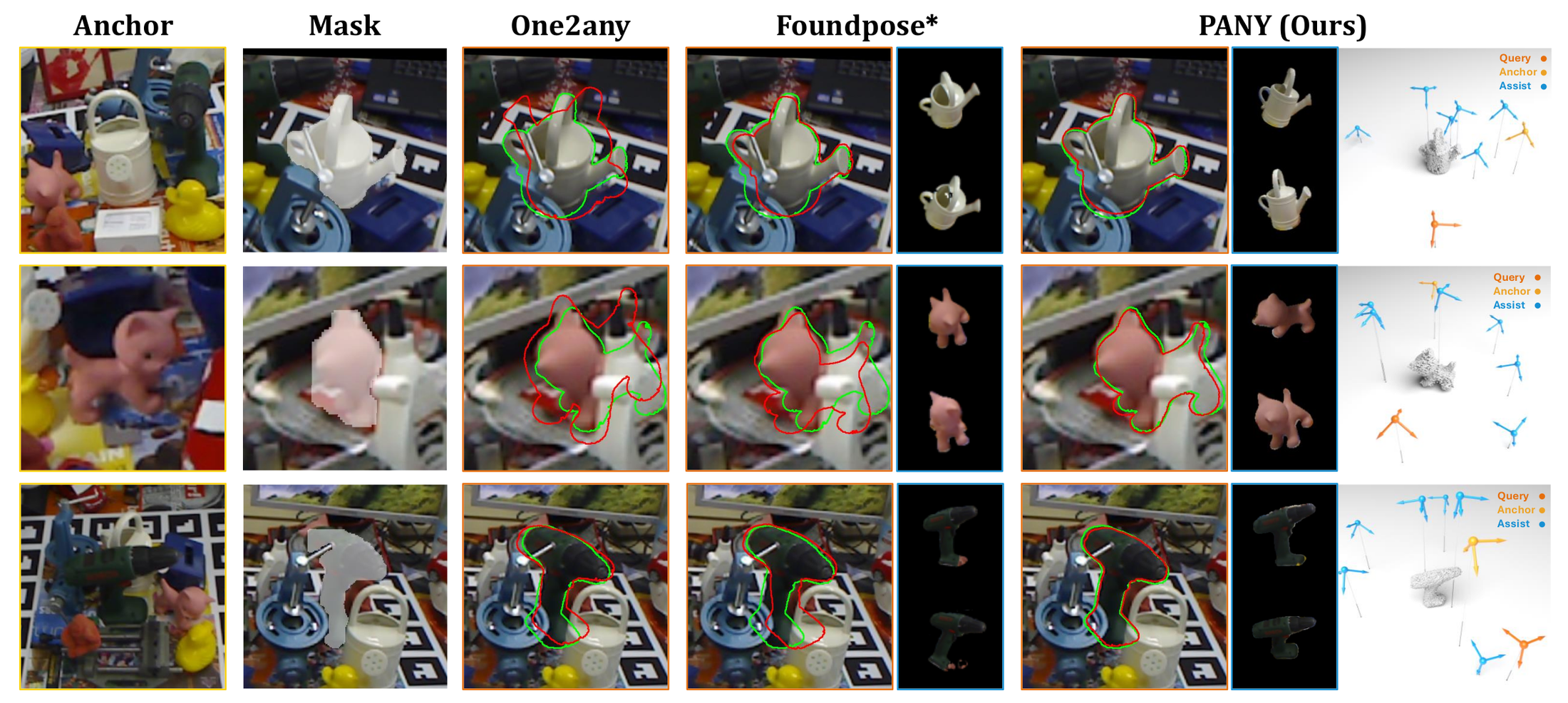
How do low-overlap / wide-baseline errors differ from One2Any / FoundPose?
Compare red / green contours and assist connections between query and anchor.
Table 4 + Figure 5
Do gains come from the backbone, matching, fusion, or multiple views?
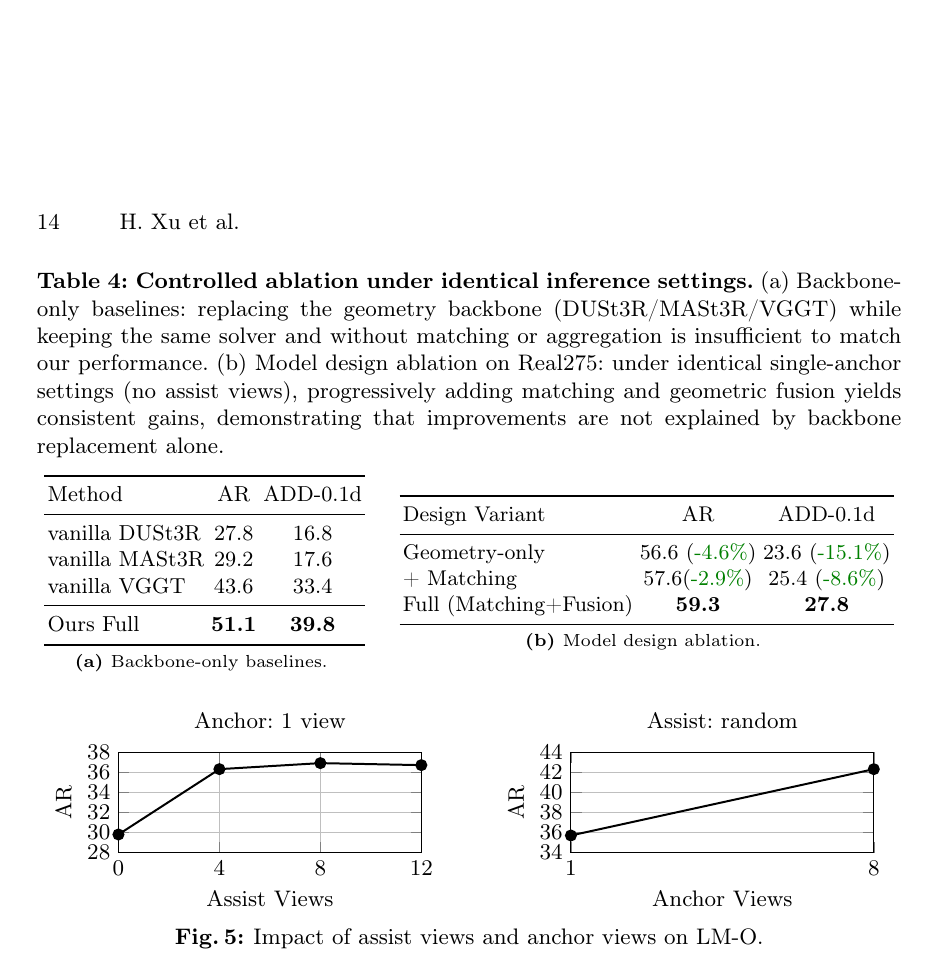
The backbone alone is insufficient; assist gains saturate around 4 views.
Inputs: query RGB / RGB-D, an anchor reference, optional unposed assist references, and object masks.
Output: query 6D pose in the canonical object frame defined by the anchor.
Not required: CAD, per-object training, or explicit NeRF / 3DGS / SfM reconstruction onboarding.
Still required: a known canonical anchor pose; intrinsics and PnP for RGB; depth for RGB-D; usable query / reference masks.
Use case: a robot encounters a new object with a few casual reference photographs, potentially sharing little query–anchor overlap under occlusion / wide viewpoints.
Pose-free references can be misleading: assists are unordered and unposed, but the anchor still defines canonical poseTA. PANY reduces extra-view labeling and CAD onboarding, rather than recovering absolute object pose without a reference coordinate frame.
4. Core motivation
Existing approaches incur distinct costs:
Accurate model-based methods need CAD, template libraries, or render-and-compare;
Reconstruction-first methods avoid CAD but often need dense posed views and costly per-object reconstruction;
Pairwise model-free methods match only query and anchor, failing when unseen backsides, occlusion, or wide baselines leave insufficient surface overlap.
The key insight is that extra photographs are cheap, while annotating every view is expensive. Unposed assists serve as geometric relays between query and anchor, reducing dependence on one pairwise match.
5. Method overview
Original Figure 2: above, joint multiview dense geometry, geometry–visual descriptors, and local contrastive matching; below, anchor, query, and unposed assists form a cross-view graph for canonical registration followed by PnP / Umeyama. Source: arXiv:2606.23634. Image copyright belongs to the authors and publisher; reproduced here for paper analysis.
5.1 Training
DINOv2 and a VGGT-style multiview Transformer process N object views;
DPT heads predict per-view depths and point maps;
A geometric encoder extracts rotation-invariant local point features, fused with visual tokens;
The MV-matching head uses bidirectional cross-entropy / local contrastive supervision on overlapping view pairs;
Total loss combines depth, point-map, and matching terms.
5.2 Inference
Predict point maps and correspondences for anchor, query, and assists;
Connect view pairs whose valid-correspondence count exceeds a threshold;
Estimate edge similarity transforms with RANSAC + Umeyama;
Register local clouds to the canonical anchor frame through the pose graph;
Use Kabsch–Umeyama for RGB-D, or 3D–2D correspondences and PnP for RGB-only query pose.
This recovers only the local multiview geometry needed for canonical alignment, without first building a complete object model.
6. Experimental overview
Training data: Omni6DPose, over 5,000 CAD instances in 149 categories, yielding over 2 million object-centric RGB-D images.
Test data: REAL275, Toyota-Light, YCB-Video, LINEMOD, and LINEMOD-Occlusion, all unseen in training.
Metrics: BOP Average Recall, ADD-0.1d, ADD AUC.
Training cost: about 36 hours on 2 NVIDIA A100s; the VGGT backbone is largely frozen with LoRA rank 8 / alpha 32, while matching trains from scratch.
Original Table 2: one anchor gives 92.5 ADD AUC on YCB-V and 55.3 ADD-0.1d on LINEMOD; 8 unposed assists raise these to 94.6 / 87.4. Starred methods additionally require CAD or GT translation. Source: arXiv:2606.23634. Image copyright belongs to the authors and publisher; reproduced here for paper analysis.
Main results:
REAL275, single-reference RGB-D: 81.8 AR / 89.3 ADD-0.1d, versus One2Any 54.9 / 41.0 and Any6D 51.0 / 53.5.
YCB-V, single reference: 92.5 ADD AUC, increasing to 94.6 with 8 unposed assists.
LINEMOD, single reference: 55.3 ADD-0.1d, rising to 87.4 with assists, supporting geometric relays for wide baselines / low overlap.
LM-O, CNOS masks: 36.9 AR with one reference and 42.3 with multiple references; One2Any gives 18.2 and RayPose with 8 posed references gives 42.1.
Inference: Table 3 reports 0.19 s / 0.75 s for single / multiple references, without fully separating segmentation or other preprocessing.
A useful counterexample is Toyota-Light RGB-only ADD-0.1d: PANY gives 10.8 versus SingRef6D’s 13.1. The main text’s across-all-metrics claim is too broad; advantages are more consistent in RGB-D and low-overlap multiview settings.
7. Strengths and limitations
Strengths
One framework covers RGB / RGB-D and single / sparse references, broader than most pairwise methods.
Unposed assists lower real acquisition barriers relative to reconstruction onboarding.
Foundation geometry, explicit correspondences, and RANSAC / Umeyama / PnP form an interpretable evidence chain.
Real benchmarks including YCB-V, LM-O, and REAL275 cover occlusion, low texture, and wide baselines.
Limitations / risks
Model-free / pose-free still needs a canonically posed anchor, masks, and calibration.
Extreme occlusion or complete query–reference nonoverlap can prevent reliable graph edges.
Strong symmetry leaves multiple geometric solutions, without explicit distributions or symmetry-aware hypothesis management.
Large synthetic CAD training and two A100s mean low onboarding cost is not low training cost.
Multiple references increase acquisition and inference costs; 8 default assists may be impractical for some robots.
8. Research takeaways
Reusable idea: organize sparse unposed references into a cross-view graph rather than averaging pairwise poses; useful for pose, object-centric tracking, and active view selection.
As a baseline: suitable for CAD-free / model-free unseen pose; when CAD is allowed, also compare FoundationPose, FoundPose, and MegaPose.
Worth deep reading: yes; focus on canonical anchors, matching labels, graph connectivity, and the RGB / RGB-D solver branches.
Open questions: noisy masks, symmetry, active views, failure confidence, unknown scale, and end-to-end detection / segmentation latency.
Available src/paper-notes/pany-eccv2026/deep.md
In-depth paper notes
Support reproduction, comparison, related-work writing, and identifying opportunities for further research.
Paper Reading Notes (Deep): Pose Anything Anywhere: Model-free Object Poses from Arbitrary References
1. Basic information
Abbreviation: PANY (Pose Anything Anywhere)
Authors: Hongli Xu, Jiaqi Hu, Junwen Huang, Boyang Zhong, Peter KT Yu, Nassir Navab, Benjamin Busam, Slobodan Ilic
Affiliations: Technical University of Munich, Munich Center for Machine Learning, Siemens AG, XYZ Robotics, ROBOX
Year / venue: ECCV 2026; full-text evidence currently comes from arXiv:2606.23634 v1
Evidence scope: methods, values, and figures below were checked against the public preprint dated 2026-06-22. Later ECCV camera-ready changes require rechecking tables and presentation status.
2. Positioning in one sentence
PANY models a canonically oriented anchor, unposed assists, and a query as an object-centric multiview graph. LoRA-adapted VGGT predicts point maps; geometry–visual descriptors learn correspondences; canonical graph registration and PnP / Umeyama recover unseen-object pose, targeting wide baselines, occlusion, and low query–anchor overlap.
2.1 Guide to the paper’s figures and tables
Figure / table
Evidence
Site interpretation
Figure 2
Full training / inference pipeline
Learned local geometry and cross-view matches feed an explicit graph that converts unposed assists into canonical-pose constraints.
Table 2
Single / multiple-reference results
LINEMOD benefits much more than YCB-V, consistent with improved viewpoint coverage.
Figure 4
LM-O qualitative comparisons
Closer GT contours do not replace quantitative evaluation; failures are not illustrated.
Table 4 + Figure 5
Backbone, matching, fusion, and view-count ablations
VGGT alone does not explain gains; returns diminish after 4 assists.
3. Problem setting and task boundaries
3.1 Mathematical setting
Inputs are:
I={IQ}∪{IA}∪{IiU}i=1M,N=M+2.
IQ: query view;
IA: anchor view with predefined canonical pose TA;
IiU: optional unordered assist views without camera-pose annotations;
YCB-V / LINEMOD follow One2Any, using each sequence’s first frame as anchor and GT masks.
LM-O uses CNOS masks, closer to practice. Reference budgets / priors differ: model-based methods have CAD / many posed templates; PANY uses 1 posed anchor plus optional 8 unposed assists.
These establish competitiveness in distinct operating regimes rather than one strictly equal-input-cost ranking.
4. Research context
4.1 Three preceding approaches
Approach
Examples
New-object cost
Typical bottleneck
CAD / template model-based
MegaPose, FoundationPose, FoundPose, GigaPose
CAD, rendered templates, or model libraries
Asset acquisition and appearance / geometry gaps
Reconstruction-first
OnePose, NeRF / 3DGS onboarding, OnePoseViaGen
Multiview acquisition, SfM / neural reconstruction or generated 3D
Slow onboarding and hallucinated geometry
Pairwise model-free
Oryon, One2Any, SingRef6D
One reference, usually no CAD
Insufficient overlap / unstable matches under wide baselines and occlusion
PANY adapts a foundation geometry model from scene-centric camera / depth prediction to object-centric canonical alignment. One2Any mainly infers reference object coordinates from one pair; PANY jointly builds a sparse-view graph with assists relaying between query and anchor.
4.2 Difference from reconstruction-first methods
Predicted point maps and canonical cloud registration resemble reconstruction, but a complete renderable model is unnecessary before pose estimation. Local geometry carries correspondences / alignment: alignment-oriented transient geometry, rather than persistent reconstruction.
5. Research motivation
Single-reference failure can be informational, beyond network capacity: front-only anchors and back-only queries may share no visible surface. Intermediate assists can replace one unreliable wide-baseline edge with several reliable shorter-baseline edges.
The central idea has two levels:
Learning: make point maps / descriptors object-consistent across views rather than strongly view-dependent;
Geometry: connect only enough valid matches and propagate transforms to the canonical anchor.
This structure makes geometry, matching, and connectivity failures more diagnosable than direct pose regression from additional image tokens.
6. Method details
Original Figure 2: DINOv2 / VGGT-style depth and point-map prediction feeds geometry–visual fusion and locally supervised MV matching. Inference builds a graph over anchor, query, and assists, registers canonically, and solves with PnP / Umeyama. Source: arXiv:2606.23634. Image copyright belongs to the authors and publisher; reproduced here for paper analysis.
6.1 Multiview geometry backbone
Patchified images enter DINOv2; Transformer blocks alternate:
Frame-wise intra-attention;
Global cross-attention across views.
DPT heads predict depth D^i and point maps P^i per view:
f:{Ii}i=1N→{(D^i,P^i)}i=1N.
The key question is not depth accuracy alone, but whether maps share sufficiently consistent geometry for canonical alignment.
6.2 Geometry–visual matching fusion
Point maps alone are insufficient because foundation visual features remain view-dependent. Parallel branches produce:
A geometric encoder maps P^i to Fig with rotation-invariant positional embeddings;
Visual features Fiv lifted into 3D using coordinates P^i;
Fused features Fif;
Matching features Fim through alternating sparse geometric and dense linear attention.
Formally:
Fim=Tmatch(Fif,P^i).
Combining visual similarity and local geometric compatibility reduces mismatches under weak texture, changing appearance, and wide baselines.
6.3 Local contrastive correspondence supervision
For valid view pair (i,j), descriptor similarities are:
Aij=Fim(Fjm)⊤.
Nearest-neighbor GT matches use point distances in a shared frame; points beyond δdis are unmatched. Bidirectional cross-entropy per pair is:
Lij=CE(Aij,Y^i)+CE(Aij⊤,Y^j),
Average over valid edges E. Local contrastive learning here trains descriptors with explicit 3D GT matches rather than generic image–text alignment.
6.4 Joint objective
L=λdLdepth+λpLpoint+λmLmatch,
Weights are λd=1, λp=1, and λm=0.05. InfoNCE temperature is also reported as 0.1, while matching is described as bidirectional CE; code should clarify the exact CE / InfoNCE relationship.
6.5 Cross-view pose graph
Among 2048 samples per view pair, count valid 3D correspondences; connect pairs exceeding η=500. RANSAC + Umeyama estimates similarity transform Ti←j on each edge.
For node i, compose transformations along anchor path π(i,A):
Ti→A=(k,l)∈π(i,A)∏Tk←l,
Register point maps as P~i=Ti→AP^i. Assists improve connectivity and intermediate coverage rather than simply being averaged.
6.6 Final pose solver
Sensor depth available: Kabsch–Umeyama aligns query and canonical points through similarity / rigid alignment.
RGB-only: predicted canonical 3D / query 2D matches enter PnP.
These have unequal information: RGB-D directly supplies metric depth, so its higher accuracy cannot be attributed entirely to network architecture.
Omni6DPose: over 5,000 CAD objects, 149 categories;
Over 2 million object-centric RGB-D images;
Each sample has a query plus 2–8 references, 3–9 views total;
At least two positive references; the stated visible-overlap / pose threshold is θOFP=10∘.
7.2 Optimization
Crop / resize to 518×518;
Largely frozen VGGT with LoRA rank 8 / alpha 32;
Matching head trained from scratch;
AdamW, learning rate 10−4, first-epoch warm-up;
15 epochs, 500 iterations each, batch size 16;
About 36 hours on 2× NVIDIA A100.
7.3 Inference cost
Table 3 reports 0.19 s / 0.75 s for single / multiple references. Detector / segmentation, crops, CNOS masks, and data transfer are not timed separately. These better describe internal reference-count costs than complete robotic perception latency.
7.4 Reproduction challenges
Correct crops, masks, and canonical anchor conventions;
Point-map frames, scale, and similarity-transform directions are easy to reverse;
Graph thresholds, RANSAC inliers, and path choices affect extreme-view cases;
Separate RGB / RGB-D solvers and input protocols in evaluation;
Align symmetric GT correspondences with BOP symmetry evaluation;
Check that linked code includes weights, training, and full preprocessing.
CNOS masks; 1 anchor plus optional 8 unposed assists
Only synthetic Omni6DPose is used for training; all real test datasets assess unseen objects / domains.
8.2 Metrics
ADD-0.1d: success when mean model-point distance is below 10% of diameter. For symmetric objects using ADD-S / BOP equivalence, consult the evaluation script.
ADD AUC: area under the ADD(-S) threshold curve, common on YCB-V.
BOP AR: multithreshold recall over VSD, MSSD, and MSPD, addressing symmetry / visible surfaces beyond one ADD score, while still depending on masks / detections.
No end-to-end detection AP, robot grasp success, or reference-acquisition time is reported; practical usability remains mainly benchmark-supported.
8.3 Main single / multiple-reference results
Original Table 2: single-reference YCB-V / LINEMOD scores are 92.5 ADD AUC / 55.3 ADD-0.1d, rising to 94.6 / 87.4 with 8 unposed assists. Larger LINEMOD gains support geometric relays across difficult viewpoint gaps. Source: arXiv:2606.23634. Image copyright belongs to the authors and publisher; reproduced here for paper analysis.
Setting
PANY
Key baseline
Absolute difference
Interpretation
REAL275 RGB, AR
59.3
SingRef6D 28.7
+30.6
Effective object-centric RGB geometry transfer
REAL275 RGB-D, AR
81.8
One2Any 54.9
+26.9
Strong depth / 3D alignment benefits
YCB-V single reference, ADD AUC
92.5
One2Any 84.4
+8.1
Better single-reference occlusion performance
YCB-V 1+8 views, ADD AUC
94.6
One2Any 84.4
+10.2
Near saturation, limited extra-view gains
LINEMOD single reference, ADD-0.1d
55.3
One2Any 52.6
+2.7
Modest single-reference improvement
LINEMOD 1+8 views, ADD-0.1d
87.4
One2Any 52.6
+34.8
Coverage is decisive
LM-O single reference, AR
36.9
One2Any 18.2
+18.7
Strong gains with CNOS masks
LM-O 1+8 views, AR
42.3
RayPose, 8 posed refs, 42.1
+0.2
Comparable using 1 posed + 8 unposed views
Two qualifications:
The abstract cites YCB-V +12% and LM-O >+20%; deep analysis should name comparators and absolute values. Differences above are recalculated from tables to avoid conflating relative percentages and percentage points.
Toyota-Light RGB ADD-0.1d is 10.8, below SingRef6D’s 13.1; Table 1 does not fully support superiority on all metrics.
8.4 Qualitative results
Original Figure 4: One2Any, FoundPose, and PANY on LM-O. Green / red contours indicate GT / prediction; right insets show query, anchor, and assist cameras. PANY contours are closer in these wide-baseline examples, but extreme-occlusion / symmetry failures are absent. Source: arXiv:2606.23634. Image copyright belongs to the authors and publisher; reproduced here for paper analysis.
The useful evidence is the right-hand view graph: assists fill the anchor–query viewpoint gap, visualizing the motivation. Author-selected examples cannot establish overall failure rates.
8.5 Ablation studies
Original Table 4 and Figure 5. Left: replacing DUSt3R / MASt3R / VGGT alone cannot match the full model. Right: under the same single-reference setup, geometry-only, matching, then matching + fusion increase Real275 ADD-0.1d from 23.6 → 25.4 → 27.8. Below: most gains occur from 0 to 4 assists, then saturate. Source: arXiv:2606.23634. Image copyright belongs to the authors and publisher; reproduced here for paper analysis.
Ablation
AR
ADD-0.1d
Claim tested
Assessment
Geometry-only
56.6
23.6
Direct point-map alignment is insufficient
Supported
+ Matching
57.6
25.4
Learned correspondences help independently
Supported, though AR rises only +1.0
+ Matching + Fusion
59.3
27.8
Geometry–visual fusion further helps
Supported
Vanilla VGGT
43.6
33.4
Backbone strength alone does not explain performance
Supported against full-model 51.1 / 39.8
LM-O AR rises from about 30 with 0 assists to about 36 with 4, reaching about 37 at 8–12 views. Default 8 balances accuracy / stability amid diminishing returns.
8.6 Robustness and failures
Occlusion: YCB-V / LM-O support moderate-to-heavy occlusion tolerance; extreme occlusion remains an acknowledged failure.
Low texture: LINEMOD / visual examples support some ability through geometric fusion.
Wide baselines: strongest experimental claim, jointly supported by assist gains and graph interpretation.
Symmetry: an explicit limitation; without multiple probabilistic hypotheses, insufficient geometry leaves direction ambiguous.
Noisy masks: limited evidence beyond LM-O CNOS, as many experiments use GT masks.
Reusable modules: geometry-aware local descriptors, valid-match thresholds, RANSAC–Umeyama edges, and anchor-centric composition.
Required baselines: One2Any, Oryon, Any6D, FoundPose / FoundationPose; multireference work should compare posed templates and unposed assists at equal budgets.
Potential directions: active reference acquisition, graph uncertainty, symmetry, and joint detector–pose robustness in open-world pose.
Engineering caution: unify TQ→A, Ti→A, and left / right multiplication for camera / object frames before graph implementation; visually plausible poses can otherwise fail evaluation completely.
12. Open questions
Conceptual questions
How are canonical anchors constructed per dataset, and do they need manual orientation?
How does RGB-only recover stable scale / translation, and where does metric point-map scale originate?
Mathematical / implementation questions
With both bidirectional CE and InfoNCE temperature stated, what exact matching loss does the code use?
With multiple paths, does the graph use tree traversal, shortest paths, or global optimization? How are loops handled?
Experimental questions
Does Table 3 timing include backbone, matching, graph, solver, and masks?
What are per-class results under BOP symmetry-aware metrics?
How much multiview gain comes from coverage versus test-time augmentation?
Reproduction questions
Does the repository supply pretrained weights, Omni6DPose sampling, and unified evaluation for all five benchmarks?
Can random 8-assist sampling reproduce Tables 2 / 3 exactly? How are seeds and candidate pools defined?