3D Representations / Reconstruction · 2024 · IROS · CCF C
PEGASUS: Physically Enhanced Gaussian Splatting Simulation System for 6DoF Object Pose Dataset Generation
PEGASUS represents objects and environments with 3D Gaussians for appearance and low-poly meshes for collision. PyBullet generates natural rigid-body trajectories, which are rendered and exported as BOP-format RGB, depth, masks, boxes, and 6-DoF poses.
PEGASUS separately scans real environments and objects into 3D Gaussian Splatting assets, using low-poly meshes extracted from their clouds for PyBullet collisions. Shared rigid transforms then move Gaussian appearance for rendering RGB, depth, masks, boxes, and 6DoF labels directly in BOP format.
3. Guide to figures and tables
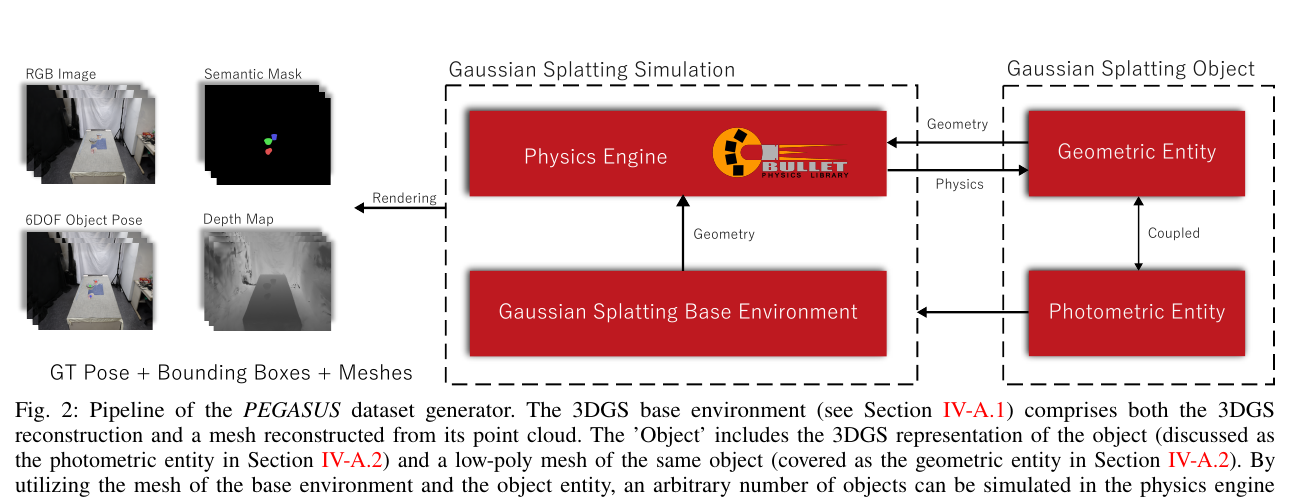
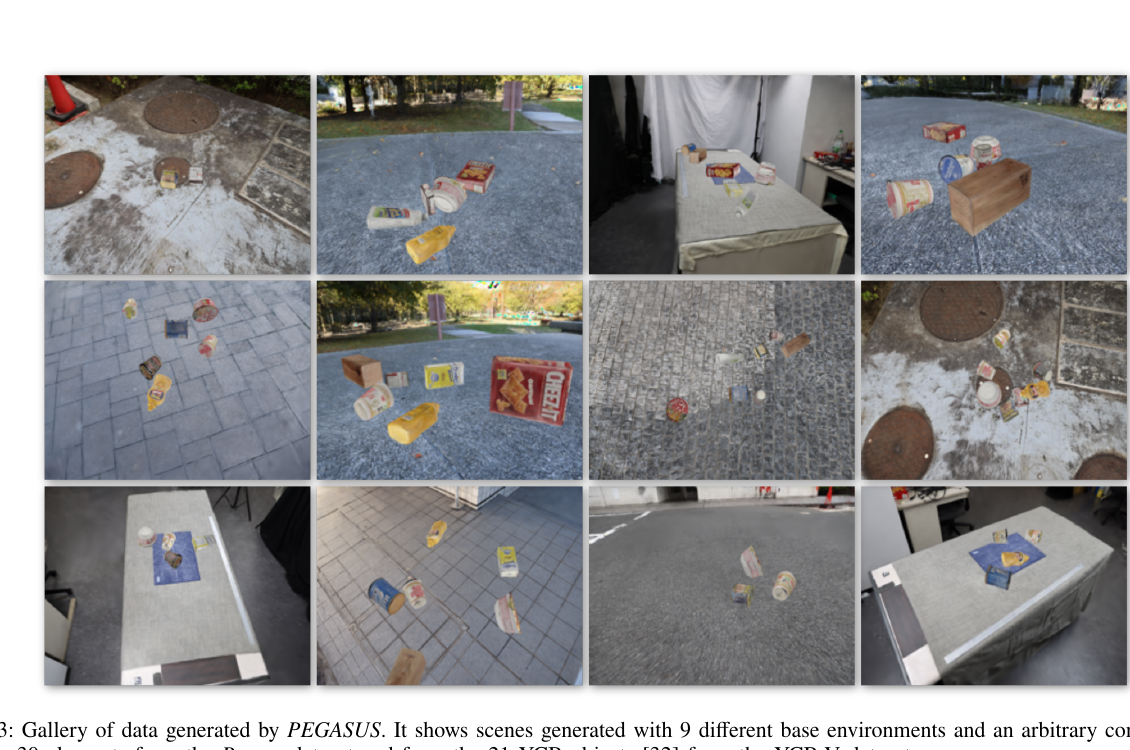
Original Figure 2: geometric entities handle collisions and photometric entities provide 3DGS appearance. Shared poses drive physical meshes and Gaussian parameters, producing BOP labels. Source: authors' public manuscript. Image copyright belongs to the authors and IEEE; reproduced here for paper analysis.Original Figure 3: generated scenes combining Ramen and YCB objects across 9 3DGS environments. This crop does not contain the Ramen asset inventory in Figure 4. Source: authors' public manuscript. Image copyright belongs to the authors and IEEE; reproduced here for paper analysis.
4. What problem does it address?
Pose networks need many images with accurate 6DoF, masks, and depth. Real annotation is costly, while conventional synthesis has a reality gap.
NeRF / 3DGS recover realistic appearance from ordinary cameras, but novel-view synthesis alone lacks controlled physical placement and precise object labels.
PEGASUS connects scanned appearance, composable assets, physics, and standard pose annotation.
5. Method overview
Capture and reconstruct separate 3DGS environments and objects.
Extract low-poly collision meshes from 3DGS clouds; store environments / objects in URDF.
Simulate falling, collisions, and settling in PyBullet to obtain framewise 6DoF trajectories.
Translate Gaussian centers; rotate centers, covariances, and spherical-harmonic appearance coefficients.
Render static / dynamic scenes from arbitrary cameras, exporting RGB, depth, semantic masks, 2D/3D boxes, meshes, and object poses.
Save BOP format for direct pose-estimator training.
6. Data and validation
Ramen contains 30 Japanese cup-noodle types; upper / lower hemisphere scans yield about 270 registered images per object and 3DGS / mesh reconstructions.
PEGASet adds 21 YCB-V object assets.
The paper shows combinations across 9 base environments.
DOPE trains on three datasets of 60,000 images each; the text separately reports 2,000 unique scenes and 30 views per scene.
Reported generation takes about 6 hours on Intel i9 12th Gen + RTX 3080 Ti Mobile, without separate timing for each dataset.
UR5 sequentially grasps 10/10 cup noodles, also demonstrating different product types.
7. Quick assessment
Value: turns real reconstructions into physically controlled, fully labeled pose data rather than a new pose backbone.
Strengths: modular objects / environments, BOP compatibility, and asset capture with ordinary cameras.
Limitations: collision meshes and Gaussian appearance have different approximate geometry; transparency, strong specularity, dynamic contact, and occlusion boundaries may remain distorted.
Audience: synthetic pose data, 3DGS, synthetic-to-real transfer, robotic data generation, and BOP tooling.
Available src/paper-notes/pegasus-iros2024/deep.md
In-depth paper notes
Support reproduction, comparison, related-work writing, and identifying opportunities for further research.
Paper Reading Notes (Deep): PEGASUS
1. Key assessment
The central design decouples geometric and photometric entities: low-poly meshes handle collisions / rigid trajectories, while Gaussian Splatting renders realistic appearance. Shared object poses yield natural-looking placement with automatic pixel masks, depth, and 6DoF labels.
This is more suitable for pose-data generation than moving a camera in a fixed NeRF, and preserves real materials / backgrounds more easily than manually modeled simulation. The same separation creates risk: collision meshes, Gaussian surfaces, and evaluation geometry may disagree.
2. Task boundaries
PEGASUS generates data rather than predicting pose directly, supporting:
Instance-level 6DoF pose-network training;
Rapid domain-specific data for new objects / environments;
BOP RGB, depth, masks, boxes, camera poses, and object poses;
Combinations of scanned assets in static / dynamic physical scenes.
Every object / environment must first be scanned, calibrated, optimized as 3DGS, and given a collision mesh. Lower modeling cost is relative to manual CAD / materials / lighting, with acquisition costs still present.
Geometric entity: a low-poly mesh extracted from cleaned 3DGS clouds using steps such as alpha shapes;
A shared object transform coupling them.
Environments likewise have Gaussian appearance and meshes; PyBullet handles only meshes. This avoids collisions among hundreds of thousands of Gaussians while retaining quality rasterization.
Original Figure 2: right, coupled object mesh / Gaussian representations; left, environments and physics create trajectories; final rendering writes RGB, depth, masks, boxes, and 6DoF poses. Source: authors' public manuscript. Image copyright belongs to the authors and IEEE; reproduced here for paper analysis.
4. Rigidly transforming 3D Gaussians
Translation updates Gaussian means:
μi′=μi+t.
Rotation must jointly update:
Centers: μi′=Rμi;
Covariances: Σi′=RΣiR⊤;
View-dependent spherical-harmonic coefficients under rotation.
Rotating only centers leaves anisotropic Gaussian orientations wrong; rotating geometry without spherical harmonics leaves directional colors in old orientations. The paper follows prior spherical-harmonic rotation methods to keep highlights / colors as consistent as possible after movement.
5. Physics and annotation
Initialize objects inside the environment mesh;
Simulate mass, gravity, collisions, and friction in PyBullet;
Record rigid mesh trajectories;
Apply the same R,t to object Gaussians;
Render at selected camera trajectories / timesteps;
Render objects separately or use entity IDs for semantic masks;
Compute 2D / 3D boxes, depth, and object-to-camera poses from geometry / camera parameters;
Export BOP format.
Labels come from simulation state rather than posterior visual inference, giving theoretically precise poses. Pixel alignment still depends on agreement between visual surfaces and collision / evaluation meshes.
6. Ramen and PEGASet assets
Original Figure 3: generated-scene gallery combining Ramen and YCB objects across 9 base environments. The Figure 4 Ramen asset inventory is not included in this crop. Source: authors' public manuscript. Image copyright belongs to the authors and IEEE; reproduced here for paper analysis.
Ramen dataset:
30 common Japanese cup-noodle products;
Separate upper / lower hemisphere scans to capture both surfaces;
Flipping changes poses relative to the calibration board, so image registration aligns bottom scans to the upper reconstruction;
About 270 registered images per product;
Both 3DGS and low-poly meshes.
PEGASet adds 21 YCB-V objects familiar to robotics. URDF describes visual / collision properties for freely composable assets.
7. Training and robot validation
The authors train DOPE on three settings with 60,000 generated images each:
The text reports 2,000 unique scenes;
30 views per scene;
About 6 hours for the generation process, without separate per-dataset timings;
Intel i9 12th Gen and RTX 3080 Ti Mobile;
Default DOPE hyperparameters over 15 epochs.
UR5 grasps cup-noodle centers and places them in a basket, succeeding sequentially on 10/10 and demonstrating different product types.
This supports synthetic-to-real execution, but the public text lacks full pose comparisons against BlenderProc, pure 3DGS, and real-annotation training, and has too few trials for reliability estimates. The defensible claim is working grasp-pose training data, rather than universal superiority to conventional PBR on standard benchmarks.
Every object still incurs scanning / reconstruction costs.
9. Reproduction checklist
Record calibration, scan viewpoints, 3DGS training, and asset scale;
Visualize Gaussian / mesh surface deviations and collision penetration;
Rotate covariances and spherical harmonics alongside centers;
Fix friction, mass, collision timesteps, and random-drop distributions;
Check pixel agreement among RGB, depth, masks, and mesh projections;
Save scene seeds and camera / object trajectories;
Compare PEGASUS, conventional PBR, domain randomization, and real data using the same pose network;
Separate detector, pose, grasp-slip, and collision failures in robot evaluation.
10. Extensions
Calibrate collision meshes / friction with differentiable physics or real contact observations;
Harmonize independent scans through relighting / inverse rendering;
Combine mesh / neural materials for transparent and reflective objects;
Drive scene generation from pose-network failures in an active synthetic-data loop;
Generate dynamic BOP sequences for tracking, uncertainty, and closed-loop policies.
11. Overall assessment
PEGASUS is a representative IROS 2024 pose-data systems paper. It turns 3DGS reconstructions into movable, collidable, automatically labeled assets with BOP compatibility. The dual-entity architecture is the main reusable idea; geometric / photometric consistency and standardized PBR comparisons are the most important gaps.