Point2Pose: Occlusion-Recovering 6D Pose Tracking and 3D Reconstruction for Multiple Unknown Objects Via 2D Point Trackers
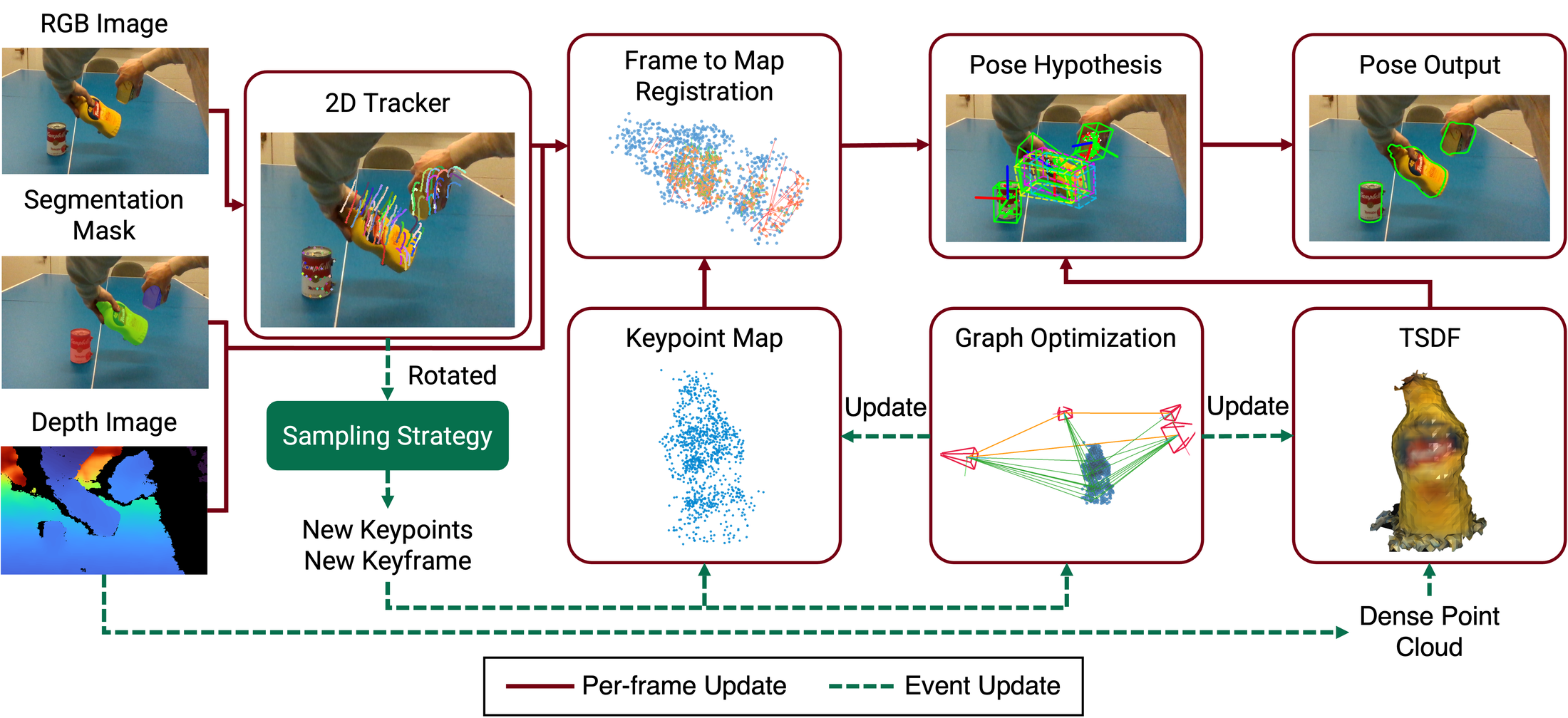
Point2Pose starts from a few clicks per unknown rigid object and RGB-D video. SAM2 supplies masks, a long-range 2D point tracker maintains associations through occlusion, and depth-lifted tracks populate object-centric keypoint maps. Multi-hypothesis SVD / RANSAC, TSDF scoring, and SDF refinement estimate per-frame poses; factor graphs and online TSDF preserve global consistency and reconstruction. YCBMultiTrack-Real-World ADD-S / ADD AUC is 89.40 / 71.19 versus BundleSDF's successful-sequence means of 62.08 / 42.34. Ordinary averages on HO3D and YCBInEOAT do not uniformly lead. Texture, accurate masks, RGB-D, and a static camera are required; outputs are first-frame-relative rather than CAD-canonical poses.
causal monocular RGB-D videosparse user point promptsper-object segmentation maskslong-range 2D point tracks
Requirements
calibrated RGB-D camerastatic camera frame in the current formulationinitial sparse clicks on each targetaccurate instance masks from SAM2 or equivalentrigid objects with trackable visual regionsenough memory for persistent multi-object point tracks and TSDF volumes
Full paper metadataAuthors, affiliations, research area, datasets, metrics, method tags, and reading statusExpandCollapse
Authors
Tzu-Yuan Lin, Ho Jae Lee, Kevin Doherty, Yonghyeon Lee, Sangbae Kim
Affiliations
MIT Biomimetic Robotics Lab / Massachusetts Institute of Technology / Boston Dynamics
calibrated RGB-D camerastatic camera frame in the current formulationinitial sparse clicks on each targetaccurate instance masks from SAM2 or equivalentrigid objects with trackable visual regionsenough memory for persistent multi-object point tracks and TSDF volumes
Reading Notes
Overview / Deep Dive
Available src/paper-notes/point2pose-eccv2026/coarse.md
Paper overview notes
Quickly assess the paper's scope, problem setting, core method, experimental findings, and whether to read it in depth.
Paper Reading Notes (Coarse): Point2Pose: Occlusion-Recovering 6D Pose Tracking and 3D Reconstruction for Multiple Unknown Objects Via 2D Point Trackers
1. Basic information
Abbreviation: Point2Pose
Authors: Tzu-Yuan Lin, Ho Jae Lee, Kevin Doherty, Yonghyeon Lee, Sangbae Kim
Affiliations: MIT Biomimetic Robotics Lab, Massachusetts Institute of Technology; Kevin Doherty lists Boston Dynamics, with work independently conducted in personal time
Year / venue: ECCV 2026; verified version: arXiv:2604.10415 v1 (2026-04-12)
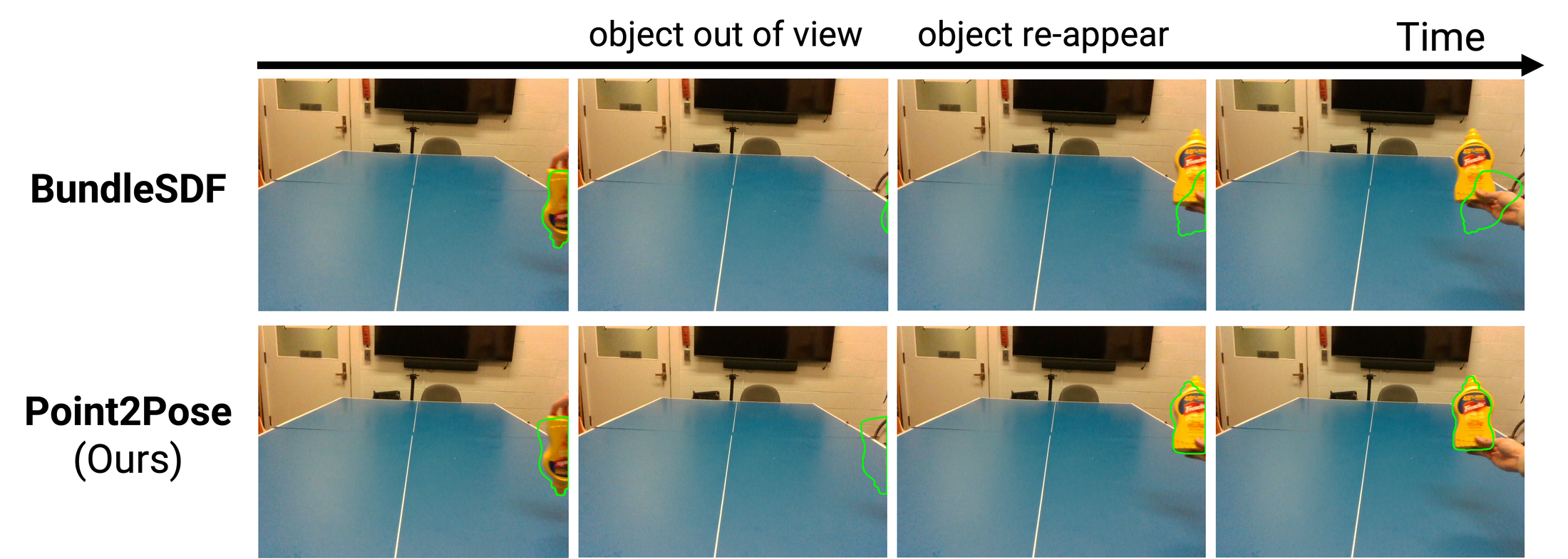
BundleSDF retains stale orientation; persistent point identities recover pose
Table 3
Is multi-object tracking steadier?
BundleSDF frequently fails; Point2Pose outputs across 1/2/3-object groups
Tables 4–5
Which modules matter?
Removing multiple hypotheses hurts most; trackability and coverage both matter
3. Problem setting
Task: causal tracking and online 3D reconstruction of multiple unknown rigid objects.
Inputs: one RGB-D stream, initial clicks per object, framewise instance masks, and intrinsics.
Outputs: initial-object-frame-relative trajectories and online object-centric TSDF / meshes.
Not required: CAD, category priors, object training, or offline reconstruction.
Required: depth, accurate masks, trackable texture / structure, a fixed camera frame, and initialized points per target.
At t=0, each object frame equals the camera frame: TOi,0C=I. This is motion relative to initialization, rather than single-frame semantic canonical orientation or CAD-based absolute pose.
4. Core motivation
BundleTrack / BundleSDF often rely on adjacent matches and prior pose initialization. Complete disappearance breaks local associations; without reliable relocalization, old orientation may persist after reappearance.
Modern point trackers retain identities, visibility, and uncertainty across long gaps. Recovered identities directly associate pre-occlusion map points with current 3D observations. Aggregating all objects’ queries in one tracker naturally supports multiple objects.
5. Method overview
Original Figure 2: RGB, masks, and depth feed tracking / sampling; lifted tracks update maps, frame-to-map registration proposes poses, TSDF scores / refines candidates, and factor graphs update maps / TSDF. Source: arXiv:2604.10415. Image copyright belongs to the authors and publisher; reproduced here for paper analysis.
5.1 Initialization and point tracking
Click a few points per object;
SAM2 produces masks;
A TAP / CoTracker-style tracker processes aggregated queries;
Obtain pixels, visibility, and uncertainty;
Back-project visible tracks through depth.
5.2 Maps and sampling
SuperPoint proposes masked candidates;
Greedy scores reward confidence / spread and penalize crowding;
Pending points need multiframe verification before map insertion;
New-surface keyframes expand object-centric maps during rotation.
5.3 pose estimation
Known observation / map correspondences permit SVD registration;
Structured outliers motivate sequential RANSAC: save a consensus, remove it, and propose another;
Dense depth-to-TSDF distances score candidates;
Huber / Levenberg–Marquardt refines the best surface alignment.
5.4 Global optimization and reconstruction
GTSAM optimizes keyframe poses and 3D landmarks. Priors fix gauges, odometry links keyframes, and bearing / range observations constrain landmarks. Optimized trajectories fuse TSDF, which then selects / refines poses in a geometric loop.
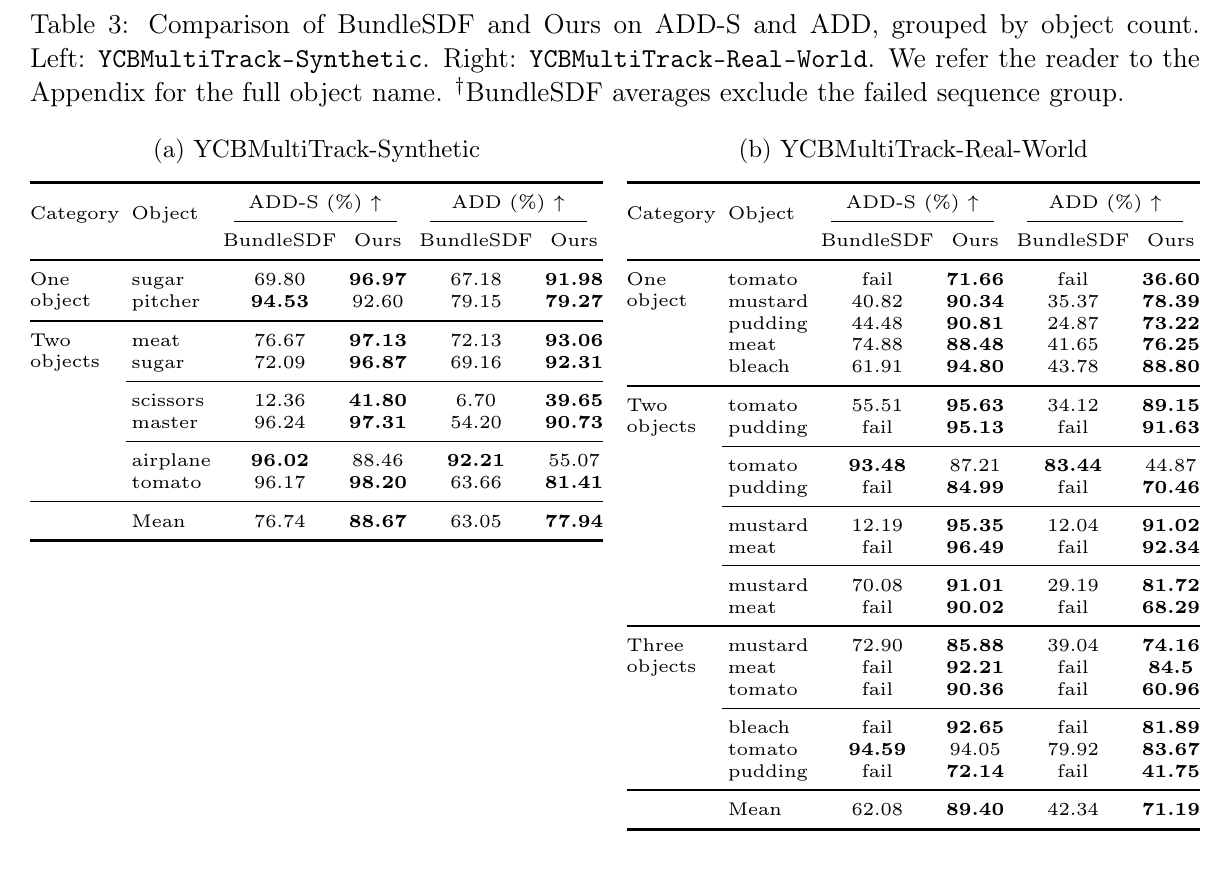
Original Table 3: synthetic mean ADD-S / ADD AUC is 88.67 / 77.94 versus BundleSDF 76.74 / 63.05. Real scores are 89.40 / 71.19; BundleSDF fails several groups and averages 62.08 / 42.34 over successful groups. Source: arXiv:2604.10415. Image copyright belongs to the authors and publisher; reproduced here for paper analysis.
Separate two result regimes:
Ordinary single-object tests: HO3D ADD-S is 94.63 versus 93.34, but ADD 80.79 versus 92.62 and Chamfer 1.02 versus 0.58 are worse. YCBInEOAT 92.67 / 85.11 trails BundleSDF’s successful-group 94.51 / 89.07, though BundleSDF fails tomato.
Full occlusion and multiple objects: real YCBMultiTrack shows clear advantages, with Point2Pose maintaining high AUC where BundleSDF fails several two- / three-object groups.
The trade-off is some reconstruction accuracy and texture dependence for multiple objects, long occlusion, and recovery, rather than universal BundleSDF replacement.
7. Strengths and limitations
Strengths
Persistent 2D associations directly address complete occlusion in 6D.
Aggregate queries avoid serial full neural reconstruction per object.
Multiple rigid instances with stable appearance / geometry
Camera
Fixed to world; no joint moving-camera / object decomposition
3.3 Causality and full occlusion
Causal: online video processing without future-frame batch optimization; keyframes update graphs / TSDF.
Recovery: invisible objects provide no new 3D observations. Reappearing query identities restore old-map correspondences beyond last-pose local refinement.
Not invisible-motion prediction: evidence concerns recovery after reappearance, not true trajectories during occlusion.
3.4 Fairness
BundleSDF is single-object, so each target is run serially. Exclusive memory / compute helps that baseline without upgrading relocalization. Capability is compared, without equal-total-latency / memory curves.
4. Research context
4.1 model-based tracking
Known-CAD FoundationPose can refine locally and use detectors / relocalizers, but CAD, rendering, and instance libraries constrain open-world onboarding.
BundleSDF: neural SDF reconstruction / relocalization; strong fidelity, mainly single-object and history-initialized after full occlusion.
Point2Pose: delegate persistence to 2D trackers, retaining SVD, TSDF, and graphs for multi-object recovery rather than maximum neural reconstruction fidelity.
4.3 Why point tracks support poses
With depth, persistent identities associate map point pn with observation p~n without descriptor retrieval. Occlusion sets visibility δt=0 without deleting identity.
This moves the bottleneck to point tracking: weak / repeated texture and blur corrupt 3D correspondences.
5. Research motivation
Adjacent tracking assumes a nearby prior pose, broken by disappearance / crossings. RANSAC alone is insufficient when many wrong static body tracks outvote few correct handle tracks.
Dense TSDF validation: judge candidates with surfaces rather than the same sparse tracks.
This is the central systems insight.
6. Method details
Original Figure 2: solid red denotes frame updates—RGB / masks, tracks, registration, hypotheses, pose. Dashed green denotes keyframe / event updates for new points, graphs, and TSDF. The surface both reconstructs meshes and selects / refines poses. Source: arXiv:2604.10415. Image copyright belongs to the authors and publisher; reproduced here for paper analysis.
6.1 2D point tracker
For query q=(tq,uq), the tracker outputs:
Pixel ut∈R2;
Visibility δt∈{0,1};
Uncertainty σt∈[0,1].
Separate object sets Qi aggregate into one tracker pass, with cost mainly following point count rather than repeating the image backbone per object.
TAP / CoTracker interchangeability makes this a framework whose performance depends on tracker versions. Exact checkpoints / causal mode need confirmation when code is released.
6.2 Trackability and coverage
SuperPoint masked candidates (pk,sk) are greedily selected by:
Jk=λsk+(1−λ)min(ridealdk,1)−βρ(dk),
sk is confidence; dk the nearest selected / mapped distance; rideal controls ideal spacing; ρ penalizes crowding below rmin.
These address:
Uniform sampling in untrackable textureless regions;
High-score clustering with degenerate 3D registration;
Joint trackability and spread.
6.3 pending keypoint verification
Back-project new points with current pose / depth, but keep them pending. Each verified observation adds +1; promote only after a window threshold.
Immediate insertion of bad-pose / depth-edge points can self-reinforce map pollution and later registration errors.
6.4 frame-to-map SVD
Depth lifts visible tracks into camera observations p~n with map counterparts pn. Solve:
TOi,tC=argT∈SE(3)minn=1∑N∥p~n−Tpn∥2,
SVD gives an efficient closed form when most matches are correct; outlier structure is the real difficulty.
6.5 sequential multi-hypothesis registration
Ordinary RANSAC retains only the largest consensus. Repeat:
RANSAC / SVD for current consensus;
Save pose;
Remove consensus;
Continue on remaining matches.
Correct handle tracks can form a second hypothesis even when wrong symmetric-body tracks dominate, resembling greedy motion segmentation.
6.6 TSDF selection and refinement
Transform masked dense depth into each candidate object frame and sum absolute TSDF values. The lowest score best fits the reconstructed surface.
Starting at T0, optimize increment D∈SE(3):
D∗=argDminp∈Pcur∑ρH(Φ(Ti−1D−1p)2),
Numerical TSDF gradients and LM separate sparse proposals from dense verification, preventing one bad track set from both proposing and deciding poses.
6.7 online factor graph
Equivalent fixed-object / moving-virtual-camera coordinates use inverse poses Xm=TCO(m) for keyframes and P for landmarks:
L(X,P)=Lprior+Lodom+Lobs.
Prior: fix X0=I to remove gauges;
Odometry: relative keyframe alignment with Huber robustness;
Observation: bearing / range jointly constrain angular and radial landmark error.
New keyframes trigger GTSAM / LM pose / landmark optimization, improving map consistency rather than predicting occluded dynamics.
6.8 TSDF reconstruction
Optimized poses fuse segmented RGB-D into object voxels. Truncation τ limits projective signed-distance updates; Marching Cubes extracts meshes and disconnected-noise components are filtered.
Classical TSDF is online, stable, and supplies usable surface gradients, trading detail / hole filling against neural BundleSDF.
6.9 Modules
Module
Input
Output
Role
Failure
SAM2 / masks
Clicks and RGB
Object masks
Bound points / depth
Leakage, merging, background
Long-range tracker
RGB and query sets
ut,δt,σt
Identity across occlusion
Low / repeated texture, blur
Sampling / pending
SuperPoint, masks, maps
Verified keypoints
Safe map expansion
Depth edges / wrong pose
Multiple-hypothesis SVD
Observations and map
Pose candidates
Preserve minority motion
All-wrong tracks / collinearity
TSDF score / refine
Depth, candidates, TSDF
Selected refined pose
Dense verification
Incomplete TSDF / depth
Factor graph
Keyframes, poses, landmarks
Optimized poses / points
Global consistency
Bad factors / nonrigidity
TSDF fusion
Masked RGB-D and pose
Mesh / SDF
Reconstruction and scoring
Reflection, transparency, masks
7. Experimental analysis
7.1 Datasets
Dataset
Sequences / objects
GT
Purpose
HO3D v3
13 sequences, 4 objects
Automatic multiframe registration
Heavy hand-occlusion comparisons
YCBInEOAT
9 sequences, 5 objects
Manual framewise 6D pose
Distant dual-arm manipulation / small targets
Synthetic YCBMultiTrack
7 YCB objects; 1 single + 3 two-object scenarios
Exact Isaac Lab poses / depth
Controlled motion / mutual occlusion
Real YCBMultiTrack
5 objects; 5 single + 4 two + 2 three-object scenarios
OptiTrack, AprilTag extrinsics, synchronization
Full occlusion, reentry, crossings
D435i captures real sequences with 4–5 mocap markers per object. More reliable than pseudo-labels, but markers may add trackable texture; that effect is unquantified.
Competitive is appropriate; universal SOTA contradicts the tables. Value lies in recovering where full-occlusion / multi-object baselines fail, beyond highest continuously visible single-object means.
7.4 Multi-object results
Original Table 3: synthetic means 88.67 ADD-S / 77.94 ADD versus BundleSDF 76.74 / 63.05; real means 89.40 / 71.19 versus 62.08 / 42.34 excluding failures. Some airplane / tomato combinations favor BundleSDF; this is not universal rowwise dominance. Source: arXiv:2604.10415. Image copyright belongs to the authors and publisher; reproduced here for paper analysis.
Real gains: ADD-S +27.32 and ADD +28.85 points, conservative since baseline failures are excluded.
Not every object: synthetic pitcher ADD-S 92.60 < 94.53; airplane 88.46 / 55.07 < 96.02 / 92.21. Fewer catastrophic failures drive the overall gain.
7.5 Full-occlusion recovery
Original Figure 5: after disappearance, old-pose initialization leaves BundleSDF stale orientation. Persistent tracks associate current observations with old map points to recover Point2Pose orientation. These selected examples supplement Table 3 statistics. Source: arXiv:2604.10415. Image copyright belongs to the authors and publisher; reproduced here for paper analysis.
Recovery does not reveal invisible trajectories; it requires reliable tracks after reappearance and may fail on wholly different visible surfaces.
7.6 Texture failures
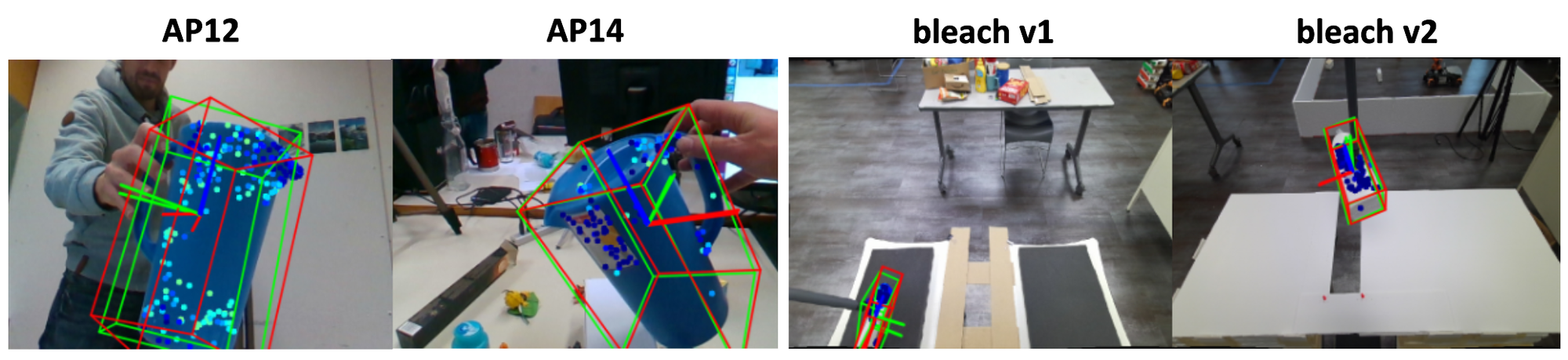
Original Figure 4: weak AP12 / bleach v1 texture gives uncertain jittery tracks and unstable pose; AP14 / bleach v2 labels and details improve tracking. Green boxes are predictions, red GT. Source: arXiv:2604.10415. Image copyright belongs to the authors and publisher; reproduced here for paper analysis.
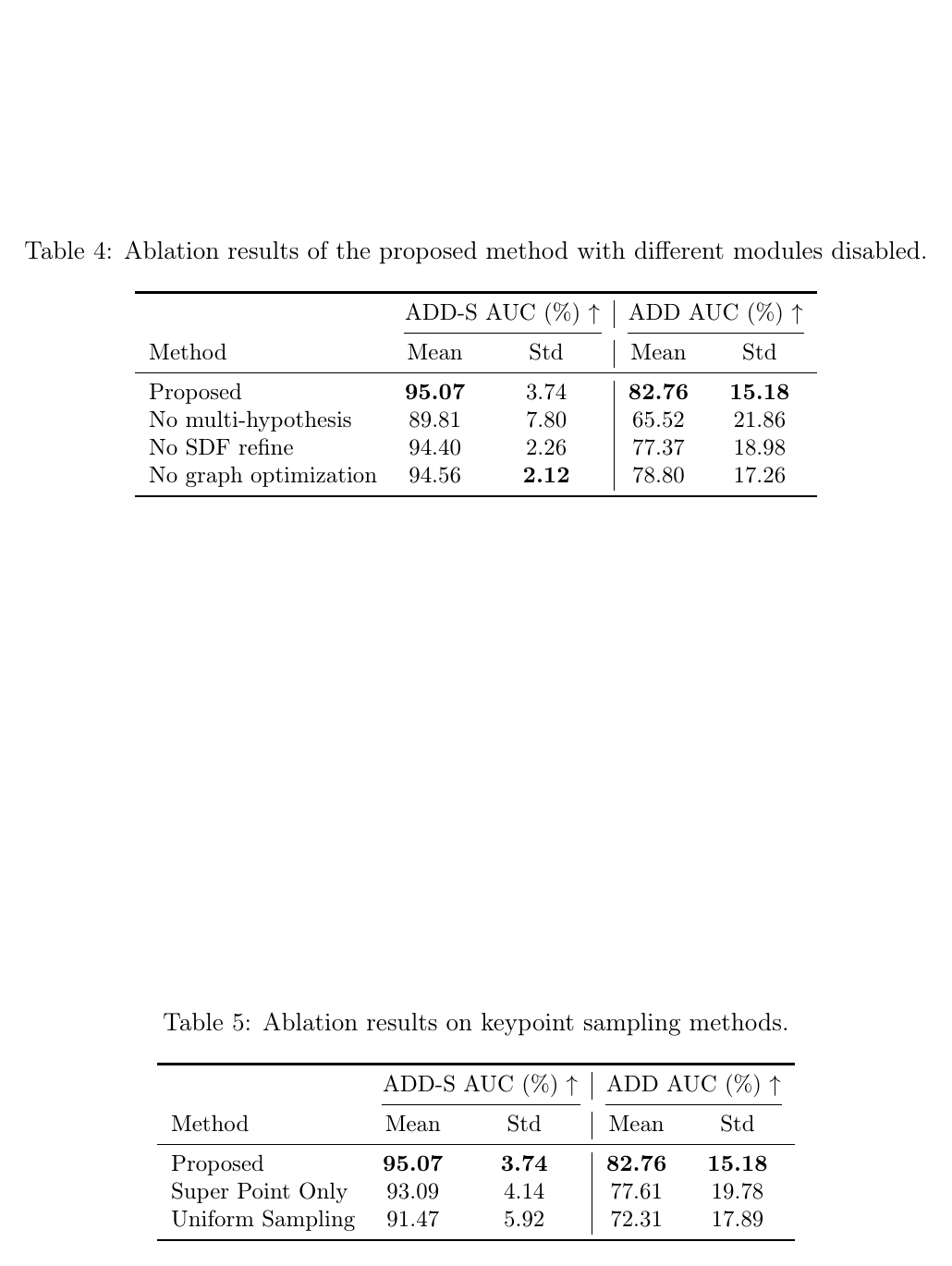
Original Tables 4–5: removing multiple hypotheses drops ADD AUC 82.76→65.52, largest of all. Removing SDF refinement / graphs gives 77.37 / 78.80. SuperPoint-only / uniform sampling gives 77.61 / 72.31, below joint trackability / coverage. Source: arXiv:2604.10415. Image copyright belongs to the authors and publisher; reproduced here for paper analysis.
Ablation
ADD-S AUC
ADD AUC
ADD drop
Claim tested
Full
95.07
82.76
—
Complete system
No multiple hypotheses
89.81
65.52
-17.24
One dominant consensus is insufficient
No SDF refine
94.40
77.37
-5.39
Dense local alignment helps
No graph optimization
94.56
78.80
-3.96
Global keyframe / landmark refinement helps
SuperPoint only
93.09
77.61
-5.15
Trackability alone lacks geometric coverage
Uniform
91.47
72.31
-10.45
Uniform textureless points are unreliable
Ablations support complementarity, without isolating TSDF selection from refinement or uncertainty weighting.
7.8 Evidence assessment
Contribution
Evidence
Sufficiency
Site assessment
Full-occlusion recovery
Real YCBMultiTrack, Figure 5, failures
Fairly strong
Quantitative / qualitative agreement, needing more objects / duration strata
Multiple objects
2 / 3-object scenarios, aggregated queries
Broad
Functional, without FPS / memory curves
Multiple hypotheses
Table 4
Strong
ADD -17.24 points
Sampling
Table 5
Strong
Beats two natural baselines; uncertainty sampling remains open
Reconstruction
HO3D Chamfer
No superiority
Online, lower fidelity than BundleSDF
Competitive standard tests
HO3D, YCBInEOAT
Broad
Similar ADD-S, weaker ADD / Chamfer
8. Critical analysis
8.1 Strengths
Occlusion as association: direct design with replaceable trackers.
Structured outliers: preserve correct small consensuses rather than merely adding RANSAC.