Pos3R: 6D Pose Estimation for Unseen Objects Made Easy
Pos3R connects 3D-consistent features from a 3D reconstruction foundation model to template selection and correspondence estimation, handling unknown objects without pose-specific training.
Authors / affiliations: Weijian Deng et al.; Australian National University, RIOS Intelligent Machines.
Task: unseen-object 6D pose from one RGB and target CAD, without additional pose training.
Reading mode: Overview.
2. Positioning in one sentence
Pos3R uses 3D-consistent reconstruction-foundation features such as MASt3R for template selection and correspondences, optionally followed by rendering refinement.
3. Problem and motivation
Out-of-plane rotations destabilize 2D foundation matches, bottlenecking template selection.
Reconstruction models already learn multiview geometry, rarely used directly in pose estimation.
4. Method overview
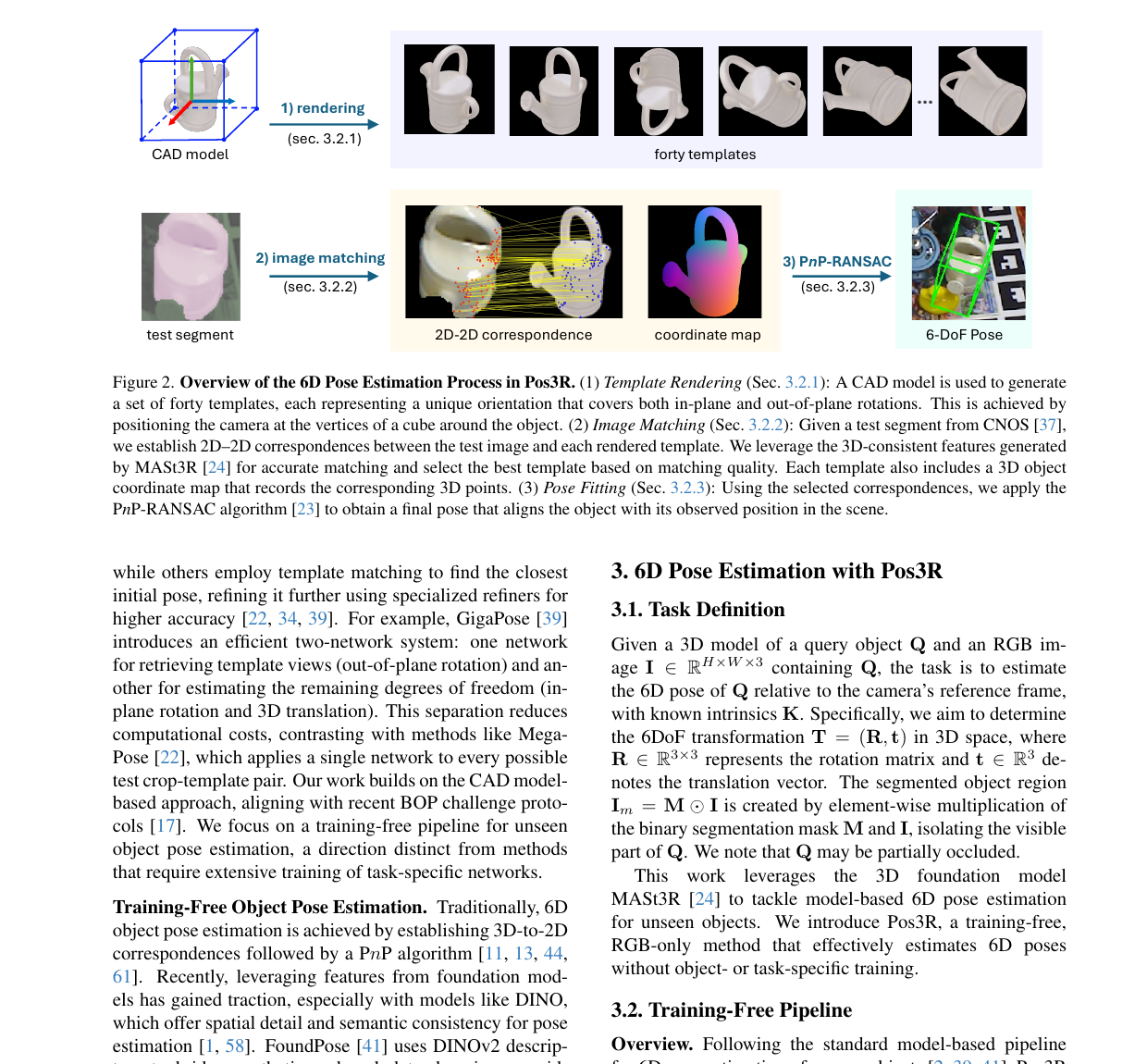
Render CAD templates; select viewpoints with 3D foundation features.
No extra pose training does not mean model-free; CAD templates remain required.
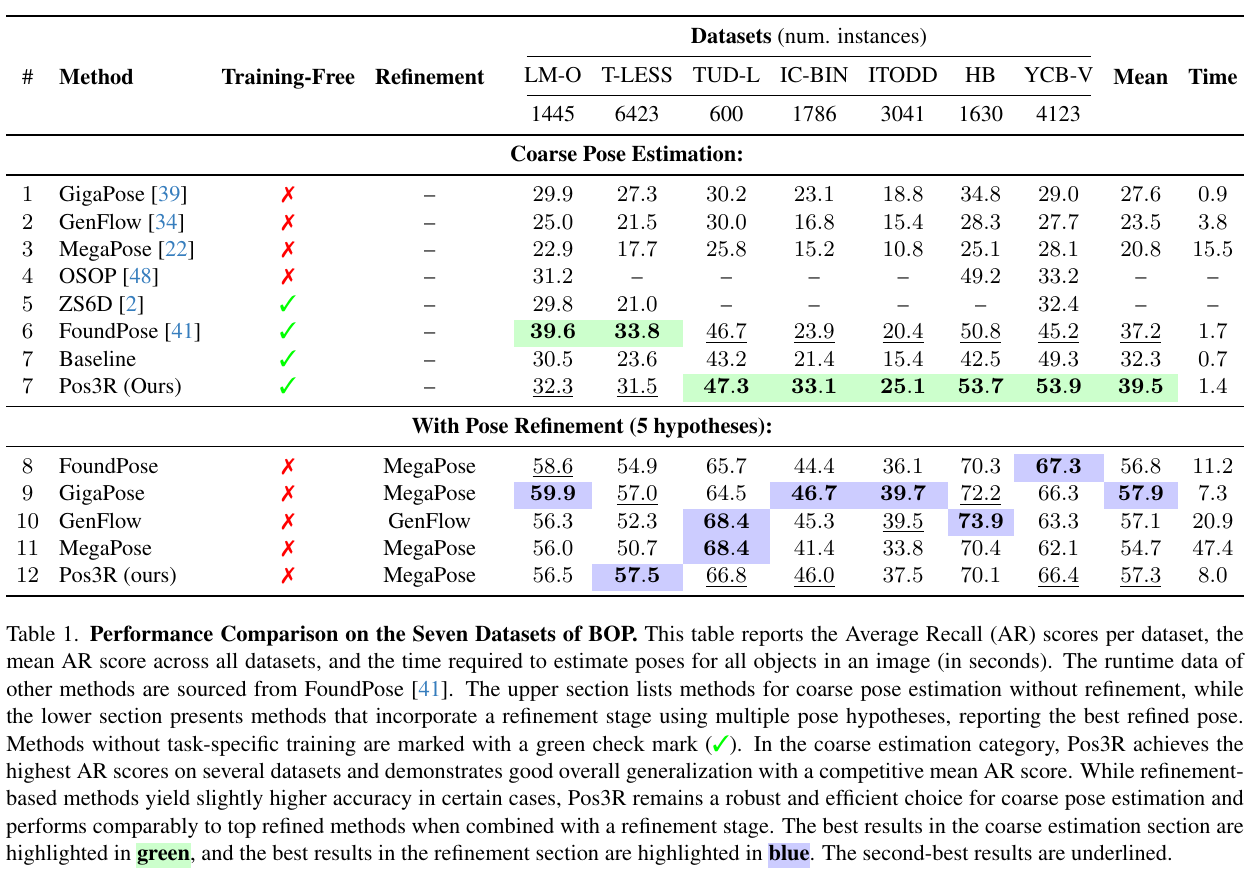
Original BOP table: upper half gives coarse pose without refinement; lower half refines five hypotheses uniformly. Training-free applies only to coarse estimation. Source: CVPR 2025 paper. Image copyright belongs to the authors and publisher; reproduced here for paper analysis.
Coarse mean AR is 39.5 versus FoundPose 37.2 and the authors’ baseline 32.3, taking 1.4 s. MegaPose refinement raises it to 57.3, but the refiner is pose-trained, so 57.3 is not an end-to-end training-free result.
6. Quick assessment
Value: a simple route from 3D foundation models to pose.
Boundaries: CAD rendering, detection, and cross-domain MASt3R matching remain dependencies; training-free is not prior-free.
Available src/paper-notes/pos3r/deep.md
In-depth paper notes
Support reproduction, comparison, related-work writing, and identifying opportunities for further research.
Paper Reading Notes (Deep): Pos3R: 6D Pose Estimation for Unseen Objects Made Easy
Problem: sparse / inconsistent 2D features under out-of-plane rotation bottleneck unseen-pose template selection.
Answer: reuse MASt3R-style reconstruction features without additional pose-supervised training.
2. Positioning in one sentence
Minimal changes connect cross-view 3D foundation alignment to CAD-template selection and BOP pipelines.
2.1 Guide to the paper’s figures and tables
Figure / table
What to look for
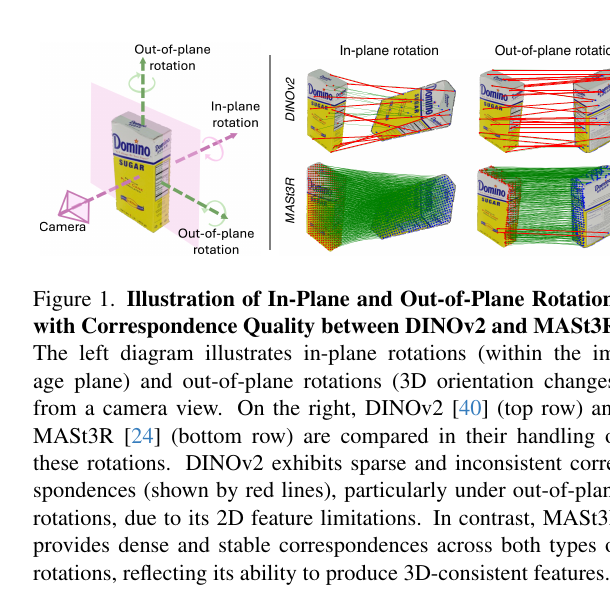
Figure 1
DINOv2 / MASt3R correspondences under in-plane and out-of-plane rotation.
Figure 2
Rendering, selection, matching, and solving.
Table 1
Seven-dataset BOP AR, distinguishing refinement.
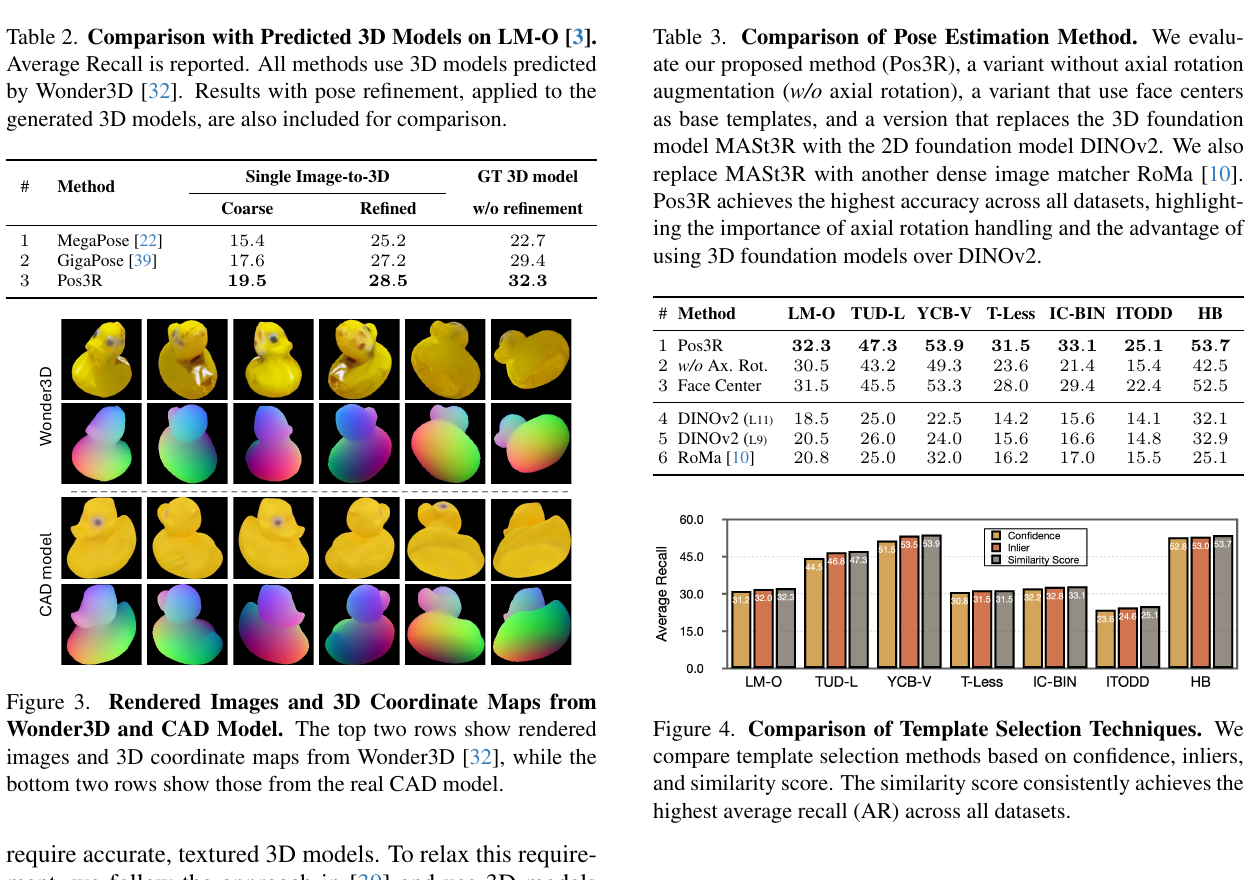
Tables 2–3
Predicted shapes versus CAD and pose-method contributions.
Original Figure 2: rendered CAD templates and 3D reconstruction features support selection / correspondences. Source: CVF Open Access. Image copyright belongs to the authors and publisher; reproduced here for paper analysis.
3. Problem setting and boundaries
Input: one query RGB and rendered CAD templates; output: BOP camera-frame 6D pose.
No additional pose training, with pretrained geometry and CAD: training-free / model-based rather than model-free.
Predicted-shape variants must be assessed separately from CAD inputs.
4. Method details
Rendering: viewpoints and corresponding 3D-coordinate maps.
Matching: MASt3R features provide geometric consistency across views.
Solving / refinement: estimate from templates / matches, optionally adding existing render-and-compare for higher accuracy.
5. Experimental analysis
Table 1 supports competitive template estimation without extra pose training against some unrefined baselines.
Predicted models in Table 2 test shape priors without CAD, a separate setting.
Table 3 separates pose methods: features alone do not determine scores; selection, PnP, and refinement contribute.
Original Figure 1: sparse / unstable DINOv2 out-of-plane matches versus denser 3D-consistent MASt3R matches across both rotation types. Source: CVPR 2025 paper. Image copyright belongs to the authors and publisher; reproduced here for paper analysis.
Figure 1 motivates rather than quantitatively proves consistency. Out-of-plane views change both texture locations and visible surfaces; point-map / confidence training better fits 3D alignment. Later controlled MASt3R→DINOv2-L11 / L9 replacements sharply lower seven-dataset AR.
Original component analysis: left, Wonder3D shapes versus GT CAD; right, axial rotations, face-center templates, DINOv2 / RoMa replacements, and three template scores. Source: CVPR 2025 paper. Image copyright belongs to the authors and publisher; reproduced here for paper analysis.
Wonder3D LM-O coarse / refined AR is 19.5 / 28.5 versus MegaPose 15.4 / 25.2 and GigaPose 17.6 / 27.2. GT CAD without refinement gives 32.3. This 13-point gap exposes predicted-shape quality as a major limit of the CAD-free variant.
Full LM-O / TUD-L / YCB-V / T-LESS / IC-BIN / ITODD / HB AR is 32.3 / 47.3 / 53.9 / 31.5 / 33.1 / 25.1 / 53.7. Without axial rotation: 30.5 / 43.2 / 49.3 / 23.6 / 21.4 / 15.4 / 42.5; face centers also weaken results. DINOv2-L11 lowers YCB-V to 22.5, RoMa to 32.0, versus 53.9. Similarity scores slightly beat confidence / inlier counts across all seven datasets, but feature replacement has larger effects.
6. Authors’ claims and my assessment
Authors’ claims
My assessment
3D foundations help selection
Figure 1 matches agree with BOP trends; template top-k recall would strengthen evidence.
Competitive without pose training
Supported, with costs shifted to pretraining, CAD renders, and detection.
7. Reproduction considerations and limitations
Synchronize rendering intrinsics with MASt3R resizing / crops to avoid biased 2D–3D matches.
Symmetry, low texture, and CAD appearance gaps can leave multiple solutions.
Report refinement gains separately to avoid overcrediting front-end features.
Coarse BOP Pos3R is training-free; five-hypothesis MegaPose refinement is not. Separate labels at the result level rather than attributing pose-refiner supervision to MASt3R.