Pose-VLA: Universal Pose Pretraining for Generalizable Vision-Language-Action Policies
Pose-VLA uses camera-centric discrete pose tokens to unify nonrobot 3D annotations with robot end-effector trajectories. Spatial grounding / motion alignment is learned from 1.4 million images, 6.5 million 3D annotations, and around 1.55 million trajectories, followed by a flow-matching action expert for few-shot embodiment alignment. Results reach 79.91% / 79.10% on RoboTwin 2.0 Easy / Hard, mean 96.0% on LIBERO, and mean 81.25% across four real bimanual tasks. Pose prediction is only a pretraining proxy; deployment does not explicitly output pose. Depth and raymaps may be masked for RGB-only inference.
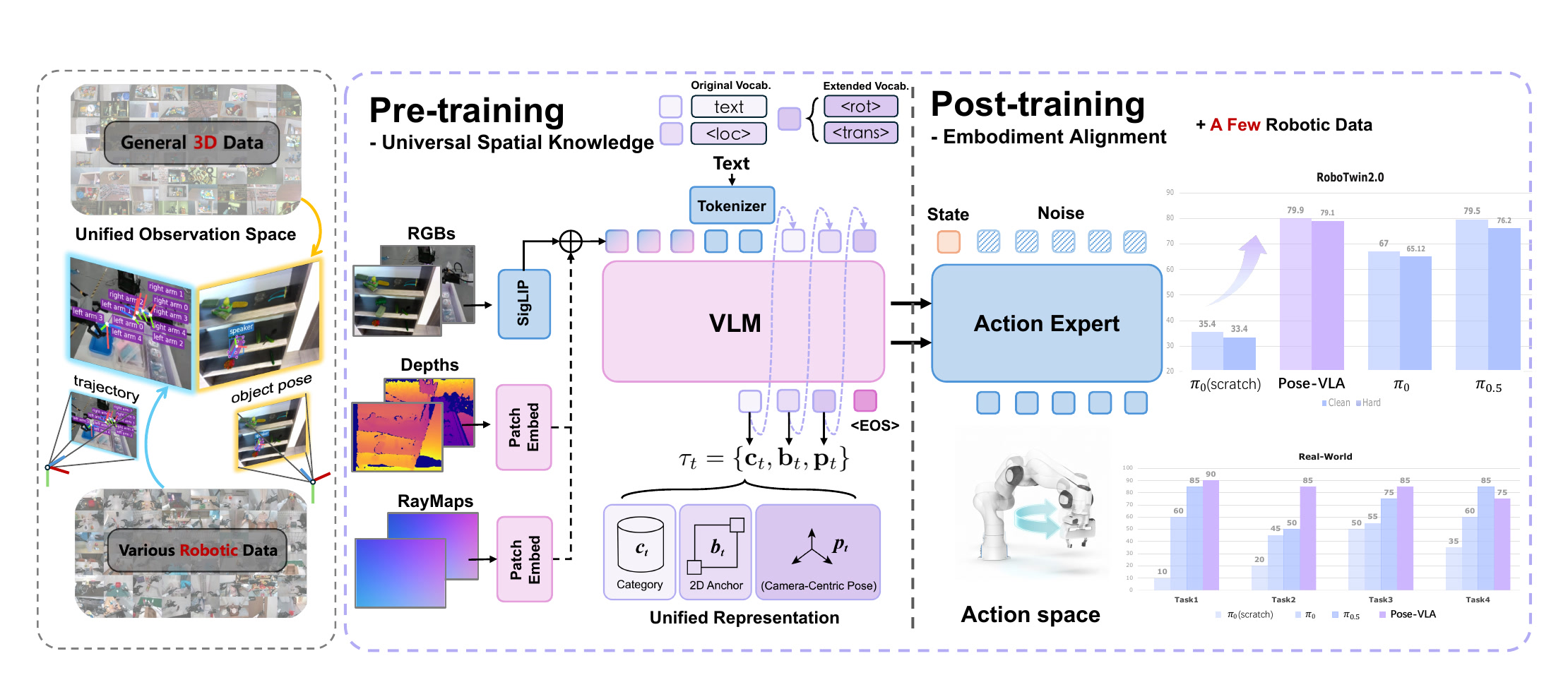
Object pose and end-effector trajectories share discrete camera-centric pose tokens. Nonrobot 3D data pretrains fine spatial understanding, robot trajectories align motion, and a flow-matching expert generates continuous actions. Explicit pose estimation is not a mandatory deployment stage.
Method inputs and outputs
Item
Content (compiled for this site)
Inference
Current RGB views and instructions; optional metric depth / intrinsic-derived raymaps. Check proprioceptive interfaces per action-expert configuration.
Output
Continuous action chunks after embodiment adaptation. Object tokens / camera-frame gripper paths are pretraining targets, not required intermediate deployment outputs.
Requirements
Demonstration-adapted policy weights; no online CAD, GT pose, or instance masks. RGB-only tests disable depth / rays; geometry-conditioned variants need calibration.
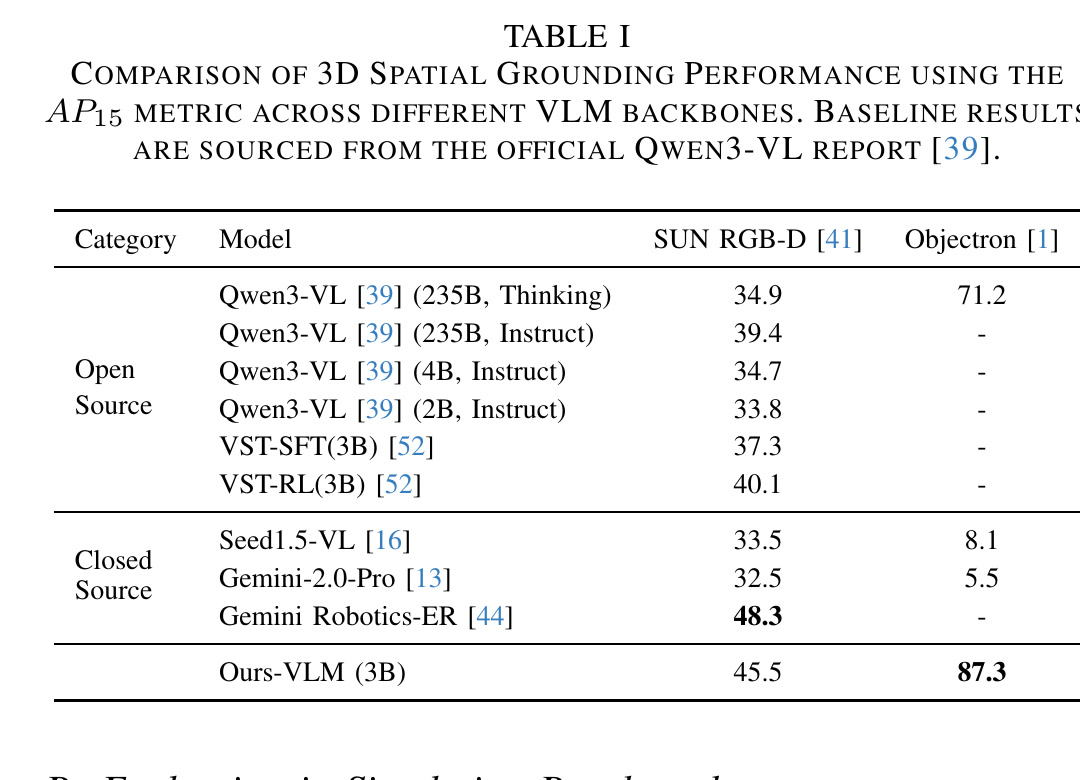
Objectron AP15 87.3 with steadier boxes in unseen scenes
Tables II–III
Policy transfer
RoboTwin 79.91 / 79.10; LIBERO mean 96.0
Figures 4–5
Few real demonstrations
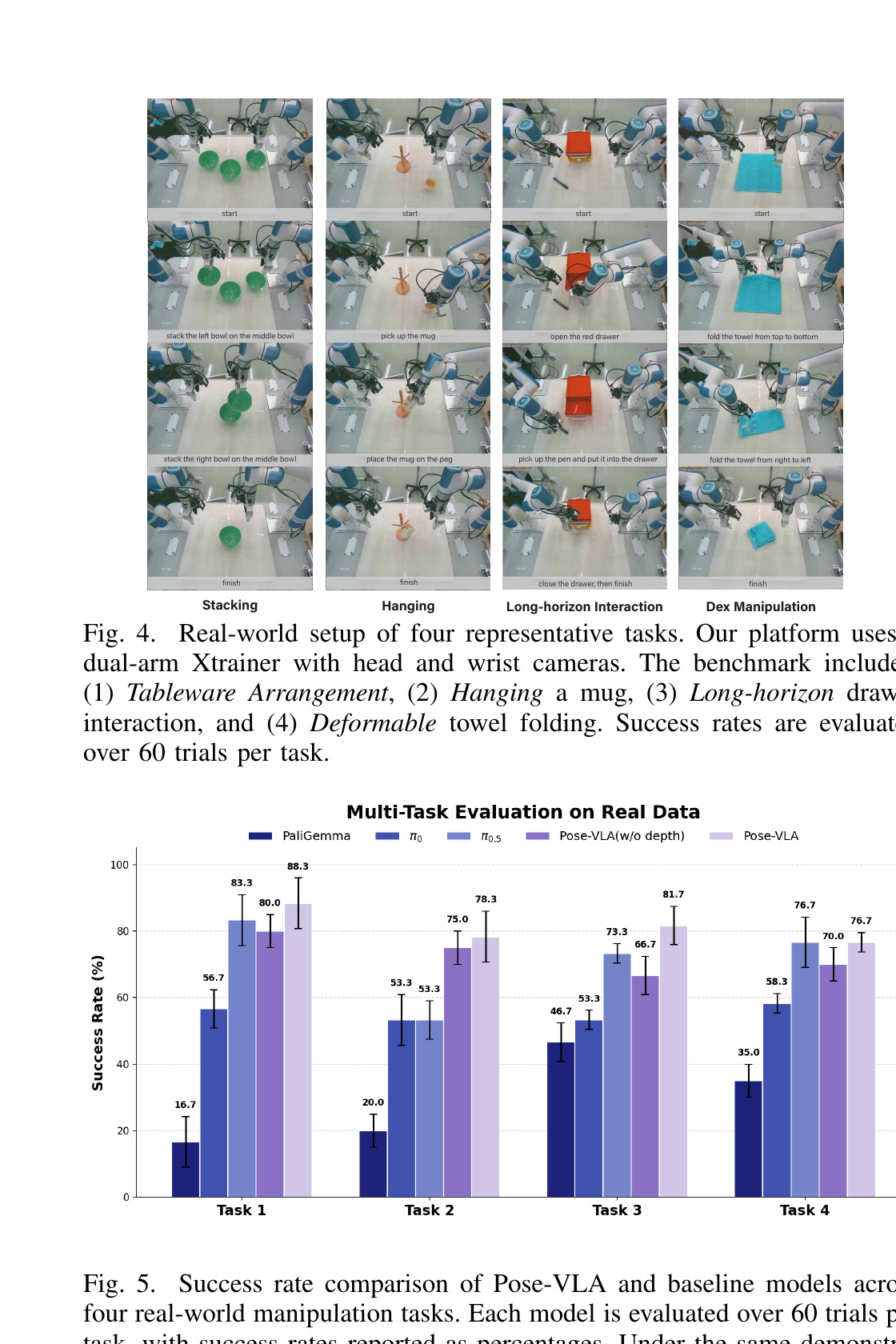
Four bimanual tasks, about 100 demos each, mean 81.25%
Tables IV–VI
Sources of gains
Nonrobot 3D data dominates; EE pose, camera frames, and nonuniform bins matter
Original Figure 2: generic 3D and multirobot trajectories share observations; categories, 2D anchors, and camera poses become structured tokens; few demonstrations align the action expert to embodiments. Source: arXiv:2602.19710. Image copyright belongs to the authors and publisher; reproduced here for paper analysis.
3. Research problem
VQA / image–text VLMs recognize semantics but may miss centimeter-scale position, contact, orientation, and continuous motion. Sparse expensive action labels tied to robot joints create two mismatches:
Granularity: semantic features are not fine 3D states.
Frames: images are camera-centric, actions often base / joint-centric.
Can abundant nonrobot 3D labels first produce geometry-aware VLM features, reducing demonstrations needed for control?
4. Unified representation
Each spatial entity is:
τt={ct,bt,pt},
ct is category, bt a 2D box center, pt∈SE(3) camera pose. Static tuples describe objects; temporal tuples describe 6DoF gripper trajectories.
Rotation: principal-axis Euler angles in <rot> tokens.
Translation: x/y share <trans_xy>, z uses <trans_z>.
Grounding also predicts <size>.
The appendix assigns N=2048 distribution-aware bins per token type, finer in dense near-field regions.
Calibrated base-to-camera transforms put gripper trajectories in the same vocabulary as object poses.
5. Two-stage training
5.1 Pose-centric pretraining
PaliGemma-3B / SigLIP jointly predicts 2D locations and 3D tokens with next-token training:
1.4 million images, 6.5 million 3D annotations: Omni3D (Objectron, SUN RGB-D, ARKitScenes), Omni6DPose (SOPE, ROPE), and BOP (YCB-V, LineMOD, HOT3D).
About 1.55 million robot trajectories: AgibotWorld Beta, 1 million real; InternData-A1, 550K simulated.
Optional geometry:
Per-pixel intrinsic raymap r=K−1[u,v,1]T;
Unnormalized metric depth / validity [D,M].
Patch embeddings add rays / depth to RGB. Random modality zeroing and sparse depth sampling support RGB-only inference.
5.2 Embodiment post-training
A lightweight expert flow-matches noisy action chunks. Self-attention connects VLM semantic / geometric conditions to robot-specific control.
Explicit pose prediction is a pretraining proxy. Deployment maps hidden features directly to actions, avoiding mandatory online tokens, object poses, or camera paths and their extra decoding latency.
6. Key results
6.1 3D spatial grounding
Original Table I: confidence fixed at 1.0, IoU=0.15. SUN RGB-D / Objectron AP is 45.5 / 87.3; Objectron beats open Qwen3-VL 235B Thinking by 16.1 points. Source: paper. Image copyright belongs to the authors and publisher; reproduced here for paper analysis.
AP15 measures 3D box grounding, not BOP AR. Fixed 1.0 confidence isolates localization rather than ranking quality.
6.2 RoboTwin 2.0 and LIBERO
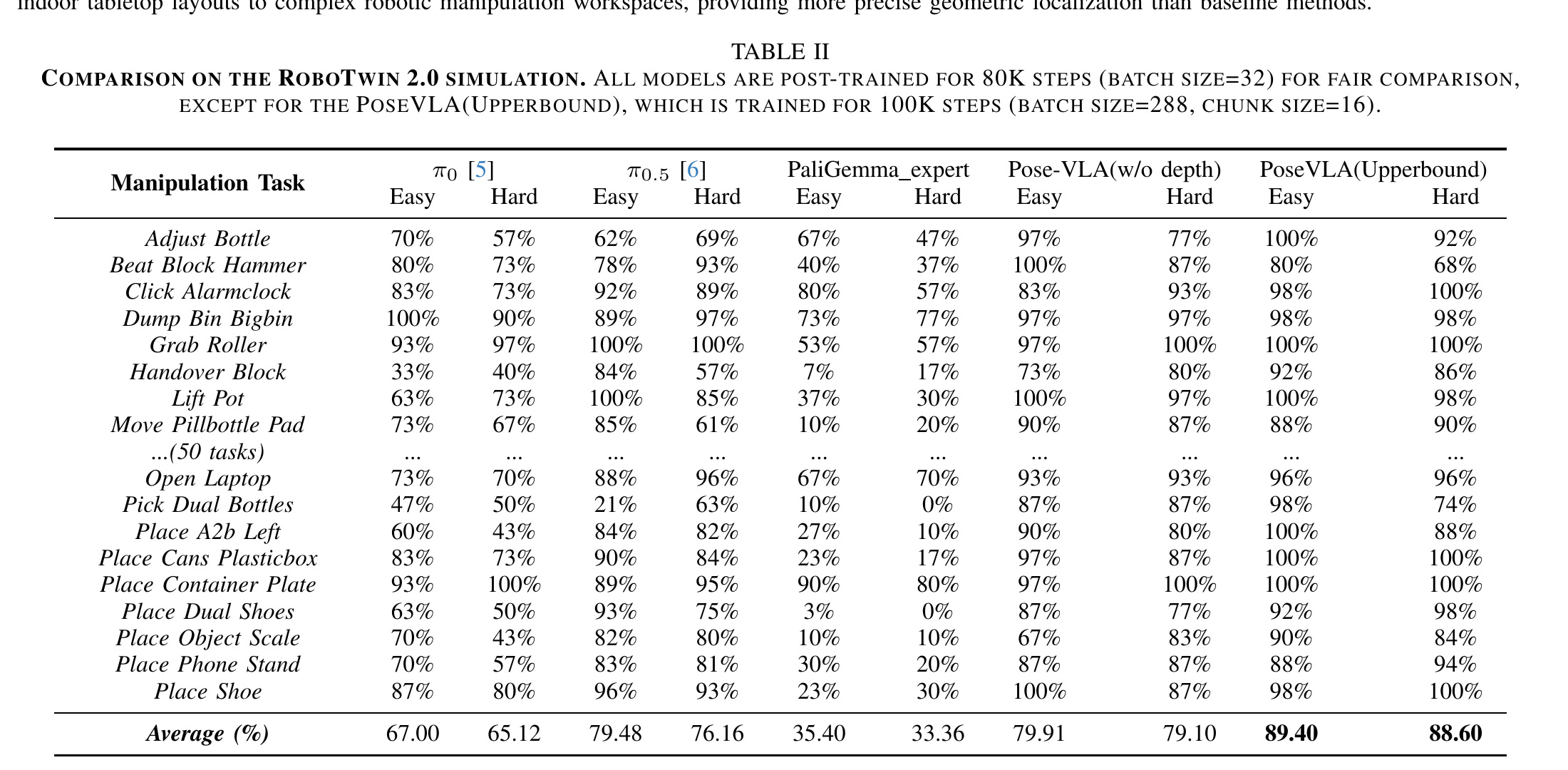
Original Table II: 80K steps / batch 32 give RGB-only 79.91 / 79.10. Upperbound uses 100K / batch 288 / chunk 16 for 89.40 / 88.60, a different budget. Source: paper. Image copyright belongs to the authors and publisher; reproduced here for paper analysis.
Main comparison: 79.91 / 79.10 versus π0 67.00 / 65.12; versus π0.5 79.48 / 76.16, Hard gains 2.94 points.
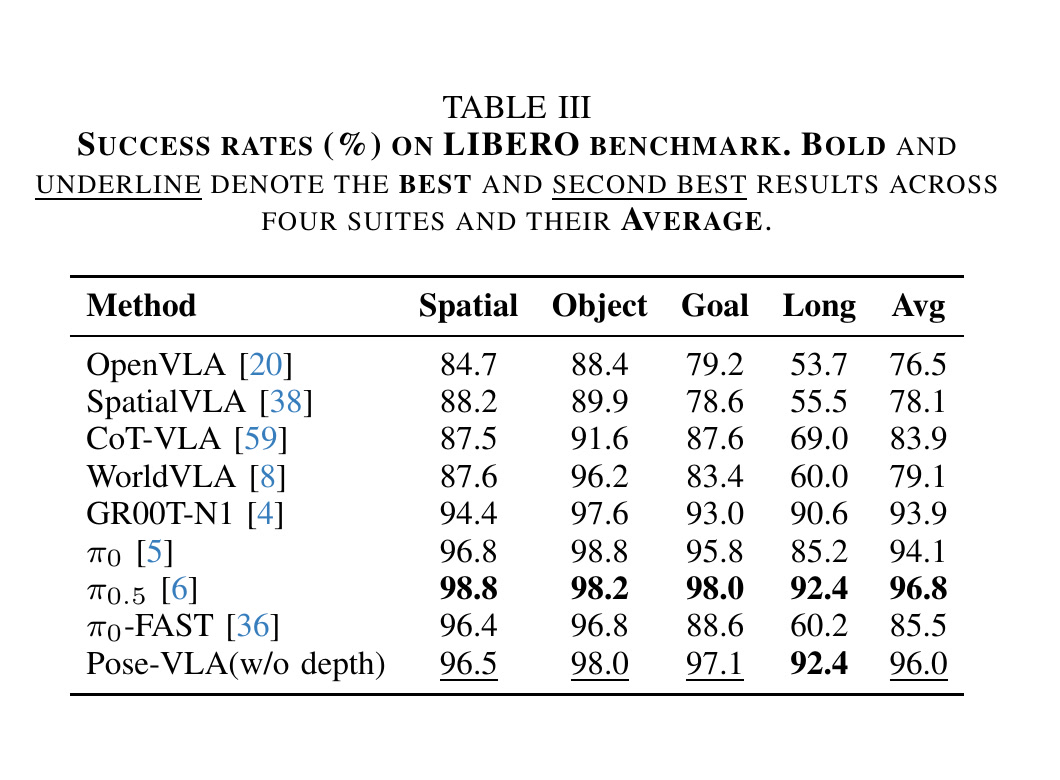
LIBERO: Spatial / Object / Goal / Long 96.5 / 98.0 / 97.1 / 92.4, mean 96.0; below π0.5 mean 96.8, tied on Long.
Later repository results: 89.40 / 88.60 use expanded training, showing scaling rather than replacing fair 80K comparisons.
6.3 Real bimanual tasks
Original Figures 4–5: Xtrainer stacks bowls, hangs mugs, places pens in drawers, and folds towels; about 100 demos / task and 60 trials. Mean Pose-VLA 81.25%, π0.5 71.65%. Source: paper. Image copyright belongs to the authors and publisher; reproduced here for paper analysis.
Full-model tasks score 88.3 / 78.3 / 81.7 / 76.7, versus 80.0 / 75.0 / 66.7 / 70.0 without depth. The drawer task loses 15.0 points: RGB compatibility does not make depth irrelevant.
7. Ablations
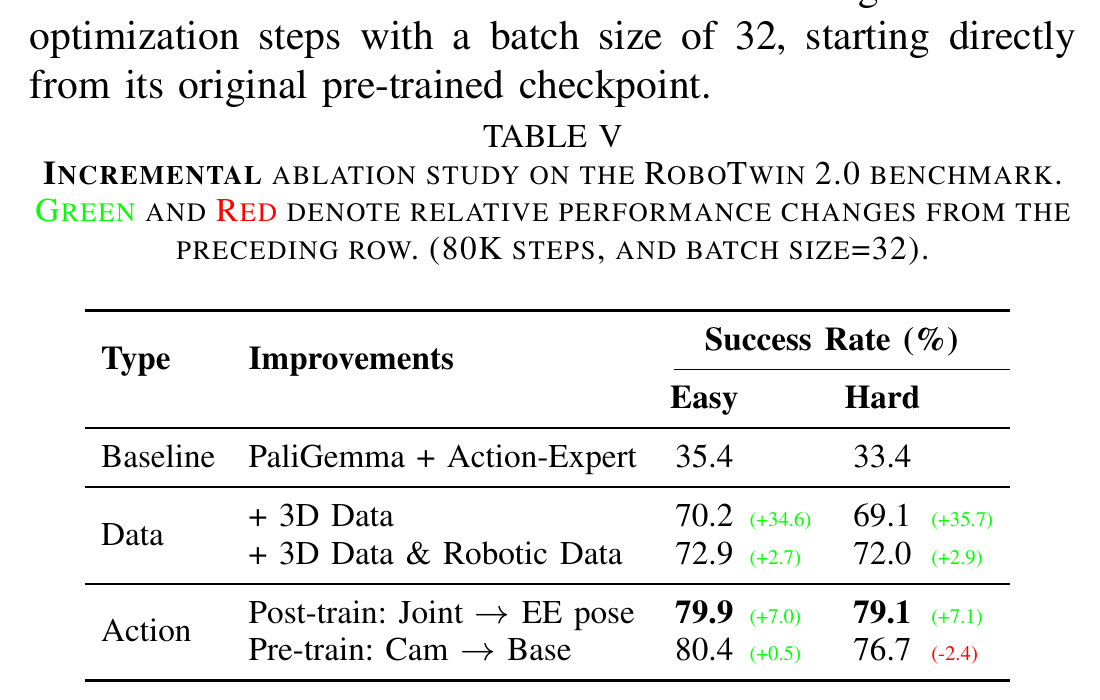
Original Table V: PaliGemma / expert 35.4 / 33.4 rises to 70.2 / 69.1 with nonrobot 3D; EE pose adds about 7 points. Camera-centric Hard exceeds base-frame by 2.4. Source: paper. Image copyright belongs to the authors and publisher; reproduced here for paper analysis.
This supports pose-centric 3D pretraining with aligned action representations, beyond simply adding trajectories.
8. Strengths and limits
Strengths
Clear scaling of nonrobot labels into spatial supervision.
Shared object / gripper tokens bridge sources, frames, and embodiments.
Grounding, two simulation benchmarks, and real tasks form a broad evidence chain.
Masked modalities support RGB, sparse / dense depth, and intrinsics.
Public code, Stage-1 and RoboTwin checkpoints.
Limitations / risks
Mostly rigid pretraining; towel adaptation does not mean deformable-state vocabulary.
Only four real tasks, one platform, and about 100 demos / task.
Camera-centric supervision / rays need reliable calibration.
Stronger geometry can hurt semantic reasoning under distractors.
Main text says scratch expert; appendix also uses π0 initialization. Fix checkpoints explicitly.
89.4 / 88.6 changes batch, steps, and chunks beyond the 80K main table.
9. Coarse-reading assessment
Pose is a VLA pretraining language rather than a separate estimator. Nonrobot 3D raises Hard 33.4→69.1; orthogonal 3D-only reaches 76.2, supporting transferable fine spatial supervision.
Pose annotations can densely supervise embodied representations beyond BOP outputs. Deployment uses implicit features; do not claim an explicit evaluable object-pose output from the policy.
Available src/paper-notes/pose-vla/deep.md
In-depth paper notes
Support reproduction, comparison, related-work writing, and identifying opportunities for further research.
Paper Reading Notes (Deep): Pose-VLA
1. Paper information and scope
Title: Pose-VLA: Universal Pose Pretraining for Generalizable Vision-Language-Action Policies
Authors: Haitao Lin, Hanyang Yu, Jingshun Huang, He Zhang, Yonggen Ling, Ping Tan, Xiangyang Xue, Yanwei Fu
Affiliations: Tencent Robotics X, Futian Laboratory, The Hong Kong University of Science and Technology, Fudan University, Shanghai Innovation Institute
Distinguish three meanings of pose across grounding and policy:
Camera-frame object 6DoF for spatial pretraining;
Camera-frame gripper waypoints for motion alignment;
Continuous deployment actions, not explicit object poses.
2. Positioning in one sentence
Camera-centric tokens connect nonrobot 3D labels and robot trajectories. PaliGemma first learns grounding, then gripper motion, with a flow-matching expert adapting control. Pose prediction is auxiliary pretraining rather than an extra deployment chain.
Method inputs and outputs
Item
Content (compiled for this site)
Inference
RGB / language, optional depth / validity and rays from K. Experts initialize action noise; platform-specific proprioceptive fields are not uniformly detailed.
Output
Flow-matched continuous action sequences, not object R,t. Structured tokens are read when separately running the pretrained VLM for grounding.
Training
Spatial images / language / geometry with object labels; calibrated gripper trajectories for alignment; robot demonstrations for post-training.
Targets
Categories, anchors, discrete pose / size or trajectory tokens, then action flow fields. GT poses / future actions are supervision rather than online givens.
Details
Quantized physical camera poses / sizes during pretraining; embodiment-specific deployment action spaces. Verify dimensions, horizons, frames, and units instead of treating a pose tuple as control.
Conditions
Pretraining / embodiment adaptation and calibration for rays / camera supervision; depth / rays can be masked and are not universal requirements.
Source: Sections III-C–III-E. Pretraining and final-policy outputs are distinct interfaces.
2.1 Guide to the paper’s figures and tables
Figure / table
Role
Focus
Figure 2
Pipeline
Shared camera tokens precede expert adaptation
Figure 6
Distributions
x/y differs from z, motivating split vocabularies / nonuniform bins
Table I / Figure 3
Grounding
AP15 and unseen-scene examples
Tables II–III
Simulation
Visual perturbations and long-horizon suites
Figures 4–5
Real tasks
About 100 demos / task; depth helps drawers
Tables IV–VI
Ablations
Geometry, data, actions, frames, tokenization
Figure 7
t-SNE
Auxiliary support for reduced feature collapse
Original Figure 2: 3D / robot data share camera-centric observations and pose vocabulary. Categories, 2D anchors, and poses train PaliGemma, followed by continuous-action denoising. Source: arXiv:2602.19710. Image copyright belongs to the authors and publisher; reproduced here for paper analysis.
3. Why ordinary VLM features are insufficient
3.1 Granularity mismatch
VQA emphasizes categories / relations, while manipulation needs small orientation, contact-distance, and handle-motion distinctions. Semantically identical observations can require different actions.
Recognizing targets does not ensure control-relevant 3D features. PaliGemma / expert Easy / Hard 35.4 / 33.4 is presented as an external symptom of feature collapse.
3.2 Representation mismatch
Nonrobot labels use camera object frames, robot data joints / base poses / local deltas. Mixing them creates:
Robot vocabularies incompatible with object-centric data;
Implicit extrinsic / kinematic transformations between images and actions.
Camera-centric 6DoF aligns supervision during pretraining, without claiming cameras are always the best control frame.
4. Formalization
Given O and instruction L, autoregressively model S:
P(S∣O,L)=k=1∏KP(sk∣O,L,s<k).
Structured tuples contain:
S=(τ1,τ2,…,τT),τt={ct,bt,pt}.
ct: category;
bt∈R2: 2D center / anchor;
pt∈SE(3): camera-frame 6DoF.
Static tuples describe objects, temporal tuples grippers. One grammar covers entities and continuous paths as universal geometric primitives.
5. Backbone and explicit geometry
5.1 PaliGemma / SigLIP
PaliGemma-3B / SigLIP retains text and <loc> vocabularies, adding rotation, translation, and size.
5.2 Camera ray encoding
Given intrinsics K, ray for pixel (u,v) is
r(u,v)=K−1[u,v,1]⊤.
Patch-projected rays add to RGB before the first Transformer block: image positions locate pixels, rays specify 3D viewing directions.
This matters for off-center crops / high resolution, where similar appearance has different viewing rays.
5.3 Metric depth prior
Depth is not just D, but
[D,M]∈RH×W×2,
M marks valid / sparse samples. Unnormalized physical values retain metric alignment; [D,M] is embedded and added to RGB.
Sparse training depths improve handling of varied sensors / missingness.
5.4 Modality masking
Random zeroing makes depth / rays optional. Fair simulation masks both; real results show depth remains useful.
6. Unified pose representation
6.1 Object-level pose tokens
Euler angles use <rot> per principal axis; translation splits statistically:
x/y: shared <trans_xy>;
z: separate <trans_z>;
Object dimensions: <size>.
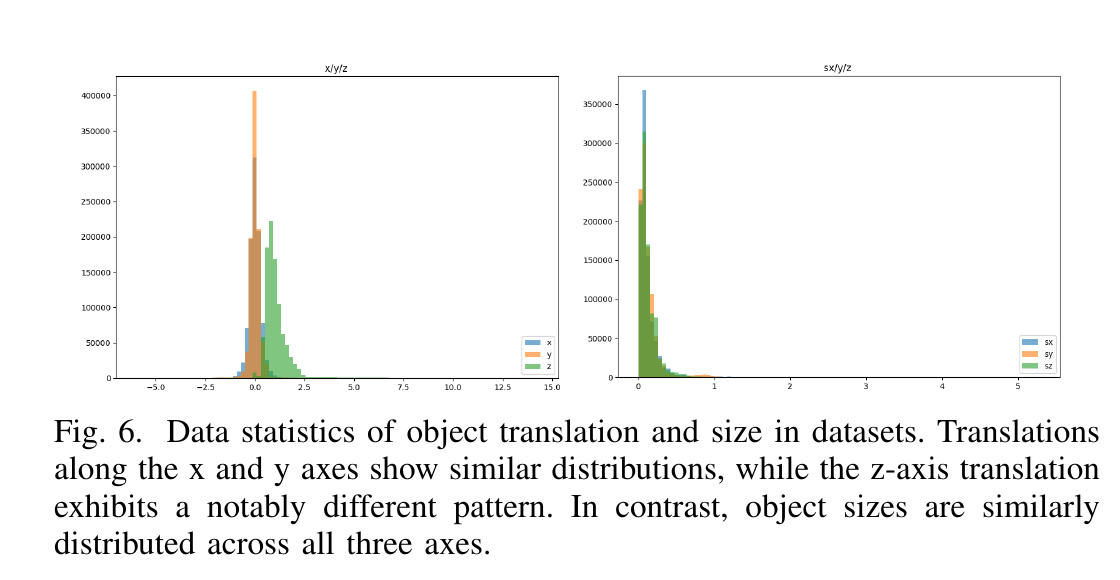
x/y concentrates near the optical axis, while z is positive and long-tailed. Uniform bins waste near-contact resolution on sparse distant values.
Original Figure 6: $x/y$ distributions resemble each other; $z$ is skewed; size axes are more similar. This motivates split translation vocabularies and distribution-aware bins. Source: appendix. Image copyright belongs to the authors and publisher; reproduced here for paper analysis.
Inverse-density bin widths make dense regions finer and tails coarser, approximately equalizing token frequency / increasing entropy. <rot>, <trans_xy>, <trans_z>, and <size> each receive N=2048 bins.
The main text calls rotation uniform, while the appendix describes spatial tokens as nonuniform. Verify tokenizer edges / checkpoint versions in code.
6.2 Trajectory-level pose tokens
Gripper actions form temporal 6DoF tokens, transformed from dataset base frames to calibrated cameras.
This aligns observed gripper motion rather than joint structure; the expert later handles embodiment control.
ϕ(O) denotes masked observations, jointly predicting 2D and 3D tokens.
Two dense supervision types:
Grounding: categories, anchors, camera pose / size from images / text.
Alignment: future camera-frame gripper paths from robot video.
The former teaches geometry, the latter control sensitivity.
7.2 Post-training: flow-matching action expert
A lightweight π0-style expert denoises action states / noise through flow matching, interacting with the VLM by self-attention.
This adapts embodiments rather than relearning geometry from scratch.
7.3 No explicit deployment pose
The paper explicitly restricts pose prediction to auxiliary pretraining. Experts map hidden features to actions without object / camera-path estimates or extra pose decoding.
Unlike modular pose-then-control with R,t, implicit features are less replaceable / separately diagnosable, while avoiding that extra latency.
7.4 Expert-initialization inconsistency
The main text says scratch experts without π0 weights; the appendix also has Pose-VLA (π0) using official initialization. Scratch gives 79.91 / 79.10; initialized gives 81.30 / 80.72.
Interpretation:
79.91 / 79.10 supports pose pretraining with scratch experts;
81.30 / 80.72 adds about 1.4–1.6 points from expert pretraining;
Name initialization explicitly rather than conflating configurations.
8. Pretraining data and compute
8.1 Nonrobot 3D
1.4 million images, 6.5 million annotations:
Pillar
Sources
Learning
General detection
Omni3D: Objectron, SUN RGB-D, ARKitScenes
Indoor / object-centric box grounding
6D pose
Omni6DPose: SOPE, ROPE
Large-vocabulary real / synthetic poses and size
Manipulation perception
BOP: YCB-V, LineMOD, HOT3D
Workspace geometry / poses
Real / synthetic mixtures vary lighting, materials, scale, and density.
Temporal tokens extend static spatial learning beyond more action samples.
8.3 Training configuration
optimizer: AdamW;
schedule: cosine;
Peak learning rate 5×10⁻⁵; 1,000 warm-up steps;
Minimum 2.5×10⁻⁶;
precision: bfloat16;
hardware: 16 × NVIDIA H20;
batch: 8 / GPU;
About 2 days each for grounding and trajectory estimation.
These cover two pretraining tasks; downloads, benchmark adaptation, simulation, and real demonstrations add separate costs.
9. Grounding evaluation
9.1 Protocol
Omni3D SUN RGB-D / Objectron subsets;
Category-specified text prompts;
IoU 0.15, AP15 / mAP@0.15;
Confidence fixed at 1.0 to reduce ranking effects.
AP15 is box grounding, not BOP AP / ADD(-S) / AR. IoU 0.15 is looser than common 2D 0.5, requiring protocol-aware comparisons.
Original Table I: SUN RGB-D / Objectron 45.5 / 87.3; Objectron exceeds Qwen3-VL 235B Thinking 71.2 by 16.1 points. SUN still trails Gemini Robotics-ER 48.3. Source: paper. Image copyright belongs to the authors and publisher; reproduced here for paper analysis.
9.2 Interpretation
Objectron 87.3: object-centric tabletop geometry gives largest gains.
SUN RGB-D 45.5: above open baselines / VST-SFT / RL, below Gemini Robotics-ER 48.3.
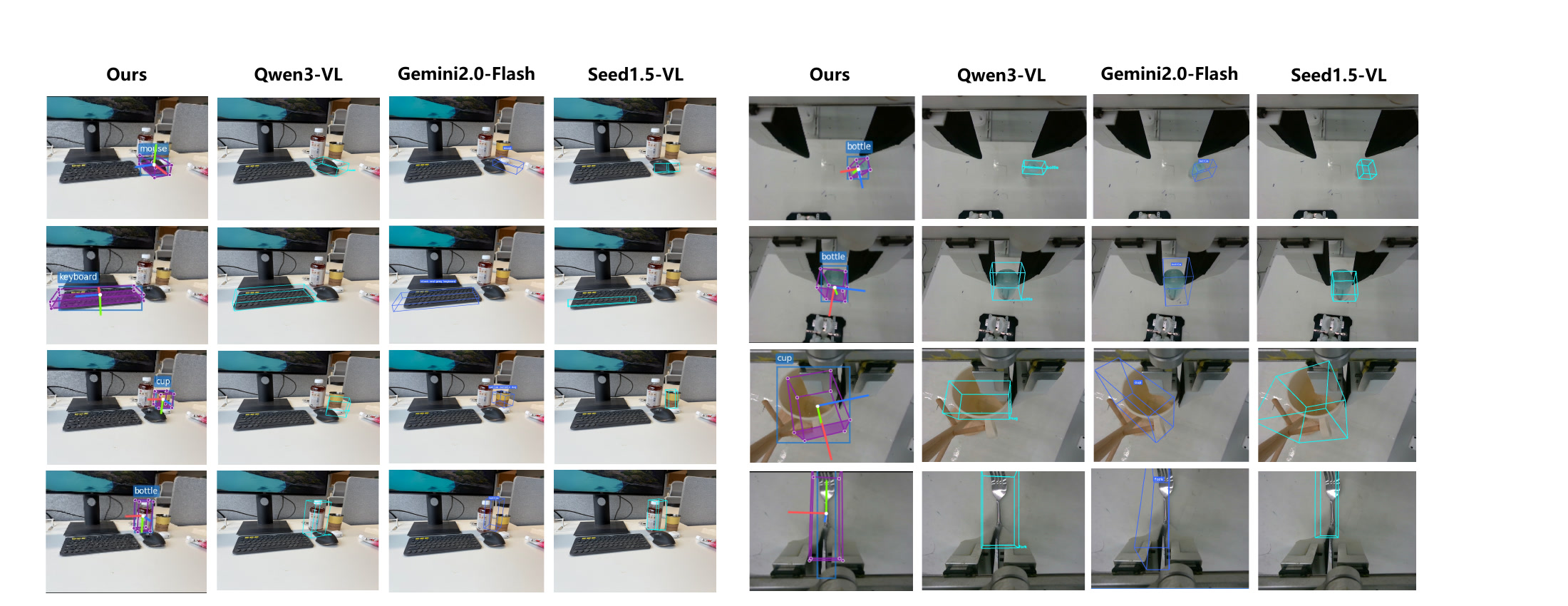
Original Figure 3: everyday tables left, robot workspaces right. Pose-VLA boxes often align better. Qualitative support cannot replace stratified errors. Source: paper. Image copyright belongs to the authors and publisher; reproduced here for paper analysis.
Original Table II: fair-budget 80K gives 79.91 / 79.10, π0 67.00 / 65.12, π0.5 79.48 / 76.16. Upperbound changes to 100K / batch 288 / chunk 16 for 89.40 / 88.60. Source: paper. Image copyright belongs to the authors and publisher; reproduced here for paper analysis.
Hard gains 13.98 over π0; relative to π0.5, the gain is 2.94. Easy / Hard differ by only 0.81, highlighting robustness to visual / geometric randomization.
July 2026 extended training uses 100K steps, 24 GPUs × batch 12, chunk 16, giving Easy / Clean 89.4 and Hard / Random 88.6. Multiple simultaneous changes prevent attributing roughly 9.5 points to one design.
10.2 LIBERO
LIBERO has Spatial, Object, Goal, and Long suites, each with 10 tasks and 500 demonstrations within that suite. Results:
Original Table III: 96.5 / 98.0 / 97.1 / 92.4, mean 96.0, below π0.5 mean 96.8 but tied with π0.5 on Long at 92.4. Source: paper. Image copyright belongs to the authors and publisher; reproduced here for paper analysis.
Competitive is more accurate than universal SOTA: second mean, no Spatial / Object / Goal column win, but tied best Long and above π0 85.2.
11. Real bimanual experiments
11.1 Platform and tasks
Dual-arm Xtrainer, 1-DoF parallel grippers;
Head-mounted Eye-on-Base D455;
Wrist Eye-on-Hand D405;
About 100 demonstrations per task;
3 seeds × 20 trials, 60 per task.
Tasks:
Stack three nesting bowls;
Hang mugs on a specified peg;
Open drawer, place pen, close;
Fold towels.
Original Figures 4–5: 88.3 / 78.3 / 81.7 / 76.7, mean 81.25; π0.5 mean 71.65. Task 4 ties π0.5 at 76.7 rather than all-column wins. Source: paper. Image copyright belongs to the authors and publisher; reproduced here for paper analysis.
Task 3’s precise multistage drawer geometry benefits most. RGB-only simulation proves compatibility, while real results support using available metric depth.
12. Sources of gains
12.1 Geometric modalities
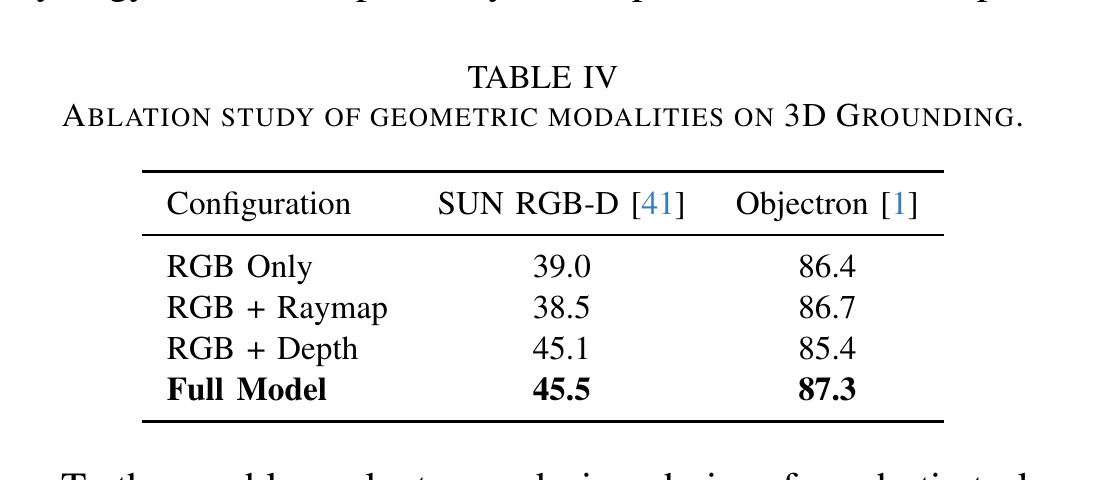
Original Table IV: SUN RGB 39.0, depth 45.1, full 45.5. Objectron sparse / localized depth gains less, full 87.3. Source: paper. Image copyright belongs to the authors and publisher; reproduced here for paper analysis.
SUN: dense context raises 39.0→45.1; rays alone give 38.5.
Objectron: RGB 86.4, rays 86.7, depth 85.4, full 87.3.
Rays are not always helpful alone. Joint rays and depth give best overall scores; rays alone lose 0.5 on SUN.
12.2 Data and actions
Original Table V: nonrobot 3D is the largest step; trajectories add about 3 points, EE pose about 7. Camera-to-base pretraining loses Hard 2.4. Source: paper. Image copyright belongs to the authors and publisher; reproduced here for paper analysis.
Increment
Easy
Hard
Change from prior row
PaliGemma + Action Expert
35.4
33.4
scratch baseline
+ 3D Data
70.2
69.1
+34.6 / +35.7, largest
+ 3D & Robotic Data
72.9
72.0
+2.7 / +2.9, motion alignment
Post-train Joint → EE
79.9
79.1
+7.0 / +7.1, aligned actions
Pre-train Cam → Base
80.4
76.7
Easy +0.5, Hard -2.4
Small robot-data increments do not imply useless trajectories: sequential action gains depend on earlier data / representations. Generic 3D is the largest marginal source at this scale.
12.3 Orthogonal ablations
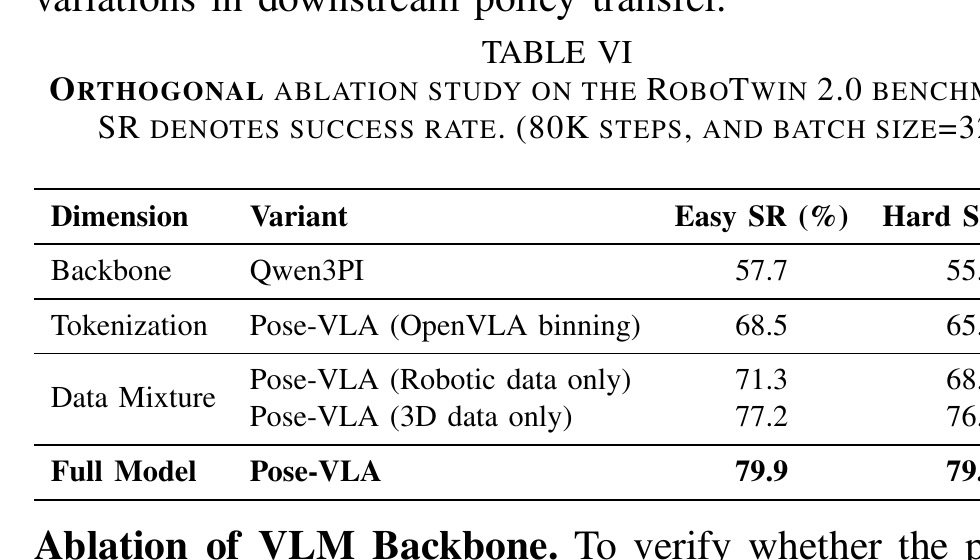
Original Table VI (the current crop cuts off the right side of the Hard column; the complete values below follow the paper table): Qwen3PI 57.7 / 55.3; OpenVLA bins 68.5 / 65.9; robot-only 71.3 / 68.3; 3D-only 77.2 / 76.2; full 79.9 / 79.1. Source: paper. Image copyright belongs to the authors and publisher; reproduced here for paper analysis.
Strongest conclusions:
Generic VLM strength does not ensure policy strength: Qwen3PI trails Hard by 23.8.
Nonrobot geometry matters: 3D-only 76.2 versus robot-only 68.3.
Representation and scaling interact: delta bins impede generic pose transfer.
12.4 t-SNE is auxiliary
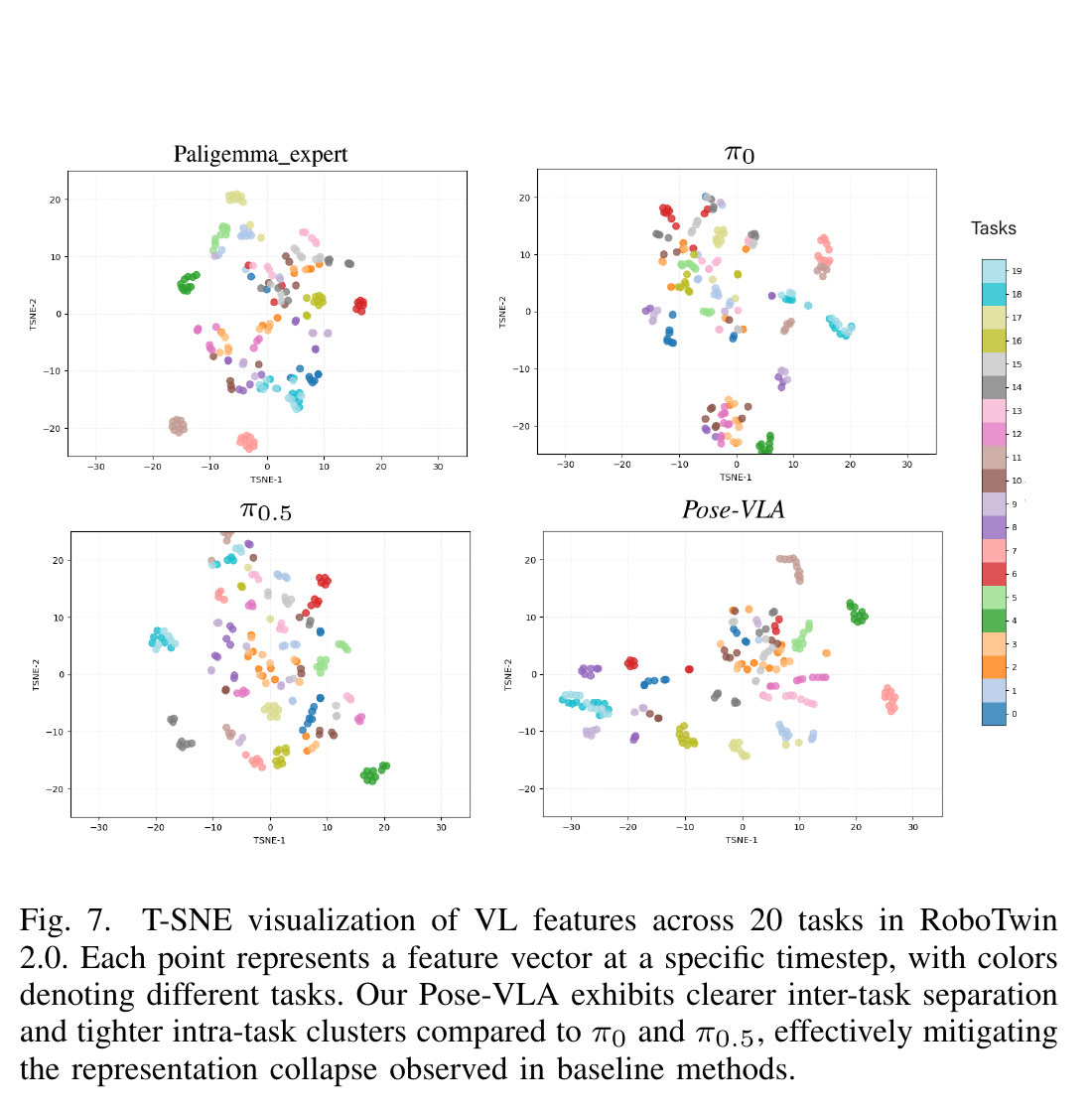
Original Figure 7: features from 20 RoboTwin tasks show clearer between-task separation / tighter clusters. t-SNE distorts global distances and supplements rather than replaces probes / controlled representation metrics. Source: appendix. Image copyright belongs to the authors and publisher; reproduced here for paper analysis.
13. Claims and evidence
Claim
Evidence
Assessment
Pose pretraining reduces collapse
PaliGemma 33.4 → Pose-VLA 79.1; t-SNE
Strong task evidence, moderate mechanism evidence, not causal t-SNE proof
Nonrobot 3D transfers to control
+3D 35.7; 3D-only 76.2
Strongest ablation
Universal camera interface
Cam→Base Hard -2.4; EE +7.1; shared data
Supported on current platforms, needing more cameras / mobile robots
RGB compatibility
Masking, depth-free simulation
Supported, depth still helps real tasks
Few-demo generalization
Four tasks, about 100 demos, 81.25
Preliminary, limited coverage
Long-horizon ability
LIBERO-Long 92.4, real drawer 81.7
Evidence exists, geometry versus memory not isolated
14. Relationship to 6D object pose
14.1 Pose supervision used
Omni6DPose / BOP annotations;
camera-centric SE(3) object state;
Structured categories, anchors, poses / sizes;
Objectron / SUN AP15 and boxes.
14.2 What is not provided
BOP VSD / MSSD / MSPD AR;
An explicit pluggable deployment-pose API;
Monotonic policy success versus independent pose errors;
Online PnP, ICP, rendering alignment, or explicit paths.
Place it in VLA / embodied intelligence, separate from BOP FoundationPose, MegaPose, SAM-6D rankings.
14.3 Implications
Pose labels can supervise general representations beyond one head.
Shared frames / tokens connect perception and control.
Depth / rays / intrinsics can be optional masked priors.
Ablations identify generic 3D as the largest source, with EE / camera alignment easing control transfer. RoboTwin, LIBERO, and real tasks cover perturbations, long horizons, and few-demo adaptation.
Rigid pretraining, fixed tables, calibration, semantic trade-offs, and initialization still limit universality. Pose supervision is shown to be useful VLA pretraining, rather than proving end-to-end policies fully replace explicit 6D pose modules.