PoseGAM: Robust Unseen Object Pose Estimation via Geometry-Aware Multi-View Reasoning
PoseGAM processes a query image and multiple posed templates with a geometry-aware multiview network. Explicit point geometry and learned geometry features directly predict pose without explicitly constructing query–template correspondences, improving average AR across five BOP datasets.
Query RGB and multiple posed templates support direct unseen-object pose reasoning through explicit points and learned geometry, without constructing query–template feature correspondences.
2.1 Guide to the paper’s figures and tables
Figure / table
Purpose
Overview reading tips
Figure 1
Initial / estimated CAD poses projected into queries
Check recovered spatial arrangements
Figure 2
Multimodal inputs, point-map and feature-map encoders
Geometry projected back into views
Table 1
Five BOP datasets
Generalization / stability
Tables 2 / 3
Data and geometry ablations
Architecture versus synthetic scale
Figure 4
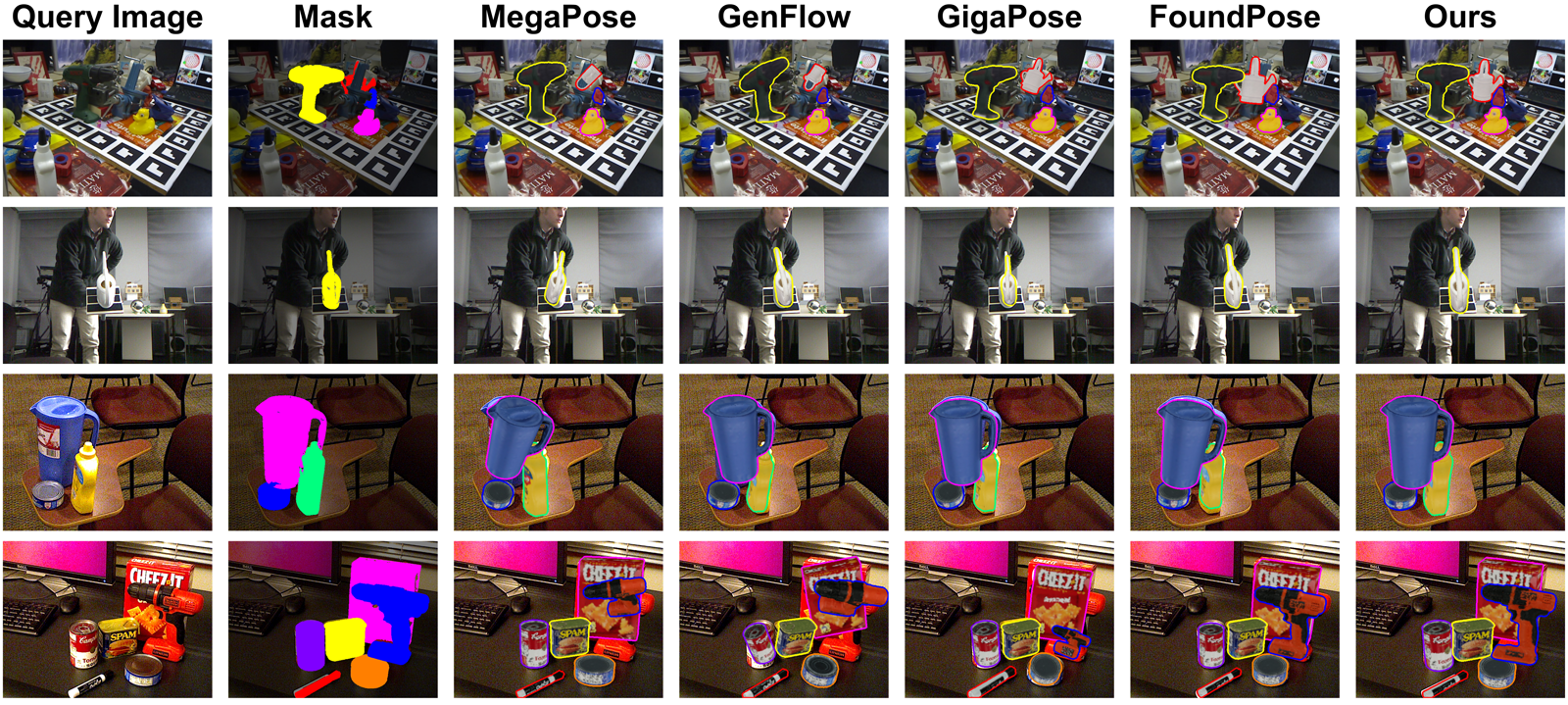
Qualitative projections
Occlusion, appearance, multiple objects
Original cross-dataset qualitative comparison: Query Image, Mask, MegaPose, GenFlow, GigaPose, FoundPose, and Ours, from left to right. Colored object contours compare projected estimates with real images. This is not an initial-red-plane / predicted-green-plane schematic. Source: CVF Open Access. Image copyright belongs to the authors and publisher; reproduced here for paper analysis.
3. Problem setting
Query RGB plus multiple same-object templates and their poses.
Test objects are unseen; generalization spans objects, appearance, and scenes.
Output rotation / translation in the query-camera frame, evaluated with BOP AR.
4. Method overview
Encode query, templates, and camera information jointly.
Point geometry supplies explicit 3D structure.
A geometry representation network provides higher-level features.
Project geometry features to view maps compatible with foundation-image reasoning.
Predict poses end-to-end without hand-built matches / separate PnP.
5. Experimental overview
Over 190k synthetic objects with lighting, materials, appearance editing, and scene variation.
LM-O, T-LESS, TUD-L, IC-BIN, and YCB-V evaluation.
Reported mean AR improvement 5.1%, maximum dataset improvement 17.6%.
6. Quick assessment
Value: direct foundation-model geometric reasoning beyond explicit matching.
Strength: a simple interface combines multiview appearance and geometry.
Risks: posed templates / CAD and large-scale training remain necessary; less training-free than ConceptPose, with additional multiview preparation.
Key assessment: explicit object geometry and reference / query appearance mismatch are the challenge, beyond attaching a pose head to a multiview model.
2. Positioning in one sentence
Point maps and learned geometry maps condition direct query-plus-template reasoning without an explicit correspondence stage.
2.1 Guide to the paper’s figures and tables
Figure / table
Deep-dive questions
Figure 1
Do CAD projections recover both position and orientation?
Figure 2
How are geometry / features encoded and projected into views?
Table 1
Are five-dataset gains concentrated in certain materials / scenes?
Figure 4
Do masks or reasoning cause appearance / occlusion / clutter failures?
Ablations
Are explicit and learned geometry complementary?
Original cross-dataset comparison: Query Image, Mask, and colored object projections from MegaPose, GenFlow, GigaPose, FoundPose, and Ours. It compares methods rather than color-coded initial / predicted pose planes. Source: project / CVF Open Access. Image copyright belongs to the authors and publisher; reproduced here for paper analysis.
3. Problem setting and task boundaries
Inputs: query RGB, template RGBs, and known template poses / CAD geometry.
Outputs: target 6D poses in the query frame.
Unseen test objects require learned geometry / reasoning rather than instance memorization.
Queries may contain multiple objects; Figure 1 emphasizes spatial arrangement.
Dependencies: masks, posed templates, and geometry make this generalizable / model-based rather than training-free / CAD-free.
4. Research context
Match-then-localize / refine expose correspondences whose errors propagate into solvers.
Multiview foundations infer cameras / geometry, but RGB-only inputs omit CAD and commonly assume consistent appearance.
PoseGAM treats geometry as a peer input, aligning it through view maps.
5. Research motivation
Removing explicit matching reduces dependence on engineered correspondences.
Raw geometry tokens disrupt image interfaces, motivating feature extraction and projection.
Synthetic data must cover CAD-to-real color, material, lighting, and background shifts.
6. Method details
6.1 Multimodal inputs
Image encoders process queries / templates; camera encoders process poses.
Point-map geometry is encoded into view-compatible features.
Learned geometry provides more stable object-level features.
6.2 Geometry-to-view map
Raw geometry-token sequences were found to hinder learning.
Extract features first, then project them into view positions for joint attention.
This retains multiview inductive structure while supplying explicit CAD evidence.