PS6D: Point Cloud Based Symmetry-Aware 6D Object Pose Estimation in Robot Bin-Picking
PS6D predicts poses pointwise with attention-based point cloud features, a symmetry-aware rotation loss, and a center-distance-weighted translation loss. Two-stage clustering first separates centers, then rotations, handling intersecting elongated parts and multiple symmetry modes. The paper also reports 91.7% real bin-picking success for one part category.
PS6D estimates poses in industrial piles using only point coordinates. Point Transformers enhance multiscale features; symmetry-aware rotation and center-distance-weighted translation losses supervise per-point poses. Two-stage voting clusters centers into instances, then clusters rotations within them, addressing merged slender objects and incorrect averaging of symmetry-equivalent poses.
3. Guide to figures and tables
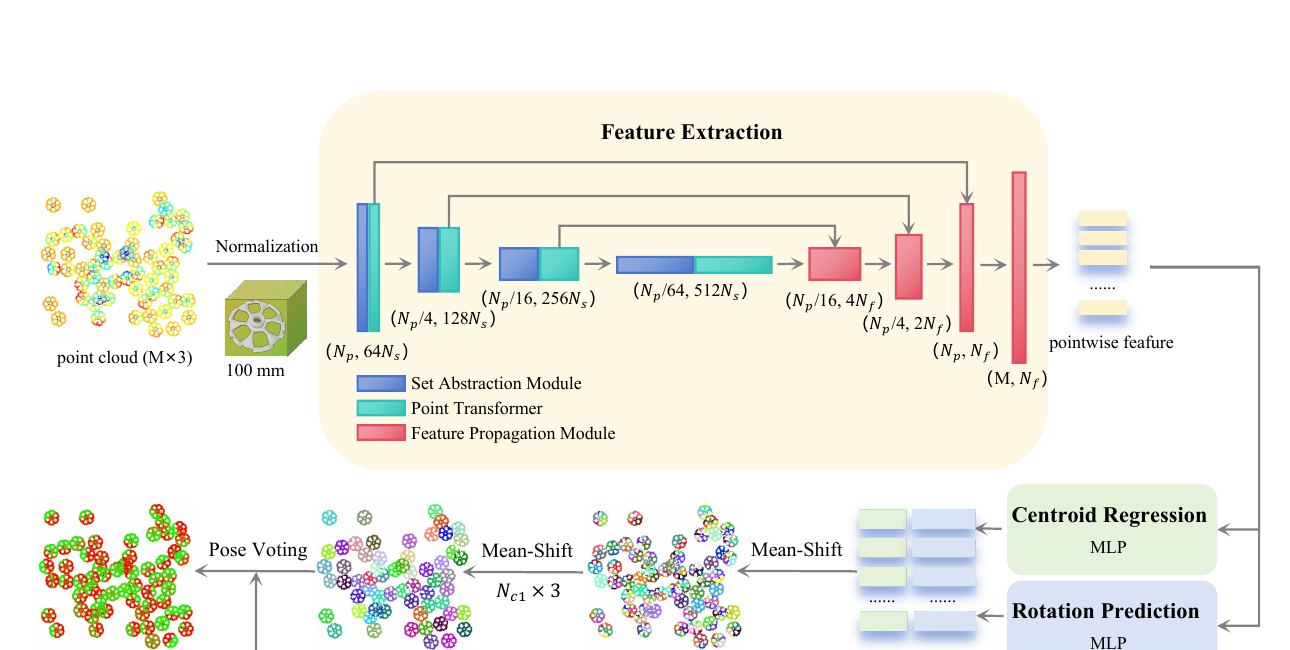
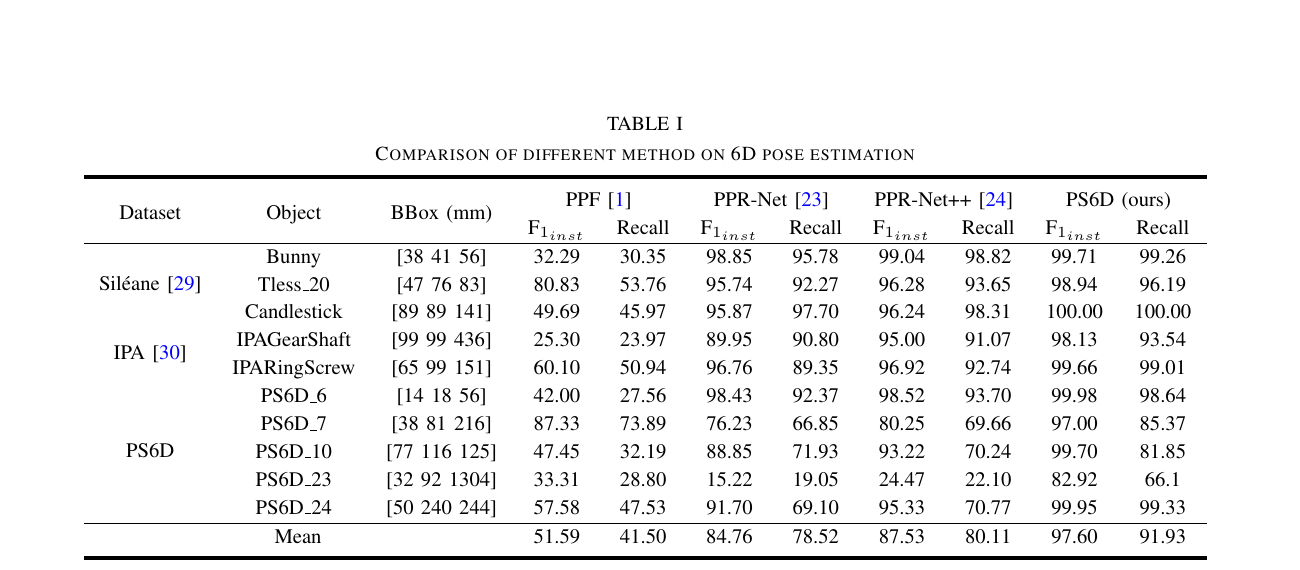
Original Figure 2: per-point coordinates feed PointNet++ / Point Transformer features, separate center and rotation heads, and two-stage Mean-Shift clustering for instance segmentation and pose voting. Source: authors' public manuscript. Image copyright belongs to the authors and IEEE; reproduced here for paper analysis.Original Table I: instance F1 / recall for 10 objects; the current image contains the quantitative table only, without Figure 5 qualitative results. Source: authors' public manuscript. Figure and table copyright belongs to the authors and IEEE; reproduced here for paper analysis.
4. Problem setting
Input: scene point cloud within the workspace ROI, without RGB or prior 2D segmentation.
Output: segmentation, rotation, and translation for each piled part instance.
Targets: known industrial parts that are rusty, reflective, textureless, slender, or symmetric about multiple axes.
Training: random simulated piles of known CAD models; real deployment adds ICP and a grasp point library.
5. Method overview
Normalize the scene point cloud into a 100 mm cube to reduce object size variation.
Insert Point Transformers into a PointNet++ multiscale encoder to learn short- and long-range point relationships.
Each point predicts an offset to its instance center and a rotation quaternion, with corresponding losses.
Rotation loss enumerates valid symmetry transforms for finite / continuous symmetries and takes the minimum rotation distance.
First-stage Mean-Shift clusters centers into instances; the second stage groups rotations within each instance, avoiding averaging across crossed slender parts or multiple valid rotations.
Vote over poses within each cluster to produce per-instance results.
6. Experiments at a glance
Ten objects across Siléane, IPA, and the authors’ PS6D dataset yield overall F1inst / recall of 97.60 / 91.93.
PPR-Net++ scores 87.53 / 80.11 overall; the paper reports improvements of 11.5% and 14.8%.
The real system uses Mech-Eye Pro S, Fanuc LR Mate 200iD, and Mech-Viz, reporting 91.7% bin-picking success for PS6D_6.
7. Quick assessment
Strengths: simple input requirements; symmetry loss and two-stage clustering address concrete industrial failures; real deployment results are reported.
Limitations: known CAD models, symmetry definitions, and grasp point libraries remain necessary; real grasping tests only one part category.
Compared with SD-Net: SD-Net focuses on symmetric keypoints and real-domain adaptation; PS6D directly regresses per-point rotations, emphasizing slender instance separation, multisymmetry voting, and object size variation.
Recommended for: industrial point clouds, pose voting, symmetry-aware rotation losses, and bin-picking deployment.
Available src/paper-notes/ps6d-iros2024/deep.md
In-depth paper notes
Support reproduction, comparison, related-work writing, and identifying opportunities for further research.
Deep Reading Notes: PS6D
1. Key assessment
PS6D addresses two concrete industrial point cloud failures: center-only clustering can merge crossed slender parts, while finite or multiaxis symmetry can make per-point regression average valid quaternions into an invalid pose. Two-stage clustering and a symmetry-aware rotation loss address these respectively, with validation on the authors’ industrial objects and real grasping.
This is not general novel-object pose estimation: CAD models, symmetry parameters, and simulation training are known. Its value lies in turning point cloud geometry, instance separation, and symmetry-aware pose voting into stable modules for known industrial parts.
2. Inputs, outputs, and system boundaries
Input is an ROI point cloud P∈RM×3. The network reads only point positions, without color. Outputs include instance segmentation and each instance’s camera-relative translation and rotation.
Suitable settings include:
Random piles of multiple instances of the same part;
Rusty, reflective, or unreliably textured surfaces;
Continuous axial symmetry, finite symmetry, multiaxis symmetry, and slender geometry.
The method still requires:
Known CAD models and symmetry orders;
Simulated scales, piles, and camera geometry close to deployment;
Sufficiently complete point clouds from the real sensor;
Predefined grasp points and further ICP correction during grasping.
3. Network architecture
Original Figure 2: the upper branch produces per-point features, followed by center regression and rotation prediction; two Mean-Shift stages separate instances and then rotation modes. Source: authors' public manuscript. Image copyright belongs to the authors and IEEE; reproduced here for paper analysis.
3.1 Size normalization and attention features
Scene point clouds are scaled / translated into a canonical 100 mm × 100 mm × 100 mm space. PointNet++ Set Abstraction builds multiscale local features; Point Transformers weight point relationships between layers, and Feature Propagation restores per-point features.
This is not object-level NOCS construction: it stabilizes center offsets and neighborhood scales across object sizes. Removing normalization has a smaller effect on small objects, but a larger effect across size variations and difficult objects.
3.2 Center-distance-sensitive translation
Each point predicts an offset to the instance center. Near-center points tend to localize centers more reliably, while distant / boundary / occluded points often have larger errors; translation loss weights depend on distance to the true center.
First-stage Mean-Shift clusters predicted centers into candidate instances. Unlike direct semantic segmentation, center voting separates multiple instances of one class. Crossed slender parts can still generate nearby center predictions around the intersection, motivating the second stage.
3.3 Symmetry-aware rotation
Each point predicts a quaternion. Predefined symmetry angles dx,dy,dz about x/y/z and continuous symmetry threshold Ts generate a symmetry rotation set S. Training compares each prediction with all equivalent ground truths and takes the minimum error:
LR=S∈Smind(Rpred,RgtS).
Multiple valid rotations for one observation are therefore not contradictory labels. For an infinitely symmetric axis, only observable axial direction needs constraining; finite multiaxis symmetry retains multiple discrete equivalent rotations.
3.4 Two-stage clustering
Mean-Shift on predicted centers produces coarse instances;
Mean-Shift on rotation prediction similarity within each coarse instance separates modes;
Rotation modes can split mixed clusters caused by crossed slender objects;
Pose voting runs within each final cluster.
This also prevents arithmetic averaging of multiple rotation modes for finite-symmetry objects. Separating “which instance” from “which equivalent rotation” is the most targeted part of the method.
F1inst: combines instance detection, segmentation, and matching;
Recall: recall of successfully matched / correctly posed instances;
Real bin-picking success rate.
These are not standard BOP AR, and VSD / MSSD / MSPD are not provided; compare within the paper’s industrial protocol and matching baselines.
5. Main results
Original Table I: instance F1 / recall across the industrial datasets; the current image does not contain Figure 5 segmentation or pose overlays. Source: authors' public manuscript. Figure and table copyright belongs to the authors and IEEE; reproduced here for paper analysis.
PS6D_23 (slender): 82.92 / 66.10, the clearest remaining weakness;
PS6D_10: 99.70 / 81.85; high F1 with lower recall suggests a gap between instance detection and pose success conditions.
The abstract’s “11.5% / 14.8% improvement” refers to mean gains over PPR-Net++, not equal gains on every object.
6. Ablations and real system
Ablations use slender PS6D_23, multisymmetric PS6D_24, and infinitely symmetric Candlestick:
Replacing the attention backbone with PointNet2MSG: PS6D_23 F1 / recall 64.15 / 45.45;
Removing normalization: PS6D_23 falls to 2.76 / 4.20;
Single-stage clustering: PS6D_24 recall 30.47;
Full model: PS6D_23 scores 82.92 / 66.10 and PS6D_24 scores 99.95 / 99.33.
These results fit the design rationale: size normalization is crucial for large, slender objects, while two-stage clustering mainly helps multiple symmetries or mixed rotation modes.
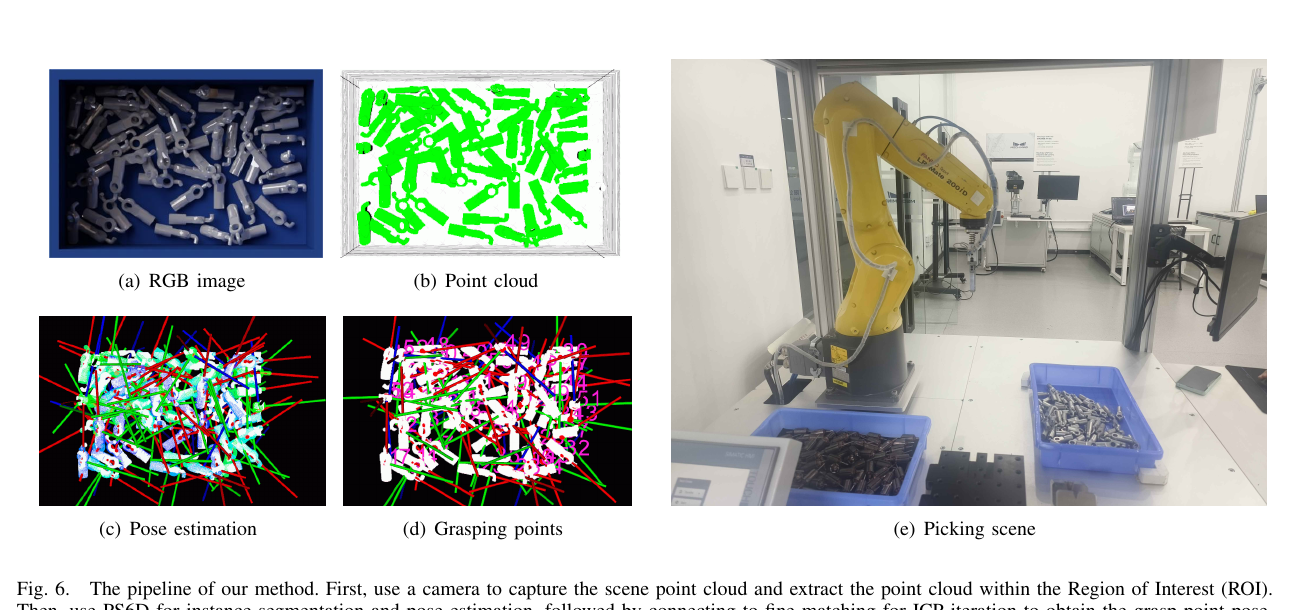
Original Figure 6: real point clouds bypass 2D segmentation; PS6D outputs instance poses, ICP refines predefined grasp points, and Mech-Viz controls the Fanuc robot. Source: authors' public manuscript. Image copyright belongs to the authors and IEEE; reproduced here for paper analysis.
Real experiments use only 3D-printed PS6D_6 parts:
Mech-Eye Pro S captures point clouds;
PS6D infers instances and poses;
Predefined grasp points generate grasp locations;
ICP refinement improves grasp point accuracy;
Fanuc LR Mate 200iD picks parts and places them in an adjacent bin;
Reported success rate: 91.7%.
Without total trial counts, failure types, or cycle times, 91.7% describes this specific object and system configuration, not a general success rate across all 10 objects.
7. Critical analysis
Strengths
Point-cloud-only input suits industrial parts with unstable color or no texture;
Symmetry definitions enter the loss rather than only evaluation tolerance;
Two-stage clustering addresses mixed clusters with similar centers but different rotations;
The authors’ data and real system cover industrial sizes, slender shapes, and multiple symmetries beyond common public everyday-object datasets.
Limitations
Symmetry parameters still require manual / CAD definitions;
The network operates within its training object set, without novel CAD or unseen-category validation;
Extremely slender PS6D_23 still has recall of only 66.10;
Real experiments include ICP and predefined grasp points, so final success cannot be attributed solely to network poses;
Standard BOP metrics, runtime, and cross-sensor domain tests are missing.
8. Reproduction checklist
Fix the 100 mm normalization rule and pose mapping back from canonical space;
Record Point Transformer layer counts, neighborhoods, sampled points, and feature propagation;
Specify dx,dy,dz,Ts and code for generating equivalent rotations;
Save first-stage center clusters and second-stage rotation clusters, and count split / merge errors separately;
Distinguish raw network poses, post-ICP poses, and final grasp success;
Add MSSD / MSPD / VSD and a shared detection protocol when comparing with BOP methods.
9. Overall assessment
PS6D turns slender-object intersections and multisymmetric rotations in industrial point clouds into a deployable pose voting system. Two-stage clustering addresses an explicit failure model supported by ablations; reported numbers should always accompany the known-CAD, single-object real deployment, and ICP backend conditions.