R²-Art: Category-Level Articulation Pose Estimation from Single RGB Image via Cascade Render Strategy
R²-Art estimates root pose and joint states in parallel from a single RGB image. Joint-centric priors transform / deform individual parts, and cascaded rendering losses progressively correct category-level articulated-part poses.
articulated object crop / maskcategory part priorcamera intrinsics
Full paper metadataAuthors, affiliations, research area, datasets, metrics, method tags, and reading statusExpandCollapse
Authors
Li Zhang, Haonan Jiang, Yukang Huo, Yan Zhong, Jianan Wang, Xue Wang, Rujing Wang, Liu Liu
Affiliations
Hefei Institutes of Physical Science, Chinese Academy of Sciences / University of Science and Technology of China / Astribot / Zhejiang University of Technology / China Agricultural University / Peking University / Hefei University of Technology
articulated object crop / maskcategory part priorcamera intrinsics
Reading Notes
Overview / Deep Dive
Available src/paper-notes/r2-art/coarse.md
Paper overview notes
Quickly assess the paper's scope, problem setting, core method, experimental findings, and whether to read it in depth.
Overview: R²-Art
One-sentence summary
R²-Art links root pose, joint states, and part poses from one RGB image. Joint-centric priors transform / deform parts, while cascaded rendering losses progressively supervise training; the paper describes inference as end-to-end without additional postprocessing.
Problem, inputs, and outputs
Input: a single RGB image, object category / part priors, and camera intrinsics.
Output: category-level 6D poses of articulated object parts and joint states.
The central challenge combines variations in size, articulation, part occlusion, and appearance within the same category.
Method at a glance
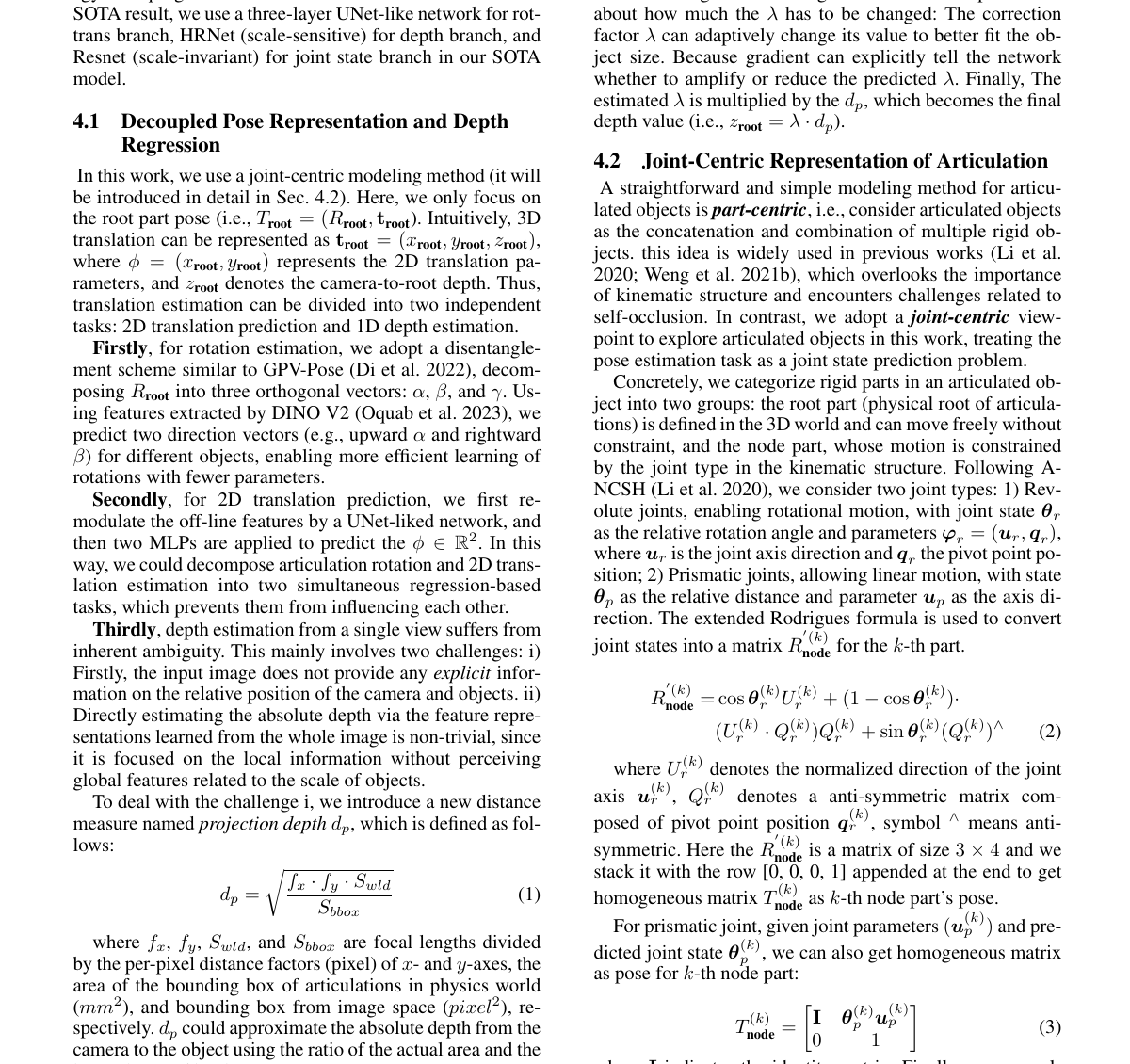
An RGB encoder regresses camera-to-root translation, rotation, and joint state.
Joint-centric deformation aligns the category prior with the target articulation.
During training, three-stage cascaded rendering projects predicted 3D priors into 2D mask / area / pixel constraints and backpropagates losses to the prediction network.
Experimental anchors
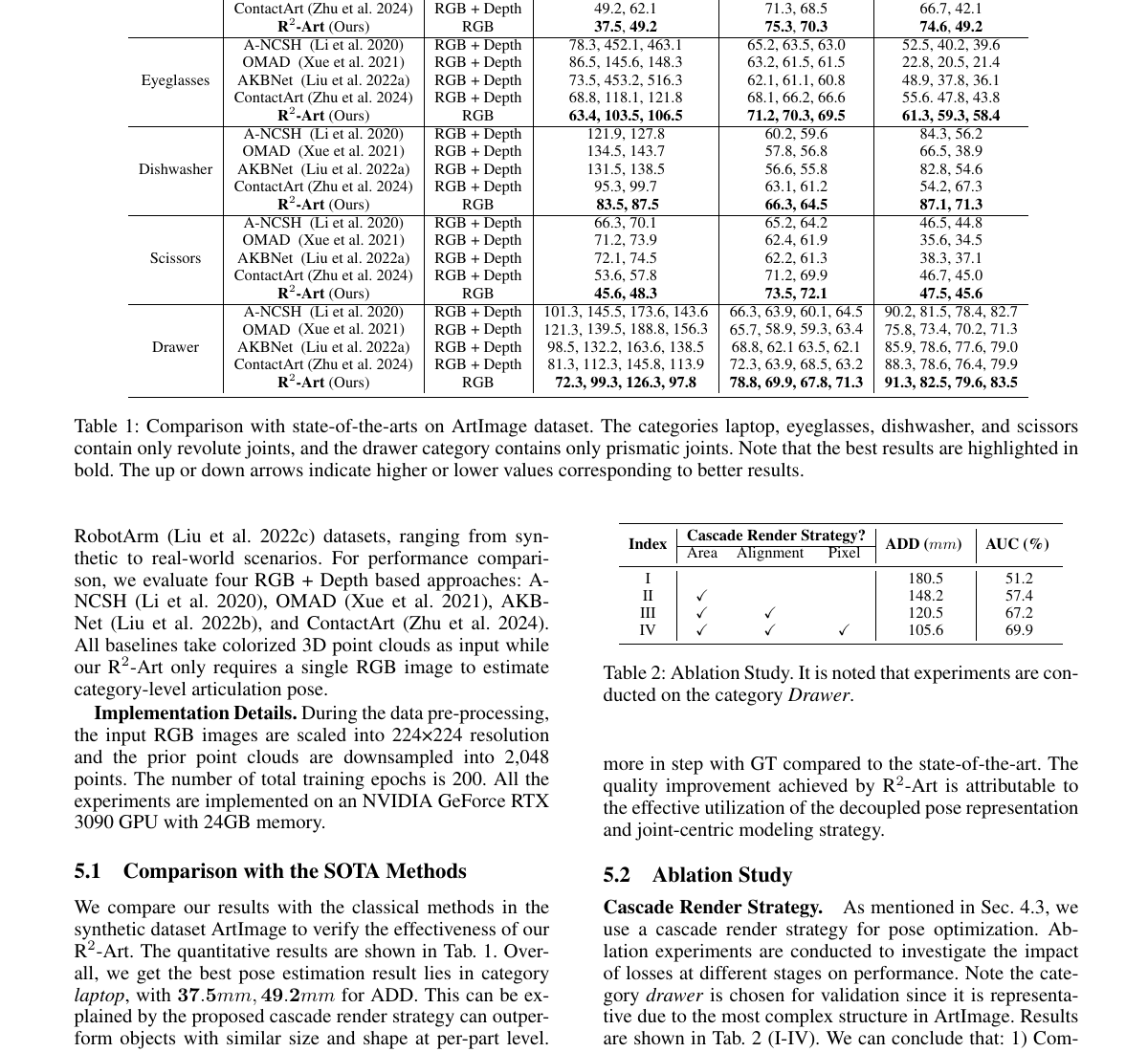
ArtImage Drawer: Table 1 reports ADD 97.8 mm and AUC 71.3% for the fourth part; these are not a category mean or 3D IoU.
ReArtMix Box: ADD 30.2 / 37.2 mm and AUC 78.3 / 76.2%.
Drawer ablation: the initial stage alone gives ADD 180.5 mm / AUC 51.2%; the full cascade gives 105.6 mm / 69.9%.
Support reproduction, comparison, related-work writing, and identifying opportunities for further research.
Deep Reading Notes: R²-Art: Category-Level Articulation Pose Estimation from Single RGB Image via Cascade Render Strategy
1. Basic information
Authors / affiliations: Li Zhang et al.; Hefei Institutes of Physical Science, Chinese Academy of Sciences; USTC; Astribot; Zhejiang University of Technology; China Agricultural University; Peking University; Hefei University of Technology.
R²-Art jointly models root pose, joint states, and per-part alignment from a single RGB image. Renderable joint-centric priors provide coarse-to-fine training supervision; inference is described as end-to-end without extra postprocessing.
2.1 Guide to the paper’s figures and tables
Figure / table
Reading focus
Method / loss figure
The three rendering stages constrain different quantities, progressively tightening the match from the 3D prior to the 2D mask
Table 1
ArtImage results include RGB-D methods; account for unequal input modalities
Table 2
Drawer gains from Stage I to the full cascade most directly support the main claim
Excerpt from Sections 4.1–4.2: decoupled root pose / depth regression and joint-centric articulation representation. Source: official AAAI PDF. Image copyright belongs to the authors and publisher; reproduced here for paper analysis.Excerpt from ArtImage Table 1 and the Drawer cascade ablation in Table 2; this image does not show ReArtMix or RobotArm result tables. Source: official AAAI PDF. Image copyright belongs to the authors and publisher; reproduced here for paper analysis.
3. Task boundaries
Input is a single RGB image, without depth or point clouds; category-level articulated priors, target region information, and a camera model are still required.
The output includes a pose for each articulated part, alongside estimated / used joint states, rather than a single rigid 6D pose.
Articulation changes within-category appearance and occlusion much more than rigid motion, making direct template matching prone to mismatch.
4. Method details
Module
Approach
Role
Initial regression
Predict camera-to-root translation, rotation, and joint state in parallel
Supply pose predictions for joint-centric modeling and rendering supervision
Joint-centric prior
Transform / deform category prior parts according to predicted joint states
Align the canonical prior with the current articulation
Cascade render strategy
Multistage rendering loss supervision from area alignment to pixel-level constraints
Improve per-part pose predictions during training using 2D evidence
The joint-centric prior connects part kinematics and projects the predicted 3D explanation into the image for supervision. Section 4.3 and Algorithm 1 optimize rendering losses by backpropagating into the prediction branches during training; the introduction states that inference needs no additional postprocessing. Prior, mask, and differentiable rendering errors affect training convergence.
5. Experiments and numbers
Setting
Key reported values
Interpretation
ArtImage Drawer
Fourth part: ADD 97.8 mm, AUC 71.3%
Per-part values, not a category mean or 3D IoU; RGB-only and RGB-D methods share the table, so account for unequal inputs
ReArtMix Box
ADD 30.2 / 37.2 mm, AUC 78.3 / 76.2%
Results for two parts demonstrate per-part alignment in semisynthetic scenes
Drawer cascade ablation
Stage I: 180.5 mm / 51.2%; full: 105.6 mm / 69.9%
Cascaded rendering contributes substantially beyond the initialization network
The paper also reports quantitative and visual results for the 7-part RobotArm. The reusable lesson is the ablation design: test whether ADD keeps decreasing with each added rendering constraint, rather than reporting only a final value.
6. Strengths, limitations, and takeaways
Strengths: joint states explicitly enter the geometric prior; RGB-only input is practically attractive; ablations separate the stages’ contributions.
Limitations: category / part priors are strong requirements; monocular depth and occlusion ambiguities may admit multiple plausible explanations; generalization to unknown articulation topologies is not fully explored.
Takeaway: place the degrees of freedom for multipart pose refinement in a kinematic graph rather than regressing every part independently; report uncertainty for unobservable parts rather than forcing a single pose.