RAG-6DPose: Retrieval-Augmented 6D Pose Estimation via Leveraging CAD as Knowledge Base
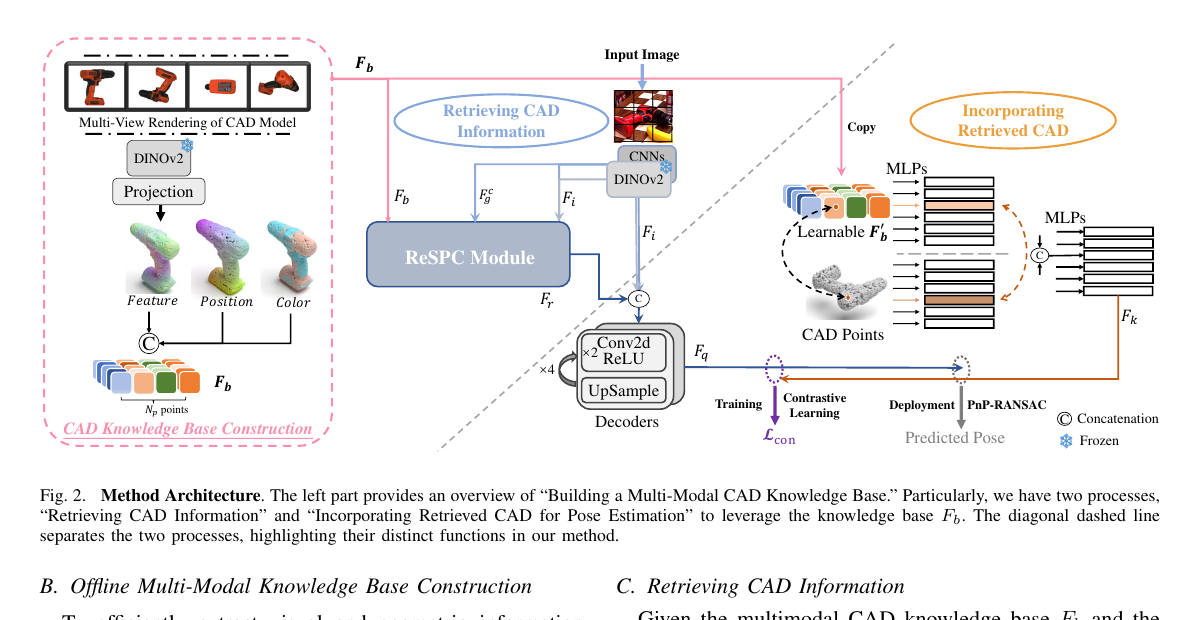
RAG-6DPose back-projects DINOv2 appearance features from multiview CAD renderings to 3D points, forming per-object memory with coordinates and colors. Query RGB uses ReSPC self-attention, PointNet, and cross-attention to retrieve relevant CAD points. SurfEmb-style InfoNCE learns dense 2D–3D correspondences, and PnP-RANSAC with optional ICP produces pose.
single RGBoptional depth for ICPmulti-view CAD RGB-D renders during offline onboarding
Requirements
known object identity and accurate CADcamera intrinsicsBOP detector / cropper-object CAD rendering and DINOv2 knowledge basePnP-RANSACoptional depth and ICP
Full paper metadataAuthors, affiliations, research area, datasets, metrics, method tags, and reading statusExpandCollapse
known object identity and accurate CADcamera intrinsicsBOP detector / cropper-object CAD rendering and DINOv2 knowledge basePnP-RANSACoptional depth and ICP
Reading Notes
Overview / Deep Dive
Available src/paper-notes/rag-6dpose-iros2025/coarse.md
Paper overview notes
Quickly assess the paper's scope, problem setting, core method, experimental findings, and whether to read it in depth.
Overview Notes: RAG-6DPose
1. Basic information
Title: RAG-6DPose: Retrieval-Augmented 6D Pose Estimation via Leveraging CAD as Knowledge Base
RAG-6DPose renders known CAD models into multiview RGB-D offline. DINOv2 appearance features are projected onto CAD points and combined with coordinates and color into a knowledge base. Query features retrieve relevant points through cross-attention, then SurfEmb-style InfoNCE 2D–3D matching, PnP-RANSAC, and optional ICP produce poses.
3. Guide to figures and tables
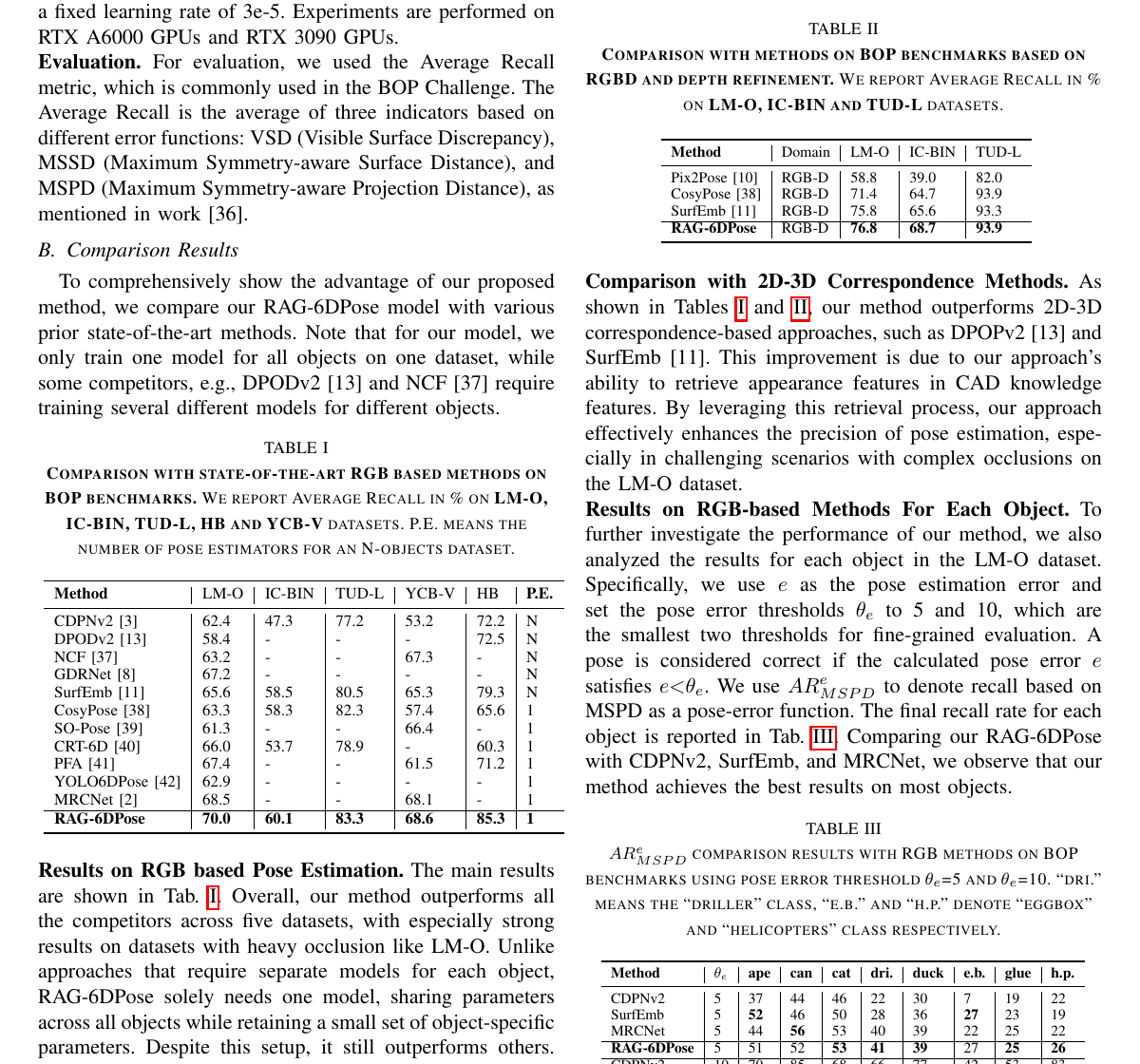
Original Figure 2: offline point-level CAD knowledge with appearance, position, and color on the left; query RGB retrieval in the middle; query / key features, contrastive learning, and PnP-RANSAC on the right. Source: authors' public manuscript. Image copyright belongs to the authors and IEEE; reproduced here for paper analysis.Original Tables I–III: RGB BOP AR on LM-O / IC-BIN / TUD-L / YCB-V / HB is 70.0 / 60.1 / 83.3 / 68.6 / 85.3; RGB-D + ICP scores 76.8 / 68.7 / 93.9 on the first three. Source: authors' public manuscript. Table copyright belongs to the authors and IEEE; reproduced here for paper analysis.
4. Problem setting
Task: single-RGB 6D pose estimation for known object instances, with optional depth + ICP refinement.
Input: object crop, camera intrinsics, target CAD, and an offline per-object multiview CAD knowledge base.
Output: dense 2D–3D correspondences, with poses produced by PnP-RANSAC and score refinement.
Training: one shared model per dataset rather than a complete network per object; some knowledge-base / key parameters remain object-specific.
Detection: default BOP Challenge 2023 detector.
5. Method overview
Render multiview CAD RGB-D using the CNOS viewpoint strategy.
Extract DINOv2 features, backproject them onto CAD surfaces using rendered depth, and average multiview features for each CAD point.
Concatenate each point’s DINOv2 appearance, 3D positional encoding, and color into a fixed knowledge base Fb.
ReSPC applies self-attention to Fb, followed by PointNet guided by global query-image features.
Query-image DINOv2 + ResNeXt features query CAD features as cross-attention keys / values, producing retrieved features Fr.
Fr and image features feed a U-Net decoder for pixel query features; CAD points and a learnable knowledge-base copy feed a SIREN MLP for key features.
Train with mask L1 + 2D–3D InfoNCE; inference builds similarity matrices, samples correspondences, and runs PnP-RANSAC and score refinement.
Over SurfEmb: +4.4, +1.6, +2.8, +3.3, +6.0 across five datasets; the paper reports a mean gain of about +3.6.
RGB-D + ICP: LM-O 76.8, IC-BIN 68.7, TUD-L 93.9; ties CosyPose at 93.9 on TUD-L.
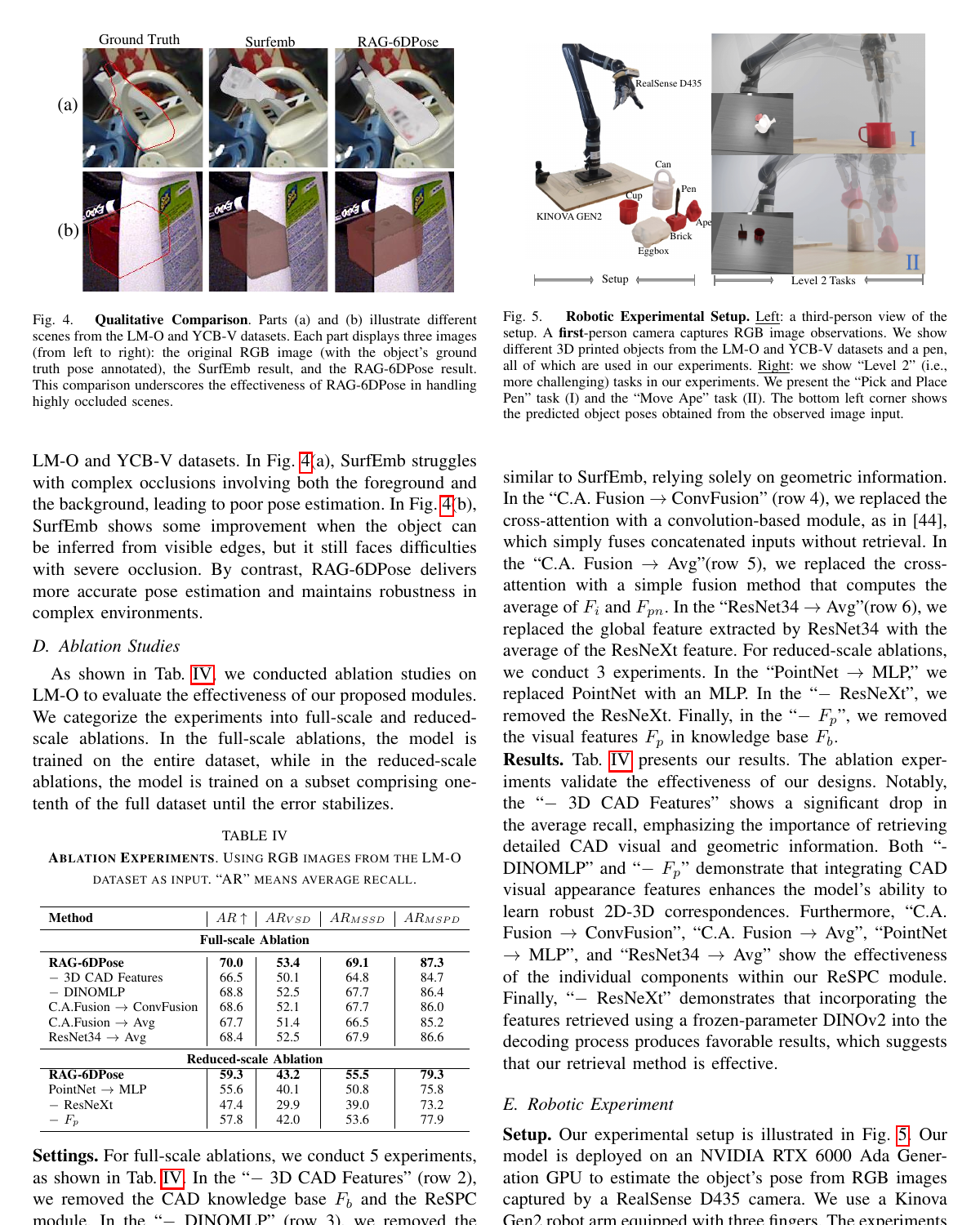
LM-O ablation: full AR 70.0; removing CAD knowledge + ReSPC gives 66.5; replacing cross-attention with averaging gives 67.7.
Robot: three simple grasps each score 10/10; Pick-and-Place Pen and Move Ape each score 9/10, with only 10 trials per task.
7. Quick assessment
Strengths: anchors rendered CAD appearance to 3D points and selects query-relevant evidence; covers five BOP datasets, RGB / RGB-D, ablations, and robot experiments.
Avoid misreading: RAG means visual / geometric cross-attention retrieval without an LLM; it is not zero-shot, and each object still requires CAD onboarding and training data.
Main limitations: the main text does not adequately quantify knowledge-base viewpoints, points, storage, or onboarding time; complete end-to-end latency is missing; robot tests have only 10 trials per task.
Recommended for: SurfEmb, dense 2D–3D correspondence, CAD rendering, foundation features, BOP, and robotic grasping.
Available src/paper-notes/rag-6dpose-iros2025/deep.md
In-depth paper notes
Support reproduction, comparison, related-work writing, and identifying opportunities for further research.
Deep Reading Notes: RAG-6DPose
1. Key assessment
RAG-6DPose starts from a limitation of RGB pose methods: CAD is often used only for training supervision or geometry encoding, leaving renderable appearance underused at inference. The authors turn CAD surfaces into retrievable point-level memory:
Each point carries multiview DINOv2 appearance;
3D coordinates and color are retained;
Query-image cross-attention selects CAD point features relevant to visible regions;
Retrieval enhances SurfEmb-style dense correspondences rather than directly generating a pose.
The analogy with text RAG is structural: a parametric model, external memory, and query-conditioned retrieval. No language model, document retrieval, or generative reasoning is involved. LM-O AR 70.0 falls to 66.5 without the knowledge base + ReSPC, providing direct experimental support.
2. Task boundaries and dependencies
Original Figure 2: pink denotes per-object offline knowledge construction, blue retrieval, and orange injection into query / CAD key features. Source: authors' public manuscript. Image copyright belongs to the authors and IEEE; reproduced here for paper analysis.
This is instance-level, known-object pose estimation:
Online input: object RGB crop, camera intrinsics, and object identity;
Offline input: accurate CAD, materials / colors, renderer, and virtual cameras;
RGB-D additionally requires depth and runs ICP after initial pose estimation;
One shared network is trained per dataset, rather than a full network per object; each object still has its own knowledge base and some learnable key features.
“One pose estimator” reduces per-object network counts; it does not imply training-free generalization to new CAD models. All five datasets use known-object protocols.
3. Offline CAD knowledge base
CAD models are rendered into multiview RGB-D using CNOS viewpoint selection. For each view:
DINOv2-Base extracts a 2D feature map;
Upsample to the original image resolution;
Backproject rendered depth into a point cloud;
For each sampled CAD surface point pk, find its nearest rendered point and assign that pixel’s feature to pk;
Average features across all views covering the same CAD point.
Averaging view-dependent backbone features into point-level representations simplifies arbitrary-view retrieval but may flatten strongly view-dependent appearance. The paper does not report viewpoint count m, CAD point count Np, disk usage, rendering / feature onboarding time, or the source of color for untextured CAD.
4. How ReSPC retrieves
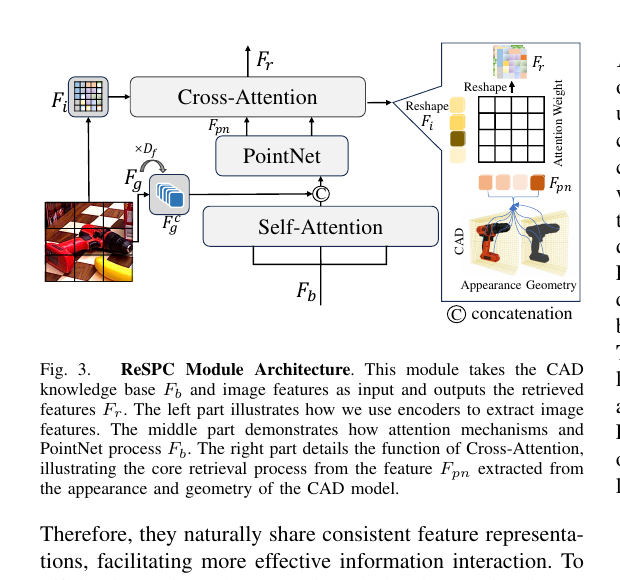
Original Figure 3: CAD memory passes through self-attention and query-global-guided PointNet. Query-image features query CAD appearance / geometry keys and values; attention weights act as retrieval weights. Source: authors' public manuscript. Image copyright belongs to the authors and IEEE; reproduced here for paper analysis.
ReSPC has three stages:
4.1 CAD self-attention
Fsa=SelfAttn(Fb),
Model global and local point-memory relationships and reduce dimensions with a linear layer.
4.2 Query-global-guided PointNet
ResNet34 extracts global query feature Fg, which is copied to every CAD point as Fgc, concatenated with Fsa, and fed to PointNet:
Fpn=PointNet([Fsa,Fgc]).
CAD memory is therefore read conditionally: different query images of the same object produce different Fpn.
4.3 Cross-attention retrieval
Frozen DINOv2 and ResNeXt-101 32×8d also encode the query into dense Fi. Then:
Fr=CrossAttn(Fi,Fpn,Fpn).
Fi supplies queries and CAD Fpn supplies keys / values. Each image location softly retrieves CAD points through attention weights; there is no discrete top-k index or external vector database.
5. From retrieved features to poses
Query branch
Fr is concatenated with original-image Fi and fed to two decoders:
A U-Net-style feature decoder outputs pixel query features Fq;
A mask decoder outputs object probabilities.
CAD key branch
Fixed knowledge base Fb is copied into learnable Fb′. For CAD point pj, retrieve the nearest 3D neighbor’s Fb′ feature fj, then combine geometry and memory through a SIREN MLP:
fk=Si([Sg(pj),Sv(fj)]).
Training and inference
Visible object coordinates rendered from GT poses supply positive 2D–3D pairs; other uniformly sampled CAD surface points are negatives. Total loss:
L=LInfoNCE+αLmask.
Inference computes the Fq / Fk similarity matrix, samples correspondences accordingly, and generates pose hypotheses with PnP-RANSAC. Learned correspondence scores select hypotheses and are further maximized for refinement. RGB-D adds ICP afterward.
6. Data, training, and metrics
LM-O, IC-BIN, HB, YCB-V: synthetic training images;
TUD-L: synthetic + real training images;
image crop: 224×224;
Optimizer: Adam with fixed learning rate 3×10⁻⁵;
Hardware: RTX A6000 and RTX 3090;
query backbone: DINOv2-Base + ResNeXt-101 32×8d;
Detector: default BOP Challenge 2023 results.
BOP AR averages recall over VSD, MSSD, and MSPD threshold sets. It is more comprehensive than a single ADD(-S) and accounts for symmetry, but cross-paper comparisons still require equal detectors, test targets, refinement, and BOP toolkit versions.
7. Main RGB and RGB-D results
Original Tables I–III: Table I reports RGB, Table II RGB-D / depth refinement, and Table III per-object LM-O MSPD recall. Source: authors' public manuscript. Table copyright belongs to the authors and IEEE; reproduced here for paper analysis.
RGB BOP AR
Method
LM-O
IC-BIN
TUD-L
YCB-V
HB
SurfEmb
65.6
58.5
80.5
65.3
79.3
MRCNet
68.5
—
—
68.1
—
RAG-6DPose
70.0
60.1
83.3
68.6
85.3
Gains over SurfEmb are +4.4, +1.6, +2.8, +3.3, +6.0 across the five datasets, averaging +3.62. Gains over MRCNet are smaller: LM-O +1.5 and YCB-V +0.5.
At the strict LM-O MSPD threshold 5, RAG does not lead every object: ape 51 is below SurfEmb 52 and can 52 below MRCNet 56; cat / driller / duck / holepuncher lead or tie. At threshold 10, eggbox 59 is below SurfEmb 70 and holepuncher 87 below MRCNet 90. A higher mean does not guarantee robustness across every symmetry / texture condition.
RGB-D + ICP
Method
LM-O
IC-BIN
TUD-L
SurfEmb
75.8
65.6
93.3
CosyPose
71.4
64.7
93.9
RAG-6DPose
76.8
68.7
93.9
RGB→RGB-D adds +6.8 / +8.6 / +10.6, making depth refinement a substantial component; RGB-D scores cannot be attributed solely to retrieval.
8. Ablations and qualitative occlusion results
Original Figures 4–5 and Table IV: heavy-occlusion SurfEmb / RAG overlays and robot setup above, full-data and 1/10-data ablations at lower left. Source: authors' public manuscript. Figure and table copyright belongs to the authors and IEEE; reproduced here for paper analysis.
Full-scale LM-O:
Configuration
AR
ARVSD
ARMSSD
ARMSPD
full
70.0
53.4
69.1
87.3
− CAD knowledge base / ReSPC
66.5
50.1
64.8
84.7
− learnable DINO memory copy
68.8
52.5
67.7
86.4
cross-attention→ConvFusion
68.6
52.1
67.7
86.0
cross-attention→average
67.7
51.4
66.5
85.2
ResNet34 global→average
68.4
52.5
67.9
86.6
The knowledge base contributes +3.5 overall, while cross-attention beats simple averaging by +2.3, supporting query-conditioned retrieval beyond extra CAD features alone. Reduced-scale −ResNeXt drops from 59.3 to 47.4, but its different training budget prevents direct comparison with full-scale values.
Only two author-selected qualitative successes are shown, without failure cases or occlusion-level bins. They support intuition; quantitative occlusion robustness mainly rests on LM-O means.
9. Robot experiments and speed
Kinova Gen2 + RealSense D435 + RTX 6000 Ada:
Task
Successes / 10
Grasp Brick
10
Grasp Cup
10
Grasp Eggbox
10
Pick and Place Pen
9
Move Ape
9
Level 2 requires sequential pose estimation for two objects. The pen is absent from training, but actions mainly depend on brick / cup poses, so this does not demonstrate 6D pose estimation of an unseen pen. Ten trials per task are few, with no baseline, failure-type, time, or confidence-interval comparison.
The main text omits runtime. The project page adds about 65 ms for the TUD-L single-object query encoder-decoder versus MRCNet’s 61 ms; total time including PnP-RANSAC is described as similar to SurfEmb without an exact value. Offline CAD onboarding is excluded, and hardware / batch details are insufficient.
10. Open source and reproduction risks
The official SurfEmb-based repository provides training commands, BOP evaluation, and custom BOP-format preprocessing. Check:
CNOS viewpoint counts / sampling, render resolution, materials, and lighting;
DINOv2 feature layers, patch alignment, and upsampling;
CAD point counts, nearest assignment, uncovered points, and multiview averaging;
Knowledge-base dtype, per-object storage, and Fb′ parameter count;
Roles of ResNet34 global, ResNeXt dense, and DINOv2 features;
ReSPC head counts, feature dimensions, and PointNet structure;
Positive / negative sampling, InfoNCE temperature, and mask weight α;
Detector, PnP-RANSAC, score refinement, and ICP parameters and stagewise latency.
11. Limitations
Accurate CAD with plausible appearance remains necessary; incorrect materials contaminate memory;
New objects need rerendering, encoding, and possibly object-specific feature training;
Offline knowledge-base costs and storage are unquantified;
Multiview averaging can flatten specular / view-dependent appearance;
No dedicated transparent, reflective, or texture-domain-shift evaluation;
Small robot experiments and predefined grasp policies obscure end-to-end manipulation errors;
RGB-D gains are coupled to ICP; judge retrieval gains from RGB ablations;
Leading under one detector / benchmark protocol does not resolve open-world detection.
12. Overall assessment
RAG-6DPose is a complete CAD-based dense matching study: multiview rendered features are anchored to CAD points, ReSPC reads query-relevant appearance and geometry, and interpretable 2D–3D correspondence + PnP yields poses. Consistent SurfEmb gains, knowledge-base ablations, and open code justify prioritizing it; deployment assessment must include per-object onboarding, detection, PnP / ICP, and memory storage.