RCGNet: RGB-based Category-Level 6D Object Pose Estimation with Geometric Guidance
RCGNet uses frozen DINOv2 to predict and fuse appearance and geometry from RGB crops. Ground-truth NOCS point cloud features guide geometry during training; category-prior deformation, a scale branch, and RANSAC-PnP recover category-level pose. Inference uses no depth, but category point clouds, masks, and training-time geometric supervision remain necessary.
RCGNet estimates category-level 6D poses from RGB alone at inference. Frozen DINOv2 supplies appearance and predicted geometric features, with training-time real NOCS point cloud features supervising the latter. Category prior point clouds are fused to predict NOCS correspondences, deformations, and scales, followed by RANSAC-PnP.
3. Guide to figures and tables
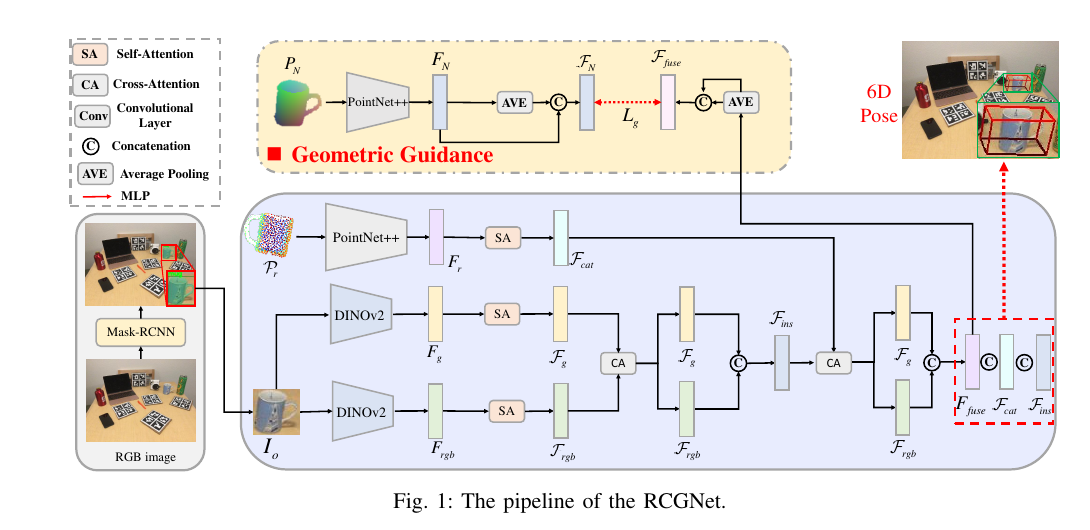
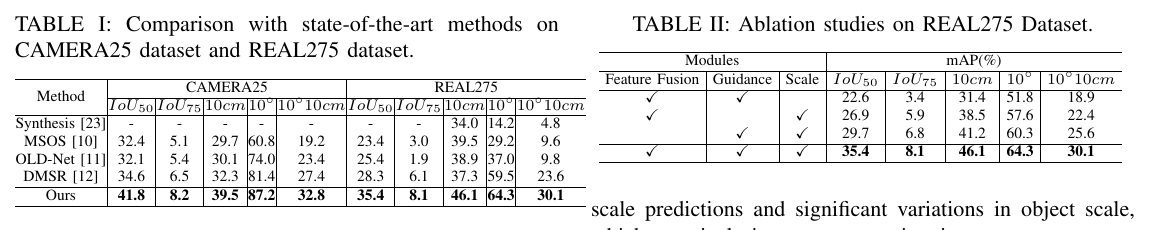
Original Figure 1: two DINOv2 branches below extract appearance and predicted geometric features from RGB crops; PointNet++ encodes category priors. Above, training-time geometric guidance supervises fused representations using real NOCS point cloud features. Source: authors' public manuscript. Image copyright belongs to the authors and IEEE; reproduced here for paper analysis.Original Tables I–II: RGB-based category-level comparisons on the left; feature fusion, geometric guidance, and scale branch ablations on the right. Source: authors' public manuscript. Table copyright belongs to the authors and IEEE; reproduced here for paper analysis.
4. Problem setting
Input: a single RGB image, instance segmentation mask, and one prior point cloud per category; no depth at inference.
Output: rotation, translation, and 3D size for unseen instances of known categories.
Training supervision: RGB, object / NOCS point clouds, poses, sizes, and correspondences.
Solver: predicted 2D–3D correspondences, category prior deformations, and scales feed RANSAC-PnP to recover R,t.
5. Method overview
Mask R-CNN produces object masks and crops 224×224 RGB patches.
Frozen DINOv2 branches supply RGB appearance and RGB-predicted geometric features.
Self-attention and bidirectional cross-attention fuse both image feature types.
PointNet++ encodes a 1,024-point category prior, then cross-attention fuses it with instance features.
During training, GT object point clouds are transformed into NOCS to extract geometric features FN; MSE brings RGB-fused features closer to FN. The GT point cloud branch is removed at inference.
Predict correspondence matrices, prior deformations, and scales relative to category benchmarks, then solve poses with RANSAC-PnP.
REAL275: the corresponding five metrics are 35.4 / 8.1 / 46.1 / 64.3 / 30.1.
REAL275 full-model 10°10 cm is 30.1; removing geometric guidance while retaining fusion and scale gives 22.4.
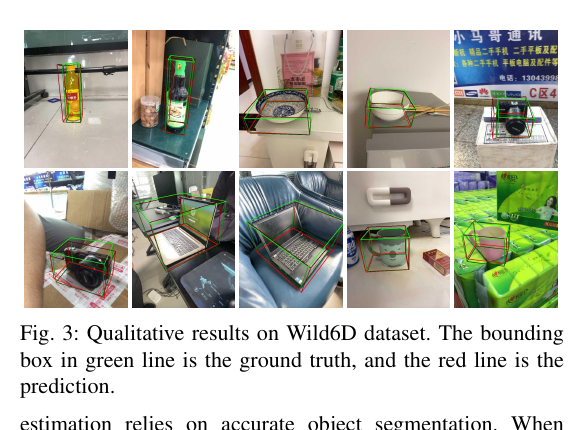
Wild6D provides qualitative cross-dataset results only, without a quantitative table directly comparable to CAMERA25 / REAL275.
7. Quick assessment
Strengths: depth is absent at inference; training-time geometry supervision has an explicit boundary; main results and ablations support guidance and scale branches.
Limitations: instance segmentation and category prior point clouds remain necessary; training needs real geometry supervision; REAL275 IoU75 is only 8.1; Wild6D generalization is qualitative only.
Support reproduction, comparison, related-work writing, and identifying opportunities for further research.
Deep Reading Notes: RCGNet
1. Key assessment
RCGNet’s main idea goes beyond replacing CNNs with DINOv2. It separates missing depth in RGB-only category-level pose into training and inference: GT object point clouds supply NOCS geometric feature supervision during training, while only RGB branches remain at inference to predict approximate geometry. The backend follows category prior deformation, correspondence, and PnP.
“RGB-only” therefore means RGB-only deployment input, not freedom from geometric priors or supervision. Category prior point clouds, training point clouds, object masks, and camera intrinsics are still needed. This distinguishes it from model-free / geometry-free approaches.
2. Task boundaries and variables
The object crop is Io∈RH×W×3 and category prior point cloud is Pr∈RNr×3, with H=W=224 and Nr=1024. The network outputs:
Prior point cloud deformation D;
Correspondence matrix A mapping deformed prior points to image pixels;
Scale offset relative to category benchmark scale sb: ΔS;
Final rotation R, translation t, and size s.
Categories are the NOCS benchmark’s bottle, bowl, camera, can, laptop, and mug; test instances may be unseen during training. This is neither open-category recognition nor zero-shot estimation for arbitrary new categories supplied with a CAD model.
3. Complete pipeline
Original Figure 1: red dashed geometric guidance is used only during training; RGB / predicted geometry / category point cloud fusion feeds PnP. Source: authors' public manuscript. Image copyright belongs to the authors and IEEE; reproduced here for paper analysis.
3.1 Object crops and dual DINOv2 representations
Mask R-CNN supplies instance masks and crops. Two frozen DINOv2 branches read the same RGB patch: one produces appearance-semantic Frgb; the other produces Fg within the geometric feature predictor. Each branch first applies self-attention:
Frgb=SA(Frgb)+Frgb,Fg=SA(Fg)+Fg.
Bidirectional cross-attention then uses RGB as keys / values for geometric features and vice versa. Concatenation produces instance features Fins, keeping color-derived geometry tied to image semantics while making RGB representations shape-sensitive.
DINOv2 weights are frozen, so pose data mainly trains attention, MLPs, and subsequent point cloud / correspondence modules. Freezing lowers training costs but places geometry learning mainly in the attached branches and losses rather than full DINOv2 adaptation.
3.2 Category prior and instance feature fusion
PointNet++ encodes the category prior into Fr, followed by self-attention aggregation into Fcat. Cross-attention fuses Fcat and Fins into Ffuse.
The prior is a category-shared canonical point set, not the query instance’s CAD. Predicted D deforms it to the current instance:
D=MLP(Fcat,Ffuse),Pinstance≈Pr+D.
This supports within-category instance adaptation, while prior topology and training categories still constrain performance.
3.3 Geometric guidance
During training, GT Po is transformed into NOCS using GT R,t,s:
PN=(Po−t)/s⋅R.
PointNet++ encodes PN into real NOCS geometric features FN. The network average-pools, repeats, and concatenates Ffuse, then uses
Lg=MSE(Ffuse,FN)
to bring RGB-fused representations closer to real geometry. Neither Po nor FN is available at inference, making this feature-level geometry distillation.
This assumes accurate training RGB–point cloud alignment and NOCS pose labels. Depth noise, inconsistent symmetry coordinates, or mask biases can also be learned through supervision.
3.4 Scale, correspondence, and PnP
RGB lacks absolute scale. A per-category benchmark scale sb lets the network regress relative changes:
s=sb+sbΔS.
The predicted correspondence matrix A maps deformed, scaled prior points to crop pixels. Finally,
R,t=PnP(PI,s⋅A(Pr+D))
recovers poses. RANSAC reduces incorrect correspondence effects. Scale, correspondence, and geometric guidance losses are combined with λ1=1,λ2=0.1,λ3=100.
The scale branch is essential: 3D coordinate scale directly affects PnP translation, and ablations show substantial degradation without category benchmark scales.
4. Data, training, and metrics
CAMERA25: about 300K synthetic training images and 25K evaluation images.
REAL275: 4,300 real training images and 2,750 real evaluation images.
Wild6D: cross-dataset qualitative tests with a network trained on CAMERA25 + REAL275.
Frontend: Mask R-CNN detection / segmentation, following prior category-level work.
Metrics include 3D IoU50 / IoU75 and mAP under 10 cm, 10°, and 10°10 cm thresholds. These measure box overlap, translation, rotation, and joint success respectively. Standard BOP VSD / MSSD / MSPD and per-category error distributions are not reported.
5. Main results
Original Tables I–II: Table I compares RGB-based category-level baselines only; Table II tests feature fusion, guidance, and scale on REAL275. Source: authors' public manuscript. Table copyright belongs to the authors and IEEE; reproduced here for paper analysis.
These support relative gains within RGB-only baselines, but IoU75 is still only about 8%, showing the difficulty of accurate sizes and tight 3D boxes. Strong RGB-D category-level methods using real depth are absent from the same table, so these results do not establish parity with RGB-D.
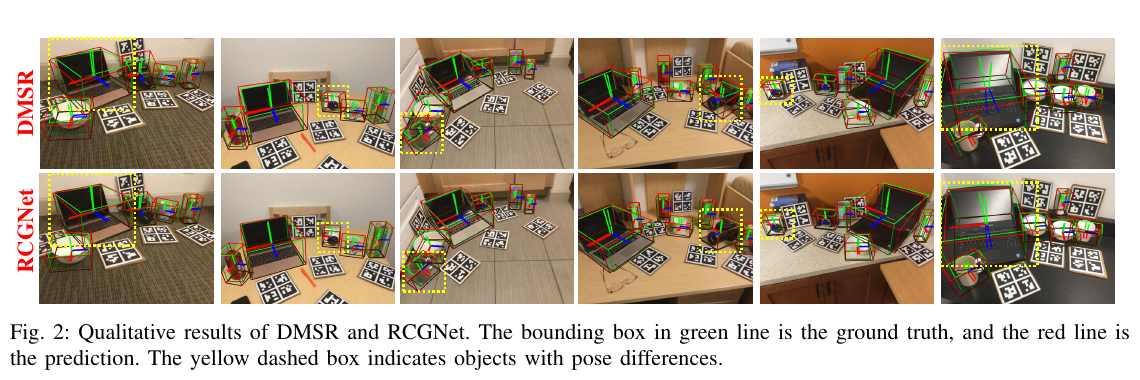
Original Figure 2: green boxes are GT and red boxes predictions; yellow dashed boxes highlight objects with larger DMSR / RCGNet differences. Source: authors' public manuscript. Image copyright belongs to the authors and IEEE; reproduced here for paper analysis.
Camera, laptop, and other complex-object boxes appear closer to GT, but author-selected scenes cannot replace per-category statistics or failure cases.
6. Ablations
The four REAL275 configurations are:
Feature fusion
Guidance
Scale
IoU50
IoU75
10 cm
10°
10°10 cm
✓
✓
—
22.6
3.4
31.4
51.8
18.9
✓
—
✓
26.9
5.9
38.5
57.6
22.4
—
✓
✓
29.7
6.8
41.2
60.3
25.6
✓
✓
✓
35.4
8.1
46.1
64.3
30.1
All three modules contribute:
Removing scale lowers joint-threshold performance from 30.1 to 18.9, the largest drop;
Removing geometric guidance gives 22.4, confirming the importance of real training geometry;
Direct concatenation instead of cross-attention fusion gives 25.6, indicating fusion has a meaningful role.
The table omits random seeds and means / standard deviations, and does not replace guidance with other distillation losses; it cannot establish that MSE with high weight λ3=100 is optimal.
7. Cross-dataset generalization and author-stated limitations
Original Figure 3: a model trained only on CAMERA25 and REAL275 predicts across datasets on Wild6D, without quantitative metrics for this test. Source: authors' public manuscript. Image copyright belongs to the authors and IEEE; reproduced here for paper analysis.
The authors explicitly state three limitations:
Accurate recognition / segmentation is required; frontend localization errors propagate into poses;
Synthetic-to-real image domain gaps remain;
RGB-based accuracy still trails RGB-D methods.
Wild6D figures show that the pipeline runs and produces plausible boxes; they do not establish a particular Wild6D accuracy or arbitrary-category generalization.
8. This site’s critical analysis
Strengths
Clearly separates training geometry supervision from RGB-only inference;
Avoids explicit depth / normal map generation, removing an intermediate prediction that could accumulate errors;
Correspondence + RANSAC-PnP preserves an interpretable geometric backend;
Main results, ablations, cross-dataset figures, and stated limitations form a reasonably complete evidence chain.
Limitations and implicit assumptions
Geometry guidance requires depth / point clouds and accurate training poses, leaving geometric annotation costs intact;
Category prior point clouds and benchmark scales remain hard priors;
Mask R-CNN is not jointly trained end to end, so pose losses cannot correct detection errors;
Only 6 indoor everyday categories are benchmarked, without slender, transparent, reflective, or open-category validation;
Runtime, parameter counts, memory use, and RANSAC iteration costs are missing, leaving the abstract’s “highly efficient” unsupported by full-system numbers;
Symmetries are handled indirectly through existing NOCS / correspondence supervision, without dedicated equivalent-pose analysis.
9. Reproduction checklist
Specify category prior point clouds, coordinate orientations, and benchmark scales;
Fix DINOv2 variant, frozen layers, token resolution, and attention channels;
Check left / right multiplication and scale units for Po→PN;
Save guidance feature dimensions, pooling / repeat details, and λ3;
Report RANSAC-PnP thresholds, candidate counts, and failure return rules;
Distinguish GT and predicted masks and report poses for each;
Add per-category and symmetric-object IoU / rotation / translation errors with multiple random seeds.
10. Overall assessment
RCGNet implements category-level pose estimation with geometry during training and RGB alone at inference. Evidence supports joint gains from guidance, attention fusion, and scale branches over CAMERA25 / REAL275 RGB-based baselines. It does not establish freedom from geometric priors, parity with RGB-D, or robust open-category generalization. These boundaries make it useful for understanding where geometric knowledge enters RGB-only category-level pose estimation.