Authors / affiliation: Junjie Chen, Weilong Chen, Yifan Zuo, Yuming Fang; Jiangxi University of Finance and Economics.
Task: transfer keypoint semantics from a few annotated support images to queries of arbitrary new categories for 2D semantic keypoint localization.
Reading mode: Overview.
2. Positioning in one sentence
Recurrent deformable attention mines fine structural cues from multiscale support / query features. Keypoint mixup replaces zero padding to handle different keypoint counts across categories.
3. Problem and motivation
Heatmap pooling and single-scale cross-attention lack local structure for pixel-level localization.
Category keypoint counts vary; zero padding supplies no meaningful supervision.
4. Method overview
Deformable attention extracts fine keypoint features from multiscale maps.
Linked-keypoint offsets mine structural features through recurrent support / query interactions.
Mixup from other keypoints pads dimensions while retaining training signals.
5. Experiments at a glance
On MP-100, the paper claims a PCK@0.05 gain of 3.2 percentage points over prior best results, reporting 1-shot / 5-shot and multiple thresholds.
This is 2D category-agnostic keypoint pose, not directly comparable to BOP rigid 6D ADD / AR.
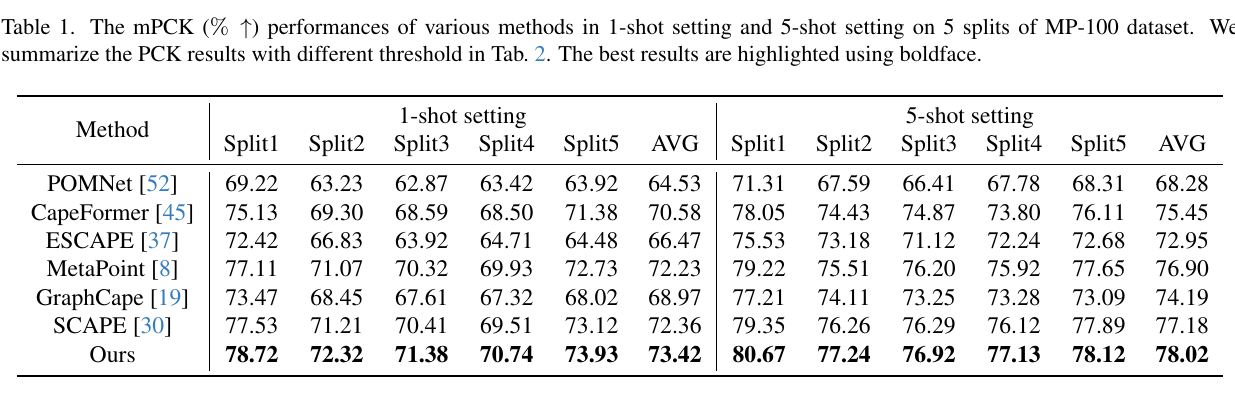
Original MP-100 main table: mean 1-shot / 5-shot mPCK across five splits is 73.42 / 78.02; mPCK aggregates multiple PCK thresholds. Source: CVPR 2025 paper. Image copyright belongs to the authors and publisher; reproduced here for paper analysis.
Against the table’s strongest SCAPE at 72.36 / 77.18, mean gains are 1.06 / 0.84 mPCK. The emphasized 3.2 points concern stricter PCK@0.05 rather than the main-table mean. Larger strict-threshold gains support finer localization.
6. Quick assessment
Value: treats variable keypoint vocabularies as a central few-shot pose problem.
Boundary: annotated support is required; outputs are 2D keypoints, not rigid 6D poses.
Available src/paper-notes/recurrent-category-agnostic-pose/deep.md
In-depth paper notes
Support reproduction, comparison, related-work writing, and identifying opportunities for further research.
Deep Reading Notes: Recurrent Feature Mining and Keypoint Mixup Padding for Category-Agnostic Pose Estimation
Problem: few-shot category-agnostic pose must transfer variable support keypoint semantics while localizing pixel-level details; fixed zero padding and single-layer attention are insufficient.
This localizes 2D semantic keypoints in arbitrary new query categories from a few support annotations; it does not fit rigid 6D poses.
2.1 Guide to the paper’s figures and tables
Figure / table
What to look for
Figure 1
Existing zero-padding / single-scale pipelines versus recurrent FGSA mining.
Figure 3
Mixup padding unifies keypoint counts without meaningless all-zero supervision.
Table 1
1-shot / 5-shot mPCK on five MP-100 splits.
Tables 2–4
Multithreshold PCK, module ablations, and model variants.
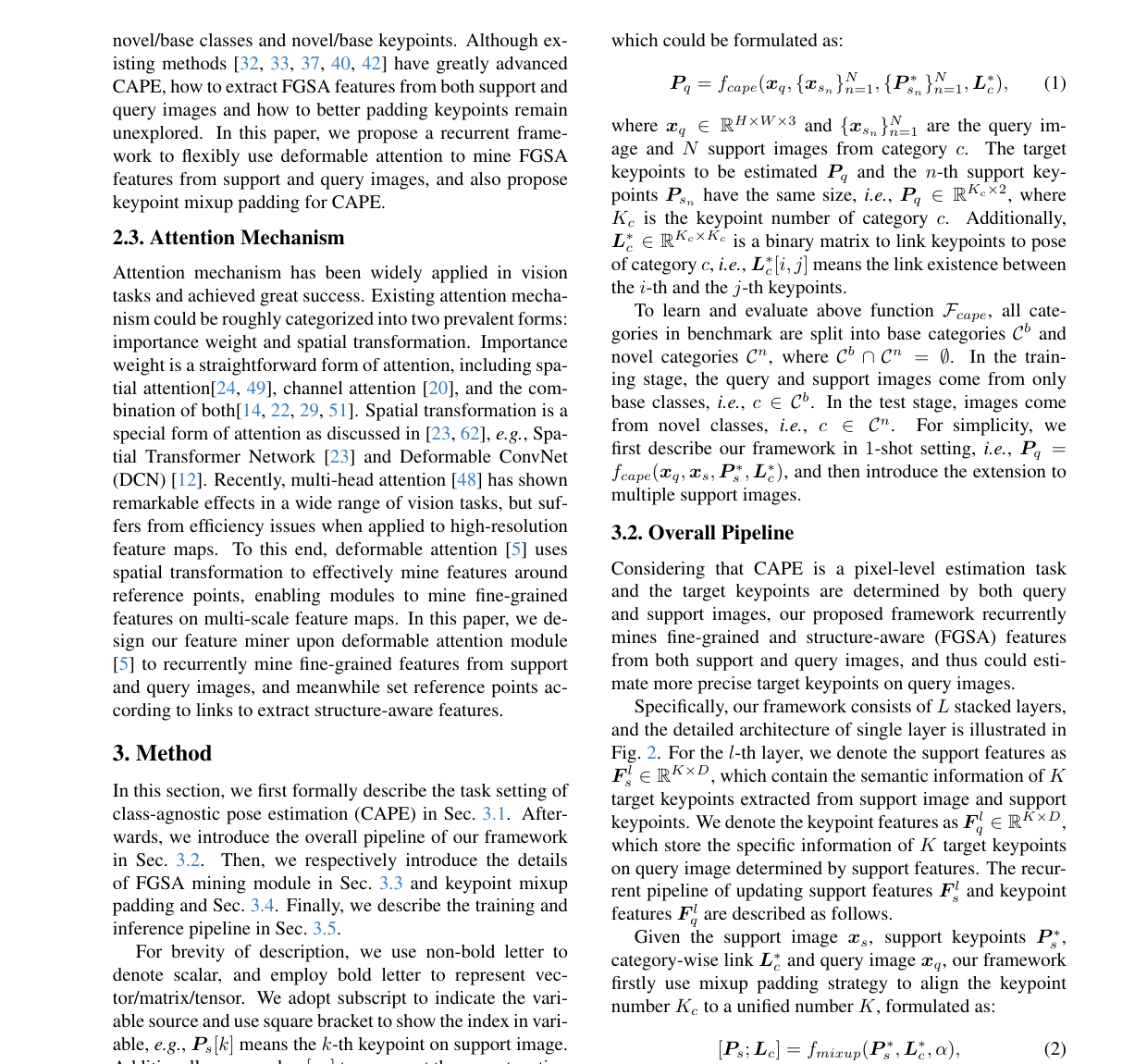
Original task and method text page: attention mechanisms, category-agnostic keypoint definitions, and recurrent FGSA / mixup padding explanations and equations. The current image is not an architecture diagram. Source: CVF Open Access. Image copyright belongs to the authors and publisher; reproduced here for paper analysis.
3. Problem setting and boundaries
Support images supply keypoint annotations; queries come from arbitrary new categories; outputs are corresponding 2D keypoint locations.
This is not RGB-D 6D object pose; without CAD coordinates or PnP, ADD / BOP AR are unsuitable.
Category-agnostic transfer still requires defined support labels and semantic correspondences within the task.
4. Method details
FGSA mining: deformable attention extracts fine features from multiscale maps; linked-keypoint offsets supply structural cues.
Recurrent support-query updates: improved support features and query estimates are fed back repeatedly rather than one cross-attention pass.
Mixup padding: mixup keypoints fill a fixed tensor shape across category-dependent counts, avoiding unsupervised zero entries.
5. Experimental analysis
Main results report five-split MP-100 1-shot / 5-shot mPCK; at PCK@0.05 the paper states a 3.2 percentage point gain over prior SOTA.
Read strict and loose thresholds together: gains only at loose thresholds cannot establish pixel-level localization improvements.
Ablate mixup alongside keypoint counts / category composition to avoid attributing split statistics to padding.
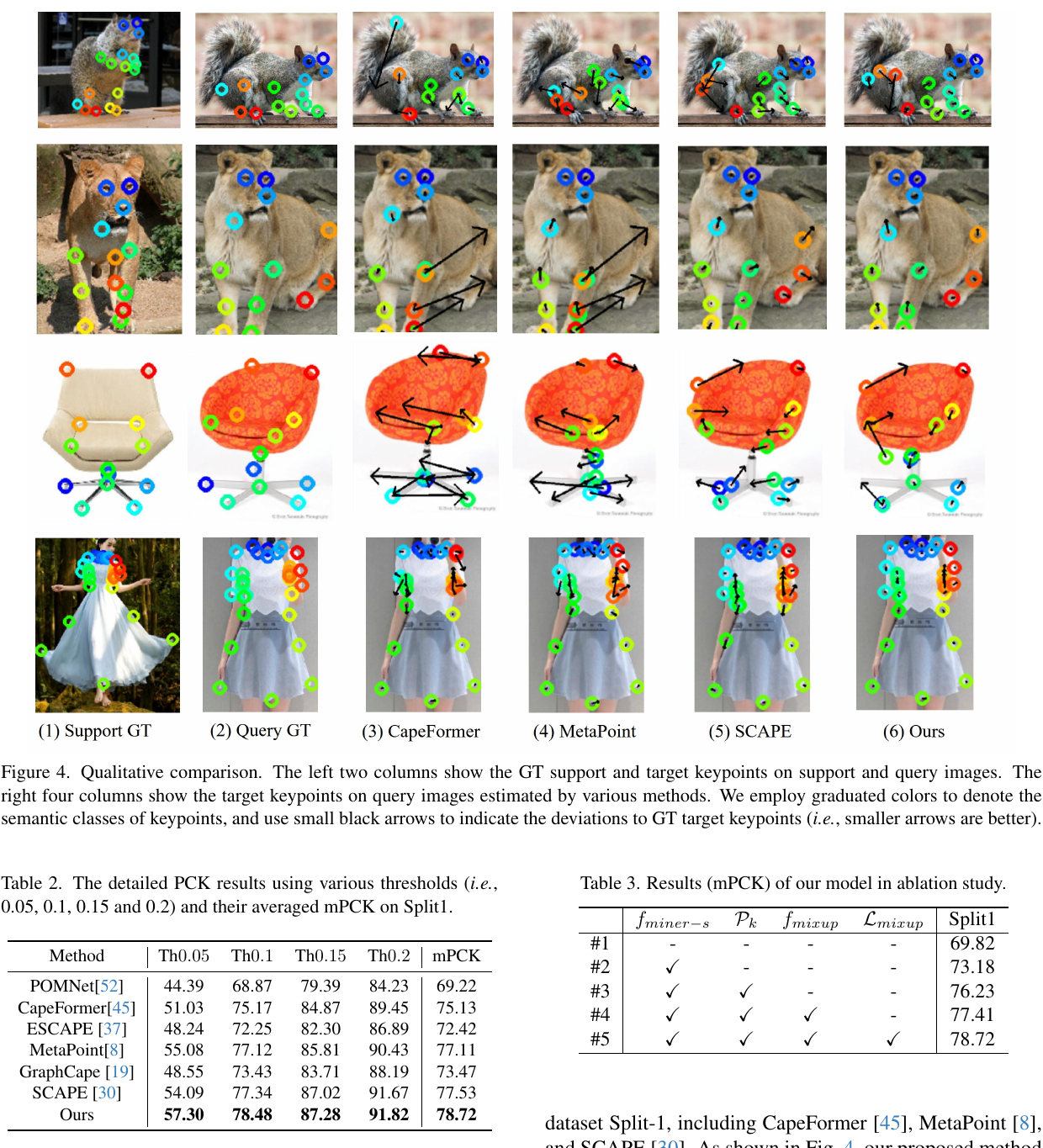
Original Figure 4 / Tables 2–3: colored dots mark keypoints; shorter black arrows indicate predictions closer to GT. Lower tables report strict-to-loose PCK and recurrent mining, structure-aware references, mixup padding / loss additions. Source: CVPR 2025 paper. Image copyright belongs to the authors and publisher; reproduced here for paper analysis.
Split-1 1-shot PCK@0.05 / 0.1 / 0.15 / 0.2 is 57.30 / 78.48 / 87.28 / 91.82, with mPCK 78.72. Closest competitor SCAPE scores 54.09 / 77.34 / 87.02 / 91.67, giving gaps of 3.21 / 1.14 / 0.26 / 0.15. Rapidly shrinking gains at looser thresholds support precise localization rather than easier coarse hits, matching the fine-grained deformable mining motivation.
Ablations rise from baseline 69.82 to recurrent support mining 73.18, structure-aware references 76.23, mixup padding 77.41, and mixup loss 78.72. Every step helps, with larger contributions from the first two; mixup padding + loss adds 2.49 mPCK, providing extra supervision without accounting for all gains.
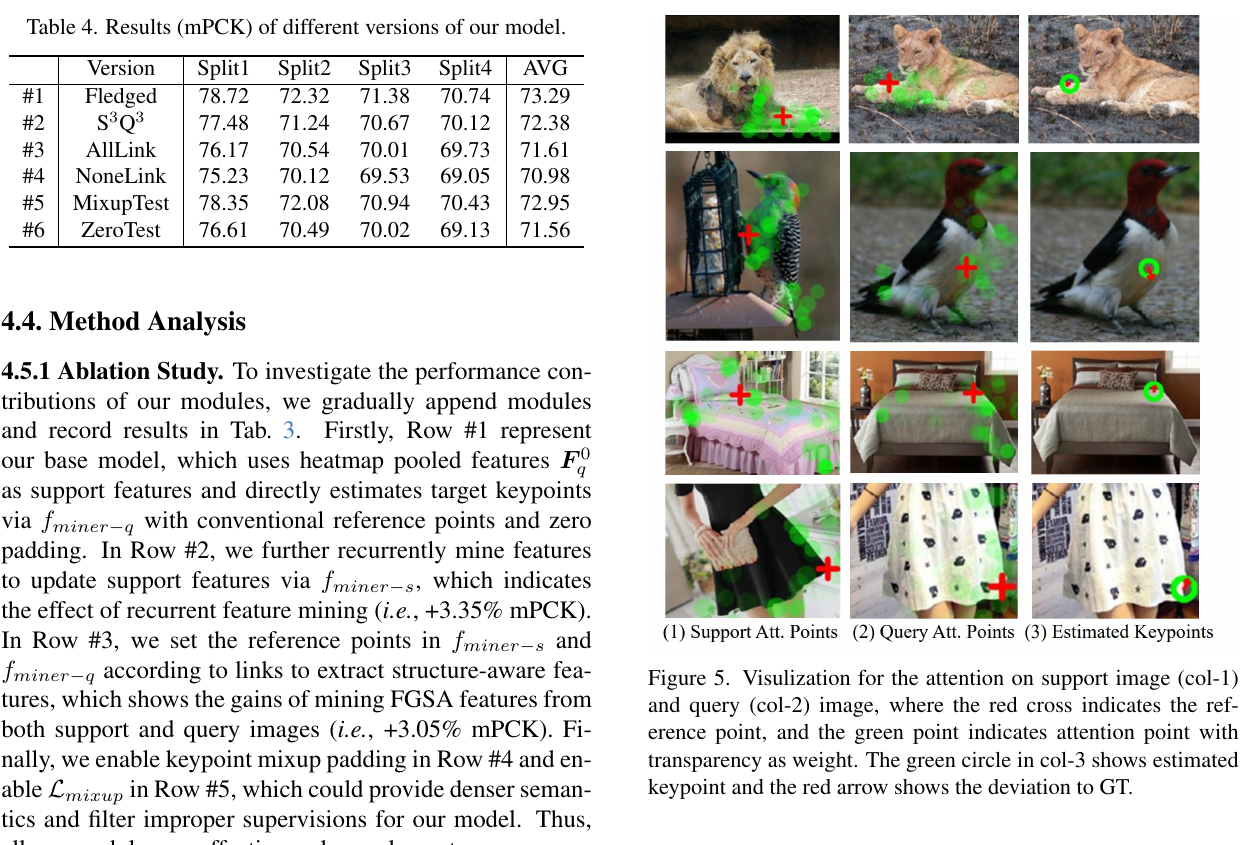
Original Table 4 / Figure 5: recurrent / stacked designs, link graphs, and test-time padding on the left; deformable support / query sampling regions and final keypoints on the right. Source: CVPR 2025 paper. Image copyright belongs to the authors and publisher; reproduced here for paper analysis.
Table 4 mean performance over Split 1–4 is 73.29 for the full recurrent model versus stacked 72.38. Fully connected / self-only link graphs give 71.61 / 70.98, supporting structural links. Random MixupTest scores 72.95 and ZeroTest 71.56, both below the full shared-padding configuration. Mixup strengthens training supervision, but random keypoint mixing at test time introduces noise.
Attention samples follow lion legs, bird bodies, bed edges, and garment structure. This qualitatively supports structural awareness but does not prove semantic interpretability; strict PCK and occlusion / dense-keypoint group results remain necessary evidence.
6. Authors’ claims and my assessment
Authors’ claims
My assessment
Recurrent FGSA improves fine localization
PCK@0.05 gains match the motivation; add occlusion, slender-structure, and sparse-keypoint groups.
Mixup padding improves over zero padding
Plausible and testable in Table 4, provided mixup does not leak semantics.
7. Reproduction considerations and limitations
Keep MP-100 splits, support sampling, linkage graphs, and resizing consistent.
Support annotation quality is critical; recurrent updates can amplify missing or incorrect labels.
A 6D pose pipeline additionally needs 3D keypoints / CAD, PnP, and symmetry handling.
This site includes the paper under broader object pose / keypoint research; continue labeling its output as 2D semantic keypoints so 78.02 mPCK is not confused with 6D pose accuracy.