RefPose: Leveraging Reference Geometric Correspondences for Accurate 6D Pose Estimation of Unseen Objects
RefPose initializes pose from reference geometric correspondences and uses correlation-volume-guided attention for render-and-compare refinement, reducing dependence on fixed object models for unknown objects.
Authors / affiliation: Jaeguk Kim, Jaewoo Park, Keuntek Lee, Nam Ik Cho; Seoul National University.
Task: estimate unseen-object 6D poses from geometric correspondences between query RGB and reference / rendered templates.
Reading mode: Overview.
2. Positioning in one sentence
RefPose uses reference geometric correspondences for coarse poses, then correlation-volume-guided attention refines them in a render-and-compare loop.
3. Problem and motivation
General geometric regressors struggle to transfer coordinate correspondences to new shapes.
Template retrieval alone struggles with large query-reference viewpoint differences.
4. Method overview
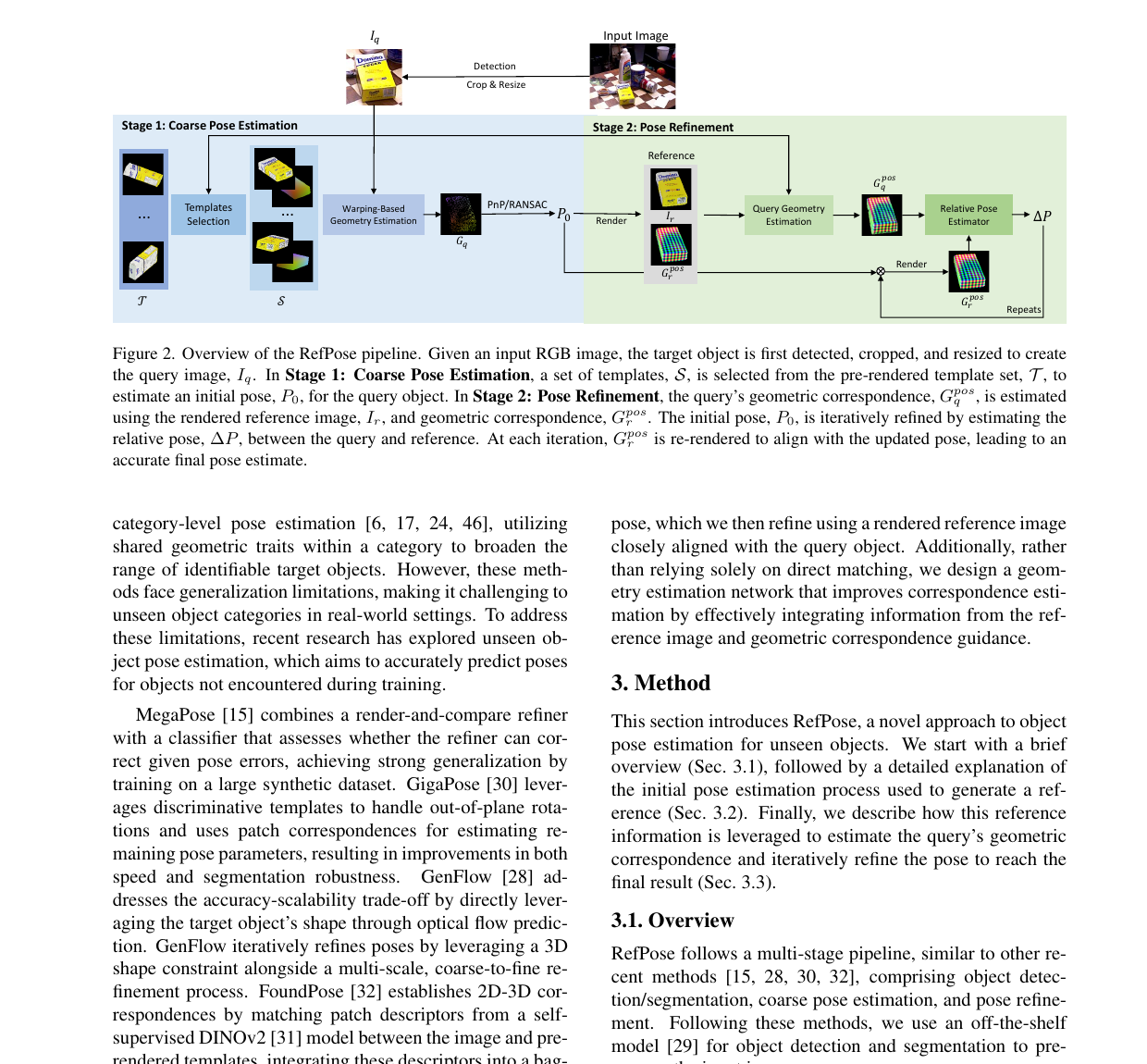
Select a few prerendered candidates from query-reference correspondences; PnP/RANSAC gives coarse poses.
Render references from current poses and predict query geometry through correlation-guided attention, iterating refinement.
Medoid voting resists poor templates and mismatches.
5. Experiments at a glance
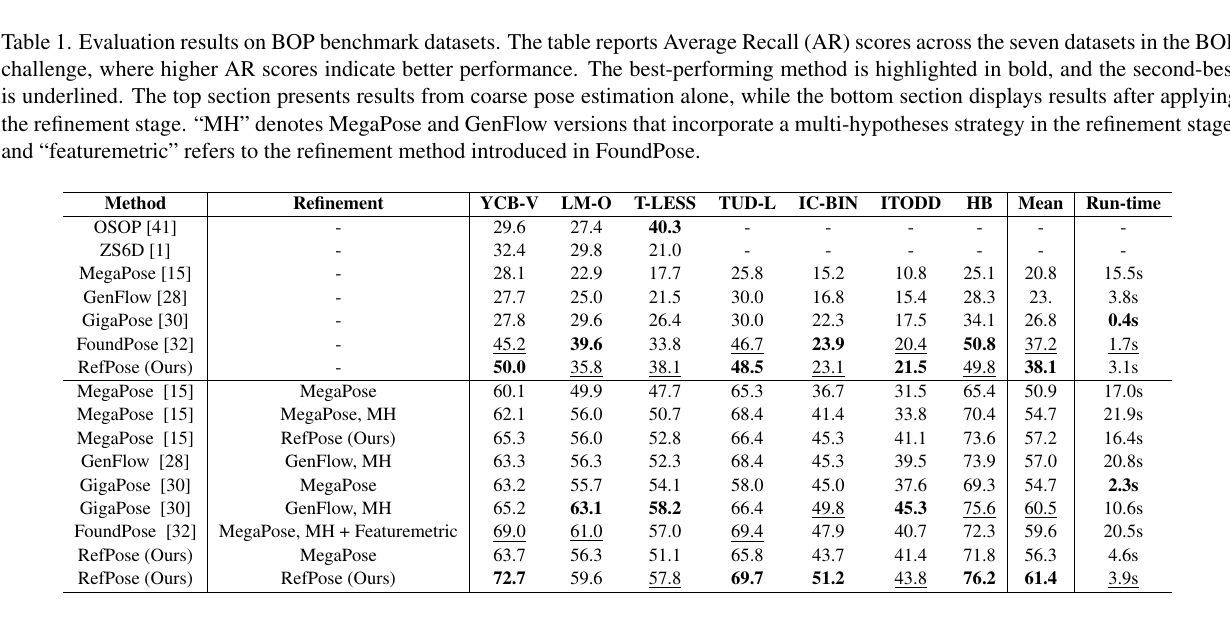
Across seven BOP datasets, coarse mean AR is 38.1 and refined mean AR 61.4.
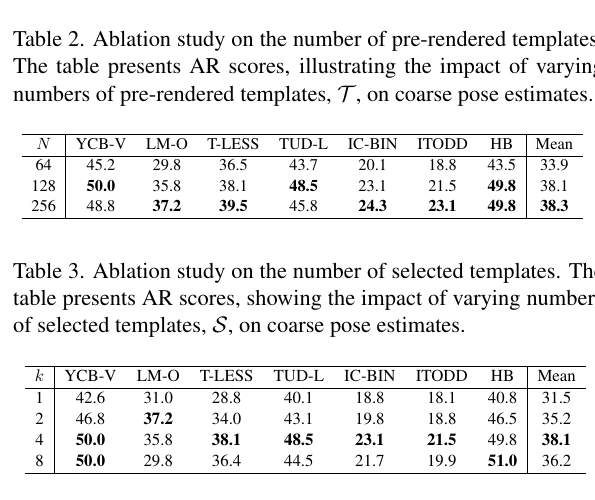
The reported setting uses 128 prerendered templates and selects 4, giving coarse mean AR 38.1.
Original BOP table: coarse comparisons above and coarse / refiner combinations below. Full RefPose mean AR is 61.4 with average processing time 3.9 s. Source: CVPR 2025 paper. Image copyright belongs to the authors and publisher; reproduced here for paper analysis.
YCB-V / TUD-L coarse scores are 50.0 / 48.5, refined to 72.7 / 69.7; seven-dataset mean rises from 38.1 to 61.4. FoundPose + MegaPose MH + Featuremetric scores 59.6, so 61.4 has a modest accuracy margin; RefPose’s 3.9 s is substantially below that comparator’s 20.5 s.
6. Quick assessment
Value: reference-assisted geometry prediction is an explicit design objective.
Boundary: CAD / templates remain necessary; refinement cannot guarantee escape from bad coarse local optima.
Available src/paper-notes/refpose/deep.md
In-depth paper notes
Support reproduction, comparison, related-work writing, and identifying opportunities for further research.
Deep Reading Notes: RefPose: Leveraging Reference Geometric Correspondences for Accurate 6D Pose Estimation of Unseen Objects
Problem: geometry estimators fail on unseen shapes without correspondences tied directly to the current object.
Answer: rendered reference geometry from coarse poses conditions refinement through correlation-volume-guided attention.
2. Positioning in one sentence
Reference images go beyond template retrieval to explicitly guide geometry prediction in each refinement round.
2.1 Guide to the paper’s figures and tables
Figure / table
What to look for
Figure 2
Detection, template selection, coarse PnP, and reference-guided refinement.
Figures 3–5
Roles of selection, warped geometry, and correlation-guided attention.
Table 1
Coarse / refined BOP AR and runtime versus MegaPose / FoundPose.
Tables 2–5
Template counts, selected candidates, flow / medoid, and attention modules.
Original method excerpt: reference renderings at the current pose combine with query geometric correspondences for iterative unseen-object refinement. Source: CVF Open Access. Image copyright belongs to the authors and publisher; reproduced here for paper analysis.
3. Problem setting and boundaries
Inputs: RGB query, target-CAD-rendered templates, and detection crops; output: 6D pose under BOP.
This is model-based unseen-object estimation: test objects may be unseen in training, but CAD is available.
Runtime averages processing for all objects in one image, not a per-object network forward pass.
4. Method details
Coarse: select from 128 prerendered templates; warped geometry and PnP/RANSAC initialize poses, with multiple results aggregated by medoids.
A 128-template pool gives coarse mean 38.1, versus 33.9 / 38.3 for 64 / 256. Saturation makes 128 an efficiency–accuracy compromise, not the sole absolute optimum.
Original template ablations: 64→128 prerendered templates improves results, while 128→256 only raises mean AR from 38.1 to 38.3; selecting 4 outperforms 1, 2, or 8 candidates. Source: CVPR 2025 paper. Image copyright belongs to the authors and publisher; reproduced here for paper analysis.
Template budgets have two effects. A sufficiently dense offline pool improves coverage: 64→128 raises mean AR 33.9→38.1, while 256 gives only 38.3. Online selected candidates are not monotonically helpful: 1 / 2 / 4 / 8 yields 31.5 / 35.2 / 38.1 / 36.2. Excess candidates introduce wrong templates into medoid voting. Tune offline coverage and online candidate width separately rather than one shared template-count parameter.
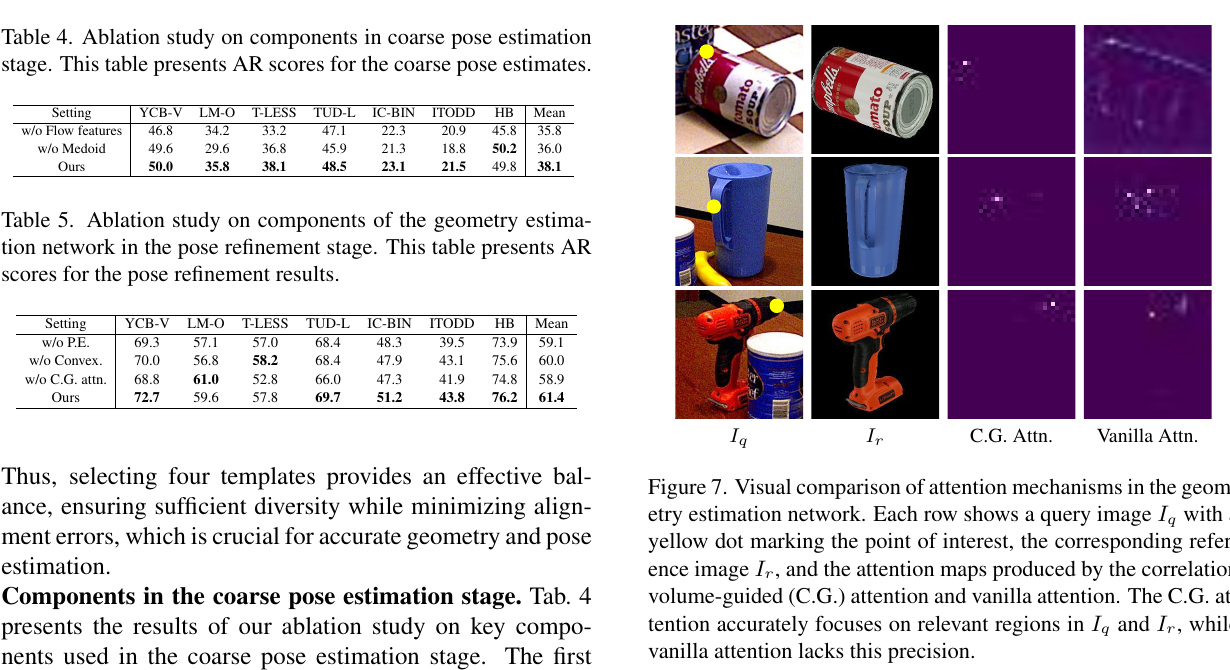
Original component ablations and attention maps: coarse and refinement tables on the left; correlation-guided versus vanilla attention regions on the right. Source: CVPR 2025 paper. Image copyright belongs to the authors and publisher; reproduced here for paper analysis.
Removing flow gives coarse mean AR 35.8, removing medoids 36.0, and the full model 38.1. Both help without accounting for the entire 23.3 AR refinement gain. Removing positional encoding gives 59.1, removing convex upsampling 60.0, replacing correlation-guided attention with vanilla attention 58.9, and the full refiner 61.4. The latter loses 2.5 AR, the largest of the three, while attention maps concentrate more on reference regions corresponding to marked query points.
6. Authors’ claims and my assessment
Authors’ claims
My assessment
Reference correspondences improve refinement
The full pipeline gains 38.1→61.4 AR but also includes better coarse poses; use module ablations for causality.
Few selected templates work best
The 4-template ablation supports selector quality over blindly increasing budgets.
Failures include symmetry, locally similar templates, shifted detection boxes, and rendered–real appearance gaps.
Smaller template budgets do not remove CAD / rendering dependencies.
Runtime covers all objects per image. Report object counts, candidates, and refinement rounds; otherwise 3.9 s cannot directly compare with per-instance timings.