Robot Perception & Manipulation · 2024 · ICRA · CCF B
RGBManip: Monocular Image-Based Robotic Manipulation Through Active Object Pose Estimation
RGBManip schedules active observation and manipulation with a high-level RL policy. Kinematics-guided multiview depth-aware features estimate category-level poses, while impedance control absorbs residual errors. Its main results are success rates on six robotic tasks rather than a standalone pose benchmark.
RGBManip jointly decides where to look, how often to observe, and when to act. A wrist-mounted monocular RGB camera actively gathers views, which are fused for category-level object / part poses; impedance control then opens doors, pulls drawers, and picks objects.
3. System components
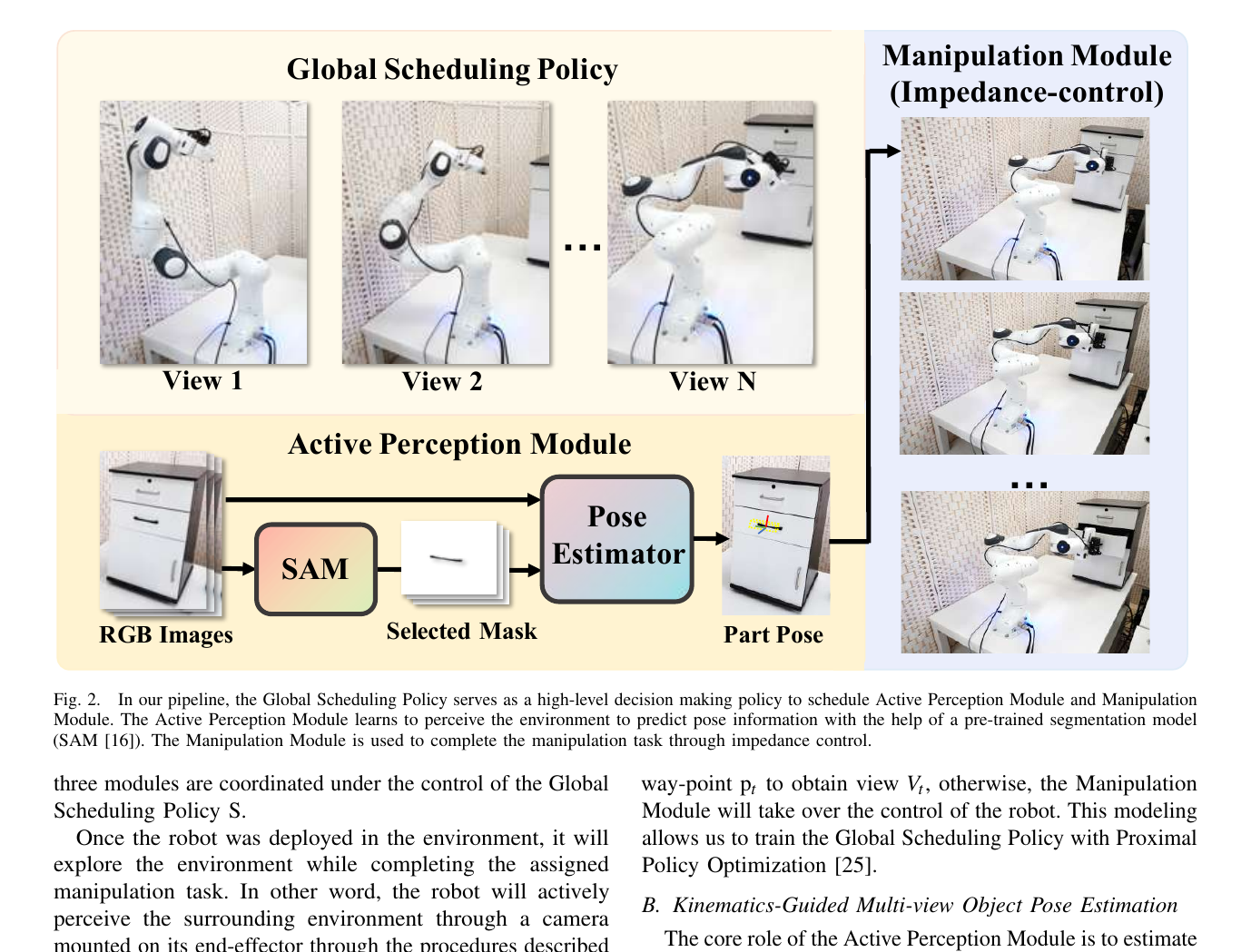
Global Scheduling Policy: switches between active perception and manipulation and selects the next observation viewpoint.
Active Perception: SAM segments targets; robot kinematics supplies inter-view transforms for a depth-aware feature volume predicting size, rotation, and translation.
Domain Randomization: varies transparent, specular, diffuse, and other appearances.
Original Figure 2: global scheduling switches between active vision and manipulation; multiview RGB category-level poses drive impedance control. Source: paper PDF. Image copyright belongs to the authors and publisher; reproduced here for paper analysis.
4. Results overview
Training environments use SAPIEN, PartNet-Mobility, and ShapeNet with 184 shapes / 4 categories. RGBManip broadly outperforms RGB and point cloud baselines on six tasks. Test success rates include Open Door 88.9%, Open Door 45° 52.9%, Open Drawer 87.0%, Open Drawer 30 cm 61.9%, Open Pot 55.6%, and Pick Mug 41.9%. Real deployment uses Franka Panda and RGB-only RealSense output.
5. Coarse assessment
This is a complete manipulation system with pose estimation as an intermediate state. Active multiview perception and compliant control jointly absorb monocular pose uncertainty. Task success must not be labeled pose accuracy, nor the method treated as training-free novel-object 6D estimation.
Available src/paper-notes/rgbmanip-icra2024/deep.md
In-depth paper notes
Support reproduction, comparison, related-work writing, and identifying opportunities for further research.
Deep Reading Notes: RGBManip: Monocular Image-based Robotic Manipulation through Active Object Pose Estimation
1. Basic information
Authors / affiliations: Boshi An, Yiran Geng, Kai Chen, Xiaoqi Li, Qi Dou, Hao Dong; Peking University, Beijing Academy of Artificial Intelligence, Chinese University of Hong Kong
Monocular eye-in-hand cameras lack direct depth, while arms, cabinets, and objects occlude fixed views. RGBManip actively chooses viewpoints and accumulates observations, then uses compliant control to tolerate remaining pose errors.
3. Task boundaries
Dimension
Setting
Sensor
Eye-in-hand RGB; real camera depth output disabled
Target
Category-level object / articulated part pose and size
This is active perception for manipulation: the camera can move and the controller can compensate for visual errors through contact feedback and compliance, unlike standard fixed-input 6D benchmarks.
Original Figure 2: scheduling decides whether to observe further or manipulate; active perception aggregates history and sends predicted poses to impedance control. Source: paper PDF. Image copyright belongs to the authors and publisher; reproduced here for paper analysis.
4. Method details
4.1 Global Scheduling Policy
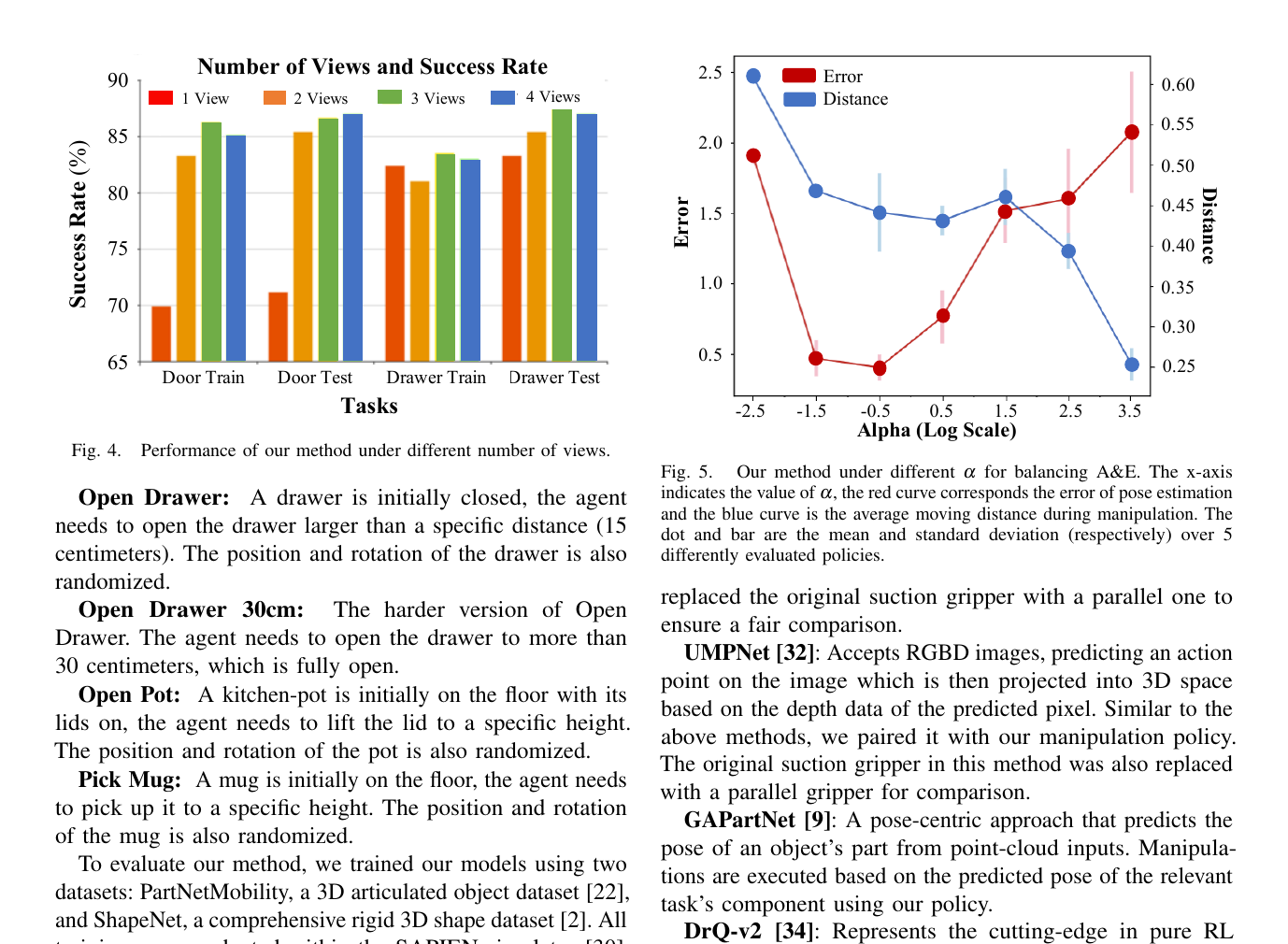
The high-level policy consumes past views, current pose predictions, and robot states, choosing a new observation waypoint or manipulation. Perception rewards combine pose precision and movement penalties, with α=rpen/rprec controlling accuracy–efficiency tradeoffs. Excess motion savings hurt pose quality; very small α can also yield suboptimal policies if other reward terms dominate.
4.2 Kinematics-guided multiview pose estimation
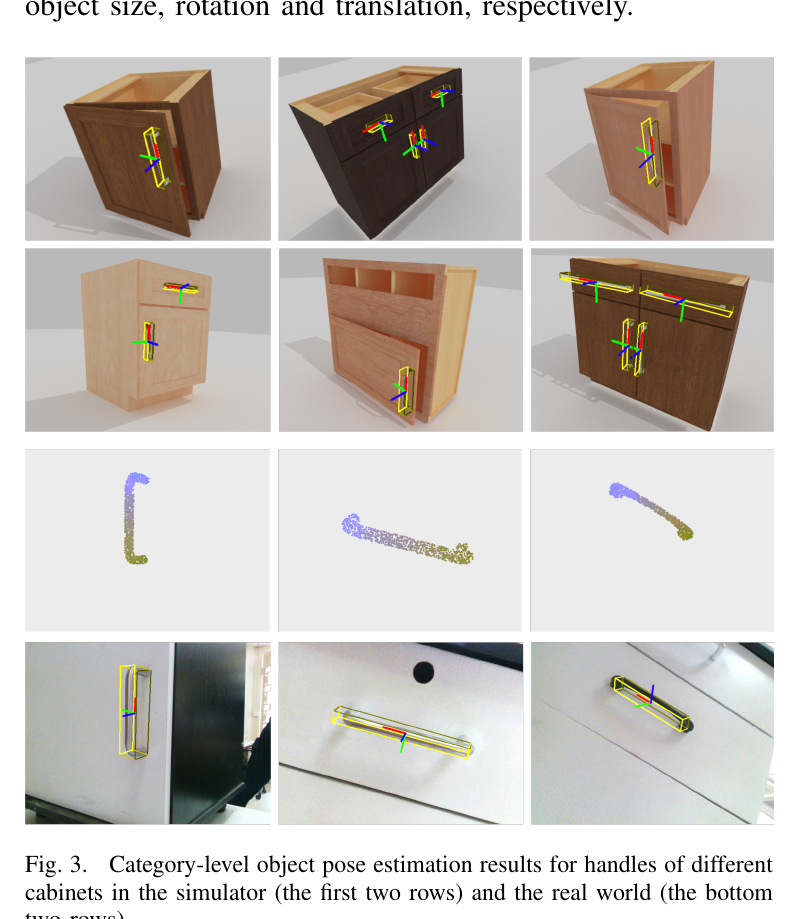
SAM supplies masks and forward kinematics supplies inter-frame extrinsics without visual odometry. Candidate depth planes warp previous features into the current view. Depth-dependent similarities form a 4D volume, regularized and concatenated with mask features to predict size, rotation, and translation separately.
Known camera motion encodes which depth aligns views within feature space, without explicitly reconstructing dense depth. This remains a category-level learned estimator with shape priors and simulation training.
Original Figure 3: category-level pose visualizations of cabinet handles in simulation and real environments. Source: paper PDF. Image copyright belongs to the authors and publisher; reproduced here for paper analysis.
4.3 Sim-to-real and closed-loop control
Training randomizes transparent, specular, diffuse materials and textures to reduce the RGB domain gap. Execution uses impedance control:
τ=J⊤[−k(XR)−b(Jq˙)]+N,
Here, X,R represents end-effector pose errors relative to the target, while k,b controls stiffness and damping. Contact allows deviation from purely visual trajectories, explaining why manipulation success depends on more than pose estimation.
5. Experimental design
Simulation: 184 shapes, 4 categories, six manipulation tasks.
Real system: Franka Panda + eye-in-hand RealSense, RGB only.
Main metric: task success; observation waypoint counts and accuracy–efficiency tradeoffs are also analyzed.
Test task
RGBManip success rate
Open Door
88.9%
Open Door 45°
52.9%
Open Drawer
87.0%
Open Drawer 30 cm
61.9%
Open Pot
55.6%
Lift Mug
41.9%
These are not pose accuracy values. Open Pot test success exceeds training because the test split has easier instances, as the authors explain; train/test gaps alone do not establish generalization.
Original Figures 4–5: viewpoint counts versus task success, and pose error versus arm movement distance. Key Tables I–II values are transcribed in the text tables. Source: paper PDF. Image copyright belongs to the authors and publisher; reproduced here for paper analysis.
6. Ablation interpretation
Removing global scheduling lowers complex-task test success, supporting geometry-adaptive viewpoints over a fixed view.
Removing impedance control particularly hurts Open Door 45° and Open Drawer 30 cm, showing the need for control tolerance in long contact tasks.
Removing domain randomization or multiview pose tricks degrades results; removing pose tricks produces the largest drops on several test tasks.
The figure compares 1–4 views: more waypoints generally help, but 4 does not win every setting. It does not establish saturation beyond 4 views; active perception should not optimize observation count alone.
7. Critical analysis
Strengths
Perception, view planning, and control share a closed loop rather than assuming perfect poses.
RGB avoids holes in consumer depth outputs for transparent / reflective objects.
Multiview fusion uses known robot kinematics, giving a clear engineering route.
Limitations
Limited independent pose metrics and error distributions hinder direct NOCS / REAL275 comparisons.
Manipulation success combines perception, planning, control, collisions, grippers, and other factors.
Category / task coverage and real experiment scale do not establish broad sim-to-real transfer.
SAM masks, calibration, and kinematic errors are not fully isolated assumptions.
Active movement adds time and safety costs in dynamic, shared human-robot, or constrained spaces.
8. Lessons for 6D pose research
Robots may benefit more from recognizing uncertainty, selecting informative views, and tolerating residual errors than from the lowest single-frame mean error. Future systems could maintain pose covariance, choose next-best views by expected task success, and jointly consider symmetry-equivalent poses and feasible contacts in scheduling.