Pseudo-keypoint RKHS Learning for Self-supervised 6DoF Pose Estimation
RKHSPose first learns radial keypoint regression / CNN voting on PBR synthetic RGB-D. Pseudo-poses from real images generate synthetic-over-real pairs, and dense MMD with a learnable RKHS kernel aligns multilayer features. Using 320 unlabeled real images improves LM-O ADD(S) from 55.7 to 68.7. Known CAD, a closed object set, and adaptation to each target domain remain necessary.
known closed-set object instancesBOP PBR synthetic pose labelstarget-domain unlabeled real RGB-D imagescamera intrinsicsfour KeyGNet model keypoints per datasetePnPoptional ICP
Full paper metadataAuthors, affiliations, research area, datasets, metrics, method tags, and reading statusExpandCollapse
known closed-set object instancesBOP PBR synthetic pose labelstarget-domain unlabeled real RGB-D imagescamera intrinsicsfour KeyGNet model keypoints per datasetePnPoptional ICP
Reading Notes
Overview / Deep Dive
Available src/paper-notes/rkhspose-eccv2024/coarse.md
Paper overview notes
Quickly assess the paper's scope, problem setting, core method, experimental findings, and whether to read it in depth.
Overview Notes: RKHSPose
1. Basic information
Title: Pseudo-keypoint RKHS Learning for Self-supervised 6DoF Pose Estimation
Authors: Yangzheng Wu, Michael Greenspan
Affiliation: RCVLab, Department of Electrical and Computer Engineering, Ingenuity Labs, Queen’s University
RKHSPose pretrains radial keypoint regression and voting on BOP PBR RGB-D, then uses 320 target-domain real images without pose labels to generate pseudo-poses and synthetic-over-real pairs. A dense Adapter aligns inputs and intermediate features through learnable-kernel MMD; 2D keypoints + ePnP recover known-CAD instance poses.
3. Guide to figures and tables
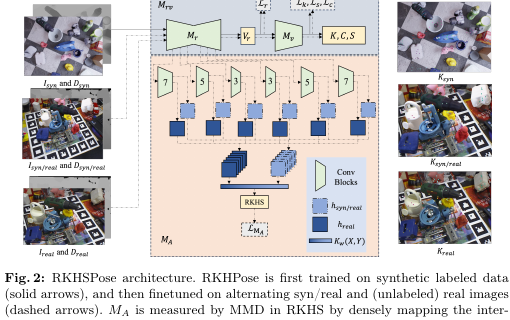
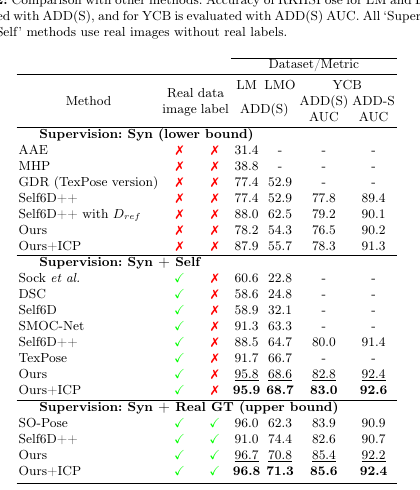
Original Figure 2: green radial regression / voting network; orange dense RKHS mappings align synthetic-over-real and real RGB-D inputs / intermediate features. MMD updates the Adapter and regressor. Source: official ECVA paper. Image copyright belongs to the authors and Springer Nature; reproduced here for paper analysis.Original Table 2: with 320 unlabeled real images, self-supervision gives LM / LM-O ADD(S) 95.9 / 68.7 and YCB ADD(S) / ADD-S AUC 83.0 / 92.6. Synthetic-only lower and real-GT upper references are also reported. Source: official ECVA paper. Table copyright belongs to the authors and Springer Nature; reproduced here for paper analysis.
4. Problem setting
Input: full RGB-D images without external ROIs; camera intrinsics, target classes, and known CAD are required.
Output: rotations / translations for one or more known instances; instance-level estimation, not category-level or unseen-object transfer.
The same backbone with synthetic-only + ICP gives 87.9 / 55.7 / 78.3 / 91.3, supporting unlabeled real adaptation as the main gain.
With real pose GT + ICP, the same backbone gives 96.8 / 71.3 / 85.6 / 92.4; self-supervision approaches but does not match every result.
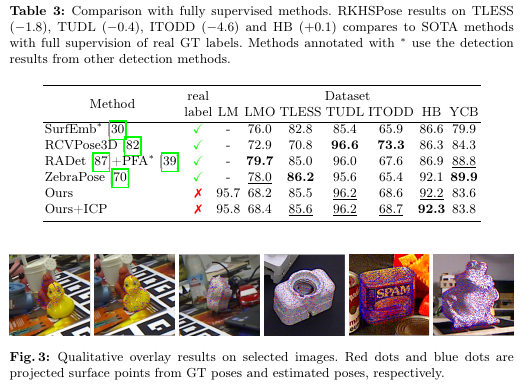
Additional / core BOP settings report +ICP T-LESS / TUD-L / ITODD / HB / YCB-V scores of 85.6 / 96.2 / 68.7 / 92.3 / 83.8. ADD(S), AUC, and BOP AR differ across tables and must not be conflated.
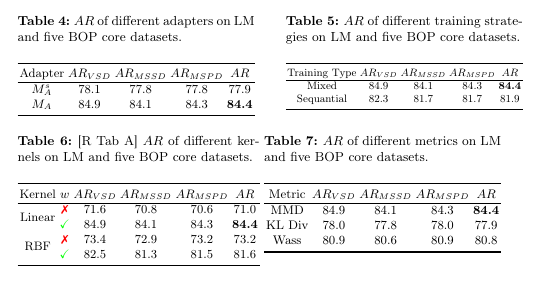
Dense Adapter mean AR is 84.4 versus sparse single-layer 77.9; alternating training gives 84.4 versus sequential 81.9.
About 34 FPS is reported: loading 8.7 ms, main network 4.5 ms, ePnP 16.2 ms; optional ICP should not be assumed included.
7. Quick assessment
Strengths: few unlabeled target images, no ROI, pseudo-pose rendering plus explicit distribution alignment, and broad datasets / ablations.
Limitations: known CAD instances, RGB-D, and real target-domain samples remain necessary; MMD marginal alignment does not guarantee keypoint semantics or conditional geometry; pseudo-poses can reinforce errors.
Available src/paper-notes/rkhspose-eccv2024/deep.md
In-depth paper notes
Support reproduction, comparison, related-work writing, and identifying opportunities for further research.
Deep Reading Notes: RKHSPose
1. Key assessment
RKHSPose embeds adaptation into an interpretable keypoint geometry pipeline rather than merely adding MMD:
RGB-D→radial maps→2D keypoints→ePnP→SE(3).
Real images provide no pose GT. Self-predicted keypoints produce pseudo-poses, CAD is rendered over real backgrounds, and an Adapter aligns inputs / intermediate features between approximately layout-matched pairs. With 320 unlabeled images, LM-O synthetic + ICP rises from 55.7 to 68.7, approaching real-GT training’s 71.3.
This is neither target-data-free zero-shot transfer nor unseen-object estimation: every evaluation domain needs CAD, synthetic PBR training, and some real RGB-D.
2. Supervision boundaries and training data flow
Training uses:
Known CAD and four KeyGNet model keypoints per object;
BOP PBR RGB-D with object labels and pose GT;
320 real target-domain RGB-D images without reading pose GT;
Self-predicted pseudo-keypoints / pseudo-poses;
A synthetic-over-real renderer and camera intrinsics.
Training does not use:
6DoF labels for those 320 real images;
External ROIs / detection masks;
Manually annotated real-image keypoints.
LM, LM-O, YCB-V, T-LESS, and TUD-L use real training images. ITODD / HB lack real training data and use test-disjoint validation images; IC-BIN lacks both and is excluded from this adaptation protocol. Access to unlabeled target-domain data is therefore a dependency beyond test images and CAD alone.
3. Radial regression and CNN voting
Main network Mrv contains radial regressor Mr and voter Mv. Input is W×H×4 RGB-D. For each predefined 3D keypoint, Mr outputs radial map Vr: Euclidean distances from surface-pixel 3D points to that keypoint.
Radial representations offer:
Redundant constraints from many visible surface points;
Keypoints inside objects or at invisible locations;
Actual 3D geometric meaning from depth;
Occlusion redundancy beyond direct sparse 2D regression.
Instead of RCVPose’s analytical voting, CNN Mv converts Vr into accumulated heatmaps, detects peaks, and outputs keypoints K, classes C, and confidences S. Five losses cover radial regression, projection, classification, confidence, and the Adapter:
L=λrLr+λkLk+λcLc+λsLs+λALA.
Regression uses smooth-L1 and classification cross entropy. A dataset shares four KeyGNet keypoints, while classes remain its known objects; new CAD does not transfer without retraining.
4. Pseudo-poses, rerendering, and the RKHS Adapter
Original Figure 2: solid paths show labeled synthetic pretraining; dashed paths alternate synthetic-over-real and unlabeled real adaptation. Dense mappings cover inputs and multiple regressor feature pairs, not only the final layer. Source: official ECVA paper. Image copyright belongs to the authors and Springer Nature; reproduced here for paper analysis.
Stage-two data generation:
Synthetic-pretrained Mrv predicts pseudo-keypoints from real RGB-D;
ePnP gives pseudo-poses;
Perturb rotations by about ±π/18 and normalized translations by about ±0.1;
Render perturbed CAD over its real background as Isyn/real,Dsyn/real;
Run it alongside Ireal,Dreal and align inputs / intermediate features.
Adapter MA maps feature pairs through convolutions into high-dimensional hsyn/real,hreal. Its main loss is Maximum Mean Discrepancy:
MMD2(X,Y)=∥Ex∼Xϕ(x)−Ey∼Yϕ(y)∥H2.
A trainable linear product kernel adapts mappings and comparison scales to pose learning. MMD constrains distribution mean embeddings rather than verifying real-pixel keypoint identities. Large initial pseudo-pose errors break object co-location, allowing alignment to absorb incorrect structure.
5. Two-stage alternating optimization
First 120 epochs: labeled synthetic PBR trains the main network;
Next 80 epochs: alternate real and synthetic epochs; unfreeze the Adapter and add MMD during real epochs;
The paper emphasizes classification / visibility in the first 80 epochs, then reweights toward keypoint localization; adaptation begins after 120 epochs;
Alternation reinjects geometric GT, reducing pseudo-label drift relative to synthetic training followed by continuous real fine-tuning.
Mixed / alternating mean AR 84.4 beats sequential 81.9 by +2.5, making scheduling part of the method.
6. Main results: separate three supervision levels
Original Table 2: LM / LM-O use ADD(S), YCB uses ADD(S) and ADD-S AUC. Do not directly average different columns; Syn + Self uses real images without real pose labels. Source: official ECVA paper. Table copyright belongs to the authors and Springer Nature; reproduced here for paper analysis.
LM-O: 55.7→68.7, a larger occlusion-domain gain but still 2.6 below full GT;
YCB: ADD(S) AUC rises 78.3→83.0 but remains below full-GT 85.6;
Self-supervised ADD-S AUC 92.6 exceeds full-GT 92.4 by 0.2 in one small fluctuation, not general superiority over GT supervision;
ICP adds only 0.1–0.2 after adaptation, while synthetic-only LM gains 9.7, indicating different initial error structures.
7. BOP results and protocols
Original Table 3 / Figure 3: comparisons with full-real-GT methods; red / blue dots below denote GT / estimated model projections. Starred baselines use other detections, so protocols differ. Source: official ECVA paper. Figure and table copyright belongs to the authors and Springer Nature; reproduced here for paper analysis.
RKHSPose + ICP Table 3 results:
LM
LM-O
T-LESS
TUD-L
ITODD
HB
YCB-V
95.8
68.4
85.6
96.2
68.7
92.3
83.8
The authors summarize gaps to strong fully supervised column references from −11.3 to +0.2, closest on HB and largest on LM-O. Three constraints matter:
Table 2 uses ADD(S) for LM / LM-O and AUC for YCB; Table 3 uses BOP-style results, so same-named columns are not directly comparable;
Starred baselines use external detections; no ROI is a system advantage but changes error sources;
ITODD / HB adapt on validation, not training images; preserve this test-disjoint split.
8. Ablations: what matters?
Original Tables 4–7: AR averages LM and five BOP core datasets. The final setup combines dense adaptation, alternating training, a learnable linear kernel, and MMD. Source: official ECVA paper. Table copyright belongs to the authors and Springer Nature; reproduced here for paper analysis.
Variable
Control
Mean AR
Final configuration
Mean AR
Adapter density
Sparse single map
77.9
Dense multimap
84.4
Schedule
Sequential
81.9
Mixed / alternating
84.4
kernel
fixed linear
71.0
trainable linear
84.4
kernel
fixed RBF
73.2
trainable RBF
81.6
distance
KL
77.9
MMD
84.4
distance
Wasserstein
80.8
MMD
84.4
Largest ablations are fixed→trainable linear +13.4 and sparse→dense +6.5, supporting task-adaptive multilevel alignment rather than any arbitrary domain loss.
Real-image budgets range from 0 to 640. All but YCB plateau around 160 images, with YCB near saturation after 320. The chosen 320 budget lacks mean / variance across alternative 320-image subsets, leaving selection sensitivity unknown.
9. Speed and system boundaries
On Intel i7 2.5 GHz + RTX 3090 24GB, the paper reports:
data loading: 8.7 ms;
Mrv forward: 4.5 ms;
ePnP: 16.2 ms;
Total about 29.4 ms, or 34 FPS.
ICP is absent from the breakdown, so +ICP accuracy cannot automatically be paired with 34 FPS. ePnP costs 3.6 times the network latency, locating the bottleneck in keypoint instance organization and geometric solving rather than FCN inference.
10. Limitations and failures
Closed known-instance set: every object participates in synthetic training; new CAD / categories are unsupported;
RGB-D dependence: holes, transparency, and reflections corrupt radial quantities;
Target-domain dependence: new cameras, lighting, or underwater domains need unlabeled real data and readaptation;
Pseudo-label confirmation bias: incorrect keypoints produce wrong poses and synthetic-over-real pairs;
Marginal alignment: MMD does not explicitly align object-, keypoint-, or occlusion-conditioned distributions;
Keypoint / class priors: four KeyGNet-preselected keypoints and a fixed class set;
Metric distinctions: report ADD(S), ADD-S AUC, and BOP AR separately;
Split exceptions: ITODD / HB use validation; IC-BIN cannot be adapted under this protocol;
No dedicated implementation: the discoverable RCVPose repository belongs to the ECCV 2022 predecessor, not evidence that the RKHSPose Adapter is released.
11. Reproduction checklist
Fix PBR versions, 320 real image IDs, and test-disjoint splits per dataset;
Fix shared four-keypoint KeyGNet sets per dataset;
Reproduce FCN-ResNet-18 radial maps, CNN voting, and grouping;
Train 120 synthetic epochs, then 80 alternating epochs;
Record pseudo-pose perturbations, rendering, overlays, and depth composition;
Cover inputs and all specified intermediate maps with the Adapter;
Use trainable linear kernels + MMD, retaining fixed / RBF / KL / Wasserstein controls;
Report accuracy and speed both with and without ICP;
Test multiple 320-image subsets for selection variance;
Avoid overlap between validation adaptation images and test scenes / videos.
12. Overall assessment
RKHSPose uses few unlabeled real RGB-D images to raise LM-O from 55.7 to 68.7 while dense / sparse, mixed / sequential, kernel, distance, and data-budget ablations locate the gains. Keypoints and ePnP retain geometric interpretability within a clearly bounded sim-to-real study.
Self-supervised and near-fully-supervised claims still require known CAD, GT-labeled synthetic PBR, real target images, and domain-specific fine-tuning. YCB ADD(S) AUC and LM-O remain below real-GT references. Its precise scope is closed-set instance-level RGB-D pose adaptation using 320 target images without pose labels to recover much of real supervision’s benefit.