Reading Notes
Overview / Deep Dive
Available src/paper-notes/roma-v2/coarse.md
Paper overview notes
Quickly assess the paper's scope, problem setting, core method, experimental findings, and whether to read it in depth.
Overview Notes: RoMa v2: Harder Better Faster Denser Feature Matching
1. Basic information
- Title: RoMa v2: Harder Better Faster Denser Feature Matching
- Authors / affiliations: Johan Edstedt, David Nordstrom, Yushan Zhang, Georg Bokman, Jonathan Astermark, Viktor Larsson, Anders Heyden, Fredrik Kahl, Marten Wadenback, Michael Felsberg; Linkoping University, Chalmers University of Technology, University of Amsterdam, Centre for Mathematical Sciences, Lund University
- Year / venue: 2025 / arXiv
- Paper: arXiv:2511.15706
- Code / project: Code
- Reading mode: Overview
2. Positioning in one sentence
RoMa v2 upgrades dense feature matching with frozen DINOv3, a multiview Transformer coarse matcher, lightweight CNN refiners, diverse training data, and pixelwise covariance. It targets harder matching, accuracy, and efficiency for relative pose, SfM, localization, and downstream 6D pose / reconstruction pipelines.
Method inputs and outputs
| Item | Content (compiled for this site) |
|---|---|
| Inference input | Two RGB images with shared visible regions. |
| Final output | Bidirectional dense pixel warps, confidence / overlap, and per-pixel 2D residual precision matrices (inverse covariances). |
| Requirements | Matching needs no CAD, depth, mask, or intrinsics. Camera-relative or object 6D poses require additional sampling, calibration, and geometric solving. |
2.1 Guide to the paper’s figures and tables
| Figure / table | Purpose | Overview reading tips |
|---|---|---|
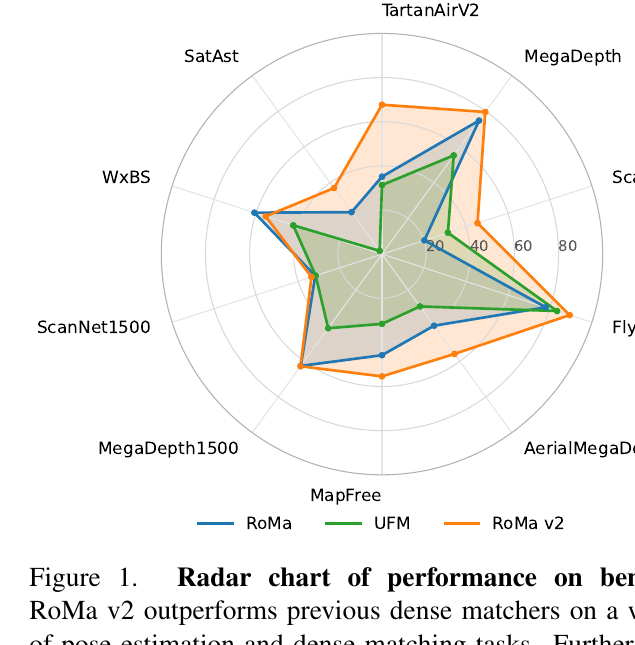
| Figure 1 | Radar overview versus RoMa / UFM | Assess the broad claim rather than one dataset |
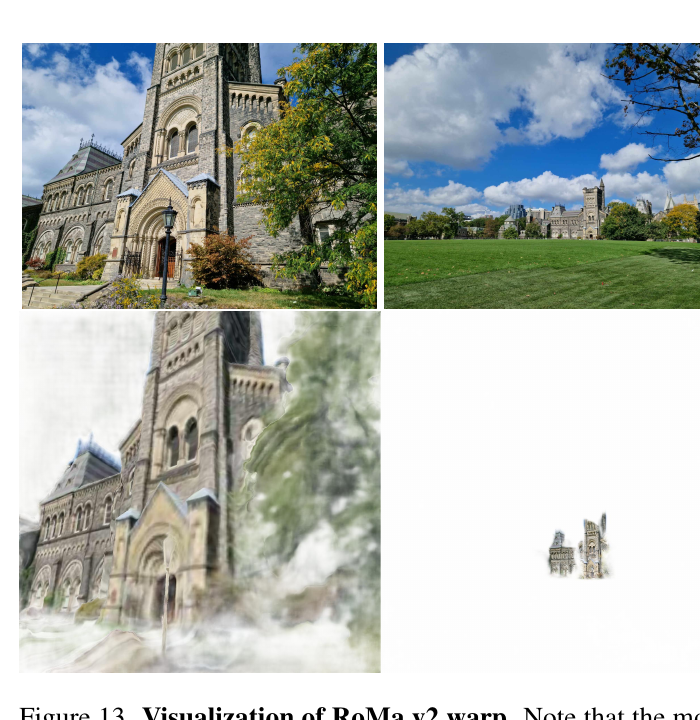
| Figure 2 | Qualitative cross-scene, viewpoint, and modality dense warps | Understand the output form |
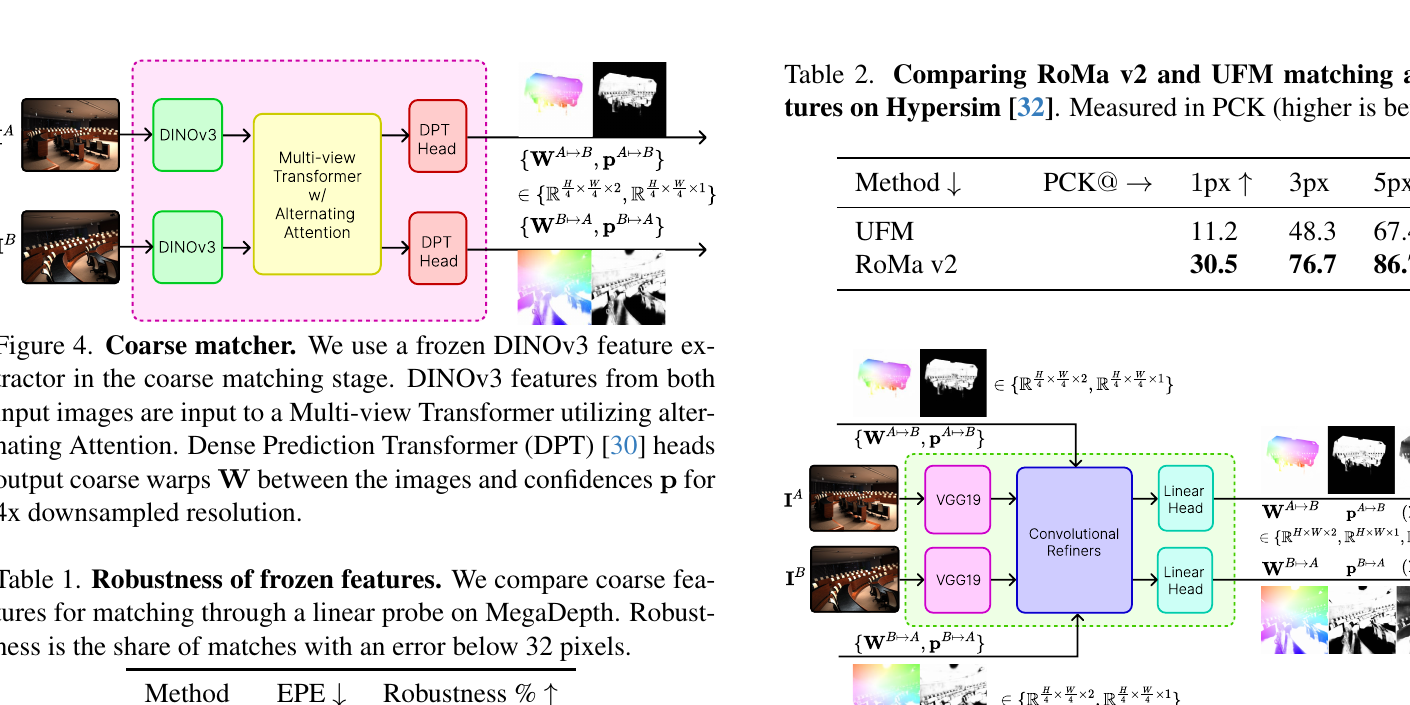
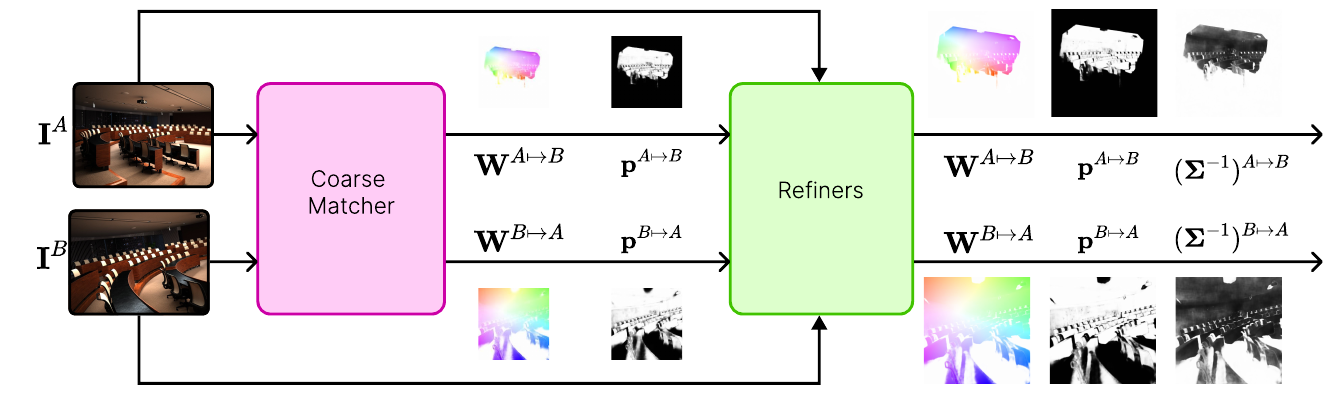
| Figure 3 | Coarse matcher, refiners, and covariance pipeline | Main method diagram |
| Figures 4 / 5 | DINOv3 coarse matching and convolutional refiners | Architecture details |
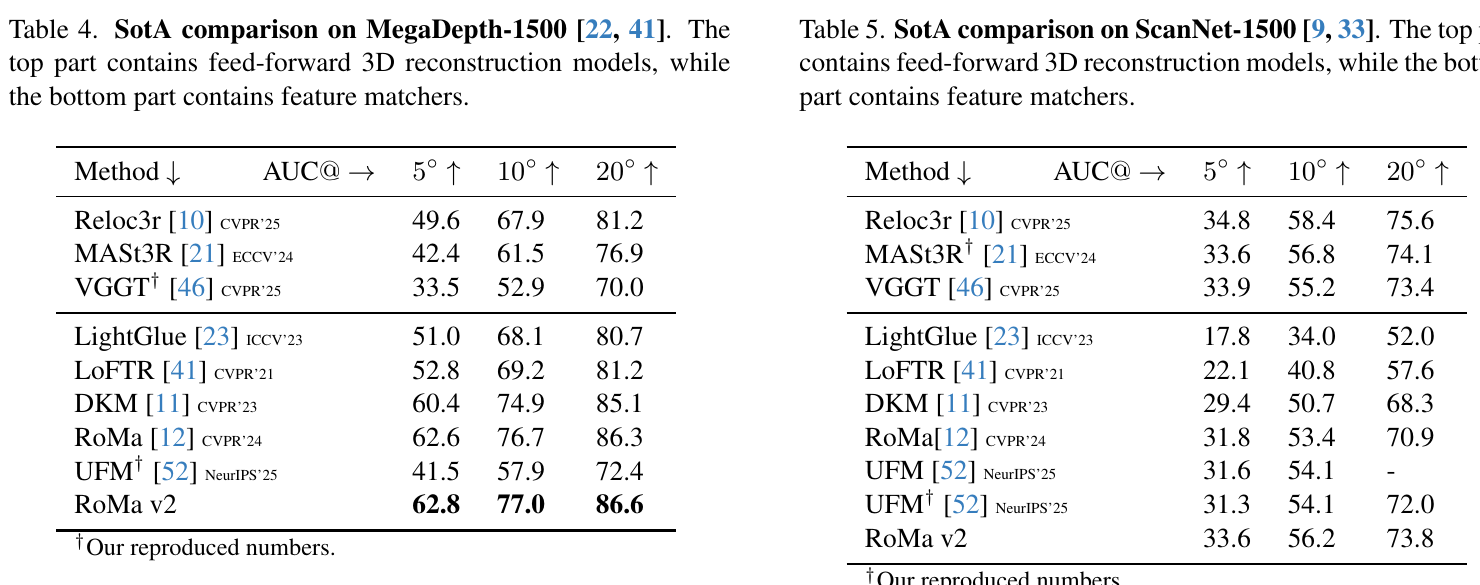
| Tables 4 / 5 | MegaDepth / ScanNet relative pose | Downstream geometric benefits |
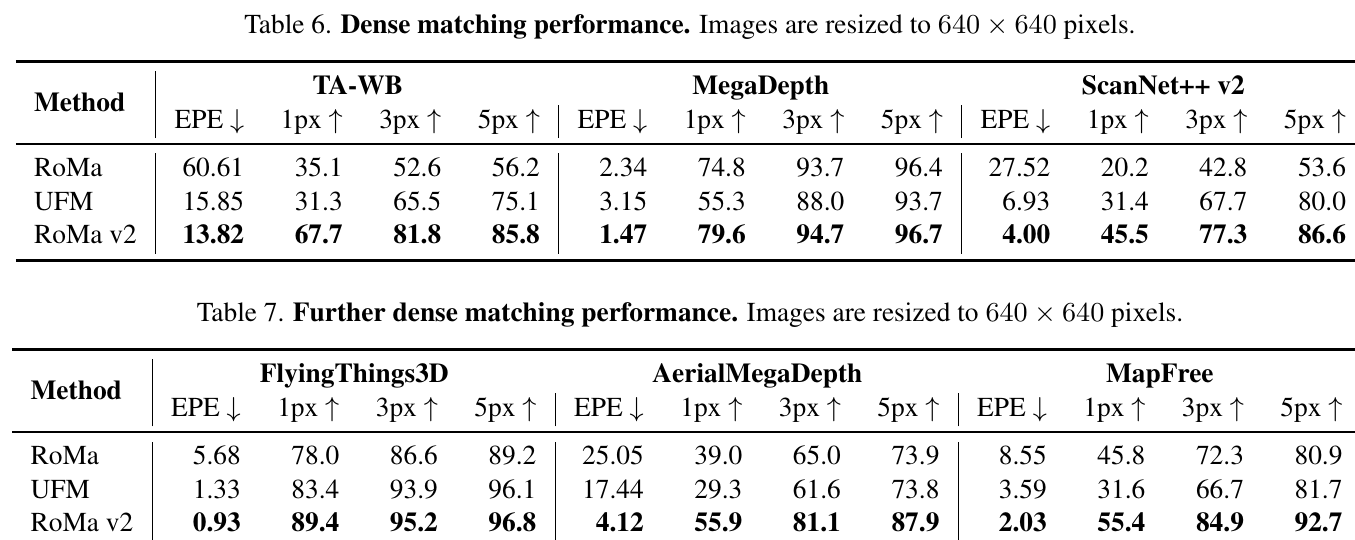
| Tables 6 / 7 | Dense matching on six datasets | Accuracy generalization |
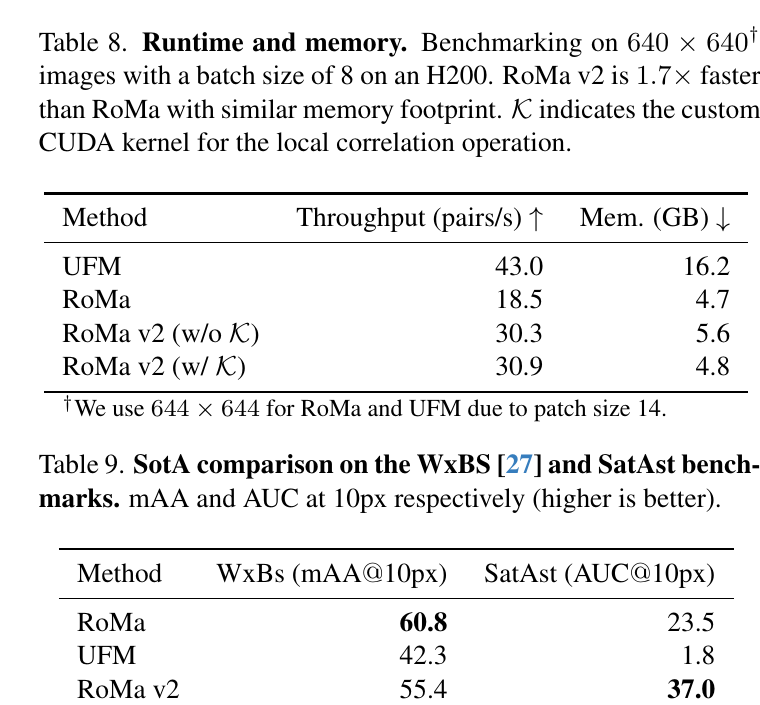
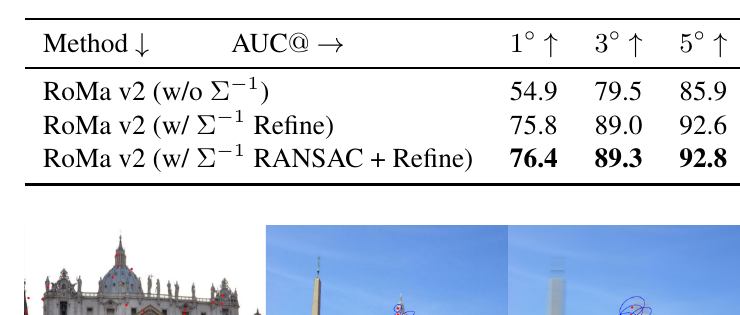
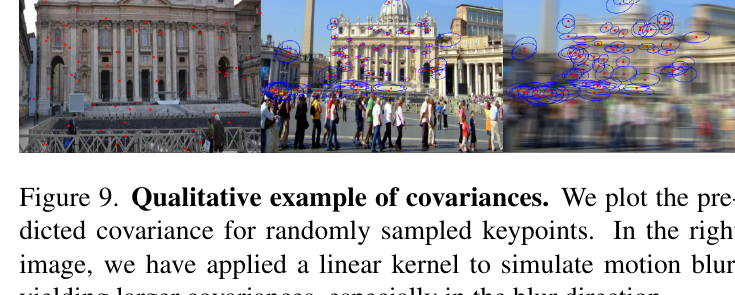
| Tables 8 / 9 / 10 | Runtime, WxBS/SatAst, covariance | Speed, OOD behavior, and robust estimation |
3. Problem setting
- Task: dense feature matching between two views of the same 3D scene, estimating A-to-B and B-to-A warps with confidence / overlap.
- Input: two RGB images.
- Output:
- Bidirectional dense warps and ;
- Confidence / overlap masks and ;
- Additional per-pixel 2D residual precision / covariance for robust geometry.
- Assumptions / priors:
- Shared visible 3D points;
- GT warp / overlap supervision from MVS, meshes, graphics, flow, and related sources;
- No CAD, depth, or camera poses at matching inference; downstream relative pose / SfM estimates geometry from matches.
- Applications: localization, relative pose, SfM / MVS, dense reconstruction, alignment, and 6D pose frontends needing reliable 2D-2D / 2D-3D correspondences.
4. Core motivation
- Problems addressed:
- RoMa handles extreme appearance changes but has high runtime / memory costs for complex, constrained, or large-scale tasks.
- Faster UFM fine-tunes its backbone, with weaker extreme appearance / modality transfer on WxBS and subpixel precision.
- Wide baselines, weak texture, aerial-ground views, dynamic / small objects remain challenging.
- Why it matters:
- Pose, SfM, localization, and reconstruction depend on reliable correspondences.
- Dense matching can support object registration, reference-based pose, and CAD-free pose.
- Gaps in prior work:
- Speed alone can sacrifice OOD robustness;
- Accuracy alone can make inference slow and memory-heavy;
- Confidence alone does not support covariance-aware geometric refinement.
5. Method overview
- Pipeline:
- Frozen DINOv3 ViT-L extracts foundation features from both images.
- A multiview Transformer with alternating attention predicts 4x-downsampled warps / confidences.
- Stride 4, 2, 1 refiners progressively recover original resolution.
- Refiners also predict per-pixel 2x2 precision matrices for covariance-weighted RANSAC / refinement.
- Key components:
- Frozen DINOv3 improves coarse matching robustness;
- LNLL + warp + overlap losses strengthen cross-image context;
- Train matcher first, freeze it, then train refiners for faster experimentation;
- Custom CUDA local correlation lowers memory;
- EMA reduces refinement subpixel bias.
- Building blocks: DINOv3, multiview Transformer, DPT heads, UNet-like CNN refiners, local correlation, predictive covariance, and RANSAC / geometric refinement.
- Training: large-scale supervised learning; inference is feed-forward dense matching.
6. Experimental overview
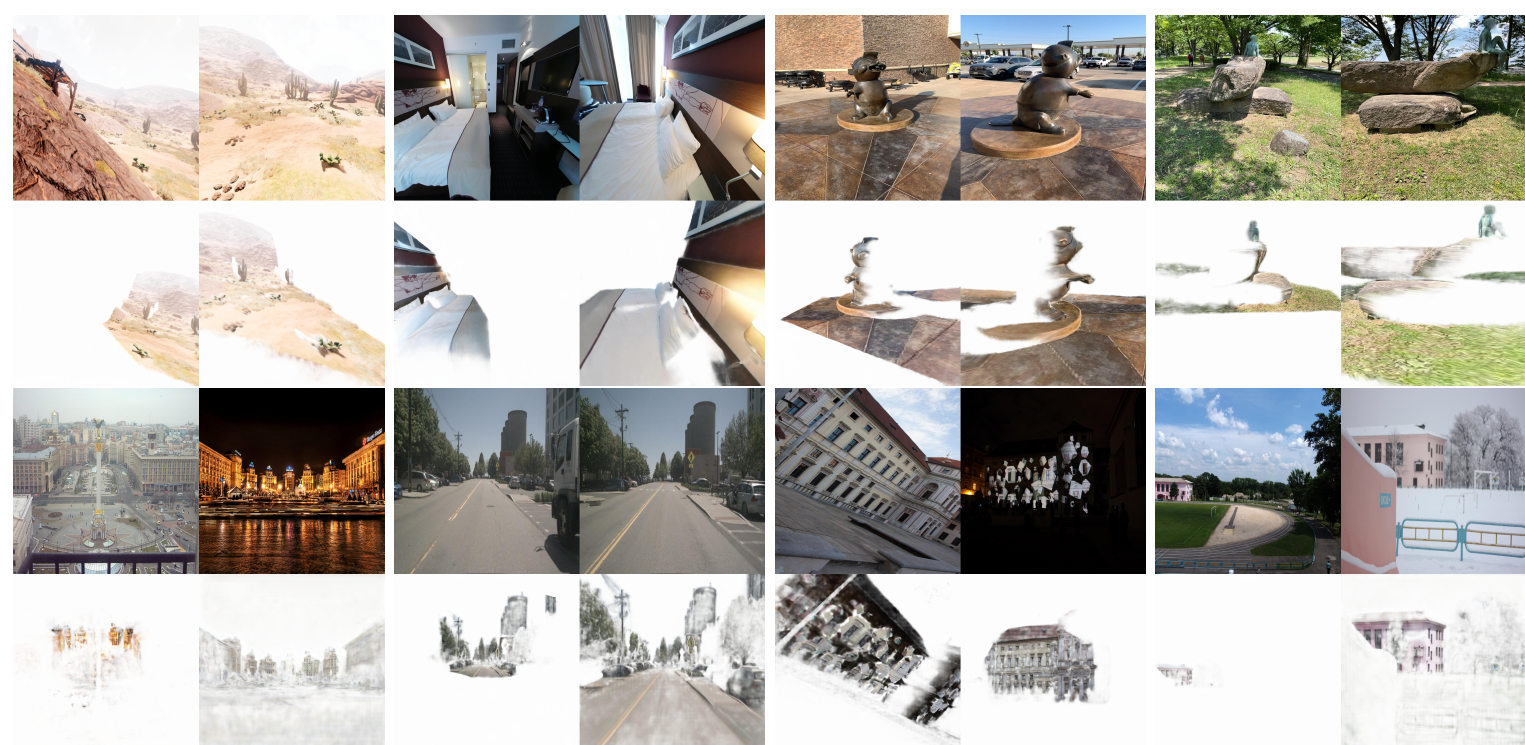
- Datasets:
- Training mixture: MegaDepth, AerialMegaDepth, BlendedMVS, Hypersim, TartanAir v2, Map-Free, ScanNet++ v2, UnrealStereo4k, Virtual KITTI 2, FlyingThings3D.
- Tests: MegaDepth-1500, ScanNet-1500, TA-WB, MegaDepth, ScanNet++ v2, FlyingThings3D, AerialMegaDepth, MapFree, WxBS, SatAst, HyperSim.
- Metrics:
- Relative pose: AUC at 5/10/20 degrees.
- Dense matching: EPE, PCK at 1/3/5 px.
- WxBS / SatAst: mAA at 10 px, AUC at 10 px.
- Runtime: throughput pairs/s, memory GB.
- Baselines: RoMa, UFM, DKM, LoFTR, LightGlue, and feed-forward 3D models Reloc3r, MASt3R, VGGT.
- Main results:
- MegaDepth-1500 pose AUC: 62.8 / 77.0 / 86.6, slightly above RoMa 62.6 / 76.7 / 86.3 and above VGGT, MASt3R, Reloc3r.
- ScanNet-1500 pose AUC: 33.6 / 56.2 / 73.8, best among feature matchers and close to feed-forward 3D models.
- Dense matching: strongest overall across TA-WB, MegaDepth, ScanNet++ v2, FlyingThings3D, AerialMegaDepth, MapFree; AerialMegaDepth EPE 4.12 versus RoMa 25.05.
- H200 runtime, batch size 8, about 640x640: throughput 30.9 pairs/s versus RoMa 18.5, about 1.7x faster.
- WxBS: mAA at 10px 55.4, below RoMa 60.8 but above UFM 42.3; original RoMa remains stronger on extreme modalities.
- SatAst: AUC at 10px 37.0 versus RoMa 23.5 and UFM 1.8.
- Are the claims supported?
- Authors’ claim: harder matching, better accuracy and speed, plus covariance for downstream geometry.
- My analysis: broad benchmarks support the claim, but weaker WxBS extreme-modality results than RoMa prevent a universal OOD improvement claim.
7. Strengths and limitations
Strengths
- Broad experiments span relative pose, dense matching, WxBS, SatAst, runtime, and covariance.
- Faster than RoMa while retaining frozen-feature generalization.
- Context-aware coarse matching and lighter refiners have clear goals.
- Covariance helps RANSAC / refinement and connects directly to geometry systems.
- A strong candidate correspondence frontend for 6D pose / localization.
Limitations / risks
- Still heavy: DINOv3 ViT-L, refiners, and custom CUDA bring more dependencies than LightGlue-like sparse matchers.
- Extreme WxBS transfer still trails RoMa, particularly IR-to-RGB.
- Complex training mixtures are costly to reproduce.
- No direct 6D object pose experiments; this supplies correspondences, not a complete pose pipeline.
- AerialMegaDepth sky depth / overlap biases affect warps in the supplement.
8. Research takeaways
- Reusable ideas:
- Predict covariance alongside matches / confidence for weighted geometric optimization;
- Mix wide and narrow baselines for robustness and fine precision;
- Use dense correspondence for reference-view / CAD-free registration.
- Suitable baseline?
- Strongly relevant to matching, relative pose, localization, and SfM frontends;
- Object 6D pose additionally needs PnP / solving / masks.
- Worth a deep read?
- Yes: Sections 3.2 and 3.3, runtime Table 8, and covariance Table 10.
- Follow-up questions:
- Are dependencies and checkpoints fully released?
- Can it replace LoFTR / DKM / RoMa in BOP / object reference matching?
- Can covariance improve RANSAC-PnP or render-and-refine initialization?