SAM-6D: Segment Anything Model Meets Zero-Shot 6D Object Pose Estimation
For zero-shot RGB-D 6D pose estimation of instances unseen in training, target CAD renderings supply the object prior. SAM/FastSAM proposes masks, filtered by DINOv2 semantic, appearance, and geometric scores. Coarse-to-fine 3D–3D matching with background tokens and weighted SVD estimates all target instance poses.
Authors / institutions: Jiehong Lin, Lihua Liu, Dekun Lu, Kui Jia; DexForce Co., Ltd., The Chinese University of Hong Kong, Shenzhen, South China University of Technology
SAM-6D is a zero-shot RGB-D 6D pose pipeline for target instances unseen during training. Given target CAD, camera intrinsics, and cluttered-scene RGB-D, it generates class-agnostic masks with SAM / FastSAM, identifies target instances using DINOv2 and CAD-rendered templates, then estimates each instance’s R,t through coarse-to-fine 3D–3D correspondence.
Method inputs and outputs
Item
Content (compiled for this site)
Inference input
One scene RGB-D frame, camera intrinsics, and the specified target’s CAD mesh; multiview RGB-D templates are rendered offline from CAD.
Final output
A segmentation mask for each discovered target instance, plus rotation R and translation t from the CAD object frame to the camera frame.
Requirements
The full SAM-6D pipeline generates and filters its own masks, so no user-supplied target mask is required. The PEM pose back end alone requires a mask. Depth, CAD scale, and camera calibration must agree. Zero-shot means no target-specific retraining for new objects.
2.1 Guide to the paper’s figures and tables
Figure / table
Purpose
Overview reading tips
Figure 1
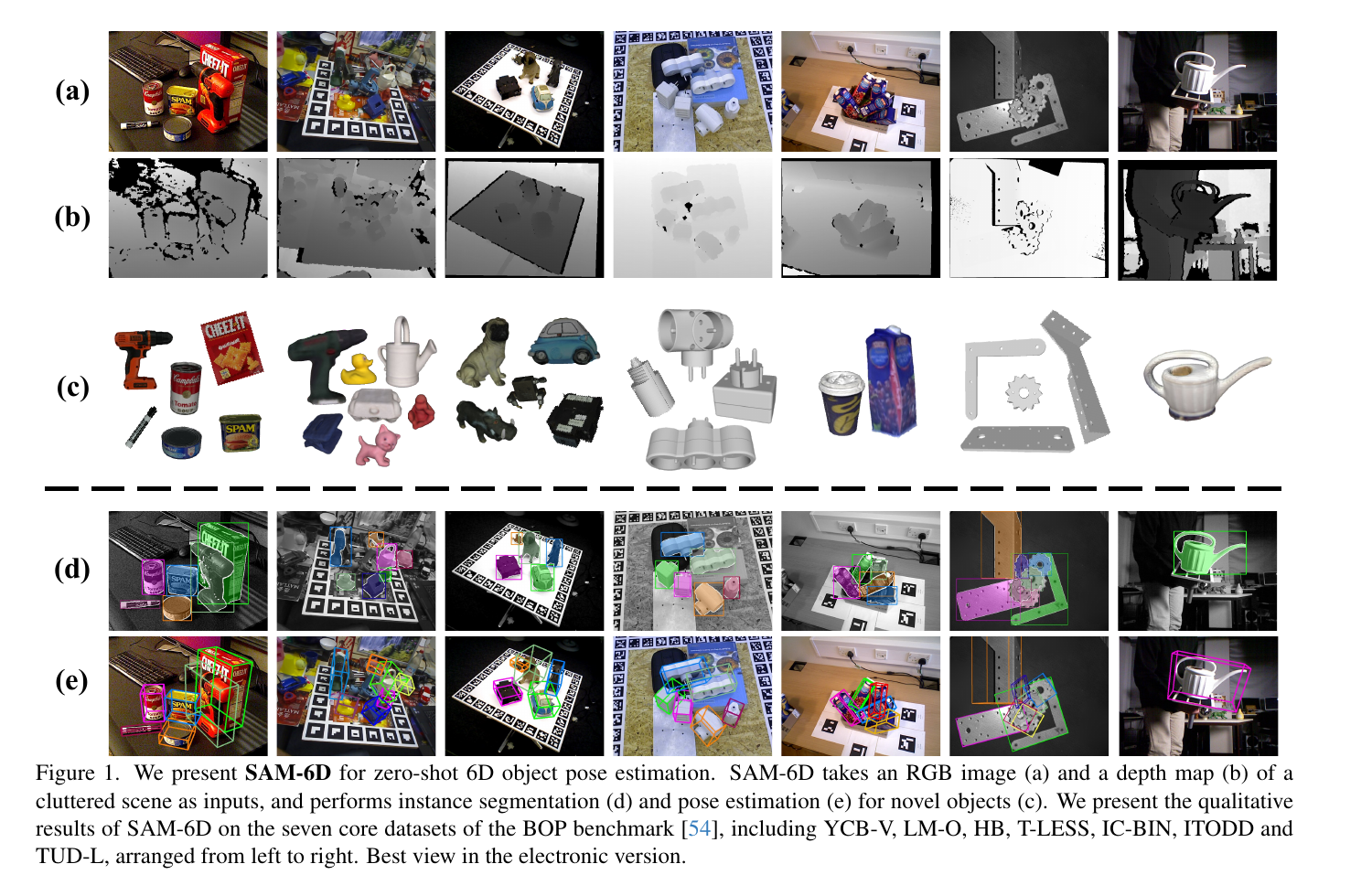
Inputs, target models, segmentation, and qualitative pose results on seven BOP core datasets
Establishes the task: CAD + RGB-D, with outputs for all target instances
Figure 2
Complete ISM and PEM pipeline
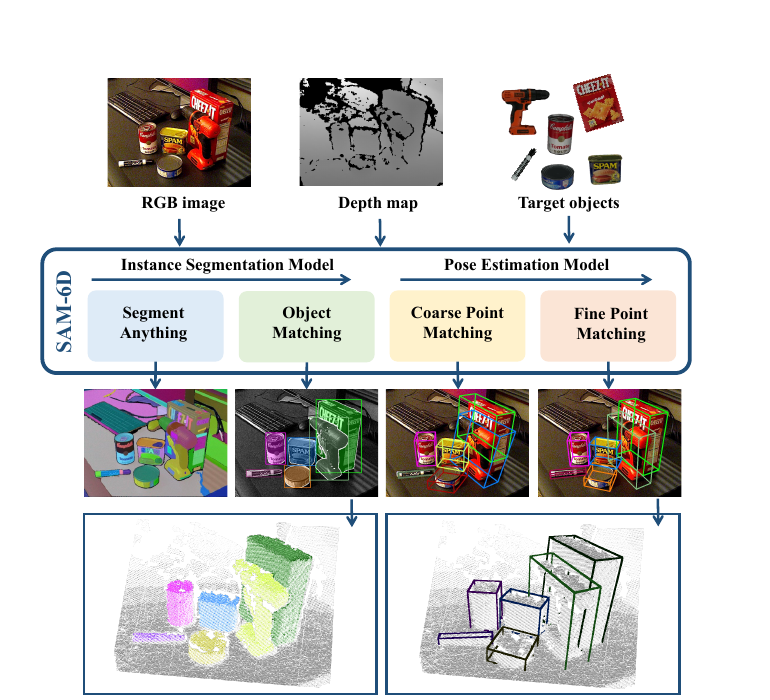
The key overview: segmentation precedes point matching
Figure 3
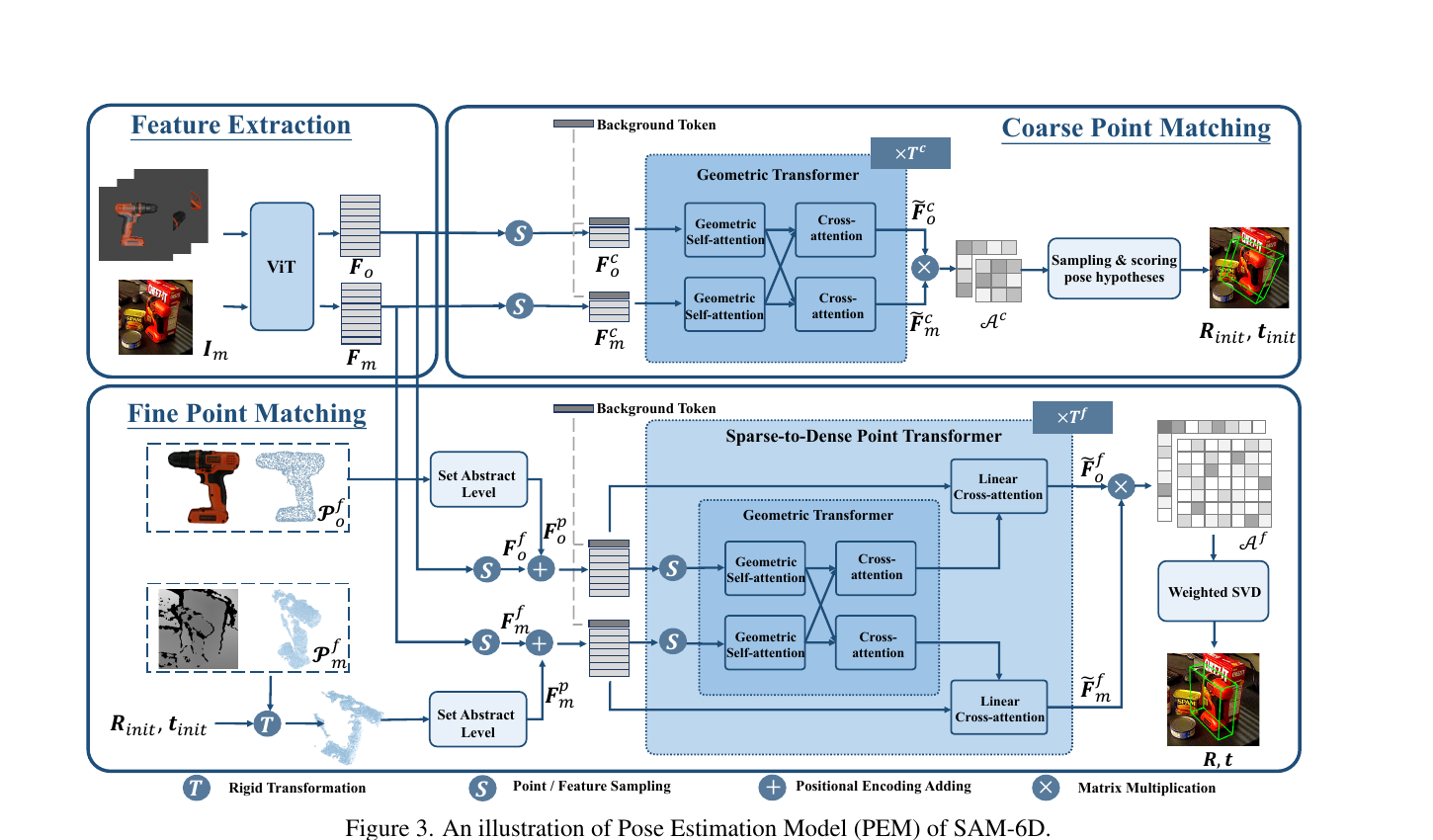
Coarse / fine point matching in PEM
Revisit background tokens, SDPT, and weighted SVD during deep reading
Table 1
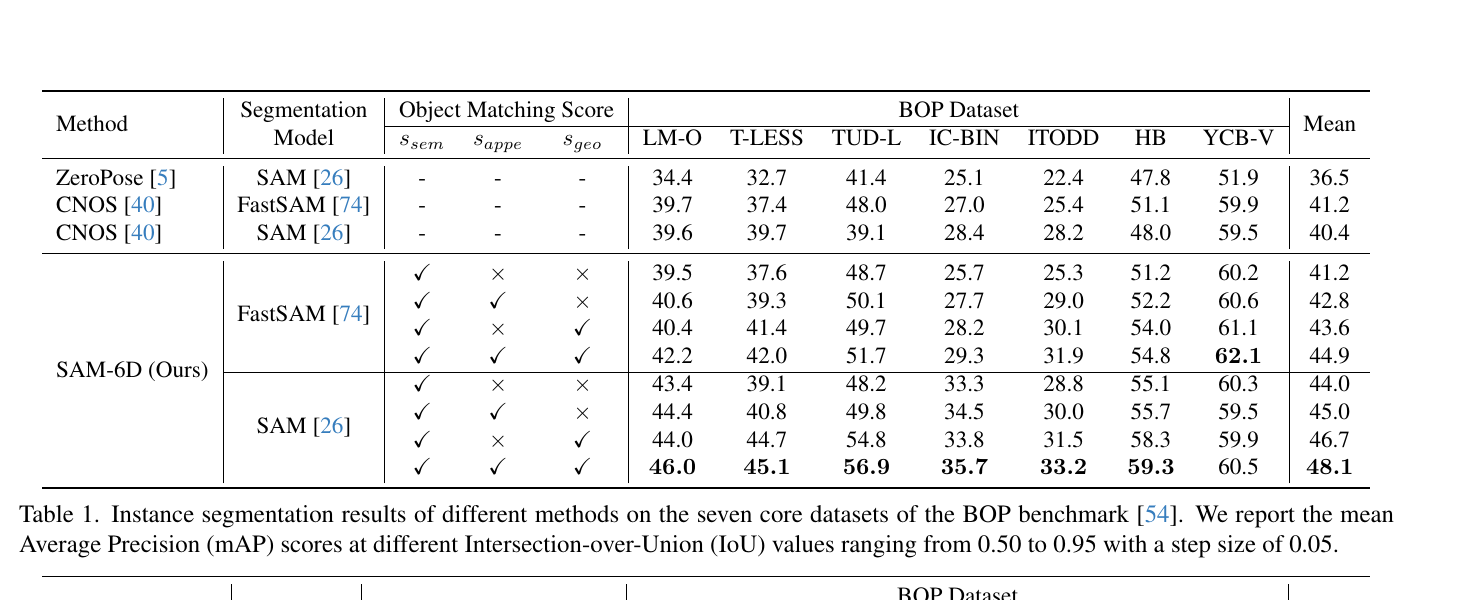
Novel-object instance segmentation
Examine the separate gains from semantic, appearance, and geometric scores
Table 2
Main pose results on seven BOP datasets
Distinguish supervised masks, external zero-shot masks, and the built-in ISM
Tables 3—6
Background tokens, two-stage matching, SDPT, and runtime
Assess whether the key designs justify their complexity and latency
Original paper Figure 1: given cluttered RGB images, depth maps, and target CAD models, SAM-6D outputs instance masks and 6D bounding boxes on seven BOP core datasets. Source: arXiv. Copyright belongs to the paper authors and publisher; reproduced here solely for paper commentary.
3. Problem setting
Task: instance-level, unseen-object, zero-shot 6D object pose estimation. Test targets are not used for target-specific training or fine-tuning. This is neither category-level nor CAD-free pose estimation.
Input: one cluttered-scene RGB image, depth map, camera intrinsics, and the specified target’s CAD model.
Object prior: approximately 42 template views rendered from CAD. The official demo also requires a .ply model, RGB, depth, and intrinsics.
Output: instance masks for all target instances in the scene, with rotation R and translation t in the camera coordinate frame.
Not required: manual object masks at test time, real-image fine-tuning for the target instance, or a dedicated detector for each object.
Suitable scenarios: new-object onboarding, warehousing, and robotic grasping where correctly scaled CAD and RGB-D acquisition are available. The aim is to find a specified object in clutter and estimate its pose.
4. Core motivation
Pose estimation for a new object cannot assume an instance-specific detector or pose network. Treating segmentation as a given input avoids a particularly difficult front-end problem in real systems.
SAM produces many class-agnostic mask proposals but does not know which corresponds to the target CAD. Global semantic comparisons alone can be confused by similar-looking objects, occlusion, and background clutter.
Scene point clouds back-projected from masks are often partial, occluded, and affected by depth noise. Forcing every point to match CAD lets incorrect regions corrupt the rigid transformation.
5. Method Overview
Original paper Figure 2: SAM-6D comprises an Instance Segmentation Model (ISM) and a Pose Estimation Model (PEM). ISM generates and filters masks; PEM then establishes coarse-to-fine 3D–3D correspondences. Source: paper PDF. Copyright belongs to the paper authors and publisher; reproduced here solely for paper commentary.
ISM: Instance Segmentation Model
SAM or FastSAM provides mask proposals for potential objects.
For each proposal, compare DINOv2 features with CAD-rendered templates and combine semantic ssem, appearance sappe, and geometric sgeo scores.
The semantic score first assesses target similarity; patch-level appearance scores add local detail; the geometric score rejects implausible candidates using consistency between the CAD bounding box projected under a coarse pose and the mask box.
PEM: Pose Estimation Model
Back-project RGB-D within accepted masks into partial scene point clouds and establish correspondences with the CAD point cloud.
Coarse point matching generates and scores pose hypotheses using 196 points; fine matching refines them using 2048 points.
Add learnable background tokens on both sides so occluded, missing, or incorrectly masked regions can match background instead of being forced onto CAD. Recover R,t by SVD using correspondence weights.
Original paper Figure 3: the upper PEM stage forms initial pose hypotheses from sparse points. The lower stage propagates geometric context to dense points through a Sparse-to-Dense Point Transformer, then uses weighted SVD for the final pose. Source: paper PDF. Copyright belongs to the paper authors and publisher; reproduced here solely for paper commentary.
Foundation models / techniques: SAM or FastSAM, DINOv2 ViT-H, ViT feature extraction, Geometric Transformer, Sparse-to-Dense Point Transformer (SDPT), 3D–3D correspondence, and weighted SVD.
Training: ISM uses public foundation models without target-object retraining. PEM is a shared network trained on the synthetic ShapeNet Objects and Google Scanned Objects data used by MegaPose. Zero-shot therefore means no retraining on test target objects, not an entirely training-free method.
6. Experimental overview
Datasets: the seven BOP core datasets, LM-O, T-LESS, TUD-L, IC-BIN, ITODD, HB, and YCB-V.
Segmentation metric: instance-segmentation mAP at IoU thresholds from 0.50 to 0.95 in steps of 0.05.
Pose metric: BOP AR, averaging VSD, MSSD, and MSPD recall; the supplement also compares with OVE6D using ADD(-S).
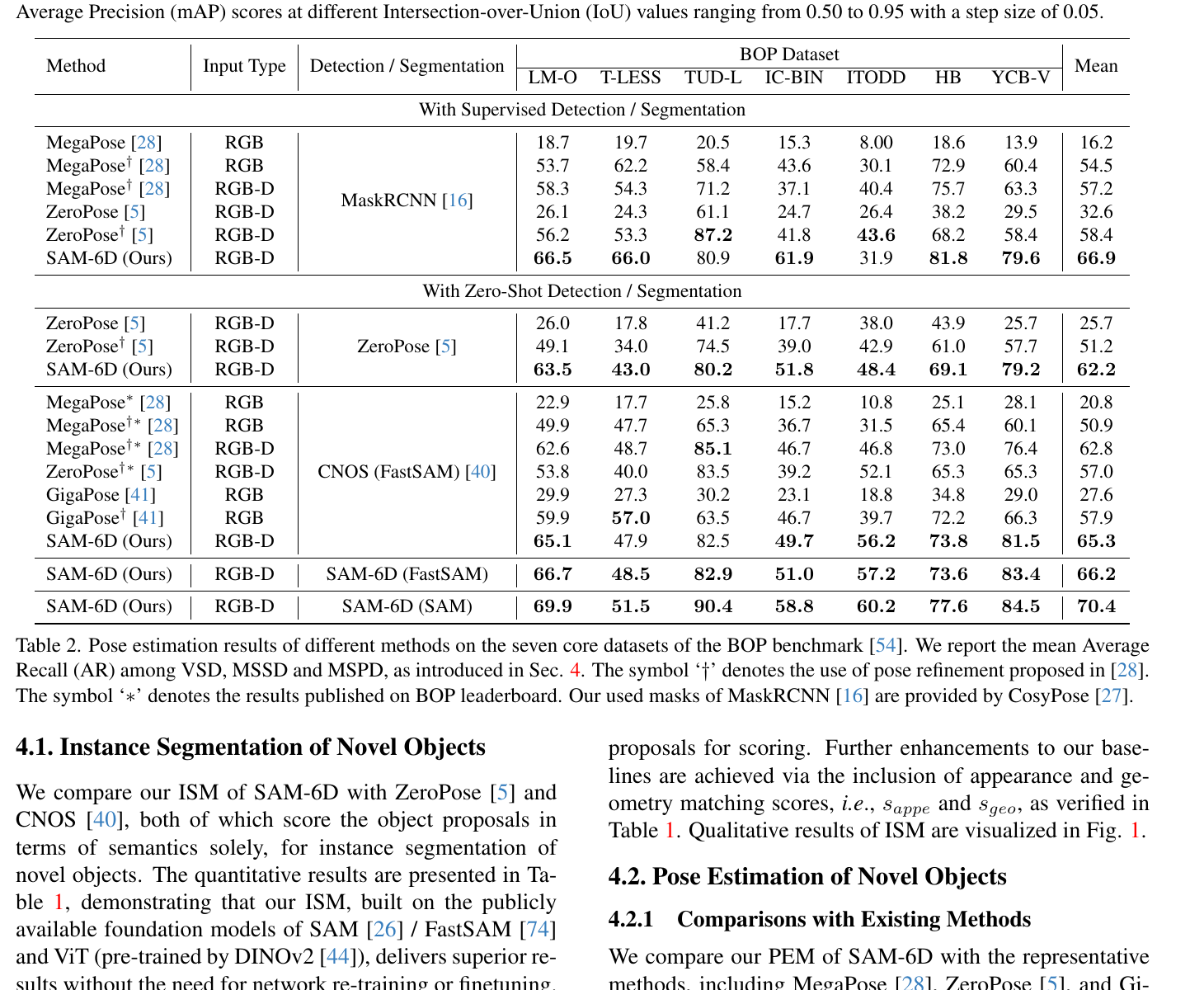
Original paper Table 1: SAM-6D instance segmentation. SAM with semantic, appearance, and geometric scores achieves mean mAP 48.1 across seven BOP datasets; the FastSAM version achieves 44.9. Source: paper PDF. Copyright belongs to the paper authors and publisher; reproduced here solely for paper commentary.Original paper Table 2: main BOP pose results. The bottom row uses SAM-6D's own SAM-based ISM masks and achieves mean AR 70.4. Some baselines marked with a cross use additional pose refinement; compare inputs and mask sources together. Source: paper PDF. Copyright belongs to the paper authors and publisher; reproduced here solely for paper commentary.
Segmentation: SAM with all three scores achieves mean mAP 48.1, above CNOS with FastSAM at 41.2 or SAM at 40.4. Semantic scoring alone gives 44.0; appearance and geometry raise this to 48.1, showing that global semantics alone are insufficient for target filtering.
pose:
With supervised MaskRCNN masks, RGB-D SAM-6D achieves mean AR 66.9, providing a relatively clean upper-bound setting for evaluating its pose back end.
With CNOS FastSAM masks, SAM-6D achieves 65.3; with its own FastSAM / SAM ISM, it achieves 66.2 / 70.4, respectively.
The final 70.4 comes from the built-in SAM ISM + RGB-D PEM. It cannot be ranked directly against RGB-only results, different detectors, or methods with rendering-based refinement without accounting for these differences.
7. Strengths and limitations
Strengths
Connects open proposals, target-specific filtering, and 6D pose in a complete pipeline, avoiding the unrealistic assumption of given ground-truth masks.
Explicitly combines RGB, depth, and CAD: semantics find candidates, template appearance identifies targets, and geometry plus 3D correspondence determines pose.
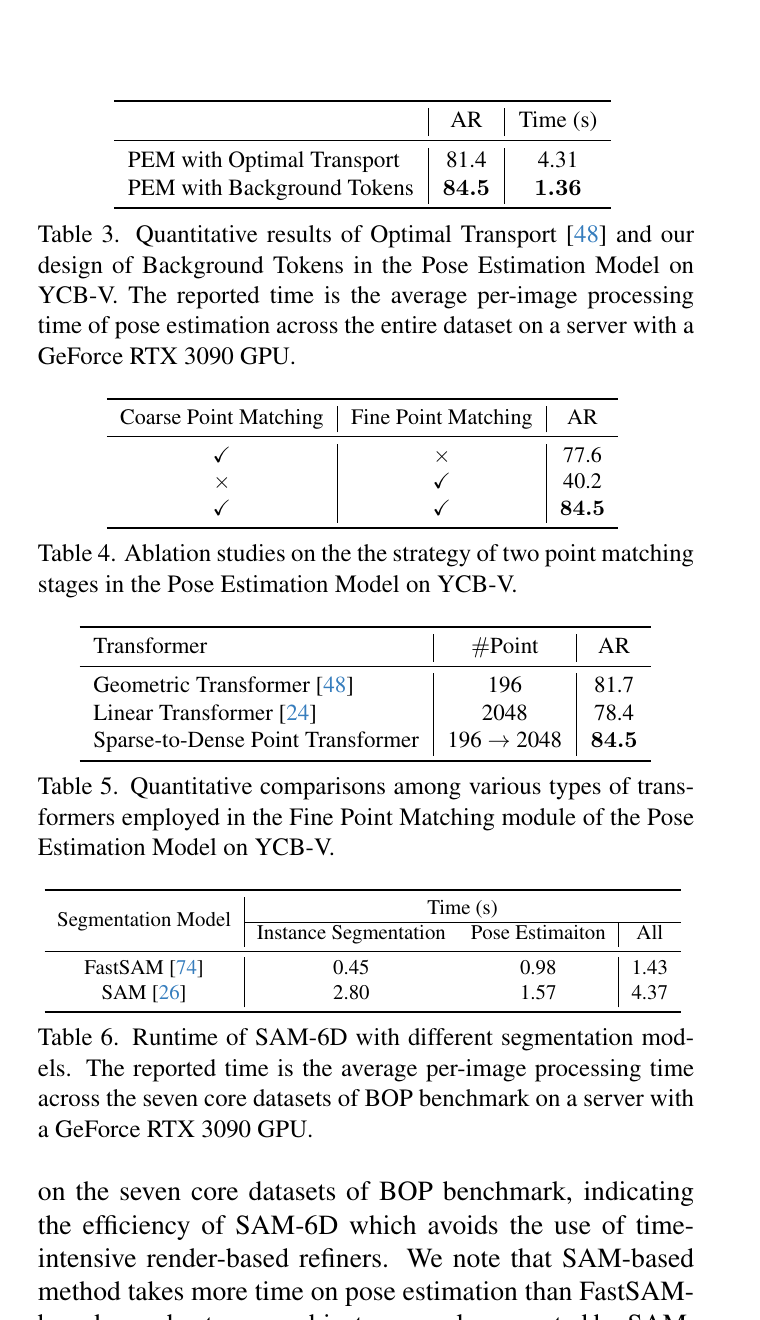
Background tokens better suit partial-to-partial matching: on YCB-V, they improve AR from 81.4 to 84.5 and reduce pose runtime from 4.31 s to 1.36 s compared with optimal transport.
Limitations / risks
Not CAD-free: accurate target CAD, dimensions, intrinsics, and RGB-D are deployment requirements, along with rendered multiview templates.
SAM proposal recall and DINO matching constrain the front end. Tiny targets, severe occlusion, or similar-looking distractors can cause missed proposals or incorrect filtering that the pose back end cannot recover from.
Missing depth, transparent objects, and specular surfaces can degrade both geometric scoring and 3D correspondence. The paper does not specifically model transparency or reflections.
Not real-time: average full-pipeline runtime on an RTX 3090 is 4.37 s / image with SAM and 1.43 s / image with FastSAM.
8. Research takeaways
Ideas to reuse: treat SAM as a class-agnostic proposal generator rather than a target segmenter; validate proposals through semantics, local appearance, and projection geometry; absorb unmatched points in partial correspondence through a background state.
Baseline suitability: a strong, system-relevant baseline for BOP / novel-object pose with CAD, RGB-D, unseen instances, and autonomous segmentation. Category-level, CAD-free, and RGB-only methods require separate comparison conditions.
Worth deep reading: yes. Focus on implementing ssem/sappe/sgeo, incorporating background tokens into bidirectional soft assignment, and balancing sparse transformer tokens against dense points in SDPT.
Available src/paper-notes/sam-6d/deep.md
In-depth paper notes
Support reproduction, comparison, related-work writing, and identifying opportunities for further research.
Deep Reading Notes: SAM-6D: Segment Anything Model Meets Zero-Shot 6D Object Pose Estimation
Authors / institutions: Jiehong Lin, Lihua Liu, Dekun Lu, Kui Jia; DexForce Co., Ltd., The Chinese University of Hong Kong, Shenzhen, South China University of Technology
SAM-6D decomposes the task of finding all instances of a target CAD model in cluttered RGB-D and estimating R,t into open-proposal filtering and partial 3D matching. SAM / FastSAM provides proposal recall, while DINOv2 semantic, appearance, and geometric scores confirm targets. Background tokens and coarse-to-fine correspondences then align partial scene clouds with CAD, and weighted SVD produces an interpretable rigid pose.
Method inputs and outputs
Item
Content (compiled for this site)
Inference input
Scene RGB, depth, intrinsics K, and target CAD / templates rendered from it. ISM uses scene data and templates to produce target masks; PEM then uses the observed point cloud inside each mask and CAD geometric features.
Final output
A mask and object-to-camera rigid transformation (R,t) for each target instance, satisfying xcam=RxCAD+t.
Training input
PEM uses synthetic training objects’ RGB-D, CAD point clouds, and ground-truth poses to construct point pairs and background / unmatched labels. ISM uses pretrained SAM / FastSAM and DINOv2 without training a segmenter for test targets.
Training objective
Learn coarse / fine correspondences and background assignments, then solve pose from the correspondences using weighted SVD. Ground-truth correspondences and poses provide supervision, not test inputs.
Output details
Masks use scene-image coordinates; R∈SO(3) and t∈R3, with length units determined by consistent CAD / depth scale. Coarse pose hypotheses and matching matrices are intermediate outputs, not category-level size estimates or reconstructed shapes.
Requirements
Full ISM + PEM does not require external masks; protocols that substitute external masks must say so explicitly. Target CAD, valid depth, calibration, and template coverage remain deployment requirements.
2.1 Guide to the paper’s figures and tables
Figure / table
Role in the paper
Suggested reading focus
Figure 1
Qualitative results on seven BOP core datasets
Examine depth quality and the relation between masks and 3D boxes
Figure 2
Overall ISM and PEM data flow
Distinguish CAD templates’ roles in front-end filtering and back-end matching
Figure 3
PEM features, coarse matching, and fine matching
Refer to the 196 points, 2048 points, background tokens, and SVD below
Table 1
ISM score ablations and comparisons with CNOS / ZeroPose
Understand why all three score types matter
Table 2
Pose results on seven BOP datasets
Group by mask source before comparing AR
Tables 3—6
PEM and runtime ablations
Assess background tokens, the two stages, and SDPT
Original paper Figure 2: inputs are RGB, depth, and target CAD templates. ISM produces valid instance masks; PEM establishes point-cloud correspondences within each mask and outputs pose. Source: arXiv. Copyright belongs to the paper authors and publisher; reproduced here solely for paper commentary.
3. Problem Definition and Task Boundaries
For a rigid CAD point xobj, the goal is to recover its camera-frame coordinates:
xcam=Rxobj+t.
Input: scene RGB I, depth D, camera intrinsics K, and a renderable CAD mesh of the specified target. The official demo takes a .ply mesh, RGB, depth, and intrinsics.
Output: a mask, R, and t for each detected target instance. The pipeline combines detection, segmentation, and pose estimation without assuming a given object crop or mask.
Test objects: target instances are unseen in PEM’s training set and receive no target-specific retraining at test time. This is an instance-level unseen-object setting.
Not category-level: no shared category NOCS is learned for cups, bottles, or other categories. Target identity is specified by that object’s own CAD templates.
Not CAD-free or RGB-only: CAD, depth, camera intrinsics, and rendered templates are core inputs. Zero-shot accurately means no object-specific training.
Assumptions: correct CAD scale and coordinate frame, consistent depth–RGB calibration, a target surface captured by SAM proposals, and enough visible area for partial alignment.
4. Research context
Traditional BOP instance-level methods typically train or render for each target object and often evaluate pose with given detections or segmentations.
Generalizable CAD-based methods such as MegaPose and GigaPose decouple network training from target instances, but the complete system still depends on obtaining target masks or bounding boxes.
CNOS / ZeroPose use CAD renders, foundation-model features, and SAM/FastSAM for novel-object detection, focusing on semantic proposal matching rather than the RGB-D pose back end developed here.
OVE6D is a closely related zero-shot RGB-D baseline. With the same masks on LM-O, the SAM-6D supplement reports ADD(-S) 74.7, above OVE6D at 56.1 and OVE6D + ICP at 72.8.
Positioning: combines open-set instance segmentation and RGB-D CAD alignment into a novel-object pipeline that runs end to end. It is not prior-free open-world 6D pose estimation.
5. Design Rationale
Proposal recall and target identification are separate problems. SAM proposes segmentable regions but does not understand a user-specified CAD target; global embeddings alone can admit similar-looking distractors.
CAD-to-scene correspondence is partial-to-partial. Scene crops are incomplete because of occlusion, mask boundaries, and sensor noise, while the CAD back surface is also invisible in the current image. Forcing complete matching creates incorrect rigid constraints.
Sparse global matching and dense local refinement have different budgets. Full Geometric Transformer attention over 2048 points is expensive, while 196 points lose detail. A bridge is needed from sparse geometric reasoning to dense correspondence propagation.
6. Method details
6.1 Overall Information Flow
Render RGB / depth templates from multiple CAD viewpoints; the paper uses 42 views.
Generate class-agnostic mask proposals from scene RGB with SAM or FastSAM.
ISM scores each proposal against templates and retains target masks.
For each accepted mask, back-project its depth using K−1 into a partial scene point cloud; sample a target point cloud from CAD.
PEM first performs coarse matching and samples and scores pose hypotheses, then outputs a fine correspondence matrix and obtains the final R,t by weighted SVD.
Module
Input
Output
Problem addressed
CAD template rendering
Target mesh, camera convention
Multiview RGB / depth templates, CAD points
Provides appearance and geometry priors for an unseen target
ISM proposal generation
Scene RGB
Class-agnostic masks
Avoids training a detector for every new object
ISM object matching
Proposals, rendered templates
Target-instance masks
Removes nontarget and invalid proposals
PEM coarse matching
Partial scene / CAD points
Rinit,tinit
Produces usable rigid hypotheses under large initialization uncertainty
PEM fine matching
Transformed points / features
Dense assignments, R,t
Improves sparse-matching accuracy and suppresses occluded regions
6.2 ISM: From Class-Agnostic Masks to Target Instances
SAM / FastSAM proposes candidate objects. For a proposal p and template set {Tj}, ISM combines three complementary sources of evidence rather than choosing solely by visual similarity.
Semantic score ssem: uses DINOv2 ViT-H class tokens to compute global proposal-to-template similarity and aggregate top-K template evidence, rejecting most unrelated categories.
Appearance score sappe: compares patch tokens to emphasize local texture, edges, and part appearance, reducing confusion between globally similar objects with different local details.
Geometric score sgeo: takes the coarse rotation associated with the best template and forms a coarse pose from the proposal’s mean depth and position. It projects the CAD 3D bounding box into the image and scores geometric consistency, including IoU with the proposal’s 2D box and visible proportion.
This coarse pose serves proposal verification rather than final pose estimation. A seemingly correct DINO match should not enter PEM if its projected scale or position is implausible.
Original paper Table 1: instance-segmentation mAP on seven BOP datasets. With SAM, $s_{sem}$ alone gives 44.0; adding $s_{appe}$ gives 45.0, and adding $s_{geo}$ gives 48.1. FastSAM shows the same trend. Source: paper PDF. Copyright belongs to the paper authors and publisher; reproduced here solely for paper commentary.
My analysis: this table supports complementary scoring rather than the sufficiency of strong DINO features alone. In particular, geometry raises SAM from 46.7 to 48.1, showing that CAD can constrain front-end false positives as well as support the pose back end. The tradeoff is greater sensitivity to consistency among depth scale, camera intrinsics, and CAD scale.
6.3 PEM: Partial 3D–3D Matching with a Background State
Back-project depth inside each valid mask into Po and sample target points Pm from CAD. Without occlusion or mask errors, the two align under the same R,t; in practice, both contain unmatched points.
Original paper Figure 3: PEM appends background tokens to both source and CAD feature streams. The coarse stage forms pose candidates through a Geometric Transformer; the fine stage uses SDPT to propagate sparse matching context to dense points. Source: paper PDF. Copyright belongs to the paper authors and publisher; reproduced here solely for paper commentary.
Feature extraction: a ViT extracts multilayer patch features from masked RGB crops and templates; each feature is paired with a depth-derived 3D position.
Background tokens: append one learnable token to each observed and CAD stream. Points without reliable object correspondences can match background instead of being forced to pair with a physical point.
Bidirectional soft assignment: apply row-wise and column-wise softmax to feature similarities and multiply the results into assignment scores. This supports source-point candidates while discouraging unconstrained many-to-one matching to a CAD point.
Weighted SVD: weight point-set centroids and covariance by correspondence probabilities, solve for the optimal orthogonal R using SVD, then recover t. The network explicitly yields geometric alignment rather than directly regressing 6DoF as a black box.
6.4 Coarse Point Matching
Sample 196 points from each side and obtain structured features through Geometric Transformer self-attention / cross-attention.
Sample three-point correspondences from assignments to form and score approximately 6000 pose hypotheses, selecting the most reliable Rinit,tinit.
Three-point rigid estimation tolerates some local errors, provided the sampled correspondences are nondegenerate and contain enough inliers.
6.5 Fine Point Matching and SDPT
The fine stage uses 2048 points, first transforming the observed cloud by the coarse pose and encoding relative geometric positions through a multiscale Set Abstract Level. Applying a Geometric Transformer directly to 2048 points is costly in computation and memory, while 196 points provide insufficient correspondence detail.
SDPT runs the heavier Geometric Transformer on sparsely sampled points, then propagates geometric context into dense features through linear cross-attention. It obtains assignments over 2048 points and applies weighted SVD again, balancing sparse reasoning with dense readout.
6.6 Training and Implementation Conditions
PEM uses MegaPose’s synthetic ShapeNet Objects and Google Scanned Objects data. Training runs for approximately 600k iterations with Adam, an initial learning rate of 10−4, cosine decay, and batch size 16 as reported in the main paper.
Ground-truth correspondences and background assignments supervise attention through cross-entropy / InfoNCE-style objectives, directing visible correspondences to physical points and unmatched regions to background.
Template count matters: the supplement reports AR 21.8, 62.7, 83.9, 84.1, and 84.5 with 1, 2, 8, 16, and 42 template views, respectively. Sufficient view coverage is required by both front and back ends.
7. Experimental Setup and Main Results
7.1 Datasets and Metrics
BOP core datasets: LM-O, T-LESS, TUD-L, IC-BIN, ITODD, HB, and YCB-V, covering occlusion, multiple objects, weak texture, and industrial parts.
Instance-segmentation mAP: averages AP over IoU thresholds from 0.50 to 0.95 in steps of 0.05, measuring mask quality rather than pose quality.
BOP AR: averages VSD, MSSD, and MSPD recall. VSD emphasizes visible surfaces; MSSD and MSPD handle 3D geometry / 2D projection and symmetry differently. Their average reduces the dominance of a single error type.
ADD(-S): the model-point distance protocol used in the supplement’s OVE6D comparison; it is not on the same scale as BOP AR.
7.2 Main Results: Group by Segmentation Protocol
Original paper Table 2: BOP AR on seven BOP core datasets, grouped into supervised detection / segmentation, external zero-shot masks, and SAM-6D's built-in ISM. Crosses indicate MegaPose pose refinement; asterisks indicate published BOP leaderboard results. Source: paper PDF. Copyright belongs to the paper authors and publisher; reproduced here solely for paper commentary.
Protocol
SAM-6D mean AR
Key interpretation
MaskRCNN supervised masks
66.9
More directly reflects PEM performance with high-quality masks; compared in the same table with MegaPose RGB-D 57.2 and ZeroPose RGB-D 58.4
ZeroPose masks
62.2
Substantial improvement over ZeroPose + refiner at 51.2 with the same external mask front end
CNOS FastSAM masks
65.3
Shares an external zero-shot segmentation source, but input conditions still differ across RGB / RGB-D / refiner baselines
SAM-6D FastSAM ISM
66.2
Built-in front end, emphasizing the faster version
SAM-6D SAM ISM
70.4
Best complete-pipeline score in the paper; per-dataset values are 69.9 / 51.5 / 90.4 / 58.8 / 60.2 / 77.6 / 84.5
Interpreting 70.4: this is the combined result of SAM-based ISM, RGB-D, CAD templates, and PEM, rather than a transferable score for the pose backbone alone. FastSAM is 4.2 AR below the version using SAM-6D’s SAM masks, showing that front-end mask quality still materially constrains the system. Separating supervised and zero-shot mask results is a useful practice in evaluation transparency: pose scores with different front ends should not be collapsed into one leaderboard.
7.3 Design Ablations and Runtime
Original paper Tables 3--6: PEM ablations on YCB-V and mean runtime across seven BOP datasets. Background tokens, coarse-to-fine matching, and SDPT each have supporting evidence. Runtime is measured on an RTX 3090. Source: paper PDF. Copyright belongs to the paper authors and publisher; reproduced here solely for paper commentary.
Ablation
Result
Interpretation
Optimal transport -> background tokens
AR 81.4 -> 84.5; pose time 4.31 s -> 1.36 s
Background states avoid forced incorrect matches and the high cost of OT
Coarse only / fine only / both
77.6 / 40.2 / 84.5 AR
Fine matching depends on coarse initialization; coarse matching lacks dense precision
196-point Geometric Transformer
81.7 AR
Global geometric context supports initial matching but misses detail
2048-point Linear Transformer
78.4 AR
Fast dense linear attention loses complex geometric relationships
SDPT 196 -> 2048
84.5 AR
Sparse geometric reasoning with dense propagation is an effective compromise
FastSAM / SAM full pipeline
1.43 s / 4.37 s
Neither is a high-frame-rate real-time configuration; SAM proposals are especially costly
My analysis: these ablations cover PEM’s three main designs rather than merely showing the final architecture. The simultaneous speed and accuracy gains from background tokens are especially convincing. However, most ablations use YCB-V; the paper does not separately establish whether proportional gains transfer to weak-texture, repetitive-geometry objects such as T-LESS, or to depth sensors with stronger distortion.
8. Robustness, Limitations, and Fair Comparison
8.1 Response to Challenging Conditions
Occlusion / partial observation: background tokens, bidirectional assignment, and coarse hypothesis sampling directly address partial matching, making this PEM’s most targeted capability.
Mask noise: ISM and PEM operate in sequence, and Table 2 compares multiple mask sources. The built-in SAM ISM outperforms external FastSAM masks, showing a strong front-end effect. Severe missed detections have no back-end recovery mechanism.
Depth noise and missing depth: using observed clouds for 3D matching benefits from point-level geometry, but also exposes the method to depth holes, quantization errors, and RGB–depth misalignment. There is no explicit uncertainty model.
Symmetry / weak texture: BOP MSSD / MSPD addresses some symmetry issues in evaluation, and CAD supplies strong structural priors. The method has no dedicated symmetry-aware correspondence or ambiguity distribution.
Transparency / reflections: no dedicated sensor or appearance model is provided. Such objects can degrade SAM masks, DINO appearance, and depth together, making them a challenging deployment domain.
8.2 Boundaries of Fair Comparison
SAM-6D uses RGB-D, CAD, and intrinsics; a single mean AR is insufficient for comparing it with RGB-only or CAD-free methods.
Some MegaPose, ZeroPose, and GigaPose rows in Table 2 carry a cross for additional pose refinement; some results come from the BOP leaderboard. Compare four dimensions: input modality, mask source, refiner use, and whether segmentation is zero-shot.
Unseen has a different meaning from category-level methods: here, the specified novel instance has a CAD prior; category-level tasks usually provide no CAD for the unseen instance within a known category.
Conclusion: Tables 1 and 2 and system ablations support strong performance as a zero-shot RGB-D CAD pose pipeline. A broader claim of universally best prior-free 6D pose would exceed the evidence.
9. Critical analysis
Strengths
Clear task boundaries and a complete system: SAM becomes part of an evaluable pipeline with CAD-aware matching and a pose back end, beyond serving as a demo segmenter.
Combining semantics, appearance, and projection geometry lets CAD templates support both target identification and accurate pose estimation, a natural engineering design.
PEM outputs point correspondences with a background state for weighted SVD rather than directly regressing pose. The geometric chain is explicit and supports diagnosis and module replacement.
All three main designs have quantitative ablations, and the SAM–FastSAM runtime difference is reported openly.
Weaknesses
Strong dependence on target CAD and RGB-D limits applicability to newly encountered objects, setups without depth cameras, and inaccurate CAD.
The importance of 42 templates in the supplementary ablation indicates that mesh cleanup, scale verification, template rendering, and caching for each new target carry meaningful costs.
Foundation-model proposal errors cascade. High front-end precision does not replace recall: without a target proposal, strong back-end correspondence cannot recover the object.
Mean runtime of 1.43—4.37 s / image is more suitable for offline processing, low-frequency grasping, or candidate ranking than high-frequency visual feedback control.
Implicit Assumptions
CAD appearance is sufficiently consistent with the real object, or DINO features bridge differences in color, material, and lighting.
Current RGB-D observations contain enough visible, nondegenerate target surface for reliable 3D correspondences.
Depth scale, intrinsics, CAD units, and camera conventions agree; an error anywhere can bias both sgeo and the SVD pose.
10. Future Directions and Research Ideas
Explicitly predict proposal confidence and failure types in ISM, and pass multiple target-ID / pose hypotheses into PEM to reduce early commitment from top-1 template selection.
Equip CAD templates with visibility, material uncertainty, or depth reliability rather than treating observed points equally. Extend background tokens into separate missing, occluded, and invalid-depth states.
Reduce dependence on consumer RGB-D and precise CAD using RGB-only geometric foundation features, monocular-depth uncertainty, or sparse reference images.
Connect the SAM-6D front end to tracking and active view selection: after low-frequency global relocalization, maintain pose with temporal constraints to avoid expensive proposal generation every frame.
Add stress tests for transparent and specular objects, incorrect CAD scale, RGB–depth misalignment, very few template views, and long-tail small objects.
11. Implications for my research
Directly reusable ideas: high-recall proposals from a foundation segmenter followed by model-aware verification with multiple evidence sources; explicit unmatched / background states for partial registration; and allocating computation between a sparse geometric transformer and dense propagation.
Baseline to include: for RGB-D 6D pose with CAD, unseen instances, and autonomous segmentation, use SAM-6D as a complete-pipeline baseline. Separately report front ends using ground-truth / supervised masks, external masks, and the method’s own masks.
Reproduction practice: the official repository provides SAM-6D / FastSAM paths and Docker. First align BOP model units, depth scale, intrinsics, and CAD rendering conventions; profile template generation, ISM, and PEM separately.
Potential entry points: reduce template count and SAM latency while retaining CAD-aware reliability, or combine uncertainty-aware correspondence with tracking / multiview fusion to handle severe single-frame occlusion and low-quality depth.