Scalable Network and Adaptive Refinement Module for 6D Pose Estimation of Diverse Industrial Components
EfficientNet and a shallow bidirectional FPN estimate initial poses from RGB; observed depth supports adaptive point-cloud registration refinement. Network scale and refinement budgets share a scaling parameter, with convergence-based stopping.
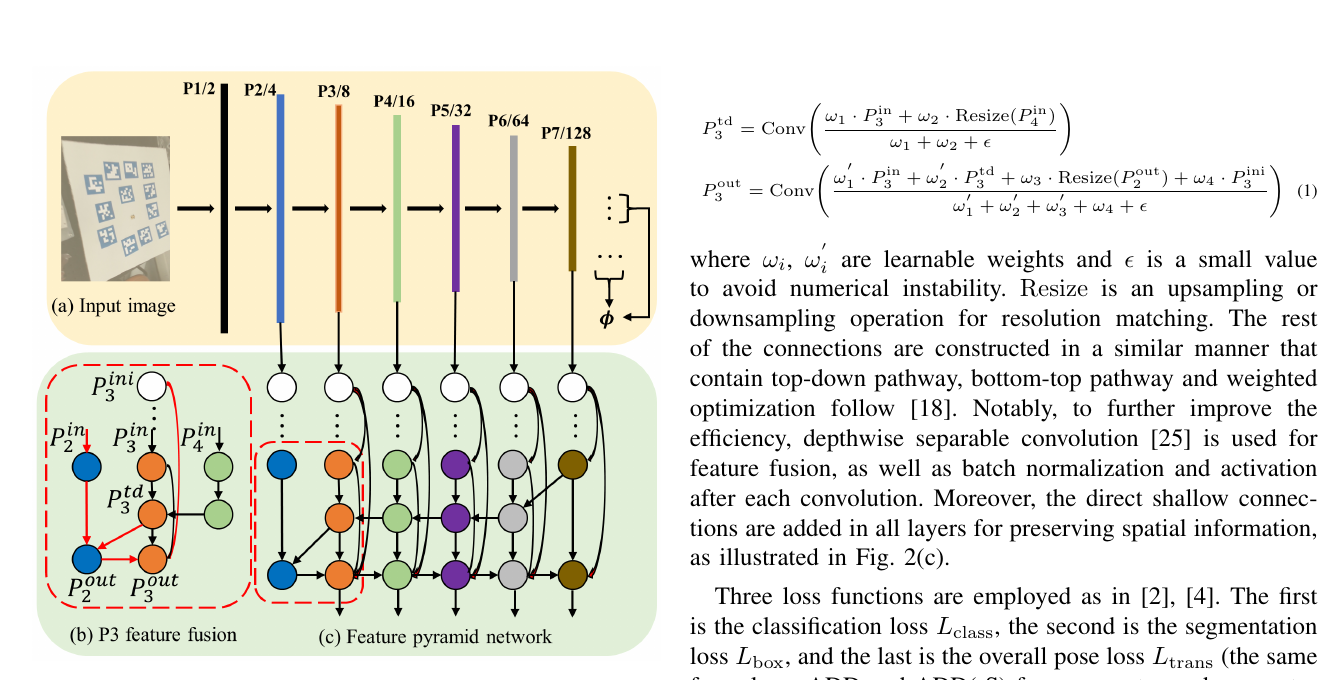
EfficientNet compound parameter ϕ scales pose width, depth, and resolution; shallow bidirectional FPN preserves small parts. Observed depth supports adaptive point-cloud registration after RGB initialization.
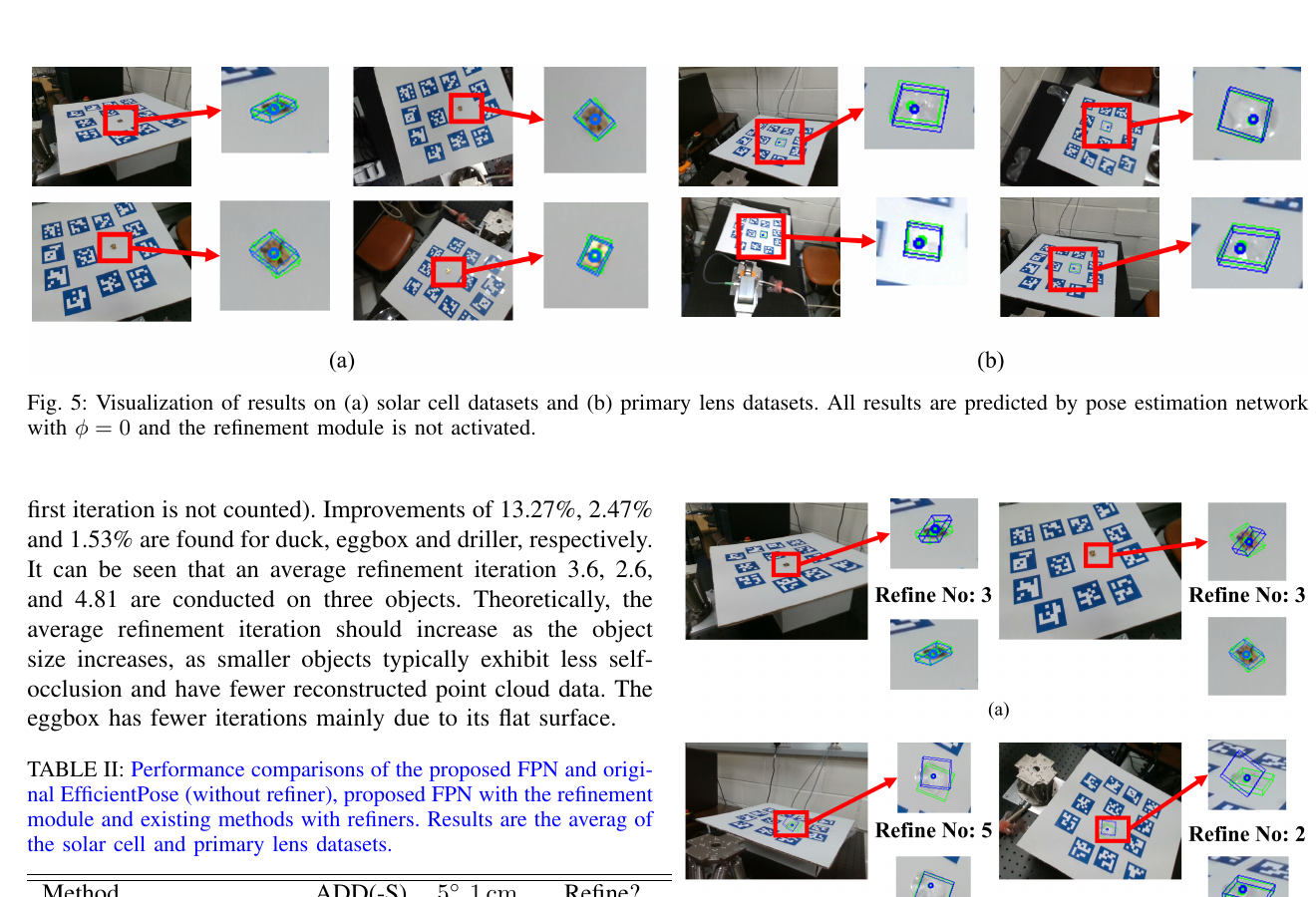
Original Figure 2: \(\phi\) jointly scales the backbone; the enhanced FPN combines top-down, bottom-up, and shallow shortcuts. Source: IROS paper. Image copyright belongs to the authors and IEEE; reproduced here for paper analysis.Original Figures 5–6 and Table II header: unrefined network examples above and individual refinement counts below; the complete quantitative table is not shown. Source: IROS paper. Figure and table copyright belongs to the authors and IEEE; reproduced here for paper analysis.
Method and results
Single-stage RGB network predicts classes, 2D boxes, axis-angle rotations, and 3D translations.
Enhanced shallow FPN connections help objects smaller than 32×32 pixels.
Loss combines classification, boxes, and ADD / ADD-S poses.
Refinement uses initial RGB poses, CAD, detections, and observed depth for cropped point clouds, FPFH-constrained sampling, and SVD registration; stop at convergence or 5 iterations.
On the authors’ solar cell / primary lens data, enhanced FPN + refinement reaches ADD(-S) 83.97 and 5°1cm 82.86.
Without refinement, enhanced FPN gives 69.93 / 63.12 versus original EfficientPose 65.63 / 59.17.
Quick assessment
Strengths: ϕ controls accuracy–speed tradeoffs; small-object features and adaptive iterations address industrial deployment.
Limitations: known CAD, object-specific training, and depth for refinement; limited custom data scale / domains.
Relevant to: RGB initialization, depth-assisted point-cloud refinement, small parts, and adjustable deployment budgets.
Available src/paper-notes/scalable-industrial-pose-iros2024/deep.md
In-depth paper notes
Support reproduction, comparison, related-work writing, and identifying opportunities for further research.
Deep Reading Notes: Scalable Network and Adaptive Refinement
1. Key assessment
Scalable EfficientNet and enhanced FPN preserve small-part features. RGB predicts initial poses, then depth-assisted point-cloud registration refines them until convergence. Evaluate RGB initialization and depth-dependent refinement separately.
2. Network
Original Figure 2: shallow P2 / P3 enter fusion more directly, with layers jointly scaled by \(\phi\). Source: IROS paper. Image copyright belongs to the authors and IEEE; reproduced here for paper analysis.
EfficientNet’s compound coefficient ϕ jointly controls depth, width, and input resolution. Four heads predict class, 2D boxes, rotations, and translations.
Enhanced FPN changes relative to EfficientPose:
Retains the top-down path;
Adds bottom-up fusion;
Adds shallow shortcuts to preserve small-object spatial information;
Uses depthwise separable convolutions to control compute;
Learns normalized fusion weights.
Axis-angle rotation is explained via SO(3) geodesic distance; the training pose loss is ADD(-S). Translation follows PoseCNN centers / distances and intrinsics.
3. Adaptive refinement
After RGB initialization, detections and observed depth crop point clouds for FPFH-constrained three-point sampling and SVD rigid registration. Stop at convergence or 5 iterations:
Good initial poses require few iterations;
Large objects, self-occlusion, or poor initializations may require more;
Mean latency depends on sample difficulty rather than a fixed worst-case budget.
Figure 6 solar cell / primary lens examples take 2–5 iterations, not dataset means. Reported means 3.6, 2.6, 4.81 belong to LINEMOD duck, eggbox, driller. Fewer iterations can indicate weak optimization signals rather than better initialization.
4. Data and results
Experiments use LINEMOD and custom solar cell / primary lens industrial data, with frame captures, masks / pose annotations, and CAD models.
Original Figures 5–6 and Table II header: the crop shows pose examples and individual iteration counts, not the complete quantitative table. Source: IROS paper. Figure and table copyright belongs to the authors and IEEE; reproduced here for paper analysis.
Method
ADD(-S)
5°1cm
EfficientPose
65.63
59.17
Proposed FPN
69.93
63.12
CosyPose
75.41
77.08
CoupledRefine
82.15
84.19
Proposed FPN + Refine
83.97
82.86
Shallow connections add about 4.3 ADD points and 4.0 5°1cm points over the original network. Refinement adds about 14.0 ADD(-S) points.
The text reports duck, eggbox, driller gains of 13.27, 2.47, 1.53 points, but Table I duck 83.92→87.19 gives 3.27. This text/table discrepancy is retained explicitly.
5. Accuracy–speed tradeoffs
Increasing ϕ raises capacity and resolution, improving accuracy while reducing FPS. Refinement adds sample-dependent latency. The framework offers deployment choices rather than one configuration that is simultaneously most accurate and fastest.
This site’s reading should specify ϕ, refinement, and mean / worst iteration counts; mixing configurations into one real-time figure is misleading.
6. Critical analysis
Strengths: industrial small-object focus, explicit speed controls through scaling / refinement, and data from physical components.
Limitations: known instances / CAD, observed depth for refinement, few categories, no cross-factory appearance / metal tests, and less comprehensive metrics than BOP.
Fair comparison: CosyPose / CoupledRefine differ in backbones, training data, and speed; one accuracy table cannot establish better overall deployment.
Failures: refinement cannot recover extremely small objects missed by detection; wrong symmetry basins can trap geometric optimization.
7. Reproduction checklist
Fix input resolution, width, depth, and FPS hardware for each ϕ;
Report detection, initial pose, and refined results separately;
Record per-sample iterations, convergence residuals, and worst latency;
Group small objects by pixel area for recall / pose evaluation;
Specify object symmetries when using ADD-S;
Add real metallic reflections, motion blur, and cross-camera tests.
8. Overall assessment
This industrial deployment study emphasizes scaling, shallow features, and point-cloud refinement as needed. Conclusions depend on known CAD, object-specific training, observed depth for refinement, and ϕ.