Reading Notes
Overview / Deep Dive
Available src/paper-notes/scaling-3d-compositional-iccv2025/coarse.md
Paper overview notes
Quickly assess the paper's scope, problem setting, core method, experimental findings, and whether to read it in depth.
Overview Notes: Scaling 3D Compositional Models for Robust Classification and Pose Estimation
1. Basic information
- Year / venue: 2025 / ICCV; reading mode: coarse.
- Task: joint classification and 3D pose over many categories, with OOD robustness.
- Source: ICCV Open Access.
2. Positioning in one sentence
3D-CompNet decomposes all-category neural mesh vertex contrast into within-category and cross-category training, focusing on confusing classes to scale structural 3D classification / pose models to 188 categories.
2.1 Guide to the paper’s figures and tables
| Figure / table | What to inspect |
|---|---|
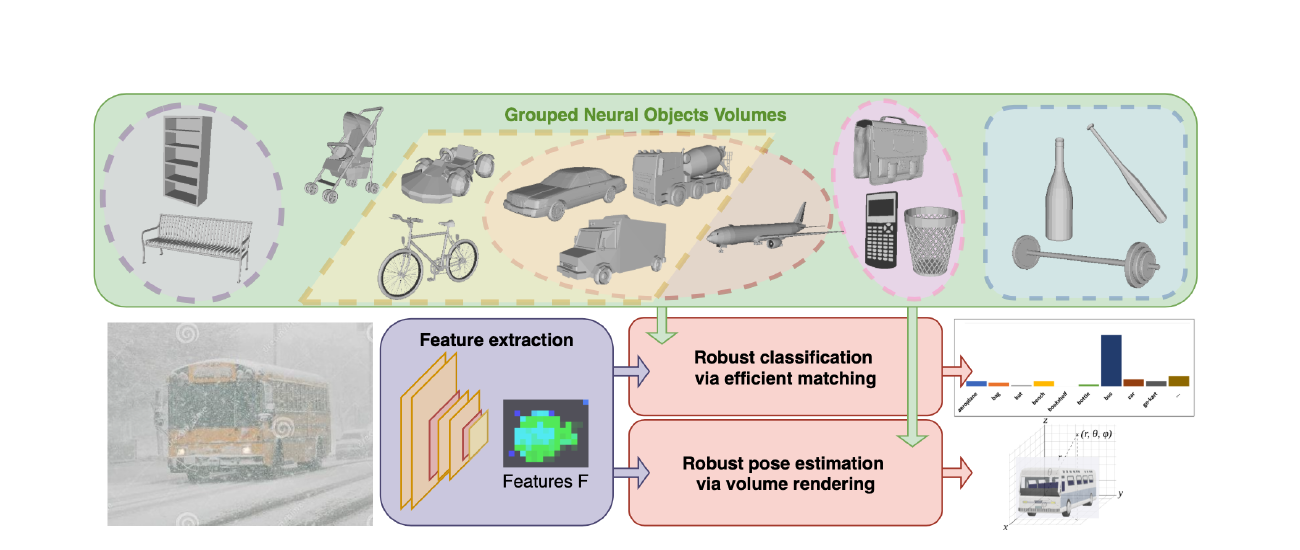
| Figure 3 | Grouped neural object volumes, feature extraction, classification matching, and pose rendering. |
3. Method overview
- Category prototypes are neural meshes / volumes with vertex features matched against image backbone features.
- All-vertex contrast grows quadratically with category count; within / cross-category decomposition and dynamic confusing-class weights reduce costs.
- Given a category label, rendering-based matching estimates pose. This studies structured category-level / OOD inference, not prior-free novel-object 6D pose.
4. Experimental overview
- Datasets: ImageNet3D+, OOD-CV; up to 188 categories.
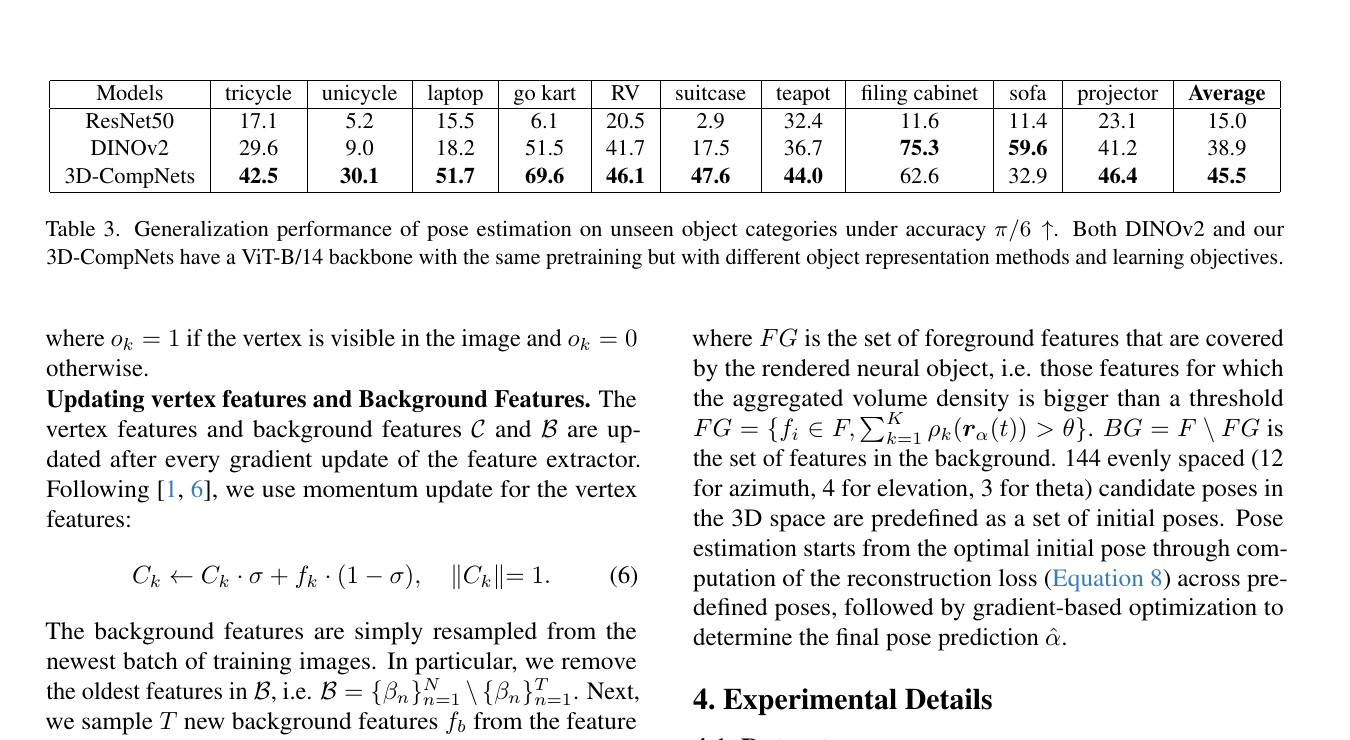
- Authors’ claim: more efficient training and robustness under occlusion, weather, synthetic stimuli, and unseen categories than prior compositional / standard DNN models.
- My analysis: scaling physically / structurally biased models is the main contribution, not redefining 6D pose benchmarks; 3D annotations / prototypes remain costly.
5. Strengths, weaknesses, and takeaways
- Strength: tackles training complexity while sharing robust classification and pose representations.
- Risk: pose depends on classification / prototypes; cluttered multi-object scenes and intrinsic errors receive limited discussion.
- Takeaway: hard negatives can operate over category-geometric prototypes rather than only image embeddings.