SCFlow2: Plug-and-Play Object Pose Refiner with Shape-Constraint Scene Flow
SCFlow2 uses RGB-D 3D scene flow as a shape constraint for recurrent matching. Its pose refiner can improve different initial estimators as a postprocessing module without retraining for new objects.
Authors / affiliations: Qingyuan Wang et al.; Xidian University, Taiyuan University of Technology, Magic Leap.
Task: RGB-D refinement of initial 6D poses with target meshes, generalizing to new objects without fine-tuning.
Reading mode: Overview.
2. Positioning in one sentence
SCFlow2 extends SCFlow render-and-match with rigid motion in 3D scene flow and shape constraints for plug-and-play RGB-D refinement.
3. Problem and motivation
2D correspondences suffer occlusion / texture noise; separate ICP splits RGB and depth into stages.
Object-specific retraining limits many strong refiners’ plug-and-play use.
4. Method overview
Render current-pose mesh RGB-D and pair it with real RGB-D.
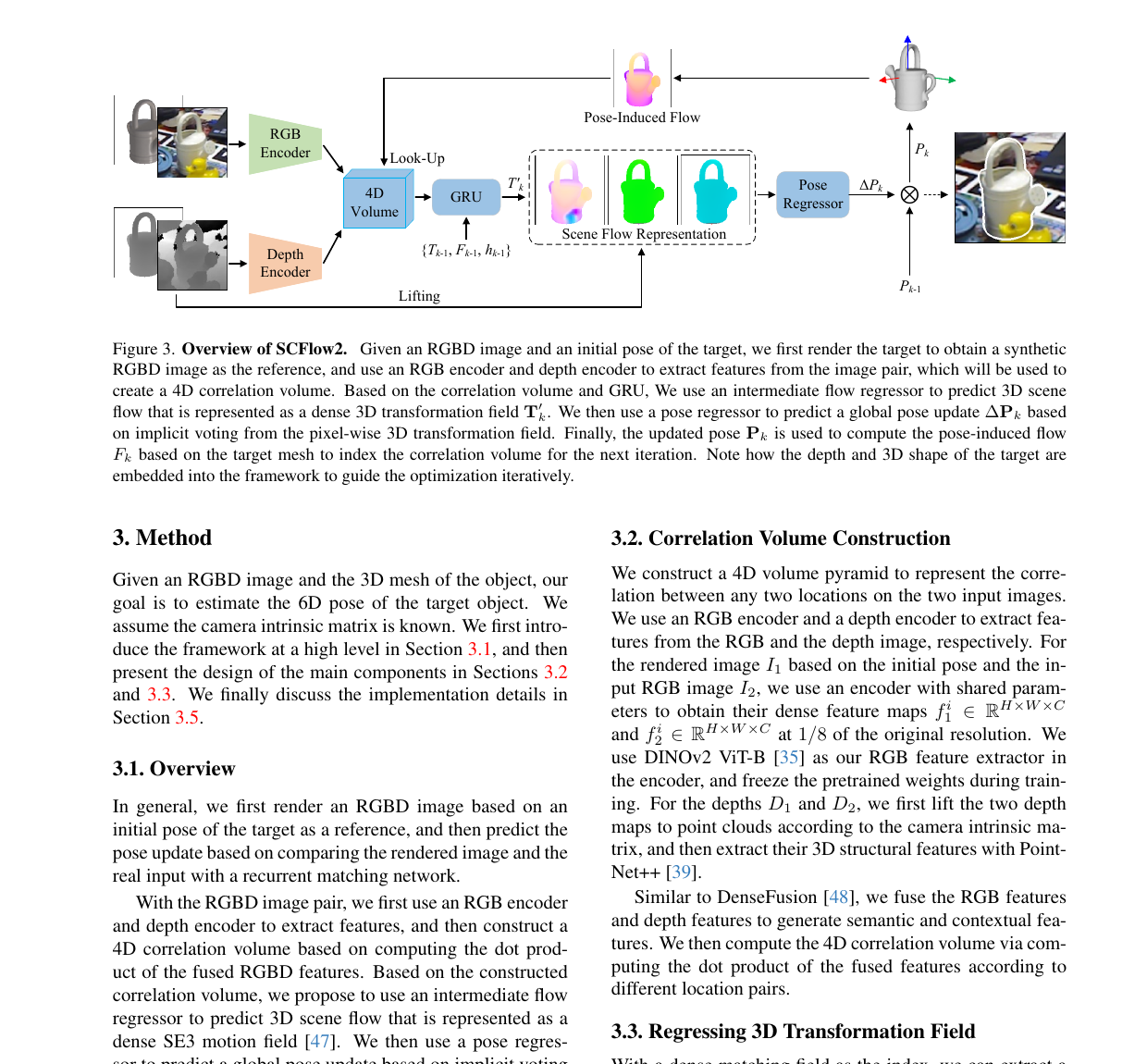
Recurrent matching predicts pose-induced flow, constrained by rigid-motion embeddings and 3D shape.
Iteratively refine poses after frontends such as GigaPose / FoundationPose.
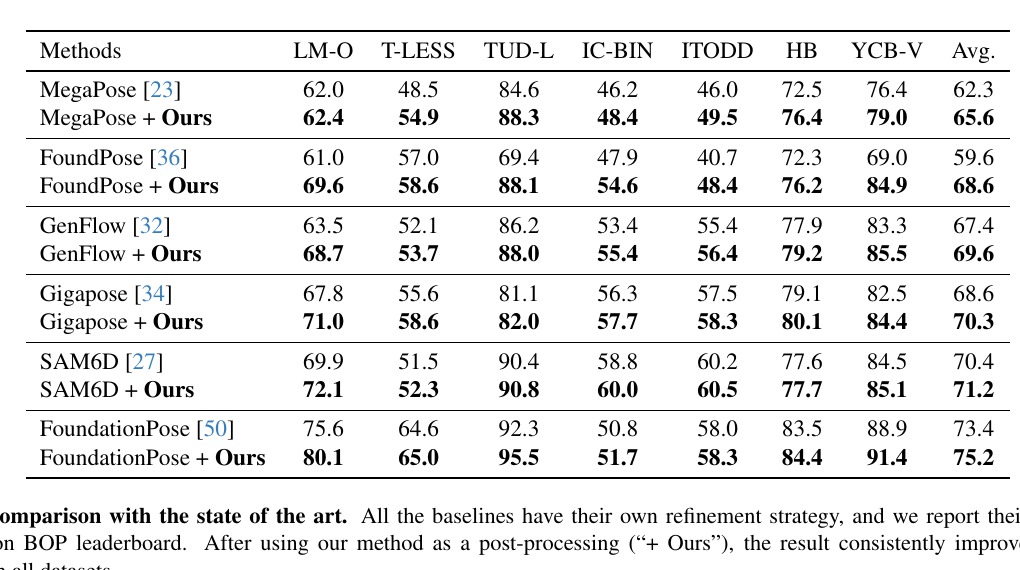
Original Table 1: postprocessing six frontends improves results across LM-O, T-LESS, TUD-L, IC-BIN, ITODD, HB, and YCB-V. Source: CVPR 2025 paper PDF. Image copyright belongs to the authors and publisher; reproduced here for paper analysis.
5. Experiments at a glance
Seven-dataset mean AR rises for MegaPose 62.3→65.6, FoundPose 59.6→68.6, GenFlow 67.4→69.6, GigaPose 68.6→70.3, SAM6D 70.4→71.2, and FoundationPose 73.4→75.2.
FoundationPose + SCFlow2 scores 80.1 / 65.0 / 95.5 / 51.7 / 58.3 / 84.4 / 91.4 across seven datasets. Gains across frontends support plug-and-play use, while +0.8 to +9.0 variation shows sensitivity to initialization error structure.
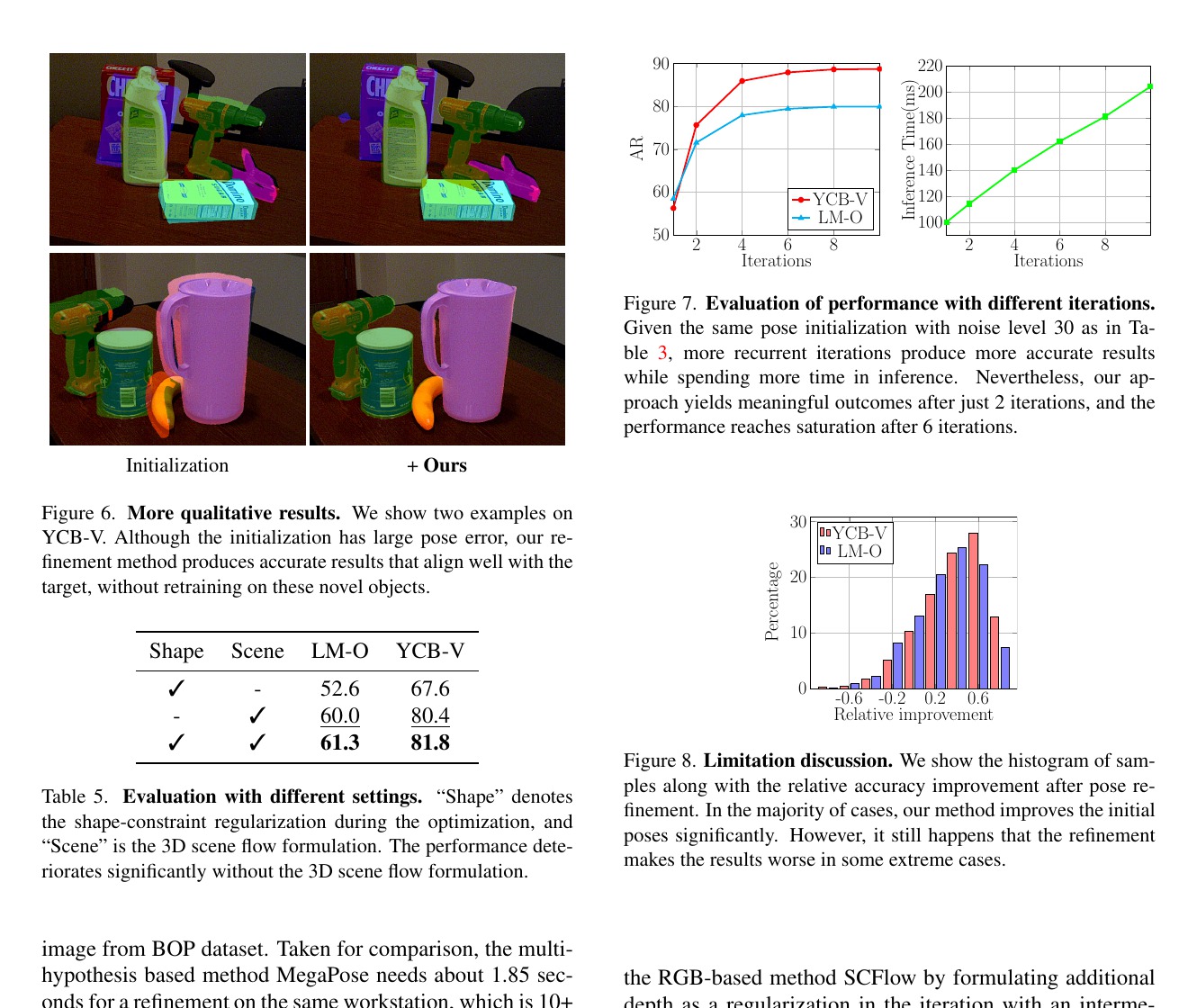
Most iteration gains arrive after two updates, approaching saturation around six; typical BOP refinement takes about 0.18 seconds on RTX 3090.
6. Quick assessment
Value: depth enters continuous 3D motion constraints instead of separate ICP postprocessing.
Boundary: mesh, depth, and reasonable initialization remain necessary. Some samples worsen after refinement; systems need confidence checks or rollback.
Available src/paper-notes/scflow2/deep.md
In-depth paper notes
Support reproduction, comparison, related-work writing, and identifying opportunities for further research.
Deep Reading Notes: SCFlow2: Plug-and-Play Object Pose Refiner with Shape-Constraint Scene Flow
Answer: lift pose-induced flow into scene flow constrained by rigid-motion embeddings and 3D shape, trained for RGB-D transfer without fine-tuning.
2. Positioning in one sentence
A geometric backend for existing initializers: detection / coarse poses remain upstream, while 3D scene flow stabilizes local convergence near object surfaces.
2.1 Guide to the paper’s figures and tables
Figure / table
What to look for
Figures 2–3
SCFlow versus SCFlow2: depth, shape, recurrent refinement.
Figure 4
Relationship between 2D pose-induced and 3D scene flow.
Tables 1–4
SOTA, plug-and-play gains, initialization sensitivity, and SCFlow comparison.
Figures 7–8
Iterations / limitations reveal the convergence basin.
Original method excerpt: shape-constrained 3D scene flow aligns real and current-pose-rendered RGB-D for iterative refinement. Source: CVF Open Access. Image copyright belongs to the authors and publisher; reproduced here for paper analysis.
3. Problem setting and boundaries
Inputs: real RGB-D, target mesh, intrinsics, and initial pose; output: refined pose.
Plug-and-play means compatibility with different initializers, not freedom from CAD, depth, or initialization.
Objaverse, GSO, and ShapeNet train cross-object generalization; data and initializers affect gains.
4. Method details
Render pair: mesh RGB / depth at current pose plus real observations.
Shape-constrained scene flow: object shape and rigid motion restrict feasible 3D flow, reducing arbitrary 2D drift.
Recurrent update: solve from flow, rerender, repeat; depth constrains every update rather than final ICP alone.
5. Experimental analysis
Frontend
Original mean AR
+ SCFlow2
Absolute gain
MegaPose
62.3
65.6
+3.3
FoundPose
59.6
68.6
+9.0
GenFlow
67.4
69.6
+2.2
GigaPose
68.6
70.3
+1.7
SAM6D
70.4
71.2
+0.8
FoundationPose
73.4
75.2
+1.8
Table 1 tests 108 objects with identical frontends plus / minus SCFlow2, stronger evidence than a cross-method leaderboard alone. FoundPose gains most and already-refined SAM6D least, consistent with a local residual backend that preserves frontend quality differences.
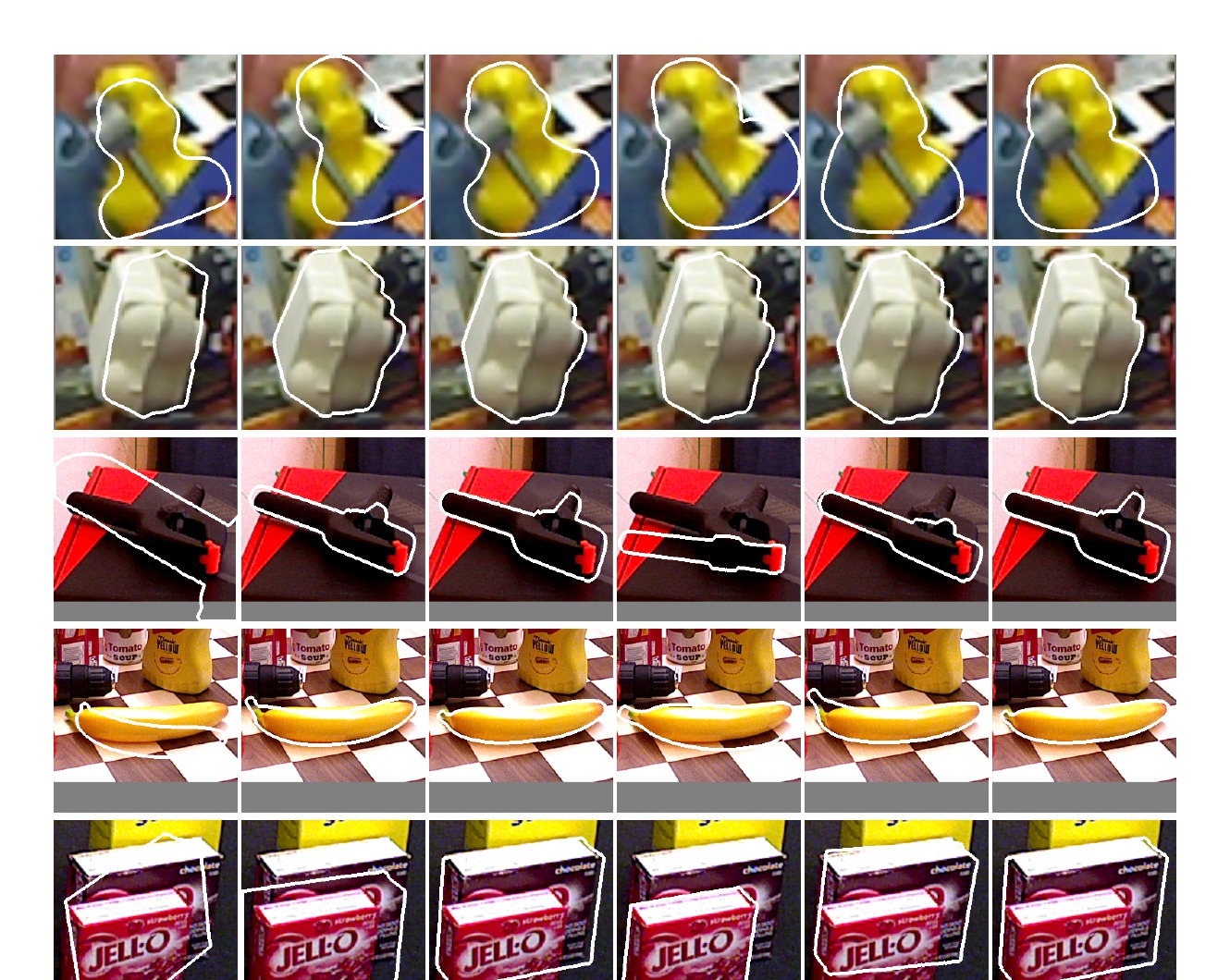
Original qualitative results: initialization, frontend refinement, then SCFlow2 bring contours closer to observations amid occlusion, weak texture, and distractors. Source: CVPR 2025 paper PDF. Image copyright belongs to the authors and publisher; reproduced here for paper analysis.
Shape-only LM-O / YCB-V scores are 52.6 / 67.6; scene-flow-only 60.0 / 80.4; combined 61.3 / 81.8. Scene flow provides most gains, with complementary shape constraints.
Improvements appear by update 2 and approach saturation around 6; runtime grows approximately linearly. The paper uses 8 updates as an accuracy / about 0.18-second tradeoff.
Original Figures 6–8 and Table 5: refinement examples, shape / scene-flow ablations, iteration saturation, and a small tail of samples worsened by refinement. Source: CVPR 2025 paper PDF. Image copyright belongs to the authors and publisher; reproduced here for paper analysis.
6. Authors’ claims and my assessment
Authors’ claims
My assessment
Depth scene flow replaces separate 2D matching + ICP
More unified design; shape-only 52.6 / 67.6, scene-only 60.0 / 80.4, combined 61.3 / 81.8 support complementary constraints.
New-object refinement without fine-tuning
Gains across six frontends and seven BOP datasets provide strong support; poor meshes / depth can still shift domains.
7. Reproduction considerations and limitations
Record initialization distributions, visibility, depth scale, mesh coordinates, and update counts.
Separately test occlusion, missing depth, and rendered–real gaps; mean BOP AR alone hides failure sources.
Reject refinement or broaden search for very uncertain initializations. Figure 8 shows a tail worsened by refinement; a local refiner is not a global solver.