SD-Net: Symmetric-Aware Keypoint Prediction and Domain Adaptation for 6D Pose Estimation in Bin-Picking Scenarios
SD-Net designs equivalent keypoint sets for each object symmetry type. Pointwise regression, instance clustering, keypoint filtering, and Hough voting recover piled-part poses; teacher–student learning and Semi-Chamfer geometric filtering adapt the synthetic model to unlabeled real point clouds.
SD-Net addresses industrial bin picking from depth point clouds by jointly asking which keypoints to predict for symmetric objects and how synthetic training transfers to textureless real point clouds. Its pointwise voting framework constructs symmetry-dependent equivalent keypoint sets, filters unreliable votes, then uses student–teacher geometric pseudo labels for adaptation to unlabeled real data.
3. Guide to the paper’s figures and tables
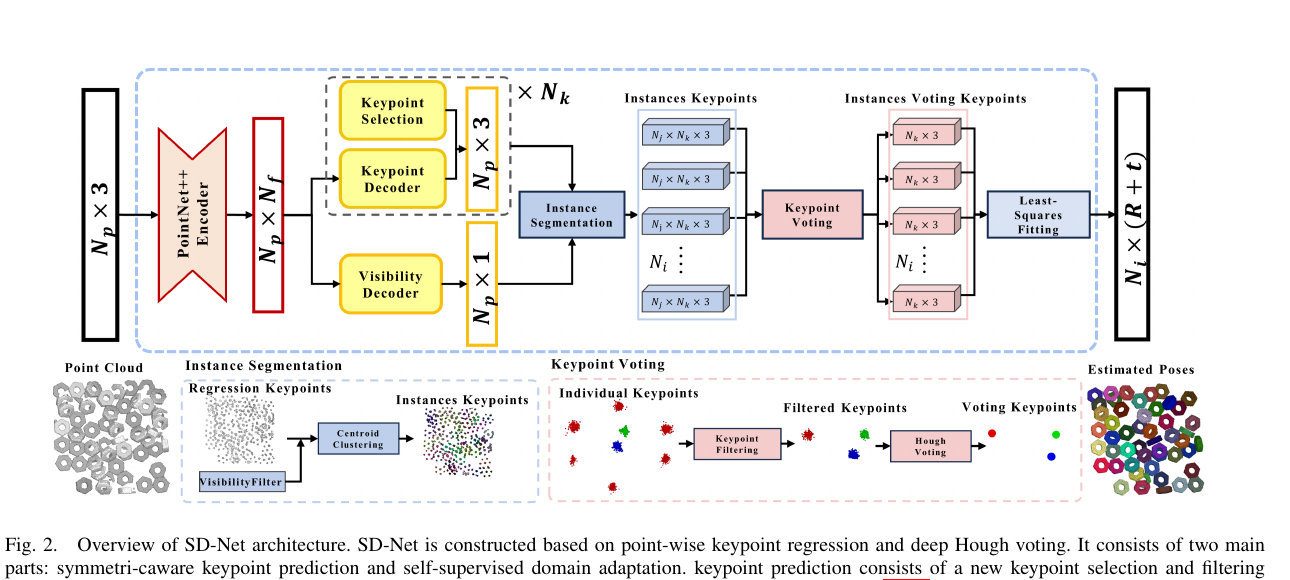
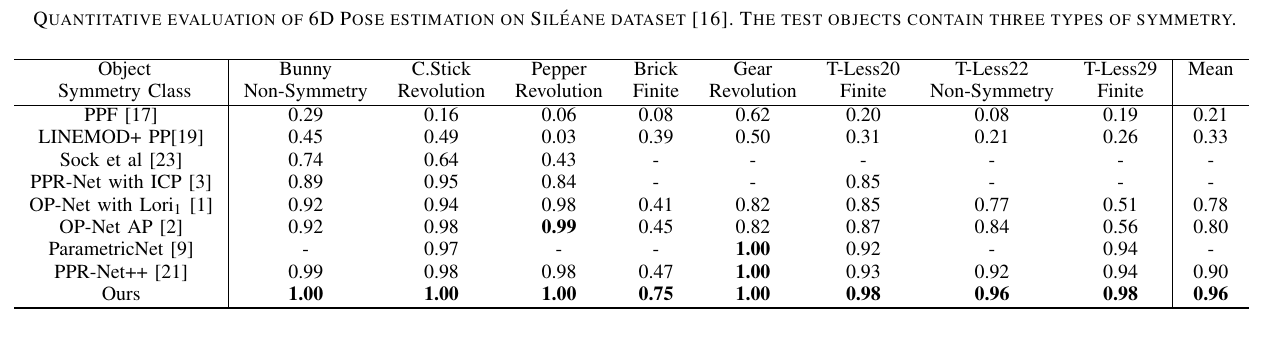
Original Figure 2: after PointNet++ encoding, instance, keypoint, and visibility predictions support instance clustering, keypoint filtering, Hough voting, and least-squares pose fitting. Source: authors' public manuscript. Image copyright belongs to the authors and IEEE; reproduced here for paper analysis.Original Table I: symmetry-aware AP over 8 Siléane objects; SD-Net averages 0.96. Consult the paper for differences in sensors, training, and refinement across methods. Source: authors' public manuscript. Table copyright belongs to the authors and IEEE; reproduced here for paper analysis.
4. Problem setting
Input: cropped, sampled scene point clouds containing randomly stacked industrial parts of one or multiple types.
Output: each instance’s rotation and translation, primarily for subsequent grasping.
Training requires CAD / synthetically labeled point clouds; deployment additionally uses a small set of real point clouds without pose labels for self-training.
Main challenges: severe occlusion, textureless surfaces, finite / continuous / mirror symmetries, and the synthetic-to-real sensor gap.
5. Method overview
Choose geometrically distinguishable keypoints from the centroid and bounding-box / coordinate-axis intersections according to object symmetry.
Construct equivalent keypoint sets for finite symmetries, preventing multiple valid poses from becoming conflicting supervision.
PointNet++ predicts instance centers, keypoint offsets, and visibility pointwise; cluster instances by their centers.
Filter outlier keypoints per instance, aggregate them with Hough voting, and fit scene keypoints to template keypoints by least squares.
For adaptation, the teacher predicts on real point clouds; visibility, geometric consistency, and Semi-Chamfer Distance select pseudo labels for iterative student training.
6. Experiments at a glance
Siléane: mean AP 0.96, versus PPR-Net++ 0.90; Brick improves from 0.47 to 0.75.
Parametric learning setting: mean AP 0.95 versus ParametricNet 0.87; mirror-symmetric TN42 improves from 0.52 to 0.78.
Parametric generalization setting: 0.94 with all parameterized instances for training; 0.92 / 0.77 when using only 1/3 / 1/5.
Removing equivalent keypoint sets, keypoint filtering, or domain adaptation substantially degrades particular objects in ablations.
Real experiments use 18,000 synthetic point clouds and 600 unlabeled real frames. The authors report success on all graspable instances in 10 Fanuc bin-picking trials, without confidence intervals for large-scale grasp success.
7. Quick assessment
Main reading takeaway: symmetry directly shapes keypoint definitions, supervision, and vote filtering, beyond its role in the final metric.
Engineering value: the algorithm, unlabeled adaptation, and real robot validation form an end-to-end pipeline.
Main limitations: depth point clouds, CAD, and known symmetry classes are required; real grasping experiments are small.
Recommended for: readers working on industrial point clouds, symmetry-aware keypoints, synthetic-to-real transfer, and robotic bin picking.
Available src/paper-notes/sd-net-iros2024/deep.md
In-depth paper notes
Support reproduction, comparison, related-work writing, and identifying opportunities for further research.
Deep Reading Notes: SD-Net
1. Key assessment
SD-Net addresses two frequent failures in industrial depth-point-cloud pose estimation: symmetry makes keypoint supervision ambiguous, and sensor differences create a synthetic-to-real point-cloud gap. Symmetry-aware keypoint prediction and self-supervised domain adaptation handle these respectively, retaining an interpretable sequence of pointwise regression, instance clustering, Hough voting, and rigid fitting.
The authors report mean Siléane AP 0.96 and substantial improvements for mirror, finite, and revolution symmetries on Parametric. My assessment: evidence for symmetry-aware keypoints is strong, especially for Brick, TN42, and T-Less, where results agree with ablations. Real adaptation also helps, but only 10 real robot trials mainly demonstrate deployability rather than large-scale reliability.
2. Problem setting and evaluation definitions
Given a point cloud P∈RN×3 of randomly stacked objects, the task separates instances and estimates each instance’s object-to-camera rigid transform R∈SO(3),t∈R3.
Siléane AP uses a symmetry-aware pose distance. A prediction is correct below 0.1 times the object’s minimum bounding-sphere diameter, followed by integration over the precision–recall curve. This AP differs from BOP AR and ADD(-S)<0.1d; values cannot be compared directly across these protocols.
System prerequisites include:
Known CAD / template point clouds and symmetry classes for training objects;
Depth-sensor point clouds cropped to the workspace;
Synthetic training scenes covering the target stacking density;
Access to unlabeled real scene point clouds for adaptation.
3. Why do ordinary keypoints fail on symmetric objects?
Common methods regress bounding-box corners or fixed surface samples. Several rotations of a symmetric object can produce identical observations, while fixed keypoint labels choose one pose. Consequently:
Visually and geometrically identical points receive different regression targets;
Averaging equivalent solutions produces off-surface or geometrically unstable points;
Mirror symmetry can introduce chirality: point sets of different handedness cannot be registered through valid rotation and translation alone.
SD-Net constructs keypoints from the centroid and intersections of selected coordinate axes with the object bounding box, choosing axes for four symmetry classes:
No proper symmetry: use all three axes to increase the keypoint count;
Continuous revolution symmetry: choose the rotation axis, using its bounding-box intersections to avoid ambiguous points on curved surfaces;
Finite nontrivial symmetry: choose the rotation axis and randomly select another from the remaining coordinate axes;
Mirror symmetry: choose two axes parallel to the mirror plane to avoid chirality conflicts.
For finite symmetries, an equivalent keypoint set allows labels associated with valid symmetric poses instead of forcing one unique target during training.
4. Network and geometric solver
Original Figure 2. The upper section shows pointwise network outputs; the lower section proceeds from scene point clouds through instance keypoints to poses. Keypoint filtering sits between instance clustering and voting. Source: authors' public manuscript. Image copyright belongs to the authors and IEEE; reproduced here for paper analysis.
4.1 Pointwise predictions
PointNet++ encodes scene point clouds; multiple decoders predict:
Instance membership and instance-center offsets for each point;
Per-point offsets to each object keypoint;
Keypoint visibility / reliability.
Predicted centers first cluster object instances. Within each instance, every scene point can vote for each keypoint, accumulating evidence even under severe occlusion.
4.2 Keypoint filtering and Hough voting
Simply averaging all pointwise predictions admits occlusion boundaries, sensor noise, and misassigned instance points. SD-Net filters strongly deviating predictions within each instance using candidate density and visibility, then aggregates each keypoint through Hough voting. Least-squares rigid fitting aligns scene and template keypoints.
This postprocessing turns uncertain predictions into inspectable geometric intermediates. Removing keypoint filtering drops AP to 0.53 / 0.03 / 0.08 for Brick / T-Less20 / T-Less29, showing that it is essential rather than a minor adjustment.
5. Self-supervised domain adaptation
Synthetic depth is often complete with clean boundaries, while real point clouds contain missing points, outliers, reflections, and occlusion. The teacher–student iteration is:
Initialize the teacher with a synthetically trained model;
Predict instances, keypoints, and poses on unlabeled real point clouds;
Filter low-quality instances using visibility and keypoint distributions;
Transform the object model into the scene with the predicted pose;
Use Semi-Chamfer Distance to measure one-way geometric consistency from the incomplete observation to the complete model transformed by the predicted pose;
Use poses passing the threshold as pseudo labels to train the student;
Update the teacher and repeat.
One-way / semi-Chamfer distance suits real point clouds containing only visible object surfaces. Bidirectional matching to the complete CAD model would wrongly penalize every occluded CAD surface.
Teacher–student training does not eliminate initial model bias. If initial poses are systematically wrong along symmetric directions, geometric consistency may still accept equivalent or incorrect pseudo labels. The equivalent keypoint set reduces this contamination earlier in the pipeline.
6. Experimental results
6.1 Siléane
Original Table I, covering asymmetric, continuously revolution-symmetric, and finitely symmetric objects. SD-Net averages AP 0.96. Source: authors' public manuscript. Table copyright belongs to the authors and IEEE; reproduced here for paper analysis.
Bunny, C.Stick, Pepper, and Gear approach or reach 1.00.
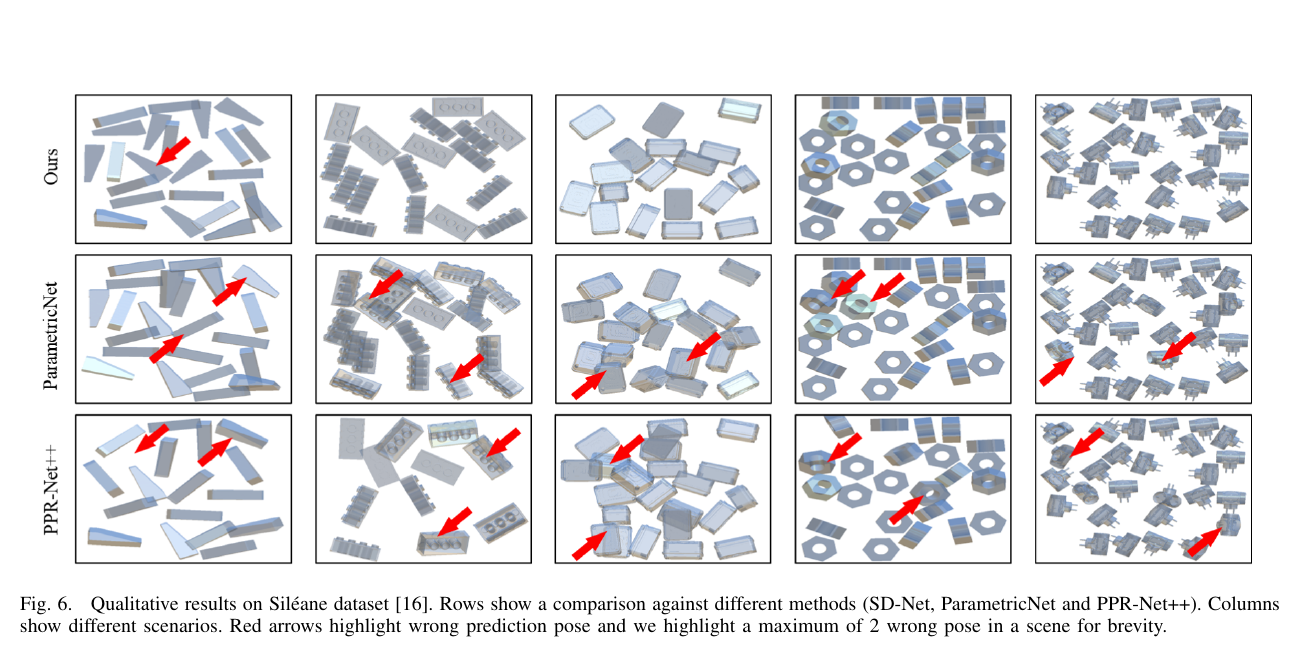
Mean AP is nearly saturated, making gains for Brick and finite-symmetry T-Less objects more informative. Qualitative results also show more incorrect ParametricNet and PPR-Net++ poses under heavy occlusion.
Original Figure 6: columns show different stacked objects; red arrows identify incorrect poses. SD-Net occupies the first row. Source: authors' public manuscript. Image copyright belongs to the authors and IEEE; reproduced here for paper analysis.
6.2 Parametric dataset
In the learning-capability setting:
Method
TN06
TN16
TN34
TN42
Mean
PPR-Net++
0.80
0.99
1.00
0.39
0.80
ParametricNet
0.94
1.00
1.00
0.52
0.87
SD-Net
1.00
1.00
1.00
0.78
0.95
TN42 has mirror symmetry; its 26-percentage-point gain agrees with keypoint design that avoids chirality conflicts. TN06 has 12 equivalent poses, for which equivalent keypoint sets reduce ambiguity from unique labels.
For generalization, SD-Net averages AP 0.94 when trained on all parameterized instances, and 0.92 / 0.77 with only 1/3 / 1/5, exceeding corresponding PPR-Net++ results of 0.73 / 0.59. Keypoint selection thus supports some transfer to unseen dimensions, but TN16 / TN34 still decline markedly at 1/5; parameter variation is not solved completely.
6.3 Ablations and real grasping
Four-object Siléane ablations:
Without equivalent keypoint sets, Brick falls to 0.08;
Without keypoint filtering, T-Less20 / T-Less29 fall to 0.03 / 0.08;
Without domain adaptation, Brick scores 0.70 versus the full model’s 0.75;
Replacing Semi-Chamfer with ordinary Chamfer drops T-Less29 to 0;
Fixed BBox / FPS / Parametric keypoint schemes are generally worse than the proposed strategy.
The real system uses Blender to generate 18,000 labeled point clouds and collects 600 unlabeled real point clouds for adaptation. An RVC X 3D camera, Fanuc robot, pneumatic gripper, ROS, and MoveIt! complete the grasping pipeline. The authors report that all graspable instances succeeded over 10 trials.
This demonstrates integration into a real grasping pipeline, but the paper does not provide total object counts, sequence lengths per trial, retries, or confidence intervals. Ten failure-free trials do not establish a stable 100% industrial success rate.
Predict complete equivalent keypoint distributions or rotation posteriors instead of accommodating ambiguity only in supervision;
Add real depth-noise models to synthetic training to reduce dependence on self-training thresholds;
Use shared geometric foundation models to generalize to unseen dimensions and new industrial parts;
Combine reachability and collision constraints so pose confidence directly controls reobservation or grasping.
11. Overall assessment
SD-Net’s research value lies in making symmetry determine keypoints, labels, and filtering, beyond an evaluation tolerance, while semi-Chamfer adapts to partially visible real point clouds. For known-CAD industrial bin picking, the design is coherent and supported by substantial ablations. Distinguish quantitative pose gains on Siléane / Parametric from the 10 real trials, which mainly demonstrate an operational robot loop.