Reading Notes
Overview / Deep Dive
Available src/paper-notes/sdfit-iccv2025/coarse.md
Paper overview notes
Quickly assess the paper's scope, problem setting, core method, experimental findings, and whether to read it in depth.
Overview Notes: SDFit: 3D Object Pose and Shape by Fitting a Morphable SDF to a Single Image
1. Basic information
- Year / venue: 2025 / ICCV; reading mode: coarse.
- Task: jointly recover category-level 3D object pose and shape from a single RGB image.
- Paper: ICCV Open Access; project: SDFit.
2. Positioning in one sentence
SDFit constrains shape search to a valid learned morphable-SDF manifold, initializes 2D–3D correspondences with foundation features, then jointly iterates shape and pose through render-and-compare.
2.1 Guide to the paper’s figures and tables
| Figure / table | What to inspect |
|---|---|
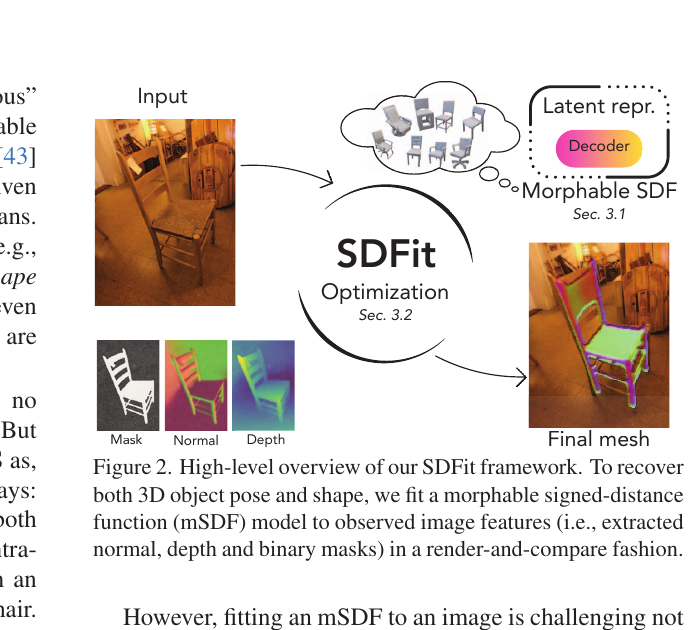
| Figure 2 | Single-image input, morphable-SDF latent prior, differentiable fitting, and final mesh / pose. |
3. Method overview
- Cross-modal foundation-model retrieval selects an initial mSDF latent from a shape database; image / mSDF feature correspondences initialize pose.
- Render-and-compare losses on image masks, normals, and depth-like features iteratively update the shape latent, pose, and scale.
- DIT mSDF provides a category-specific deformable shape prior. It needs no retraining for each in-the-wild image, while retaining a category model rather than supporting prior-free open-world pose.
4. Experimental overview
- Datasets: Pix3D, Pascal3D+, COMIC; comparisons emphasize occlusion, common / unusual poses, and image alignment.
- Authors’ claim: comparable to feed-forward baselines without substantial occlusion, more robust under occlusion and unusual poses, and applicable to natural images without retraining.
- My analysis: this approach explicitly optimizes against visual evidence; quality and speed depend on the shape prior, initialization, and test-time optimization. It is unsuitable as a real-time 6D pose system.
5. Strengths, weaknesses, and takeaways
- Strengths: joint shape / pose refinement, some flexibility for topology changes, and an interpretable feedback loop.
- Risks: category mSDFs, intrinsics / visual cues, and minute-scale optimization budgets are required; cluttered multi-object scenes are outside the main setting.
- Takeaway: explicit shape manifolds remain valuable alongside single-pass regression for occlusion and OOD images.