Robot Perception & Manipulation · 2025 · ICRA · CCF B
Semantic Cross-Pose Correspondence from a Single Example
Semantic Cross-Pose automatically localizes interaction regions in demonstrations, learning soft inter-object correspondences from DINO-ViT semantics and local geometry. Differentiable SVD transfers the bottleneck relative pose to unseen object pairs.
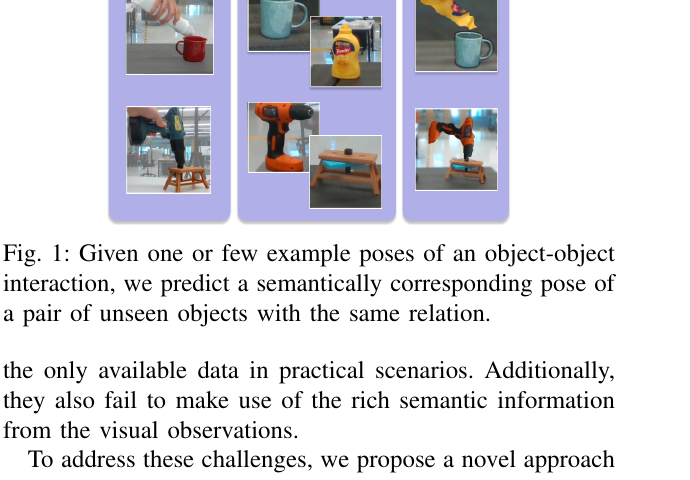
From one demonstrated two-object interaction, the method automatically locates contact-related regions, combines DINO-ViT semantics with local geometry to learn soft correspondences between new objects, and transfers the demonstrated relative pose through differentiable SVD.
2.1 Guide to the paper’s figures and tables
Original Figure 1: transfer one or a few interaction examples, including pouring and drilling, to new object pairs with different appearances and geometry. Source: accepted manuscript. Image copyright belongs to the authors and publisher; reproduced here for paper analysis.
3. A relative-pose interaction task
Input: demonstrated interaction between manipulator A and manipulandum B, plus a new object pair.
Output: a relative transform realizing the same semantic interaction between new objects.
Focus: where contact occurs and how the objects should be placed relative to one another.
Outside scope: complete trajectories, collision avoidance, force control, and dynamics.
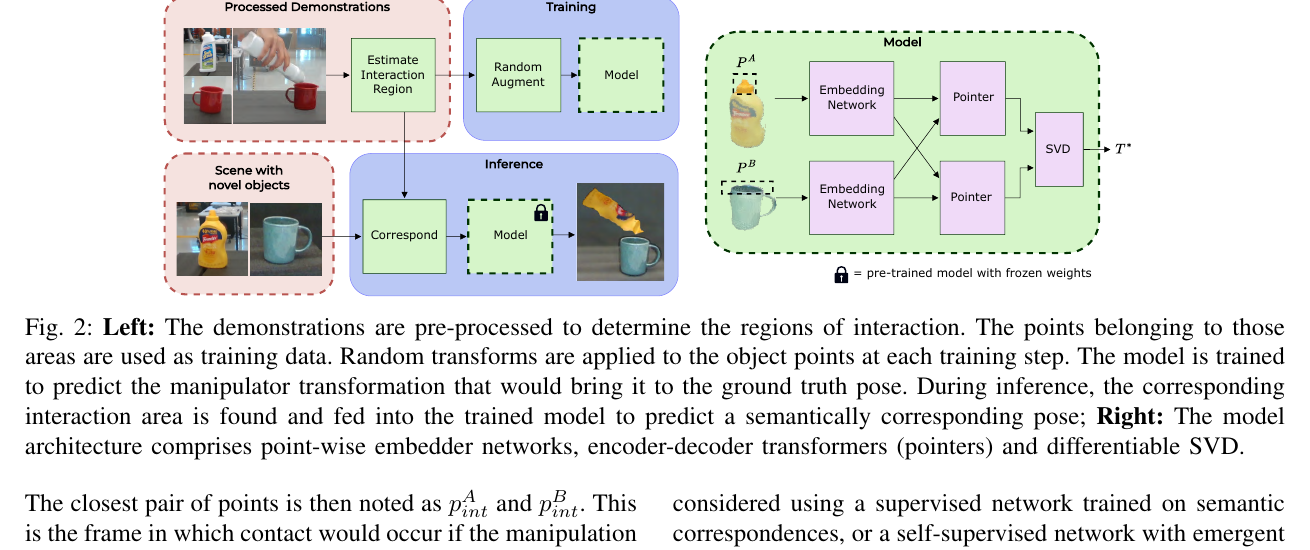
4. Method pipeline
Find the interaction frame with the smallest distance between tracked object point clouds.
Automatically crop interaction regions around nearby points.
Project dense DINO-ViT features onto 3D points.
Predict soft correspondences and displacement residuals with a TAX-Pose-style dual-branch network.
Solve relative rigid transforms through differentiable SVD.
Apply random SE(3) perturbations during training to learn cross-pose consistency.
5. Results at a glance
Task
TAX-Pose
Proposed
Mug-Pour 1-shot
53%
66%
Mug-Pour 2-shot
55%
68%
Mug-Pour 5-shot
56%
78%
Mug-Rack arbitrary rotation
41%
78%
Both achieve 100% in upright Mug-Rack settings, where semantic modules have limited advantage. Arbitrary rotations provide the stronger cross-pose generalization test.
6. Coarse-reading conclusion
The paper shifts pose toward how two objects should be arranged to preserve an interaction’s meaning. DINO supplies cross-instance semantics, while local geometry and SVD enforce rigid consistency. This suits one-shot manipulation, with a planner still needed to turn target relative poses into safe trajectories.
Available src/paper-notes/semantic-cross-pose-icra2025/deep.md
In-depth paper notes
Support reproduction, comparison, related-work writing, and identifying opportunities for further research.
Deep Reading Notes: Semantic Cross-Pose Correspondence from a Single Example
1. Problem definition
Let A be the manipulating tool and B the acted-on object. A demonstration supplies relative transform TBA∗ during interaction. For new objects A′ and B′, seek a semantically equivalent transform rather than copying absolute camera coordinates:
T^B′A′.
Different mugs should still align their openings with a container’s interior, and different racks should still receive mug handles on hooks. Object shapes and canonical frames may both change.
Original Figure 2: automatically locate demonstrated interaction regions, project DINO-ViT features, and predict cross-object soft correspondences with symmetric dual-stream pointer transformers. Source: accepted manuscript. Image copyright belongs to the authors and publisher; reproduced here for paper analysis.
2. Automatically discovering interaction regions
From demonstrated pose tracks, find the frame with minimum inter-object point-cloud distance, then expand a neighborhood using a distance threshold. This:
Removes large task-irrelevant surfaces;
Focuses learning on functional regions such as rims, handles, and hooks;
Avoids manual keypoint or contact labels.
Minimum distance need not identify the semantically important region. Precontact motion, soft contact, and multiple contacts can make this heuristic miss the task’s true bottleneck.
3. Semantic–geometric point features
Extract dense DINO-ViT features from RGB and project them onto point clouds using depth and camera intrinsics. Each point carries:
3D coordinate / local geometry;
Visual semantics that are relatively stable across instances;
Interaction-region membership.
Geometry alone confuses similarly shaped regions with different functions; semantics alone lack precise placement. Combining them first identifies functional correspondences, then aligns geometry at centimeter / angular precision.
4. Bidirectional soft correspondence and SVD
Symmetric A→B and B→A streams predict soft correspondences through pointer transformers. Beyond weighted-average correspondence points, displacement residuals compensate for sparse samples and within-category shape variation.
Given predicted correspondences (xi,yi), differentiable SVD solves:
R,tmini∑wi∥Rxi+t−yi∥22.
The geometric solver produces valid rigid transforms while gradients flow to the correspondence network. Random SE(3) transforms during training encourage correspondences independent of initial pose.
5. Few-shot training cost
The authors report about 1000 steps on one RTX 3080, taking roughly 10 minutes for task adaptation. This is lightweight adaptation from one or a few examples; the title describes low data requirements rather than training-free inference.
6. Experimental results
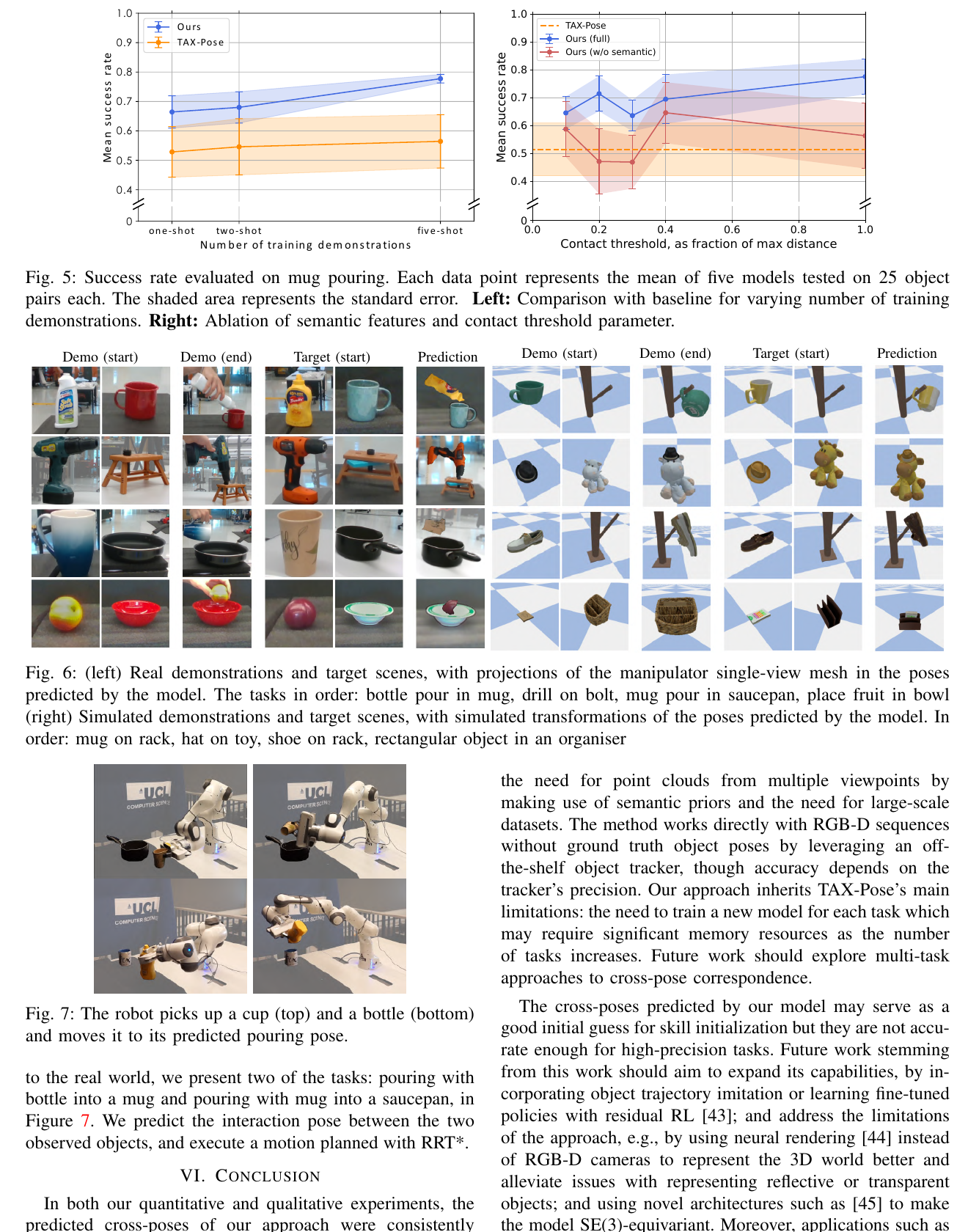
Original Figures 5–7: Figure 5 shows Mug-Pour success and contact-threshold / semantic ablations; Figure 6 shows real and simulated cross-object examples; Figure 7 shows robotic pouring-pose execution. This crop contains no arbitrary-initial-rotation table or human preference scores. Source: accepted manuscript. Image copyright belongs to the authors and publisher; reproduced here for paper analysis.
Setting
TAX-Pose
Semantic Cross-Pose
Mug-Pour 1 / 2 / 5-shot
53 / 55 / 56
66 / 68 / 78
Mug-Rack upright
100
100
Mug-Rack arbitrary rotation
41
78
Human ratings are 4.17 ± 1.13 versus 2.45 ± 1.07 for the comparison. These support more semantically appropriate poses, while subjective ratings do not substitute for physical task success.
7. What success actually establishes
Gains from 1-shot to 5-shot show that additional examples remain useful;
Saturated upright results and separation under arbitrary rotations support rotation augmentation and cross-pose consistency;
78% is still short of full reliability: wrong correspondences, collisions, and geometric tolerances cause failures.
8. Limitations
Outputs target relative poses without approach / departure trajectories.
Does not model contact forces, fluid dynamics, friction, or reachability.
Single-view RGB-D occlusion disrupts interaction regions and DINO projection.
Soft correspondences can remain multimodal for symmetric or visually similar functional regions.
Each interaction type still needs demonstrations and brief training.
9. Deep-reading conclusion
The main contribution connects semantic functional correspondence with rigid geometric solving: DINO identifies regions sharing functions across instances, and differentiable SVD converts them into actionable relative poses. This is a manipulation-task pose-transfer module, with greatest value when combined with planning, collision checks, and force control.