Shape-Biased Texture Agnostic Representations for Improved Textureless and Metallic Object Detection and 6D Pose Estimation
Without changing GDR-Net, Pix2Pose, or detector architectures, the paper randomly samples from 1,226 textures and UV-maps them onto objects during BlenderProc PBR rendering, reducing CNN dependence on fixed colors and materials. The full shape-biased detection–pose pipeline improves GDR-Net / Pix2Pose BOP AR from 56.29 / 46.68 to 58.32 / 50.13 on T-LESS and from 10.70 / 12.90 to 11.10 / 15.30 on ITODD. Gaussian noise, shot noise, and brightness robustness improve, while motion / Gaussian blur barely improves. Gains depend on detection and online augmentation; CAD + shape bias reaches 62.95 AR versus reconstructed meshes + shape bias at 46.57, so random textures do not replace accurate geometry.
synthetic PBR RGB training imagesCAD or reconstructed object meshesreal RGB test images2D detections for the pose stage
Requirements
object mesh for PBR training-data generationknown object identity and one pose estimator trained per objectBlenderProc-compatible material and UV mappinga diverse opaque texture librarycamera intrinsics and BOP-format pose annotationsseparately tuned online augmentation for detector and pose estimator
Full paper metadataAuthors, affiliations, research area, datasets, metrics, method tags, and reading statusExpandCollapse
Authors
Peter Hönig, Stefan Thalhammer, Jean-Baptiste Weibel, Matthias Hirschmanner, Markus Vincze
Original paper terminology:BOP Average Recall / MSPD Average Recall / MSSD Average Recall / VSD Average Recall / COCO detection mAP / image-perturbation robustness
object mesh for PBR training-data generationknown object identity and one pose estimator trained per objectBlenderProc-compatible material and UV mappinga diverse opaque texture librarycamera intrinsics and BOP-format pose annotationsseparately tuned online augmentation for detector and pose estimator
Reading Notes
Overview / Deep Dive
Available src/paper-notes/shape-biased-texture-agnostic-wacv2025/coarse.md
Paper overview notes
Quickly assess the paper's scope, problem setting, core method, experimental findings, and whether to read it in depth.
Overview Notes: Shape-Biased Texture Agnostic Representations for Improved Textureless and Metallic Object Detection and 6D Pose Estimation
1. Basic information
Short name: Randomized Texturing / Shape Bias
Authors: Peter Hönig, Stefan Thalhammer, Jean-Baptiste Weibel, Matthias Hirschmanner, Markus Vincze
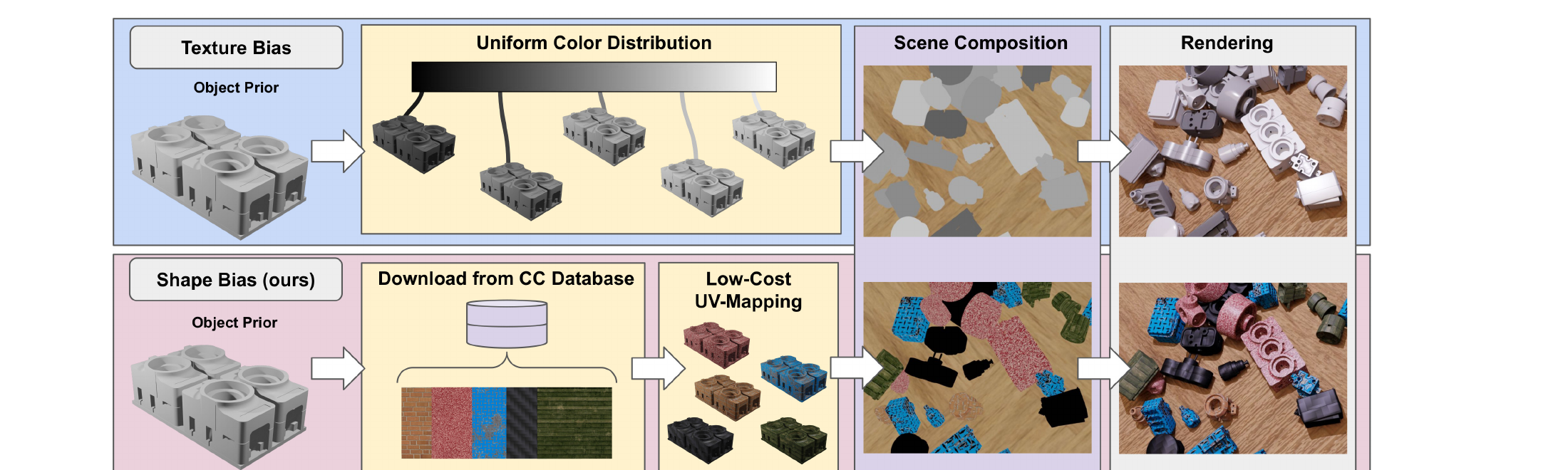
Without changing GDR-Net, Pix2Pose, or YOLO architectures, this paper replaces random solid CAD colors during BlenderProc data generation with low-cost UV mapping of randomly selected textures from a pool of 1,226. Discouraging fixed color / surface shortcuts encourages contours, occlusion relationships, and geometric projections, improving detection and instance-level 6D pose for textureless and metallic industrial objects.
This lightweight synthetic-to-real data strategy is tested with five detectors and two pose estimators on T-LESS and ITODD. Main findings:
On T-LESS, fully shape-biased detection / pose pipelines raise GDR-Net BOP AR from 56.29 to 58.32, and Pix2Pose from 46.68 to 50.13;
On ITODD, GDR-Net rises from 10.70 to 11.10, and Pix2Pose from 12.90 to 15.30;
Gaussian noise, shot noise, and brightness robustness improve substantially, with little consistent benefit for motion or Gaussian blur;
Gains depend on the detector, online augmentation strength, and CAD / reconstructed-mesh quality; improvement is not universal.
2.1 Guide to figures and tables
Figure / table
Question
Coarse-reading takeaway
Figure 2
What changes in training data?
Standard BOP PBR backgrounds, cameras, and lighting remain; random texture UV mapping replaces object solid-color sampling
Table 4
Does biasing both detector and pose improve accuracy?
Overall AR matches or exceeds texture baselines for two datasets / two estimators, with larger relative Pix2Pose gains
Figure 6
Clean-image gains or broader robustness?
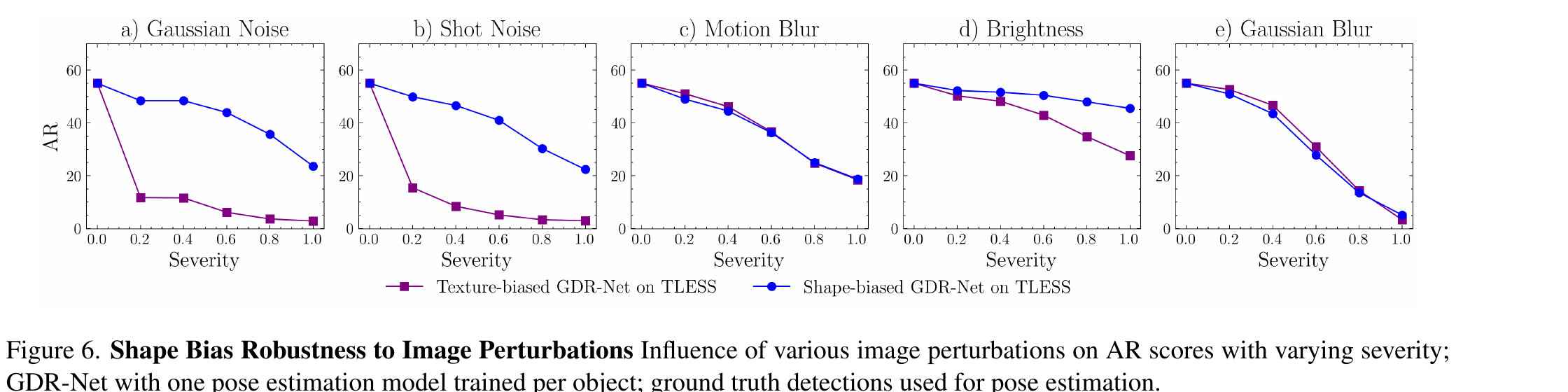
Noise and brightness improve; blur barely does, bounding the appearance-reliance mechanism
Table 6
Can textures compensate for poor geometry?
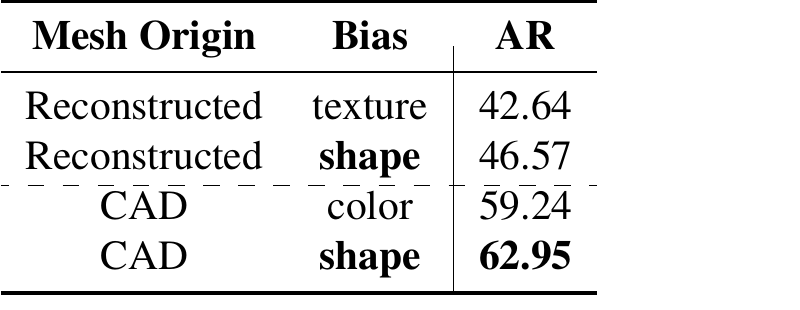
No: accurate CAD + shape bias reaches 62.95 AR, versus reconstructed mesh + shape bias 46.57
Original Figure 2: texture bias above samples uniform colors; shape bias below samples Creative Commons textures, applies low-cost UV mapping, then composes scenes and renders with PBR. Source: CVF Open Access. Image copyright belongs to the authors and publisher; reproduced here for paper analysis.
3. What problem does the paper address?
Many T-LESS / ITODD objects are monochrome, weakly textured, or metallic. Illumination, exposure, shadows, and highlights radically change a surface’s pixels. Models relying on fixed training colors / materials may mistake appearance changes for changes in identity or pose.
BOP synthetic data already randomizes backgrounds, cameras, poses, lighting, roughness, and specularity. Yet untextured objects commonly receive one uniformly sampled RGB color, leaving a shortcut through large, stable color regions instead of geometry.
The paper asks:
If object textures deliberately vary inconsistently across training images, will networks abandon texture shortcuts for more stable shape cues?
Shape bias describes a statistical representation preference, without explicit 3D reconstruction or complete texture disregard. More precisely, decorrelating identity from fixed surface appearance reduces reusable texture shortcuts.
4. Method: change synthetic object materials
4.1 Texture-biased baseline
The conventional configuration randomizes:
Specularity: uniform sampling from 0 to 1;
Roughness: uniform sampling from 0 to 1;
RGB color: each channel sampled uniformly from 0.1 to 0.9.
This creates varied colors but leaves surfaces low-frequency, continuous, and approximately uniform.
4.2 Shape-biased rendering
Keeping specularity, roughness, cameras, lighting, backgrounds, and scene composition identical, replace color sampling with:
Download available textures from the CC texture database;
The authors argue that mapping onto real 3D surfaces retains local geometry consistent with curvature, occlusion, and lighting. Style transfer helps classification but may suit spatially precise detection / pose less well.
5. Experimental setup
5.1 Datasets
T-LESS: textureless, geometrically similar, often symmetric industrial objects;
ITODD: metallic industrial objects with stronger reflections and low contrast.
Both train on synthetic PBR data and test on real images. Full ITODD test GT annotations are unavailable; results come from the BOP evaluation server. Metallic-object analysis is therefore less complete than T-LESS analysis, and qualitative detections cannot establish comprehensive GT statistics.
5.2 Models
Detectors include:
Faster R-CNN;
RetinaNet;
YOLOx;
YOLOv8;
YOLOv10.
Pose models are:
GDR-Net, ResNet34 backbone;
Pix2Pose, ResNet50 backbone.
Main pose experiments use YOLOx boxes and train a separate pose estimator per object. These do not evaluate category-level or unseen-object transfer.
5.3 Metrics
Pose evaluation follows three BOP Average Recalls:
AR_MSPD: symmetry-aware maximum projection distance;
AR_MSSD: symmetry-aware maximum surface distance;
AR_VSD: visible surface discrepancy;
Their mean gives overall BOP AR.
These surface / projection metrics evaluate full 6D pose rather than rotation accuracy alone.
6. Main 6D pose results
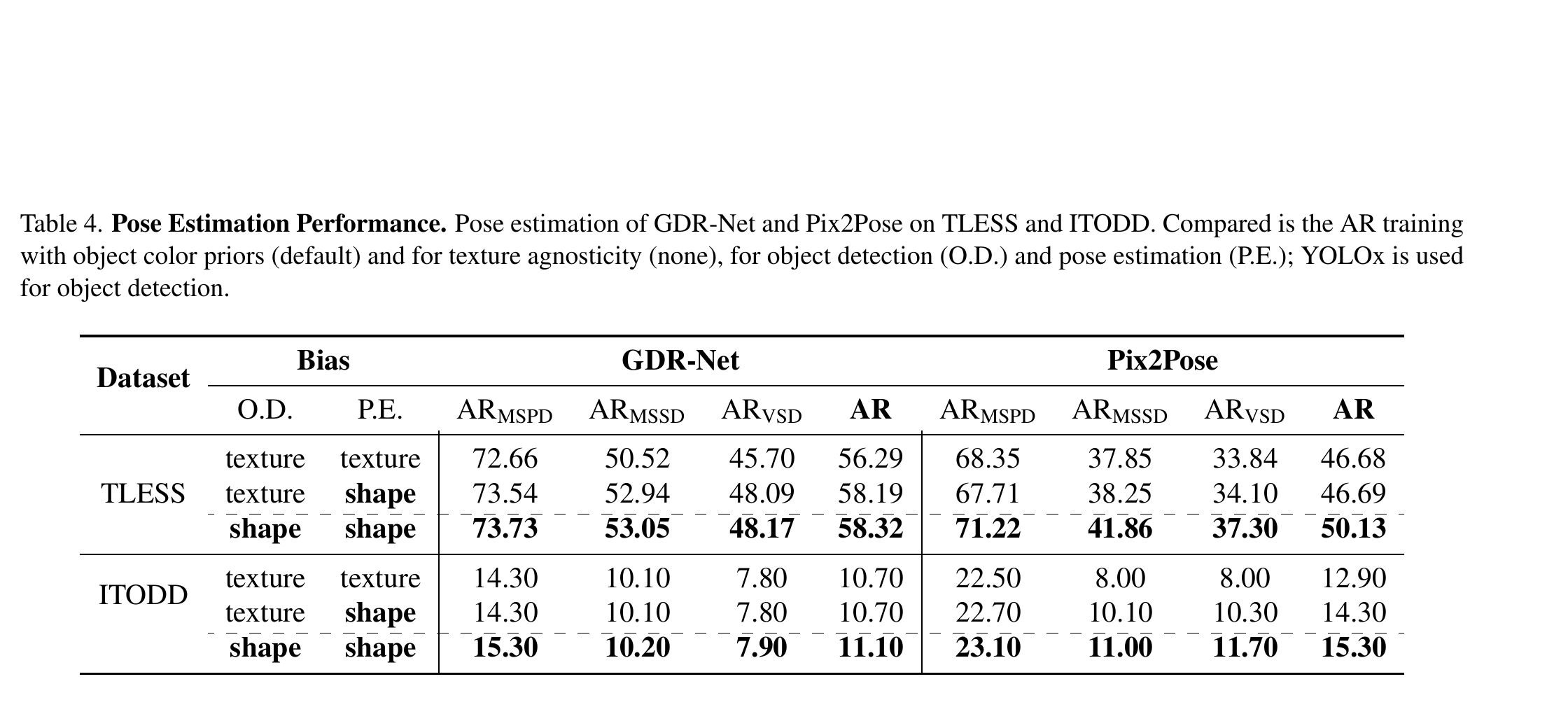
Original Table 4: O.D. is the training bias of YOLOx object detection; P.E. is that of pose estimation. Rows three and six use shape bias at both stages. Source: CVF Open Access. Image copyright belongs to the authors and publisher; reproduced here for paper analysis.
6.1 T-LESS
Model
Detection / pose bias
MSPD
MSSD
VSD
Overall AR
GDR-Net
texture / texture
72.66
50.52
45.70
56.29
GDR-Net
texture / shape
73.54
52.94
48.09
58.19
GDR-Net
shape / shape
73.73
53.05
48.17
58.32
Pix2Pose
texture / texture
68.35
37.85
33.84
46.68
Pix2Pose
texture / shape
67.71
38.25
34.10
46.69
Pix2Pose
shape / shape
71.22
41.86
37.30
50.13
Biasing only GDR-Net pose training raises 56.29 to 58.19, so gains extend beyond boxes; biasing detection too reaches 58.32. Pix2Pose barely changes with pose bias alone, reaching 50.13 when both stages change, indicating dependence on frontend quality and distribution consistency.
Relative gains over texture baselines are 3.61% for GDR-Net and 7.39% for Pix2Pose.
6.2 ITODD
Model
Detection / pose bias
MSPD
MSSD
VSD
Overall AR
GDR-Net
texture / texture
14.30
10.10
7.80
10.70
GDR-Net
texture / shape
14.30
10.10
7.80
10.70
GDR-Net
shape / shape
15.30
10.20
7.90
11.10
Pix2Pose
texture / texture
22.50
8.00
8.00
12.90
Pix2Pose
texture / shape
22.70
10.10
10.30
14.30
Pix2Pose
shape / shape
23.10
11.00
11.70
15.30
Low ITODD AR reflects difficult metallic objects. GDR-Net pose-only bias gives no gain; its improvement comes mainly from shape-biased YOLOx. Pix2Pose benefits at both stages. Full-pipeline relative gains are 3.74% for GDR-Net and 18.60% for Pix2Pose.
The 18.60% relative gain needs context: Pix2Pose improves by only 2.40 AR, ending at 15.30, far from solving metallic-object pose.
7. Robustness and ablations
7.1 Image perturbations
On T-LESS, GT detections and GDR-Net isolate five perturbations across increasing severity:
Gaussian noise: substantially more stable with shape bias;
Shot noise: substantially more stable with shape bias;
Brightness: clear advantage at medium / high severity;
Motion blur: nearly overlapping curves;
Gaussian blur: no consistent advantage, with both degrading rapidly at high severity.
These results bound the mechanism: random textures reduce reliance on surface appearance / local pixel statistics, but cannot recover edges and spatial detail removed by blur.
7.2 Texture count
All 1,226 textures give the best result;
Only 5 textures already reach 93.85% of that maximum;
100 textures reach 99.63%.
Diversity helps, but thousands of textures are unnecessary for an initial test. Start with dozens to a hundred, then expand the library.
7.3 Online augmentation
Shape bias and ordinary online augmentation interact rather than adding independently:
Pix2Pose pose performs best around augmentation scales 0.2–0.4;
YOLOx detection peaks around 0.4;
Shape-biased pose generally benefits across several augmentation settings;
Detectors can worsen if augmentation strength is not retuned.
Fair reproduction should tune both baseline and shape-biased variants rather than mechanically copying a baseline-optimized strength.
Random textures improve reconstructed meshes without canceling reconstruction errors; geometric accuracy and appearance randomization are complementary variables.
8. Strengths
Changes stay in data rendering, with little intrusion into existing detection / pose code.
Five detectors and two pose estimators give broader evidence than one model.
Separating detector and pose bias in Table 4 locates the source of gains.
Deliberate train / test appearance mismatch may hurt tasks distinguishing near-identical shapes through stable, informative textures.
Absolute gains are generally moderate, and ITODD AR remains low.
10. Is a deep read worthwhile?
Yes for BOP synthetic training, T-LESS / ITODD, industrial parts, and synthetic-to-real pose.
The main strength is a clear data-strategy experiment. Reusable elements include:
Randomize foreground materials alongside backgrounds and lighting;
Control detector and pose training biases separately;
Bound mechanisms using noise, brightness, blur, mesh origin, and augmentation grid search;
Report absolute and relative gains together, especially with low baselines.
11. Coarse-reading conclusion
Randomized Texturing offers a cheap, modular intervention with explicit scope: decorrelating synthetic surface texture from identity reduces CNN dependence on fixed appearances, improving textureless / reflective-object detection and 6D pose under noise and lighting changes. Its value extends beyond the size of its BOP AR gain.
It complements geometry, detection quality, and augmentation. Accurate CAD remains more valuable than noisy reconstructions; blur still destroys important edges; detectors still need tuning. Treat it as one dimension of a synthetic-to-real toolbox, with clear applicability limits.
Available src/paper-notes/shape-biased-texture-agnostic-wacv2025/deep.md
In-depth paper notes
Support reproduction, comparison, related-work writing, and identifying opportunities for further research.
Deep Reading Notes: Shape-Biased Texture Agnostic Representations for Improved Textureless and Metallic Object Detection and 6D Pose Estimation
1. Basic information
Short name: Randomized Texturing / Shape Bias
Authors: Peter Hönig, Stefan Thalhammer, Jean-Baptiste Weibel, Matthias Hirschmanner, Markus Vincze
The paper frames textureless / metallic synthetic-to-real transfer as a training shortcut: fixed textures or low-frequency solid colors let CNNs exploit appearance correlations instead of contours, surface projections, occlusion, and shadows. Without architecture changes, BlenderProc PBR replaces uniform colors with randomized natural-texture UV mapping. The 1,226 inconsistent appearances disrupt this shortcut.
Experiments give bounded support, rather than a universal proof that textures are irrelevant:
Fully shape-biased detection / pose raises T-LESS GDR-Net BOP AR from 56.29 to 58.32, and Pix2Pose from 46.68 to 50.13;
ITODD improves from 10.70 to 11.10 and 12.90 to 15.30 respectively, with low absolute accuracy;
Gaussian / shot noise and brightness improve; motion / Gaussian blur barely do. This agrees with reducing appearance shortcuts without recovering lost geometric detail;
Detector / pose interactions matter: T-LESS Pix2Pose barely changes with pose-only bias, needing shape-biased YOLOx too for its total 3.45 AR gain;
Accurate CAD matters more than texture intervention: Pix2Pose CAD + shape bias reaches 62.95 AR, versus reconstructed mesh + shape bias 46.57;
Some older detectors and augmentation configurations decline, ruling out an untuned universal augmentation;
Evidence covers CNNs, per-object instance-level training, and T-LESS / ITODD, without establishing ViT, diffusion-feature, category-level, or unseen-object gains.
The reusable experimental lesson is to intervene on material distributions while controlling detectors, pose estimators, image corruption, online augmentation, and geometry priors separately.
2.1 Key figures and levels of evidence
Evidence
Controlled variables
Supported conclusion
Unsupported conclusion
Figure 2
Only object color / texture generation changes
Easy integration into standard BOP PBR
Networks necessarily learn explicit 3D shapes
Table 3
T-LESS classification, same ResNet50
UV mapping exceeds the reproduced AdaIN setting
Superiority over all style-transfer methods
Table 4
Two datasets / pose models, YOLOx detections
Matching or improved tested 6D pose results
Universal gains across detection / pose architectures
Figure 6
T-LESS, GT detections, GDR-Net
Better noise / brightness robustness, little blur benefit
Equal gains under detection errors or every real corruption
Appearance randomization cannot replace accurate geometry
Reconstructed meshes are never useful
3. Task definitions and terminology
3.1 What pose is estimated?
The paper represents instance-level 6D object pose as:
TCO=[R∣t],
Here R∈SO(3) and t∈R3 map object coordinates to camera coordinates. Training / testing use T-LESS / ITODD instances, with a separate GDR-Net or Pix2Pose estimator trained per object.
It therefore differs from:
category-level pose;
model-free / reference-free pose;
unseen-object generalization;
Orientation-only or relative-rotation tasks.
BOP VSD, MSSD, and MSPD Average Recall evaluate full poses; CAD / reconstructed meshes remain necessary to generate training data and define geometry.
3.2 What is texture bias?
Texture bias is CNN preference for local texture statistics among available cues. ImageNet classification may succeed through such cues, but textureless industrial pose can suffer brittle shortcuts:
Continuous, stable synthetic object colors;
Real appearance altered by light, exposure, specularity, and shadows;
Learned local appearances inconsistent with pose-discriminative geometry;
Failed synthetic-to-real transfer.
3.3 What does shape bias mean here?
Training distributions favor shape-related evidence: silhouettes, boundaries, occlusion structure, surface texture deformation, and PBR lighting / shadows. There is no explicit 3D-coordinate supervision or proof of a complete decodable shape in feature maps.
A stricter interpretation is:
Randomized texturing reduces statistical coupling between fixed appearance and labels / poses, making cross-texture geometric projection cues more useful for minimizing risk.
Texture agnosticism similarly means relative robustness, without mathematical texture invariance.
4. A training-distribution interpretation
Let mesh be M, category / instance o, pose p, camera / lighting / background nuisance variables z, and surface appearance a. Rendering produces:
I=R(Mo,p,z,a).
The texture-biased baseline uniformly samples RGB colors for untextured objects:
a=(r,g,b),r,g,b∼U(0.1,0.9).
Changing colors still leaves large low-frequency continuous materials within each object. Networks can learn surface statistics specific to the synthetic pipeline.
The proposed texture pool is:
T={T1,T2,…,Tn},n=1226,
Each rendering samples uniformly:
Ti∼U(T),a=UVMap(Mo,Ti).
The training objective remains:
θminEo,p,z,Ti[L(fθ(R(Mo,p,z,Ti)),y(o,p))].
When the same o,p admits many Ti, fixed-texture features cannot consistently lower expected losses; contours, occlusion, and surface deformations that remain stable across Ti become more valuable.
This resembles appearance intervention, but is not a strict causal experiment. Random textures jointly alter spectra, edge density, color distributions, and PBR interactions without isolating them.
5. Rendering and implementation
Original Figure 2: the baseline above uniformly samples object colors; the method below samples Creative Commons textures and UV-maps CAD surfaces. Scene composition and PBR rendering are otherwise identical. Source: CVF Open Access. Image copyright belongs to the authors and publisher; reproduced here for paper analysis.
5.1 Relationship to BOP PBR
BlenderProc and standard BOP configurations retain randomization of:
Background textures;
Camera viewpoints;
Object positions and rotations;
Scene object combinations;
Lights and shadows;
Specularity and roughness.
The added variable is foreground surface texture. Background randomization helps foreground separation but leaves internal object appearance shortcuts intact.
5.2 Two material configurations
Parameter
Texture-biased baseline
Shape-biased variant
specularity
U(0,1)
U(0,1)
roughness
U(0,1)
U(0,1)
Surface color
Per-channel RGB U(0.1,0.9)
Uniformly sample and UV-map 1,226 textures
Scene / camera / lighting
Standard BOP
Same
Both randomize specularity and roughness. The difference is solid-color versus spatial-texture priors, rather than extra reflection-parameter randomization.
5.3 Texture library
The Creative Commons texture database used by the paper;
Translucent textures removed;
1,226 opaque textures retained;
A texture can cover multiple objects, and each object changes textures across renderings;
Figure 2 shows only 5 examples, not the full training pool.
Low-cost UV mapping needs no manually designed semantic texture per industrial part. Its purpose is diverse surface patterns without stable identity associations.
5.4 Data scale and cost
The full synthetic set has 50,000 renderings. Sampling and mapping add negligible cost relative to standard PBR generation / training, with no new inference module or model FLOPs. Actual throughput still depends on texture I/O, material caching, and renderer settings, which reproduction should record.
AdaIN-style transfer redistributes 2D style statistics and can encourage classification shape bias; pose needs precise spatial cues. The authors offer three motivations:
Textures attach to actual 3D surfaces: rendering consistently handles perspective, surface deformation, occlusion, and shadows;
Textures decouple from identity: different appearances share pose labels;
One generation method supports classification, detection, segmentation, and pose, avoiding separate style-transfer pipelines per task.
Controlled T-LESS classification uses ResNet50 with GT box crops:
Training
Top-1 accuracy
Top-5 accuracy
Solid-color texture bias
63.22
86.27
AdaIN style-transfer shape bias
75.88
91.16
UV-mapping shape bias
87.27
97.37
Against AdaIN, UV mapping improves top-1 / top-5 relatively by 15.01% / 6.81%. This supports classification representations in this setting; pose evidence comes separately from Table 4.
7. Experimental design
7.1 Dataset selection
T-LESS
T-LESS has textureless industrial objects, geometric similarities, symmetries, occlusion, and clutter, testing whether fixed color priors obscure shape differences.
ITODD
ITODD’s metallic surfaces depend strongly on incident light, specularity, and exposure, directly stressing appearance changes.
ITODD test GT is not public. BOP-server results and Figure 4 without detection GT establish benchmark gains but cannot support comprehensive per-object / failure-type attribution. The conclusion also calls for fuller metallic-object evaluation.
7.2 Detectors
Faster R-CNN;
RetinaNet;
YOLOx;
YOLOv8;
YOLOv10.
Models span two-stage / one-stage designs and generations, without transformer detectors. Newer YOLO models benefit more consistently; the authors suggest capacity and architecture, without causally controlling those factors.
7.3 Pose estimators
Model
Backbone
Protocol
GDR-Net
ResNet34
Separate estimator per object; YOLOx detections
Pix2Pose
ResNet50
Separate estimator per object; YOLOx detections
Both are CNN-based multistage instance-level systems. Boxes affect crops and subsequent correspondence / regression, so Table 4 separates object-detection bias (O.D.) from pose-estimation bias (P.E.).
7.4 Metrics
Overall BOP AR averages three terms:
ARBOP=3ARMSPD+ARMSSD+ARVSD.
MSPD: maximum symmetry-aware projection error, emphasizing image alignment;
MSSD: maximum symmetry-aware surface distance, emphasizing 3D displacement;
VSD: visible surface discrepancy, accounting for occlusion / visible regions;
Each first averages recall across error thresholds.
ADD or angular errors alone may penalize equivalent symmetric poses unfairly; BOP’s three terms better suit textureless / symmetric objects.
8. Detection: gains are not universally monotonic
Detection findings are more nuanced than gains for all five detectors.
8.1 Default augmentation
Reported relative changes include:
T-LESS: Faster R-CNN 247.03%, RetinaNet 200.87%. Low baselines explain these large relative gains; absolute mAP is essential context;
Randomized texturing and augmentation can overlap or conflict. Strong existing color / contrast / noise augmentation can shrink marginal gains, while unsuitable strengths damage detection training.
The supported claim is more consistent benefits for newer YOLO models in tested settings, with no unconditional gain across all detectors.
9. Main 6D pose results
Original Table 4: varying YOLOx detection (O.D.) and pose-estimation (P.E.) texture / shape biases separates each stage's gains. Bold rows use shape bias at both stages. Source: CVF Open Access. Image copyright belongs to the authors and publisher; reproduced here for paper analysis.
Most GDR-Net gains come from pose training, with a small extra YOLOx benefit.
T-LESS / Pix2Pose
baseline: 46.68;
Pose-only change: 46.69, nearly unchanged;
Also change detection: 50.13, another +3.44 AR;
Full pipeline relative to baseline: +7.39%.
Pix2Pose shows why final gains cannot all be assigned to shape-biased pose representations: improved / distribution-consistent detections are a crucial mediator here.
Table 4 lacks uncertainty, multiseed variance, and per-object breakdowns, leaving unclear whether many small gains or a few difficult objects drive the means.
10. Image perturbations: the clearest mechanism boundaries
Original Figure 6: GT detections isolate texture-biased and shape-biased GDR-Net on T-LESS. Random textures clearly help Gaussian / shot noise and brightness, with little consistent benefit for motion / Gaussian blur. Source: CVF Open Access. Image copyright belongs to the authors and publisher; reproduced here for paper analysis.
10.1 Protocol
dataset: T-LESS;
estimator: GDR-Net;
One pose model per object;
Ground-truth detections isolate detector error;
Test-image corruptions vary in severity;
Compare texture-biased and shape-biased training.
10.2 Gaussian and shot noise
Baseline AR collapses at low severity; the shape-biased model declines more smoothly. Richer high-frequency training patterns may reduce dependence on specific stable pixel statistics.
This mechanism remains tentative: no frequency-response, feature-attribution, or linear-probe experiment directly tests it.
10.3 Brightness
Shape-biased AR stays substantially higher at medium / high brightness severity. This matches the metallic-object motivation: features less tied to fixed colors / intensities should resist global brightness shifts.
10.4 Motion and Gaussian blur
Both models follow similar declines. Blur removes contours, edges, and fine spatial structure that shape-biased models also need. Changing training textures cannot recover geometric information absent from inputs.
This useful negative result prevents claims of universal corruption robustness.
10.5 Protocol limits
GT detections isolate pose backbones under idealized conditions. Real noise / brightness changes also damage detection, so Figure 6 does not establish equal full-pipeline advantages at those severities.
11. Ablation studies
11.1 Texture count
Figure 5 measures YOLOx detection mAP versus texture-pool size on T-LESS:
n=1226 performs best;
n=5 already reaches 93.85% of the maximum;
n=100 reaches 99.63%.
Diminishing returns suggest few textures already disrupt fixed-color identity shortcuts; further textures broaden local patterns and spectral coverage.
These ratios belong to the YOLOx / T-LESS detector ablation. They do not establish that all pose models reach 99.63% with 100 textures.
11.2 Shape bias and online augmentation
The authors multiply ordinary augmentation probabilities by scale λ∈[0,1] and grid-search it. Candidates include coarse dropout, Gaussian blur, sharpness, contrast, brightness, color, add, invert, multiply, Gaussian noise, and linear contrast. Detection / pose lists and base probabilities differ.
Figure 7 finds:
Pix2Pose pose peaks around 0.2≤λ≤0.4;
YOLOx detection peaks around λ=0.4;
Shape bias benefits pose across multiple strengths;
Original Table 6: T-LESS, Pix2Pose, GT detections, online augmentation scale 0.2. Shape bias improves both mesh types, but accurate CAD still leads reconstructed geometry by about 16 AR. Source: CVF Open Access. Image copyright belongs to the authors and publisher; reproduced here for paper analysis.
Geometry prior
Appearance prior
AR
reconstructed mesh
reconstructed texture
42.64
reconstructed mesh
randomized texture / shape
46.57
CAD
randomized grayscale color
59.24
CAD
randomized texture / shape
62.95
Two orthogonal effects are evident:
Within each mesh type, shape bias adds +3.93 and +3.71 AR;
Within each bias type, CAD exceeds reconstruction by +16.60 and +16.38 AR.
Geometry-prior quality is the larger main effect, with randomized textures adding gains. Errors in reconstruction scale, contours, or local structure cause systematic coordinate-supervision bias that texture randomization cannot repair.
12. Why do models benefit differently?
The authors attribute larger Pix2Pose gains to its higher-capacity ResNet50 versus GDR-Net’s ResNet34. Plausible, but experiments also mix:
Heads and training losses;
Correspondence / regression mechanisms;
Crop and detector sensitivities;
Baseline absolute AR;
Online augmentation protocols.
Two models cannot establish that larger backbones necessarily gain more. Isolate backbone scale within one architecture or run capacity-matched comparisons.
A stronger observation is that gains jointly depend on local appearance use, crop sensitivity, and consistency between training distributions.
13. Main strengths
13.1 Modular intervention
No inference branch, changed pose output, or extra real labels are required. Integration needs a synthetic renderer capable of assigning mesh materials.
Real appearance depends on light, making fixed synthetic-color priors fragile. Unrealistic random textures deliberately broaden appearance support to encourage stable cues.
13.3 Evidence beyond clean accuracy
Corruptions, texture counts, augmentation strength, and mesh origin test where / why the method works, providing stronger evidence than one result table.
13.4 Separate detector and pose controls
Table 4’s bias combinations expose mediators in two-stage systems. T-LESS Pix2Pose shows why comparing only shape/shape with texture/texture would incorrectly credit pose estimation for much of the detector gain.
14. Limitations and causal boundaries
14.1 CNNs only
Vision Transformers and diffusion models are explicitly untested. DINO / ViT may prefer different shape / texture cues; gains, texture counts, and augmentation strengths need fresh evaluation.
14.2 Known instances with per-object training
Per-object networks can encode geometry in weights. Unseen-object systems use cross-instance matching or CAD-template retrieval, where random textures may help or harm reference-query matching.
14.3 Incomplete ITODD evidence
Without public test GT, the paper cannot perform comprehensive error analysis. Metallic objects motivate the title, but most diagnostic robustness / mesh ablations use T-LESS.
14.4 Missing statistical uncertainty
Main tables lack multiseed means, standard deviations, or confidence intervals. Full-pipeline T-LESS GDR-Net gains only 0.13 AR over pose-only bias; whether this exceeds training randomness remains unknown.
14.5 Shape representations are not measured directly
Accuracy and robustness show behavior, rather than probing feature geometry. Further tests could include:
texture-swap consistency;
silhouette / edge occlusion sensitivity;
feature linear probe for object coordinates / normals;
cross-texture correspondence stability;
Centered kernel alignment between representations trained on different distributions.
14.6 Random textures may hurt fine-texture discrimination
T-LESS / ITODD lack stable textures. For similarly shaped products distinguished by logos / prints, enforced texture agnosticism can remove useful evidence. Mixing shape-biased and texture-faithful data may suit these better than total replacement.
14.7 Geometry, detection, and blur remain
Reconstructed geometry still incurs about a 16 AR gap;
Detector augmentation needs retuning;
Motion / Gaussian blur does not improve;
ITODD absolute AR remains low.
This addresses one data-distribution dimension within an industrial pose system.
15. Reproduction checklist
15.1 Data preparation
Obtain T-LESS / ITODD CAD and BOP camera / pose annotations;
Prepare a license-compatible texture library;
Remove alpha / translucent textures and textures the renderer cannot handle reliably;
Fix pool versions / file lists and record n;
Check each object’s UV mapping for extreme scales or unmapped regions.
15.2 Strictly comparable rendering variants
Texture baseline:
Uniform RGB channel sampling from 0.1–0.9;
Specularity / roughness sampled from 0–1.
Shape variant:
Identical specularity / roughness;
Uniform sampling from the texture pool;
UV mapping onto object surfaces.
Match scene composition, cameras, lights, backgrounds, object / rendering counts, resolution, and seed policy; otherwise extra randomization differences confound results.
15.3 Training
Match initialization policies, epochs, optimizers, and batch schedules;
Tune reasonable online augmentation separately for both variants;
Train detection and pose separately; retain at least texture/texture, texture/shape, and shape/shape combinations;
Add shape detection + texture pose if affordable, completing the interaction analysis;
Run at least 3 seeds and report means / standard deviations.
Reusing baseline-optimal augmentation without retuning shape variants;
Reporting relative percentages without absolute AR;
Extrapolating GT-detection robustness to full pipelines;
Treating ITODD qualitative box overlays as quantitative evidence with public detection GT;
Describing texture agnosticism as complete invariance.
16. Future research takeaways
These extensions follow from the evidence; the authors have not already validated them.
16.1 Adaptive texture–shape mixtures
Increase randomized textures for textureless / metallic objects, preserving faithful appearances for informative logos / printing. Mixture probabilities could depend on material and geometric symmetry:
I∼{R(M,Trandom),R(M,Tfaithful),q(o)1−q(o).
This discourages appearance shortcuts while retaining discriminative textures.
16.2 Combine with physical material randomization
Roughness / specularity already vary, but textures are ordinary opaque surfaces. Further cover metallic BRDFs, anisotropy, clear coats, environment maps, and exposure responses; ablate random patterns separately from physical materials.
16.3 Revalidate foundation features
Repeat texture-swap consistency and BOP tests for DINOv2, DINOv3, CLIP / SigLIP, diffusion correspondences, and ViT detectors. Check existing shape bias and remaining texture-randomization gains.
16.4 Feature consistency beyond data intervention
Render multiple textures for the same object / pose, adding feature consistency to task loss:
Linv=fθ(ITi)−fθ(ITj),
Align corresponding surface regions only. This directly encourages invariance but risks erasing useful real textures, requiring balance with a faithful branch.
16.5 Joint geometry-quality curriculum
Table 6 identifies geometry gaps as dominant. Randomize mesh noise, missing surfaces, normals, and textures to improve reconstruction-asset robustness, while preventing inaccurate geometric supervision from corrupting pose labels.
17. Relationship to 6D pose approaches
This is a training-data intervention upstream of correspondence, PnP, render-and-compare, or direct regression:
Synthetic data: extends randomization to foreground surfaces;
Correspondence: may encourage geometric 2D features, without direct correspondence evaluation;
Model-based pose: still requires CAD / meshes;
CAD-free reconstruction: improves reconstruction-based training without closing geometry gaps;
Robustness: helps noise / brightness, with blur unresolved;
Unseen-object pose: related motivation, but transfer remains untested.
18. Deep-reading conclusion
Randomized Texturing is a small intervention supported by carefully bounded experiments. The strongest conclusion is:
In tested CNN-based instance-level T-LESS / ITODD detection and pose pipelines, replacing uniform surface colors with many random UV textures reduces fixed-appearance dependence. Clean BOP AR matches or improves, and Gaussian / shot noise and brightness robustness improve substantially. Gains depend on detection, pose architecture, online augmentation, and geometry priors.
As an engineering option, it is inexpensive to try in BlenderProc / BOP, especially for textureless reflective parts. Research should add multiseed statistics, feature probes, ViT / diffusion tests, faithful-material mixtures, and full-pipeline corruption evaluation.
Three numbers keep expectations grounded:
Full T-LESS gains: GDR-Net +2.03 AR, Pix2Pose +3.45 AR;
ITODD Pix2Pose improves relatively by 18.60% but ends at only 15.30 AR;