Sim-to-Real Object Pose Estimation for Random Bin Picking
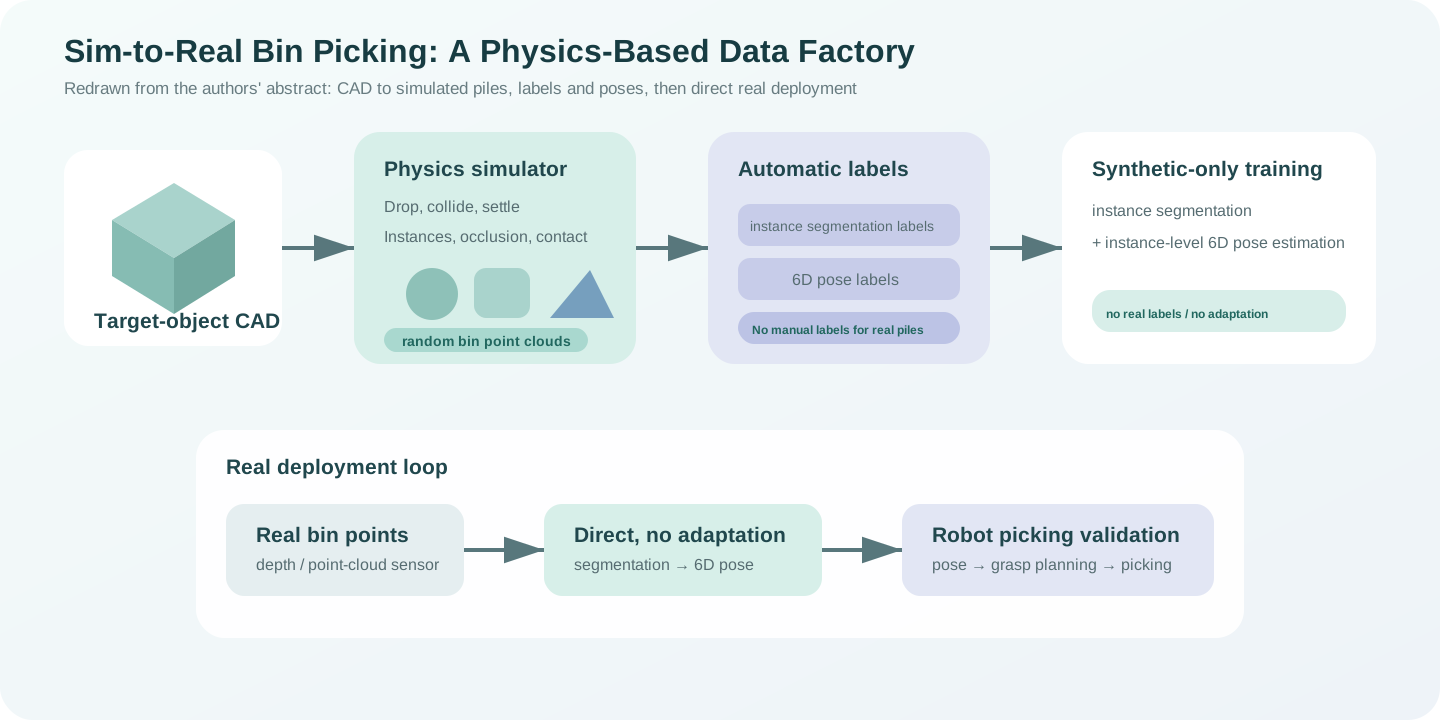
Target CAD and a physics simulator automatically generate random piles, instance segmentations, and pose annotations. Training uses only synthetic point clouds, followed by deployment to real bins without additional domain adaptation and integration into a robot-picking loop. The public abstract reports competitive synthetic recall / accuracy and improved real grasp success without numerical results.
Task: same-type multi-instance segmentation and 6D pose in random industrial piles, for robotic picking
Inputs / priors: real or simulated point clouds, target CAD, physics simulation
Availability at compilation: full text was not open access; ResearchGate stated “No full-text available”; no public author code or data was found
2. One-sentence summary
The method replaces costly real-bin instance / pose labels with a data factory: simulate CAD piles, automatically export point clouds, masks, and poses, train on synthetic data only, then deploy without additional adaptation and validate real robotic picking.
3. Method pipeline
Dense piles of identical, touching, occluding parts are harder than clean single objects. Annotators must separate each instance and label its camera-relative 6D pose, at much greater cost than ordinary 2D boxes.
Train point-cloud segmentation and instance-level pose estimators;
Process real bins without real training data or extra domain adaptation;
Use estimated poses in real robot bin picking.
Redrawn by this site from the authors' public abstract, rather than an original paper figure. Networks, simulators, and parameters are undisclosed; only verified data / deployment paths are shown. Paper content copyright belongs to the authors; redraw for academic analysis. Source: Sim-to-Real Bin Picking Pose, ICRA 2024.
4. Experimental evidence
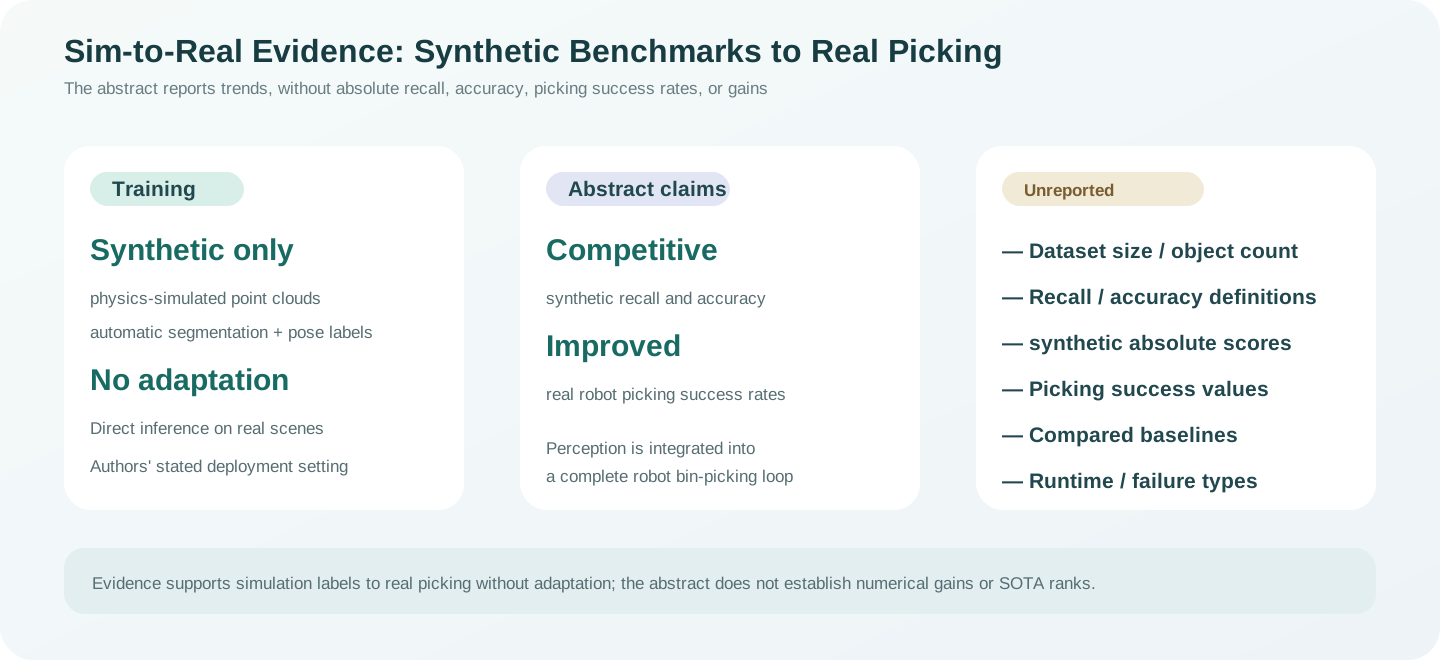
The public abstract reports two findings:
Competitive synthetic-dataset recall / accuracy;
Substantially improved success after integration into real robotic bin picking.
No absolute values, gains, object counts, data scale, baselines, or runtime are disclosed in the abstract.
Compiled by this site from DOI metadata and the authors' public abstract. Invented bars do not substitute for undisclosed recall, accuracy, or picking success. Source: paper DOI.
Evidence supports synthetic-only training → real deployment without adaptation → robot picking. Available materials cannot establish numerical gains, SOTA rankings, or throughput comparisons.
5. Value and limitations
Value:
Automatically label every densely piled instance;
Avoid real training data and self-supervised adaptation;
Point clouds reduce RGB material / lighting appearance gaps;
Validate a real grasping pipeline beyond pose alone.
Limitations / risks:
Target-specific: new parts require CAD and may need new simulation / training;
Ideal simulation may miss depth noise, holes, and edge outliers;
Incorrect friction, collisions, or pile distributions shift visibility statistics;
Picking success combines pose, planning, collision handling, and grippers, rather than measuring pose alone;
Without public full text / code, engineering costs remain unclear.
6. Coarse-reading assessment
This is known-object, zero-real-label, fully simulated training, rather than zero-shot unseen-object pose. It suits stable industrial product lines with available CAD and expensive labels, with less suitability for frequently changing unknown objects that cannot be retrained.
Available src/paper-notes/sim-to-real-bin-picking-icra2024/deep.md
In-depth paper notes
Support reproduction, comparison, related-work writing, and identifying opportunities for further research.
Deep Reading Notes: Sim-to-Real Object Pose Estimation for Random Bin Picking
1. Research positioning
In industrial random bin picking, identical, often textureless parts touch and occlude one another. Robots must separate visible instances, estimate camera-relative 6D poses, and select feasible collision-free grasps.
The central bottleneck is real-label cost. Annotating one piled point cloud requires more than category labels:
Separate visually identical touching instances;
Associate each with CAD;
Label accurate R∈SO(3) and t∈R3;
Handle symmetric poses, occlusion, and unseen surfaces.
Instead of real labels or deployment-time unlabeled adaptation, physical simulation supplies all supervision.
Here Ps is the bin scene, Ps(j) the j-th visible instance, and Tco(j) its CAD-object-to-camera transform.
The subtasks strongly interact:
Merged touching instances leave points unexplained by one rigid body;
Missing important surfaces weaken pose constraints;
Pose errors affect approach, collision checks, and instance selection.
Simulation must cover real instance boundaries, occlusion ratios, and contacts, beyond producing plausible-looking points.
3. Automated synthetic-data factory
The public abstract confirms:
Import target CAD;
Simulate random piles;
Export simulated points;
Automatically label instance segmentation;
Automatically label instance poses.
Physics produces stable piles through gravity, collisions, and contact, rather than arbitrary floating placements. Simulator transforms provide exact 6D labels, while instance-ID buffers can generate masks.
Redrawn by this site from the authors' public abstract, rather than an original paper figure. Simulators, sensor-noise models, networks, and grasp hardware are undisclosed; only verifiable data flow is shown. Paper content copyright belongs to the authors; redraw for academic analysis. Source: Sim-to-Real Bin Picking Pose, ICRA 2024.
4. Why might point-cloud transfer be easier than RGB?
RGB simulation must match materials, textures, light, exposure, shadows, and backgrounds. Points retain geometry while removing surface-color differences, concentrating gaps in:
Quantization and depth noise;
Systematic errors at oblique surfaces;
Missing reflective / dark surfaces;
Flying pixels at edges;
Camera views, resolution, and cropping;
Real pile-pose distributions.
Accurate CAD, realistic occlusion distributions, and suitable sensor corruptions can make synthetic points transfer more easily than photorealistic RGB.
Geometry alone still has domain gaps. Repeated planes, cylinders, and symmetric holes create ambiguity; metallic depth dropouts can make ideal-CAD simulation particularly misleading.
5. Training and deployment boundaries
The abstract explicitly states:
Training uses simulated data only;
Real deployment needs no additional adaptation;
The method is integrated into real robot bin picking.
Distinguish neighboring settings:
Setting
Target CAD?
Real training data?
Retrain new objects?
Proposed synthetic-only, object-specific
Yes
No
Usually
Sim-to-real self-training
Yes
Unlabeled real data
Usually
Zero-shot CAD-template methods
Yes
Depends
No object-specific training
Category-level methods
No instance CAD
Category data may be needed
Not for new within-category instances
Seamless real-world application means no real-domain adaptation; new CAD may still need fresh generation / training.
6. Results and evidence levels
The abstract reports:
Competitive synthetic recall / accuracy;
Substantially improved real robotic picking success.
Compiled by this site from DOI metadata and the authors' public abstract. With no specific numbers available, this figure avoids fabricated recall / accuracy / picking-success bars. Source: paper DOI.
6.1 Synthetic recall / accuracy
The abstract does not define recall over segmentation, pose thresholds, or both, nor accuracy thresholds / symmetry handling. These cannot be mapped to ADD(-S), BOP AR, or 5°5cm.
6.2 Real robot picking success
Real picking is valuable downstream evidence, with success decomposable into:
Any stage can change the result. Improved success suggests system-level value, but unavailable full text prevents attributing all gains to pose or classifying segmentation, pose, collision, and grasp failures.
7. Critical engineering variables
Even fixed networks depend on simulation choices.
7.1 Pile distributions
Drop heights, object counts, initial poses, friction, restitution, mass, and collision meshes determine stable poses / occlusions. Loosely random simulated piles can mismatch tightly packed real parts.
7.2 Virtual depth sensors
Match:
Intrinsics and working distance;
depth quantization;
Range-dependent noise;
Edge holes and outliers;
Reflective-surface dropouts;
Crop and voxel resolution.
The abstract does not distinguish geometric sampling from sensor-aware corruption.
7.3 CAD fidelity
Chamfers, holes, wear, burrs, and assemblies can depart from design CAD. These change correspondences; small details may be the only symmetry-breaking pose cues.
8. Possible network roles, beyond verified paper facts
The abstract identifies learned point-cloud segmentation and instance-level pose, without specifying:
segmentation backbone;
Correspondence, keypoint voting, direct regression, or point-pair features;
Joint or separate segmentation / pose training;
ICP refinement;
Symmetry handling;
Hypothesis counts per inference.
Reproduction needs these details, but familiar methods cannot fill the gaps. Site metadata retains only verified point-cloud, segmentation, pose, and sim-to-real tags.
9. Failure modes
Merged instances: touching identical parts may have nearly invisible boundaries.
Heavy occlusion: one plane / arc gives insufficient pose constraints.
Symmetry: equivalent poses complicate rotation losses and grasp requirements.
Missing depth: metallic, dark, or oblique surfaces become sparser than simulation.
CAD mismatch: physical parts differ from nominal models.
Grasp coupling: accurate poses still need feasible approaches and nearby collision clearance.
10. Checks requiring the full paper
Simulator, object / scene / point counts, and training scale;
Physics parameters and randomization ranges;
Virtual cameras, depth noise, and dropout models;
Segmentation and pose architectures;
Pose representations, losses, and symmetry handling;
Synthetic recall / accuracy definitions and absolute scores;
Real objects, sensors, arms, grippers, and trial counts;
Picking baselines, gains, and failure types;
Whether real fine-tuning, threshold tuning, and calibration data are entirely absent;
New-object generation plus training time;
Inference hardware / speed and robot cycle time.
11. Research takeaways
The main lesson is to treat generation as part of system design:
Fit depth corruptions from a few unlabeled real scans, without pose supervision;
Generate hard synthetic piles from deployment failures;
Combine pose metrics with grasp feasibility, prioritizing errors affecting decisions;
Output symmetry-equivalent or grasp-equivalent pose sets;
Report new-CAD-to-deployable-model time alongside inference FPS.
Stable industrial products with existing CAD may favor object-specific synthetic training over fully general zero-shot solutions. Real picking supports feasibility, but unavailable full text / scores make this methodological and system-trend evidence, rather than a reproducible leaderboard entry.