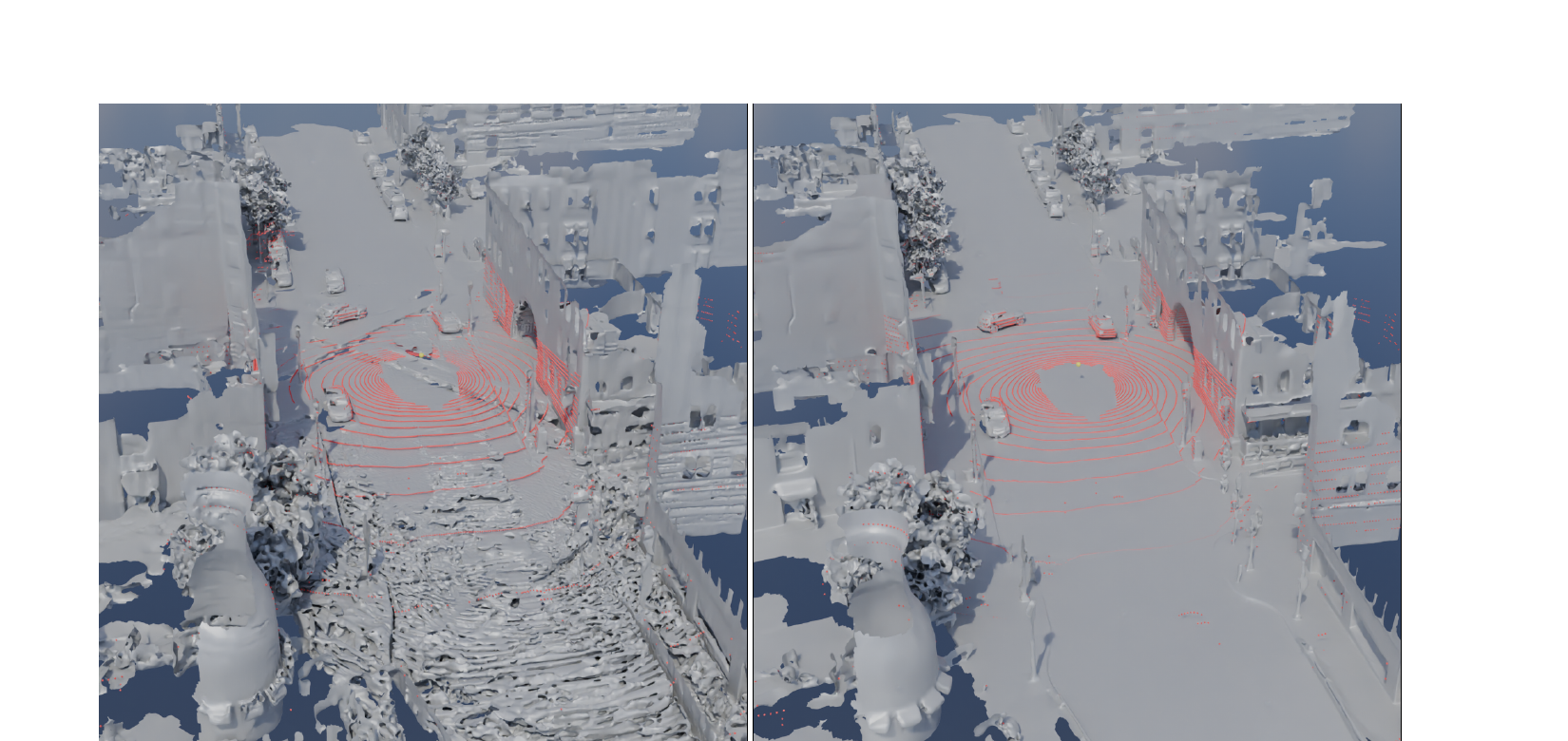
SMORE jointly optimizes ego trajectories, moving rigid-object trajectories, and global surfaces in vehicle LiDAR sequences. Continuous-time compensation for both ego and object motion removes scan distortion, while explicit surfaces anchor registration geometrically.
3. Problem setting
Inputs: spinning LiDAR sweeps, initial ego odometry, and coarse dynamic-object tracks from detection / tracking.
Outputs: refined ego / object pose sequences plus background and object surfaces.
Scenes: nuScenes and Argoverse 2 driving sequences.
This is dynamic state / surface reconstruction, with different protocols from single-image 6D object pose.
4. Method overview
Build continuous-time SE(3) trajectories for ego and actors, accounting for acquisition times within each sweep.
Deskew / aggregate points, then reconstruct background and objects with Neural Kernel Surface Reconstruction.
Alternate robust point-to-plane ICP / Huber registration updates for ego, actors, and surfaces.
Registration–reconstruction alternation turns coarse box tracks into geometrically consistent trajectories.
5. Experiments at a glance
Surfaces with GT tracks: NN distance drops from NKSR 0.071 to 0.048, with strict coverage 0.91. LT3D tracks retain 0.048 / 0.90.
Actor ATE at 1 Hz / 0.5 Hz / 0.25 Hz labels: 0.20 / 0.22 / 0.52 m, versus linear interpolation 0.29 / 0.40 / 0.74 m.
LiDAR NVS: Chamfer 0.26, median depth error 0.0002; the authors report substantial gains over NeuRAD.
6. Strengths, weaknesses, and reading assessment
Strengths
Explicit rotating-LiDAR timing avoids treating sweeps as synchronized exposures.
Global geometry corrects ego and object poses together, supporting long sequences.
Offline optimization depends on detections / tracking, with different costs from real-time tracking.
Some reconstruction / pose claims lack independent GT and rely on indirect geometric evidence.
Occlusion, sparse points, and association errors damage trajectories and surfaces jointly.
7. Research takeaways
Multiframe pose should make motion-compensated observations explain one surface, beyond smooth trajectories alone. Surface errors can supervise pose more effectively than box interpolation.
Available src/paper-notes/smore-3dv2025/deep.md
In-depth paper notes
Support reproduction, comparison, related-work writing, and identifying opportunities for further research.
Deep Reading Notes: SMORE: Simultaneous Map and Object REconstruction
1. Basic information
Method: SMORE
Authors / affiliations: Nathaniel Chodosh, Anish Madan, Simon Lucey, Deva Ramanan; Villanova University, Carnegie Mellon University, University of Adelaide
SMORE models urban spinning-LiDAR sequences through continuous-time surfaces for background and rigid actors. Deskewing, robust ICP, and neural reconstruction alternate to correct ego poses, object poses, and maps, beyond treating box annotations as final motion truth.
2.1 Guide to the paper’s figures and tables
Figure / table
Content
Reading focus
Figure 1
Annotation-only aggregation versus joint reconstruction
Pose errors create duplicated / smeared surfaces
Figure 2
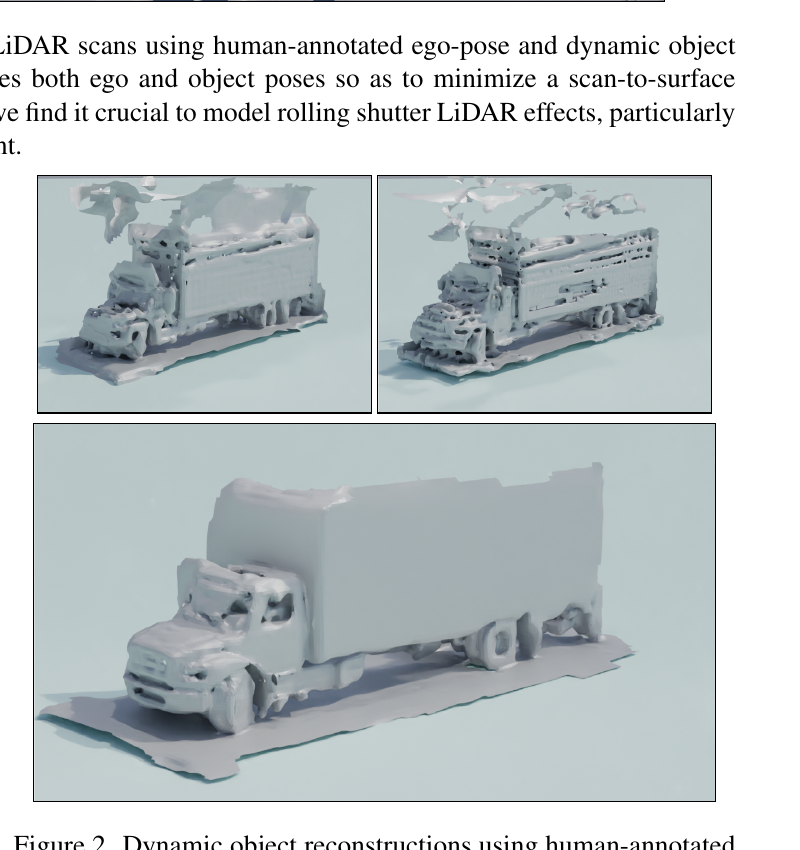
Coarse actor boxes, pose optimization, then deskewing
Scan timing affects actors as well as ego
Tables 1–2
Surface quality, actor ATE, annotation subsampling
Recover states from sparse / coarse tracks
Tables 3–4
LiDAR NVS and ego-pose evaluation
Cross-check geometry and motion quality
Original Figure 1: LiDAR reconstruction from initial annotated poses at left, versus jointly optimized SMORE at right. Source: arXiv PDF. Image copyright belongs to the authors and publisher; reproduced here for paper analysis.Original Figure 2: actor reconstruction under coarse annotations, pose optimization, and deskewing. Source: arXiv PDF. Image copyright belongs to the authors and publisher; reproduced here for paper analysis.
3. Setting and meaning of object pose
Spinning LiDAR sweeps, initial ego poses, and actor boxes / tracks; returns have different within-sweep timestamps.
Outputs: background / actor surfaces, actor rigid-pose sequences, and corrected ego trajectories.
Simultaneous map and object reconstruction: poses are global sequence states rather than single-image RGB object-to-camera estimates.
Actors are approximately rigid and associable through detection / tracking; LiDAR timestamps are available.
4. Why model continuous-time LiDAR explicitly?
Spinning LiDAR is not a global shutter. Ego / object motion changes relative poses within each sweep; one sweep timestamp creates smeared cars and duplicated maps. Ego-only deskewing misses actor motion, which SMORE additionally compensates.
Wrong poses produce wrong surfaces, but reconstructed surfaces can correct poses through registration. This motivates alternating geometry and motion optimization.
5. Method details
5.1 State representation and alternating optimization
Background / actor points map to their own world / canonical frames. Continuous-time SE(3) trajectories explain exact acquisition times:
Initialize ego / actors from odometry and detection / association.
Deskew / aggregate using current trajectories; reconstruct separate neural kernel surfaces.
Optimize ego / object poses against surfaces using point-to-plane residuals with Huber kernels.
Update points / surfaces and iterate until registration converges or stops early.
Component
Problem
Pose relationship
Continuous-time deskewing
Within-sweep motion distortion
Restore each point to its correct observer / actor pose
Object-centric surfaces
Actors overwhelmed by background
Supply local geometric anchors
Point-to-plane ICP
Boxes give coarse locations
Refine rigid transforms through normal-direction residuals
Joint ego / actor updates
Coupled errors
Avoid transferring one fixed side’s errors to the other
5.2 Reconstruction and optimization beyond end-to-end learning
Neural Kernel Surface Reconstruction handles surfaces without training an end-to-end pose network. After updates, train / test sweeps undergo refinement; about 100 test refinement iterations use mean-registration early stopping. Interpretability comes with runtime / initialization costs requiring separate evaluation.
surface: input-to-surface nearest-neighbor distance, 10 cm / 5 cm relaxed / strict coverage.
Pose: actor-location Average Translation Error against held-out boxes.
LiDAR NVS: Chamfer / median depth; NeuRAD PSNR / SSIM / LPIPS across ego-pose variants indirectly assess motion quality.
Public actor / ego GT annotations themselves are imperfect, without defining an absolute reconstruction upper bound. Complementary metrics help, but some pose evidence remains indirect.
6.2 Key numbers
Result
Values
Interpretation
NKSR + GT tracks
NN distance 0.071; strict coverage 0.76
Initial-track aggregation leaves poor surfaces
SMORE + GT tracks
0.048; 0.91
Joint motion / surfaces improve consistency
SMORE + LT3D tracks
0.048; 0.90
Tracker starts approach GT-track quality
Actor ATE, 1 / 0.5 / 0.25 Hz
0.20 / 0.22 / 0.52 m
More robust than interpolation under sparse labels
LiDAR NVS
CD 0.26, median depth 0.0002
Reported gains over NeuRAD and its pose variants
6.3 Interpreting results
Tables 1–2 and Figures 1–2 support improved poses from noisy annotations, especially actor ATE under sparse labels. Ego-pose evidence is less direct: the same NeRF backend fitted to nuScenes, odometry, and SMORE poses gives better SMORE rendering / geometry. This is useful evidence, distinct from independent high-precision GNSS/INS pose GT.
7. Limitations, failures, and reproduction
Association: missed detections, ID switches, or wrong boxes create incorrect surfaces and local ICP solutions.