SpotPose addresses two central bottlenecks in category-level correspondence pipelines: shape-sensitive / pose-invariant features and outlier removal. Incorrect correspondences are explicitly filtered before fitting.
SpotPose identifies two essentials: shape-sensitive, pose-invariant descriptors, followed by explicit correspondence-outlier removal before pose fitting.
3. Problem and motivation
NOCS / correspondence prediction without shape discrimination and pose stability propagates systematic errors into Umeyama fitting.
A few incorrect point correspondences can strongly bias rigid / similarity transforms.
4. Method overview
Extract dense pointwise features from RGB-D / point-cloud observations.
Use local / global geometry to improve shape-sensitive, pose-invariant correspondences.
Score and remove outliers before final pose / size fitting.
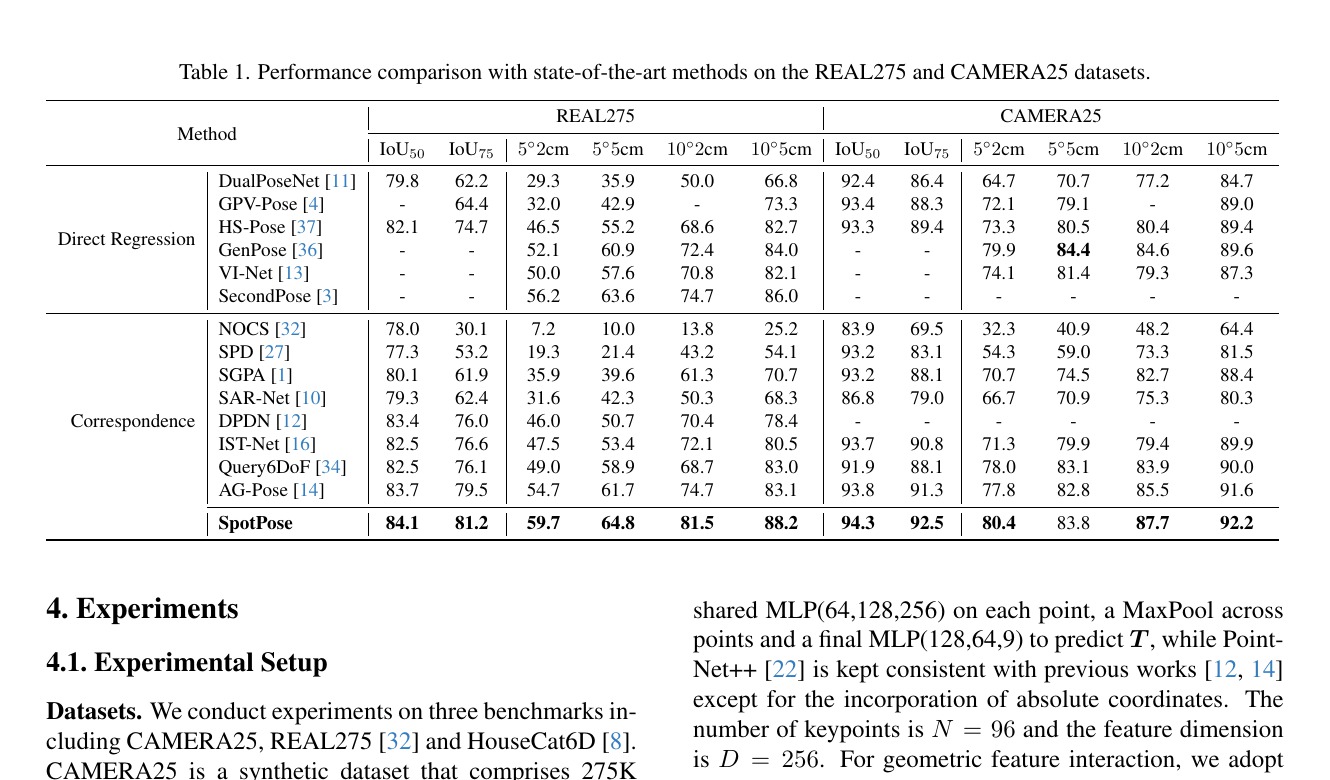
Original Table 1: 3D IoU and joint rotation / translation thresholds on REAL275 / CAMERA25, grouped into direct-regression and correspondence-based methods. Source: CVPR 2025 paper PDF. Image copyright belongs to the authors and publisher; reproduced here for paper analysis.
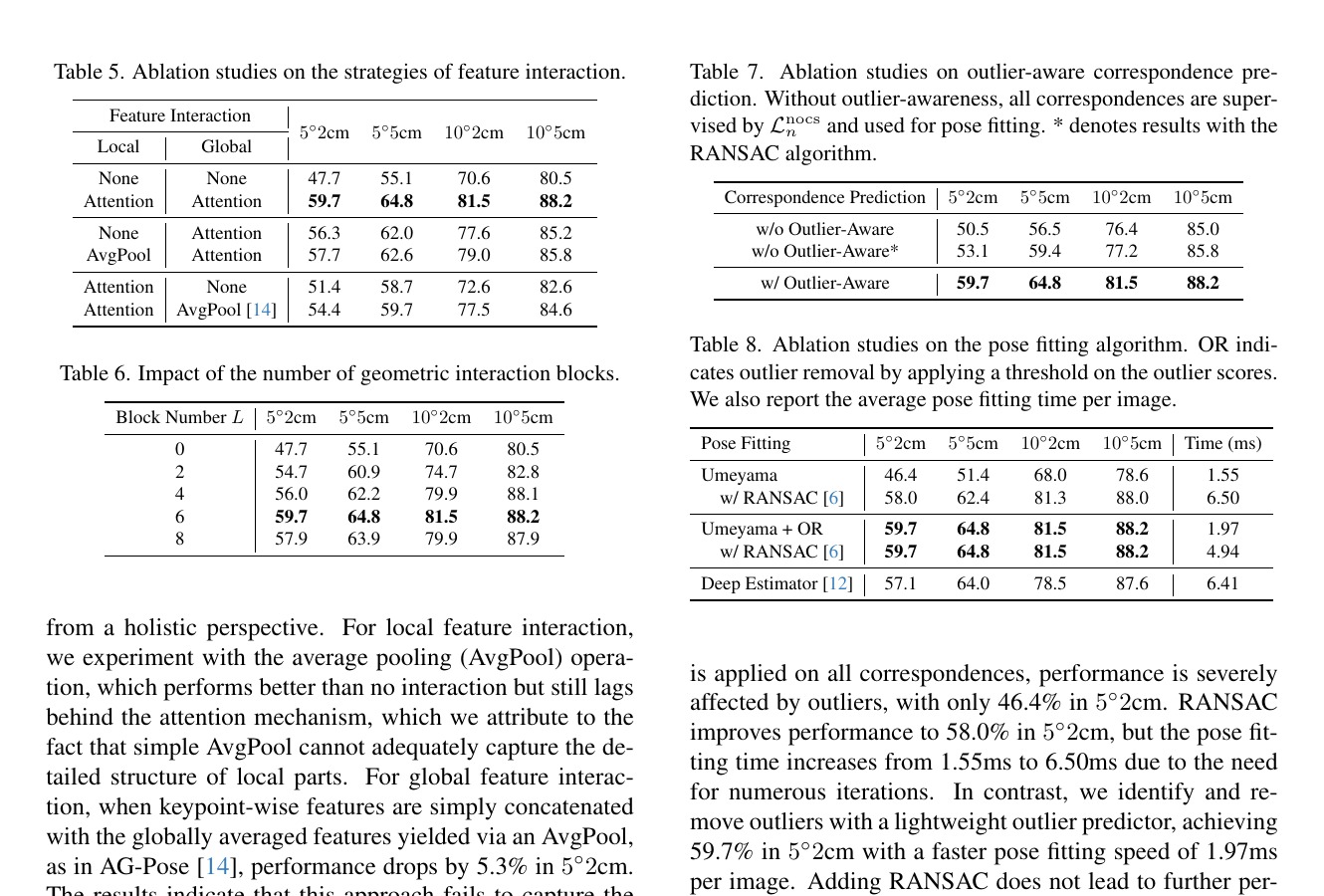
Learned outlier removal raises 5°2cm from 50.5 to 59.7; adding RANSAC afterward remains at 59.7. Gains mainly reflect learned outlier identification rather than heavier random sampling.
6. Quick assessment
Value: separates representation quality from robust estimation within better correspondence prediction.
Boundary: requires usable object point clouds; depth noise, symmetry, and missing geometry still affect descriptors.
Available src/paper-notes/spotpose/deep.md
In-depth paper notes
Support reproduction, comparison, related-work writing, and identifying opportunities for further research.
Deep Reading Notes: Rethinking Correspondence-based Category-Level Object Pose Estimation
Problem: two-stage category-level pipelines often optimize NOCS / correspondence regression while overlooking shape discrimination, pose stability, and outlier effects on final fitting.
Answer: improve correspondences through shape-sensitive, pose-invariant features and explicitly remove outliers before pose fitting.
2. Positioning in one sentence
SpotPose diagnoses the paradigm: correspondence prediction also needs discriminative / invariant features and robust geometric fitting, beyond a coordinate map alone.
2.1 Guide to the paper’s figures and tables
Figure / table
What to look for
Figure 1
Why poor correspondences and fitting outliers amplify pose errors nonlinearly.
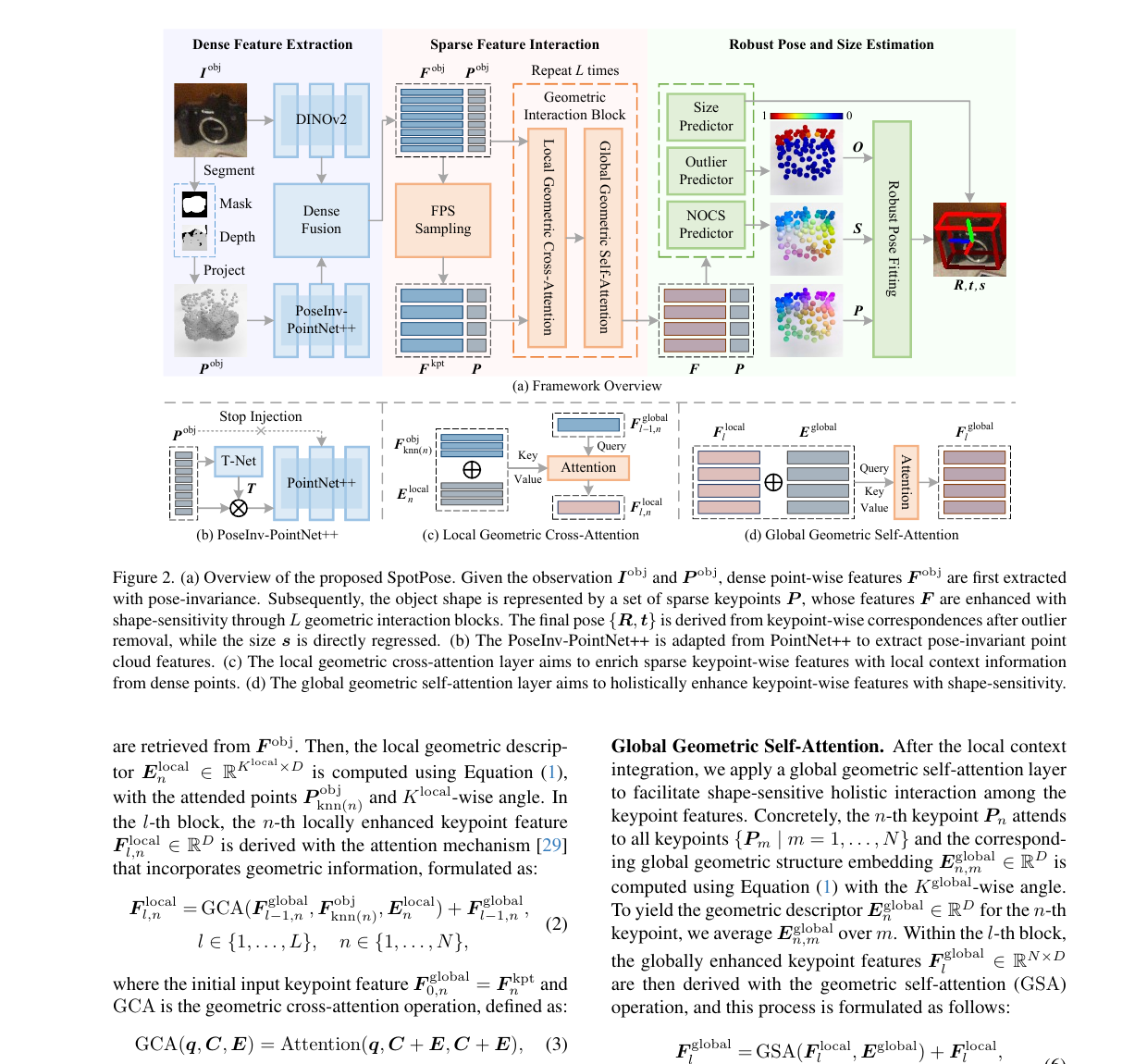
Figure 2
Dense features, descriptors, outlier removal, and pose fitting.
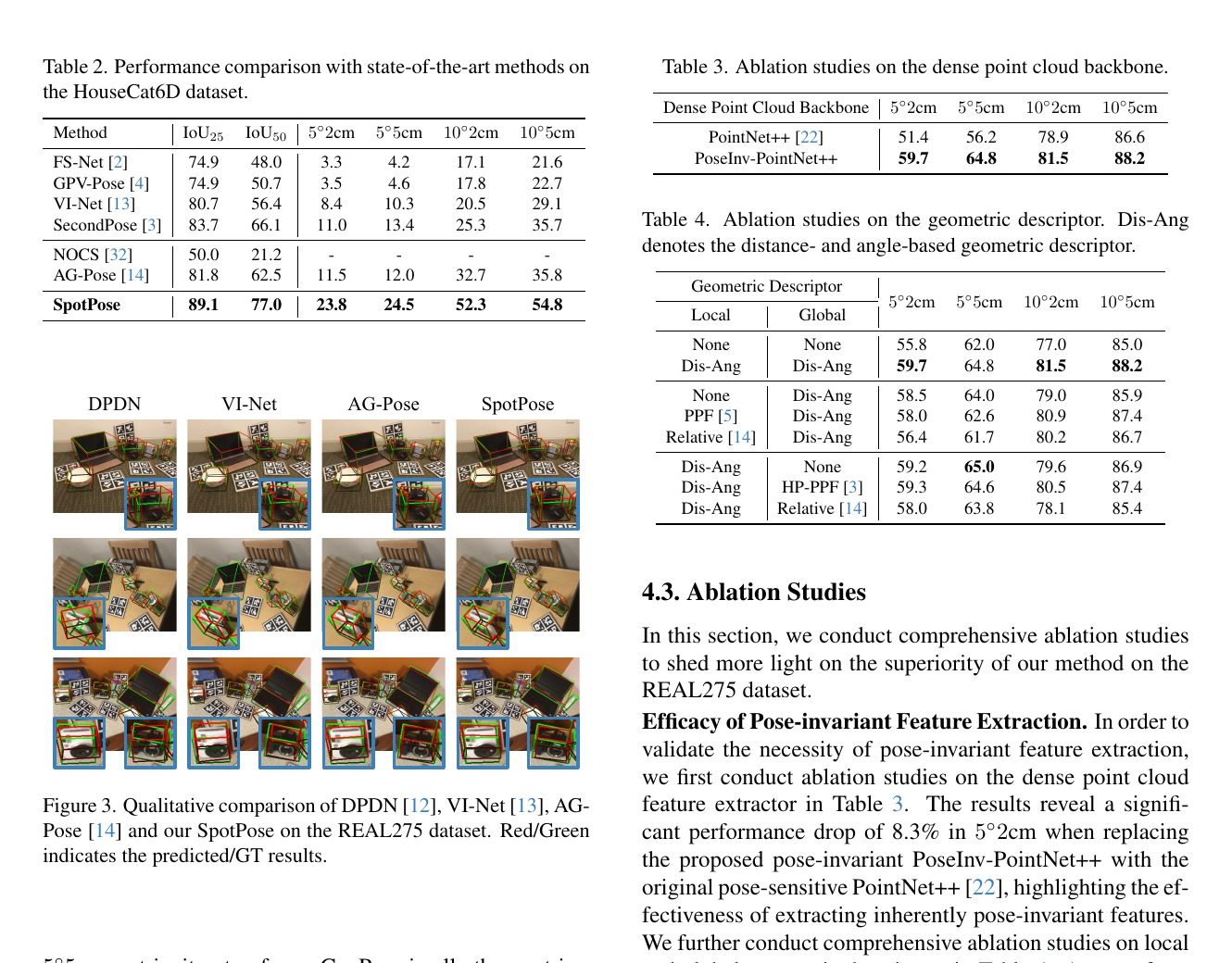
Tables 1–2
Differences in priors / modalities across REAL275, CAMERA25, and HouseCat6D.
Tables 3–7
Roles of backbones, geometric descriptors, feature interaction, and outlier strategies.
Original method excerpt: learn shape-sensitive, pose-stable features, remove correspondence outliers, then fit poses. Source: CVF Open Access. Image copyright belongs to the authors and publisher; reproduced here for paper analysis.
3. Problem setting and boundaries
Inputs: RGB-D / object point clouds. Outputs: unseen within-category instance poses / sizes, typically through NOCS-like correspondences and similarity fitting.
Generalization stays within trained categories; arbitrary new categories remain outside scope.
Feature extraction: dense pointwise observations combining local geometry with global shape.
Descriptor design: invariant geometry matches corresponding structures while shape-sensitive discrimination avoids mixing different instance surfaces.
Outlier-aware prediction: score / filter correspondences before fitting, reducing contamination of rigid / scale transforms.
5. Experimental analysis
Dataset / metric
AG-Pose
SpotPose
Gain
REAL275 5°2cm
54.7
59.7
+5.0
REAL275 10°5cm
83.1
88.2
+5.1
CAMERA25 5°2cm
77.8
80.4
+2.6
HouseCat6D 5°2cm
11.5
23.8
+12.3
HouseCat6D IoU50
62.5
77.0
+14.5
Larger HouseCat6D gains than CAMERA25 fit the motivation: clutter, shape variation, occlusion, and depth anomalies leave more room for invariant descriptors / outlier removal. High synthetic CAMERA25 scores alone cannot establish deployment quality.
Original Tables 2–4 and Figure 3: HouseCat6D results, DPDN / VI-Net / AG-Pose / SpotPose qualitative comparisons, and point-backbone / local-global descriptor ablations. Source: CVPR 2025 paper PDF. Image copyright belongs to the authors and publisher; reproduced here for paper analysis.
Replacing PointNet++ with PoseInv raises REAL275 5°2cm / 5°5cm from 51.4 / 56.2 to 59.7 / 64.8, substantively supporting invariant features.
Without local / global descriptors, 5°2cm is 55.8; combined Dis-Ang descriptors reach 59.7. Local neighborhoods and global shape cues complement each other under instance deformation.
Feature interaction raises 47.7 / 55.1 without interaction to 59.7 / 64.8 with local and global attention. Increasing blocks from 0 to 6 helps, but 8 drops to 57.9; depth gains are not monotonic.
Original Tables 5–8: local / global attention, interaction depth, outlier-aware prediction, and pose-fitting options. Learned removal reaches the best accuracy with less runtime. Source: CVPR 2025 paper PDF. Image copyright belongs to the authors and publisher; reproduced here for paper analysis.
Key solver comparison: Umeyama 46.4 (1.55 ms), RANSAC 58.0 (6.50 ms), Umeyama + learned removal 59.7 (1.97 ms), plus RANSAC still 59.7 (4.94 ms). Improvements come from earlier correspondence quality control rather than more expensive test-time solving.
6. Authors’ claims and my assessment
Authors’ claims
My assessment
Invariant, shape-sensitive features matter
Backbone 5°2cm 51.4→59.7 and full-descriptor 55.8→59.7 directly support this; symmetry / visibility breakdowns remain needed.
Outlier removal improves fitting
Removal + Umeyama scores 59.7 versus RANSAC 58.0 at lower runtime; cross-dataset threshold calibration still needs reporting.
7. Reproduction considerations and limitations
Fix point sampling, normal / RGB preprocessing, NOCS conventions, solvers, and outlier thresholds.
Depth noise / heavy occlusion can jointly damage descriptors and outlier confidence.
Real-time comparisons need total dense-correspondence, filtering, and RANSAC / solver costs.