SurgiPose: Estimating Surgical Tool Kinematics from Monocular Video for Surgical Robot Learning
SurgiPose initializes 324 candidates from a 3×3 mask-center grid and 36 viewing-axis angles, then jointly refines tool 6D pose and three joint angles with joint-conditioned 3D Gaussian Splatting. Subsequent frames use warm-start optimization. ADE on two tasks is 9.7 / 12.0 mm; ACT policies supervised by estimated trajectories achieve 70% / 60% success versus 100% / 80% with ground truth. Speed and quantitative cross-dataset generalization remain unreported.
monocular endoscopic RGB videoSAM2 instrument masksknown surgical-tool URDFsynthetic multi-view articulated renderswrist-camera RGB for downstream policy only
Requirements
known tool geometry and joint limitscamera intrinsicsper-tool articulated 3D Gaussian modelaccurate first-frame segmentationboth jaws visible at initializationcontinuous tool visibilityMuJoCo synthetic training data
Full paper metadataAuthors, affiliations, research area, datasets, metrics, method tags, and reading statusExpandCollapse
Authors
Juo-Tung Chen, XinHao Chen, Ji Woong Kim, Paul Maria Scheikl, Richard Jaepyeong Cha, Axel Krieger
known tool geometry and joint limitscamera intrinsicsper-tool articulated 3D Gaussian modelaccurate first-frame segmentationboth jaws visible at initializationcontinuous tool visibilityMuJoCo synthetic training data
Reading Notes
Overview / Deep Dive
Available src/paper-notes/surgipose-iros2025/coarse.md
Paper overview notes
Quickly assess the paper's scope, problem setting, core method, experimental findings, and whether to read it in depth.
Overview Notes: SurgiPose
1. Basic information
Title: SurgiPose: Estimating Surgical Tool Kinematics from Monocular Video for Surgical Robot Learning
Authors: Juo-Tung Chen, XinHao Chen, Ji Woong Kim, Paul Maria Scheikl, Richard Jaepyeong Cha, Axel Krieger
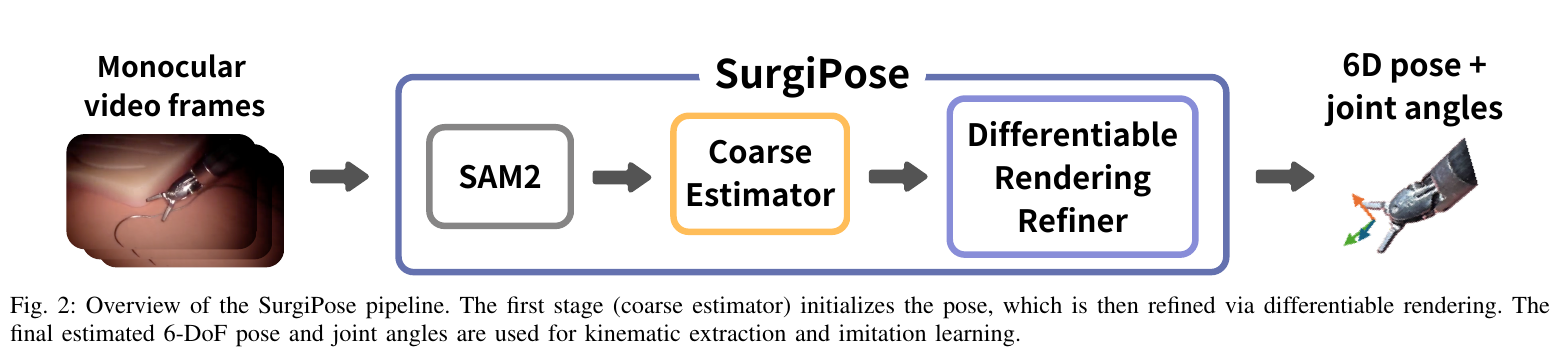
SAM2 segments monocular surgery video; a 3×3 image grid and 36 optical-axis rotations provide 324 first-frame starts. Joint-conditioned 3D Gaussian rendering refines end-effector pose / three joints. Two dVRK Si tasks give ADE 9.7 / 12.0 mm; estimated-label policies succeed 70% / 60%, versus GT-label 100% / 80%.
3. Guide to figures and tables
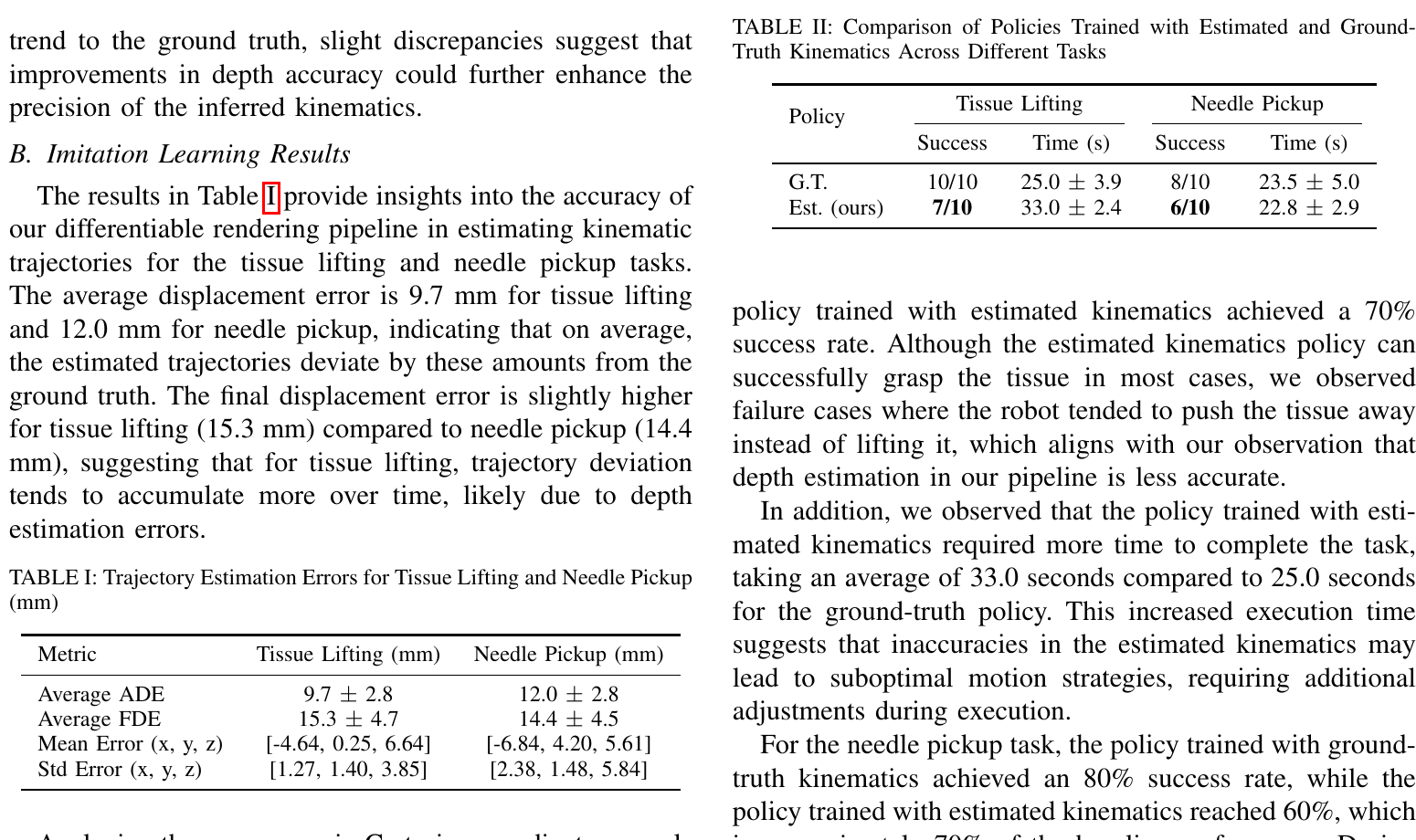
Original Figure 2: SAM2 segments tools, coarse initialization handles the first frame, and differentiable refinement estimates poses / joints; later frames start from preceding predictions. Source: authors' public manuscript. Image copyright belongs to the authors and IEEE; reproduced here for paper analysis.Original Tables I–II: depth errors dominate. Estimated-trajectory policies succeed 7/10 and 6/10 on tissue lifting / needle pickup, versus GT supervision 10/10 and 8/10. Source: authors' public manuscript. Table copyright belongs to the authors and IEEE; reproduced here for paper analysis.
4. Problem setting
Inputs: monocular endoscopic video, intrinsics, and target-tool URDF / geometry.
Frontend: SAM2 tool masks / crops per frame.
Outputs: camera-relative end-effector pose TCE∈SE(3) and pitch / bilateral jaw angles, three articulation freedoms.
Goal: recover demonstration trajectories from videos without robot state, providing imitation action labels.
Platform: dVRK Si PSM, large needle driver, fixed endoscope. Policy training additionally uses wrist imagery; pose estimation does not.
Each tool needs URDF and a joint-conditioned Gaussian renderer trained with MuJoCo multiview synthesis; arbitrary-tool single-image foundation inference is outside scope.
5. Method overview
First-frame initialization
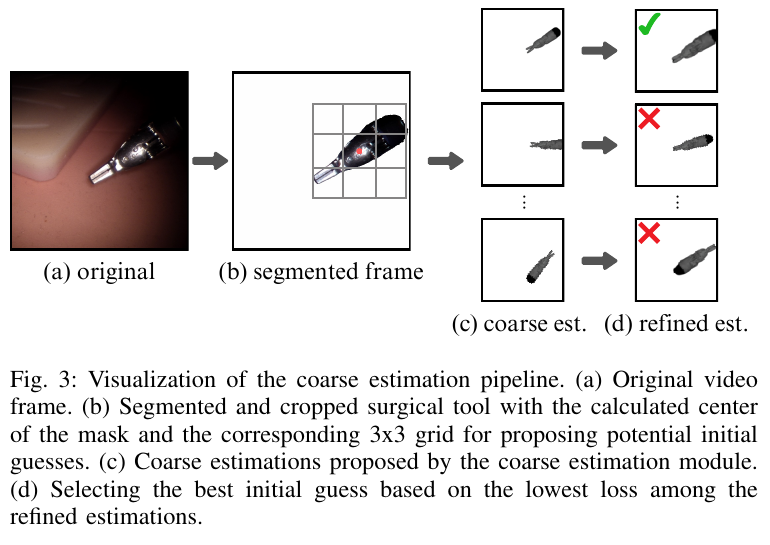
Center a 3×3 image-plane grid on the SAM2 mask.
Each grid point gets 36 rotations from 0 to 2π around optical z, totaling 9×36=324 candidates.
Coarse search omits image x/y rotations and depth, relying on refinement.
Refine every candidate, rank pixel-averaged loss, and select first-frame TCEinitial.
Rendering and framewise optimization
MuJoCo generates 500 neutral configurations and 10,000 collision-free random joint configurations, each from 12 random cameras.
Learn canonical 3D Gaussians, articulation deformation, then train jointly for 20,000 iterations.
Test-time objective:
L=0.8(1−SSIM(Iren,Iobs))+0.2∥Iren−Iobs∥22.
Jointly descend pose / three angles, clamped to physical bounds.
Later frames start from preceding poses, with up to 10 steps and plateau stopping.
Reestimate both sets from video and separately train ACT policies.
Policies use endoscope / wrist images and hybrid-relative actions: endoscope-frame translation, current-end-effector-frame rotation, and jaw commands.
Pretrained EfficientNet-B3 encoder; about 20 training hours on RTX 4090.
SurgRIPE and captured ex vivo cholecystectomy / ProGrasp examples provide qualitative overlays only.
7. Results at a glance
Trajectory estimation
Metric
Tissue lifting
Needle pickup
ADE ↓
9.7 ± 2.8 mm
12.0 ± 2.8 mm
FDE ↓
15.3 ± 4.7 mm
14.4 ± 4.5 mm
Mean error (x,y,z)
[−4.64,0.25,6.64] mm
[−6.84,4.20,5.61] mm
Monocular scale / depth is weakest: mean z biases are 6.64 mm and 5.61 mm, with tools estimated too far from cameras.
Imitation learning
Kinematic supervision
Tissue lifting
Needle pickup
Ground truth
10/10; 25.0 ± 3.9 s
8/10; 23.5 ± 5.0 s
Estimated
7/10; 33.0 ± 2.4 s
6/10; 22.8 ± 2.9 s
Estimated labels train usable policies, but each has only 10 tests and absolute success gaps of 30 / 20 points. Comparable denotes feasibility, not statistical equivalence.
8. Quick assessment
Highlight: estimation quality is tested through policy learning beyond visual overlays.
Visibility dependence: occlusion propagates errors; both jaws must be visible initially.
Depth failures: silhouette / appearance scale–depth ambiguity causes z bias and tissue-pushing failures.
Online-video ambition: main quantitative data use synchronized dVRK captures, fixed cameras, known intrinsics, and matched models, without policy learning from public online videos.
Weak transfer evidence: SurgRIPE / ex vivo overlays only; ProGrasp still needs a different model, rather than CAD-free zero-shot transfer.
Unknown speed: up to 10 steps per frame without extraction FPS / wall-clock reports.
Availability: dVRK / 3DGS dependencies are public; no SurgiPose code, data, or pretrained models found as of 2026-07-31.
Available src/paper-notes/surgipose-iros2025/deep.md
In-depth paper notes
Support reproduction, comparison, related-work writing, and identifying opportunities for further research.
Deep Reading Notes: SurgiPose
1. Key assessment
SurgiPose bridges surgery video without synchronized robot state to action trajectories for imitation learning:
Known URDF and an offline-trained joint-conditioned Gaussian renderer recover framewise end-effector poses / joints through render-and-compare, then adjacent states become relative actions.
The important experiment uses the same 220 / 224 demonstrations with GT or estimated labels. Roughly 1 cm trajectory errors still permit learning, but 70% versus 100% and 60% versus 80% show real costs, not lossless replacement.
2. Inputs, outputs, and hidden priors
Original Figure 2: coarse global first-frame initialization precedes differentiable 6D pose / joint refinement. Source: authors' public manuscript. Image copyright belongs to the authors and IEEE; reproduced here for paper analysis.
Direct inputs
monocular endoscopic video frames;
camera intrinsics;
Target URDF / geometry;
Pretrained articulated Gaussian renderer;
SAM2 segmentation.
Output states
TCE,t∈SE(3),qt=[qpitch,qjaw1,qjaw2]⊤.
Only three end-effector joints are modeled, rather than all PSM states. Absolute poses use camera coordinates.
Interpreting hardware independence
Test inference avoids robot encoders, stereo depth, and mocap, making existing monocular videos attractive. Priors remain:
Accurate intrinsics;
Tool URDF;
Per-tool MuJoCo data and renderer training;
Initial bilateral jaw visibility;
Continuous tool visibility;
Stable SAM2 masks.
This is model-based video-kinematics recovery without synchronized telemetry, with different assumptions from arbitrary-video model-free motion capture.
3. Producing 324 first-frame candidates
Original Figure 3: SAM2 centers a 3×3 grid; 36 optical-axis angles per position are all refined, then pixel-averaged loss selects the best. Source: authors' public manuscript. Image copyright belongs to the authors and IEEE; reproduced here for paper analysis.
Initial guess means the first video frame’s tool pose:
Compute the mask center;
Center a parallel 3×3 image-plane grid;
Generate 36 z rotations per point, spanning [0,2π);
Refinement must recover these variables. Candidates stay manageable, but weak monocular depth outside convergence basins is not solved by 324 starts. Missing experiments include:
SSIM constrains local structure / appearance; MSE retains pixel errors. SurgiPose uses articulated Gaussian appearance rather than only binary silhouettes, unlike the preceding calibration paper.
Optimization settings:
Rotation learning rate αR=0.3;
Translation learning rate β=3×10⁻⁴;
Translation-gradient clamp [−0.02,0.02];
Joint learning rate γ=10−3;
learning-rate reduction factor 0.5;
plateau patience 20 epochs;
Stop when loss changes stay below 10−7 over 10 iterations;
Clamp joints to [qmin,qmax].
The reported approximate rotation update is:
Rupdated=Rcurrent(I+αR∇R),
Then enforce a valid homogeneous transform. Projection to SO(3) is unspecified: SVD, Gram–Schmidt, and quaternion normalization differ materially.
Joint update:
qupdated=clamp(qcurrent−γ∇qL,qmin,qmax).
Bounds enforce mechanical limits without resolving pose–articulation ambiguity in monocular projections.
6. Temporal tracking
After first-frame initialization / refinement, subsequent frames:
Reuse preceding refined poses;
Optimize poses and joints jointly;
Limit optimization to 10 steps;
Stop at plateaus.
This is framewise warm-start optimization, without explicit:
velocity / acceleration motion model;
Kalman / particle filter;
optical flow;
temporal consistency loss;
re-detection / lost-state recovery;
occlusion memory.
Continuous visibility / small interframe motion allow smooth following; occlusion, exiting views, and mask jumps propagate errors. The authors explicitly require continuous visibility and both initial jaws.
Ten iterations alone do not establish real-time operation. Extraction timing, FPS, sequence lengths, and memory are unreported; hardware / time concern model and policy training only.
7. Absolute states to learnable actions
The dVRK Si setup includes:
PSM + large needle driver;
A fixed ECM endoscope defining the global frame;
A needle-driver wrist camera for policy-local imagery;
Pink suture-pad background;
White 2D tissue-lifting pad;
Surgical needles for pickup.
Only endoscopic monocular video estimates kinematics. Wrist images do not enter pose estimation, but supply additional ACT training / execution feedback.
SRT hybrid-relative actions use:
Endoscope-frame translation deltas;
Current-end-effector-frame rotation deltas;
Separate jaw commands.
Relative actions reduce encoder absolute-state effects. Policies are image-conditioned feedback systems rather than blind trajectory replays; both needle policies visually align using wrist cameras. Success therefore also depends on encoders, ACT chunks, and feedback, beyond label accuracy.
8. Data and evaluation
Main data:
tissue lifting: 220 demonstrations;
needle pickup: 224 demonstrations;
Synchronized videos and GT kinematics;
The same videos reestimated by SurgiPose.
Each task trains:
Images with GT relative actions;
Identical images with estimated relative actions.
Shared demonstrations isolate label replacement reasonably well. Splits, use of all 444 demonstrations, seeds, horizons, ACT settings, and augmentation remain unspecified.
Each policy / task has 10 trials: one sample changes success by 10 points. The 100% / 70% and 80% / 60% comparisons have substantial binomial uncertainty, without intervals or multiseed results.
9. Trajectory errors
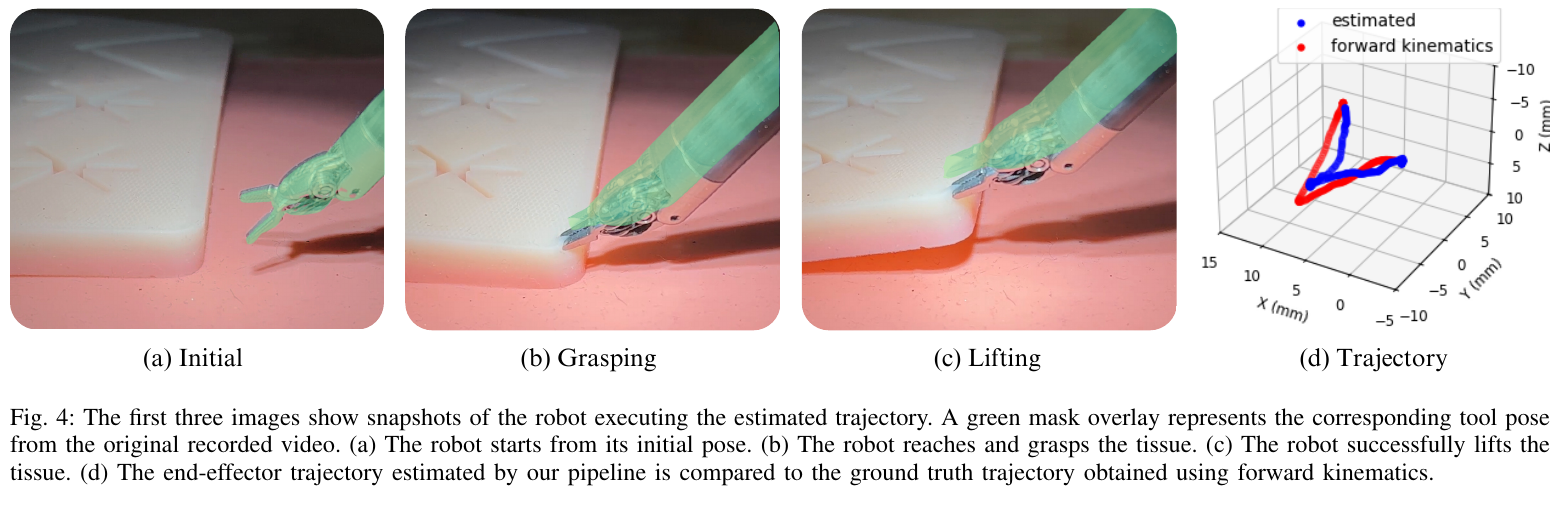
Original Figure 4: replay progresses through initial, grasping, and lifting phases. Green overlays represent original-video estimated tool poses; blue estimates broadly follow red kinematic trajectories, with depth bias. Source: authors' public manuscript. Image copyright belongs to the authors and IEEE; reproduced here for paper analysis.
Definitions:
ADE=T1t=1∑T∥p^t−pt∥,FDE=∥p^T−pT∥.
Results:
Metric
Tissue lifting
Needle pickup
ADE ↓
9.7 ± 2.8 mm
12.0 ± 2.8 mm
FDE ↓
15.3 ± 4.7 mm
14.4 ± 4.5 mm
Mean (x,y,z)
[−4.64,0.25,6.64] mm
[−6.84,4.20,5.61] mm
Std (x,y,z)
[1.27,1.40,3.85] mm
[2.38,1.48,5.84] mm
Two interpretations:
Needle pickup has greater average error, but tissue lifting slightly greater final error, suggesting different accumulation patterns.
Both tasks have positive, largest z bias, consistent with monocular scale / perspective ambiguity.
Rendering may shrink projected tools to reduce discrepancy, placing them too far from cameras. This can be systematic loss / representation bias rather than zero-mean noise.
GT comes from robot forward kinematics, itself subject to cable-driven encoder errors. Hybrid-relative actions mitigate this. These notes distinguish recorded paper GT from external physical ground truth.
10. Imitation learning has a measurable cost
Original Tables I–II. Estimated labels permit both tasks, but tissue success falls 30 points and time rises 8 seconds; needle success falls 20 points. Only 10 trials per cell, without confidence intervals. Source: authors' public manuscript. Table copyright belongs to the authors and IEEE; reproduced here for paper analysis.
Policy supervision
Tissue lifting
Needle pickup
Ground-truth kinematics
10/10; 25.0 ± 3.9 s
8/10; 23.5 ± 5.0 s
Estimated kinematics
7/10; 33.0 ± 2.4 s
6/10; 22.8 ± 2.9 s
Tissue lifting
Estimated labels reduce absolute success by 30 points;
Successful trials average an extra 8.0 s;
Pushing tissue away rather than lifting matches the depth bias;
Failed trials are excluded from timing; 33.0 s is not an all-10-trial average.
Needle pickup
GT policy success is itself only 80%, showing task / data limitations;
Estimated labels yield 60%, down 20 points;
Both policies visually align through wrist views rather than open-loop replay;
Mostly successful training demonstrations lack recovery behavior for accumulated errors.
Comparable supports useful supervision / feasibility, without statistical equivalence. Ten trials without seed variation cannot establish stable gap estimates.
11. Cross-dataset evidence
SurgRIPE
SurgRIPE uses keydot markers for absolute tool poses, then inpaints markers; it lacks joint-angle GT. SurgiPose reports random-frame qualitative silhouettes only, despite available absolute GT, without rotation / translation errors.
Ex vivo cholecystectomy
Captured ex vivo cholecystectomy includes kinematics and ProGrasp forceps. Figure 6 shows:
Blue estimates / red recorded trajectory projections;
Three segmented-tool / rendered overlays.
ADE, FDE, and joint errors remain absent. New tools need geometry / URDF and articulated Gaussians; synthetic ProGrasp counts / parameter reuse are unspecified. This does not establish arbitrary-tool zero-shot transfer.
Evidence supports operation with a second tool / ex vivo domain, without quantitative cross-tool validation.
12. Gaps toward internet-scale surgical learning
Although motivated by online video, main data use synchronized dVRK Si captures:
Fixed cameras;
Known intrinsics;
Known tool types;
Known URDFs;
Relatively controlled first poses;
Synchronized video / kinematics, unused by the estimation branch.
Public videos additionally introduce:
Compression, scaling, and unknown / changing intrinsics;
Camera motion, zoom, and cropping;
Multiple / replaced / partially visible tools;
Smoke, blood, tissue occlusion, and highlights;
Unknown robot models;
Edits, shot changes, and discontinuous trajectories;
Unknown metric scales;
Left / right and symmetric-tool ambiguities.
Current results demonstrate controlled-video feasibility rather than completed internet-scale harvesting.
3×3 spacing, initial depth, and crop normalization;
first-frame candidate refinement steps;
SAM2 prompt / tracking strategy;
SO(3) projection implementation;
pose extraction runtime;
ACT config, train split, random seeds;
220 / 224 demonstrations and ex vivo data;
per-frame rotation error / joint-angle error;
Failure detection / reinitialization.
As of 2026-07-31, the author page linked the paper, but no public SurgiPose code, data, or checkpoints were found. Cited dVRK / 3DGS dependencies do not establish that the method itself is open source.
14. Limitations
Per-tool URDF and specially trained Gaussian models;
First-frame planar / optical-axis search without coarse depth or x,y rotation;
Unreported 324-candidate initialization time;
Unreported FPS despite 10-step later frames;
No explicit temporal loss, dynamics, occlusion recovery, or redetection;
Continuous visibility required;
Both jaws visible initially;
SAM2 first-frame dependence;
Systematic positive depth bias;
Kinematic rather than externally measured GT;
Translation trajectories only, without rotation / joint errors;
No quantitative comparison with other monocular articulated trackers;
Only 10 policy tests per task;
Estimated supervision loses 20–30 success points;
Qualitative SurgRIPE / ex vivo transfer only;
No actual online-video dataset experiment;
Unreleased method code / training data.
15. Overall assessment
SurgiPose asks whether recovered kinematics suffice for policy supervision beyond framewise pose metrics. Its 324-candidate initialization, articulated Gaussians, and temporal warm starts form a clear model-based pipeline. Roughly 1 cm ADE still permits tissue / needle policies, a useful positive result.
Estimated and GT kinematics are not equivalent: 20–30-point success gaps, depth-induced pushing failures, and qualitative-only transfer remain. On controlled known-tool, fixed-camera, continuously visible dVRK data, approximate RGB kinematics can supervise imitation. Internet-video learning still needs camera self-calibration, occlusion recovery, metric depth, cross-tool models, and large independent-GT evaluation.