ToolEENet estimates the pose of a tool's functional contact end instead of the whole tool. Mask R-CNN and depth extract an end-effector point cloud, score-based diffusion generates category-level 6D poses, and predicted per-axis symmetry properties handle unobservable rotations.
ToolEENet shifts tool pose from a whole-object frame to the functional-end frame that actually produces contact. It segments hammer-head, screwdriver-head, wrench-head, and other affordance regions in RGB-D, then uses point-cloud-conditioned diffusion to generate category-level functional-end 6D poses, resolving ambiguity with a symmetry-aware representation.
3. Guide to figures and tables
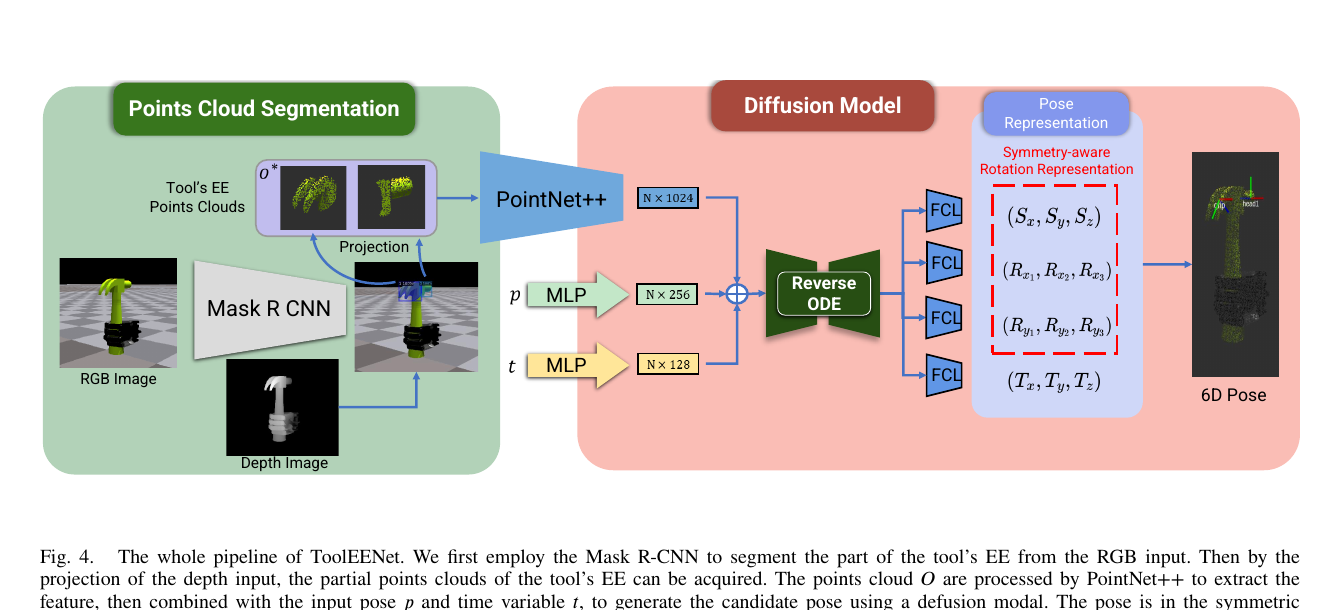
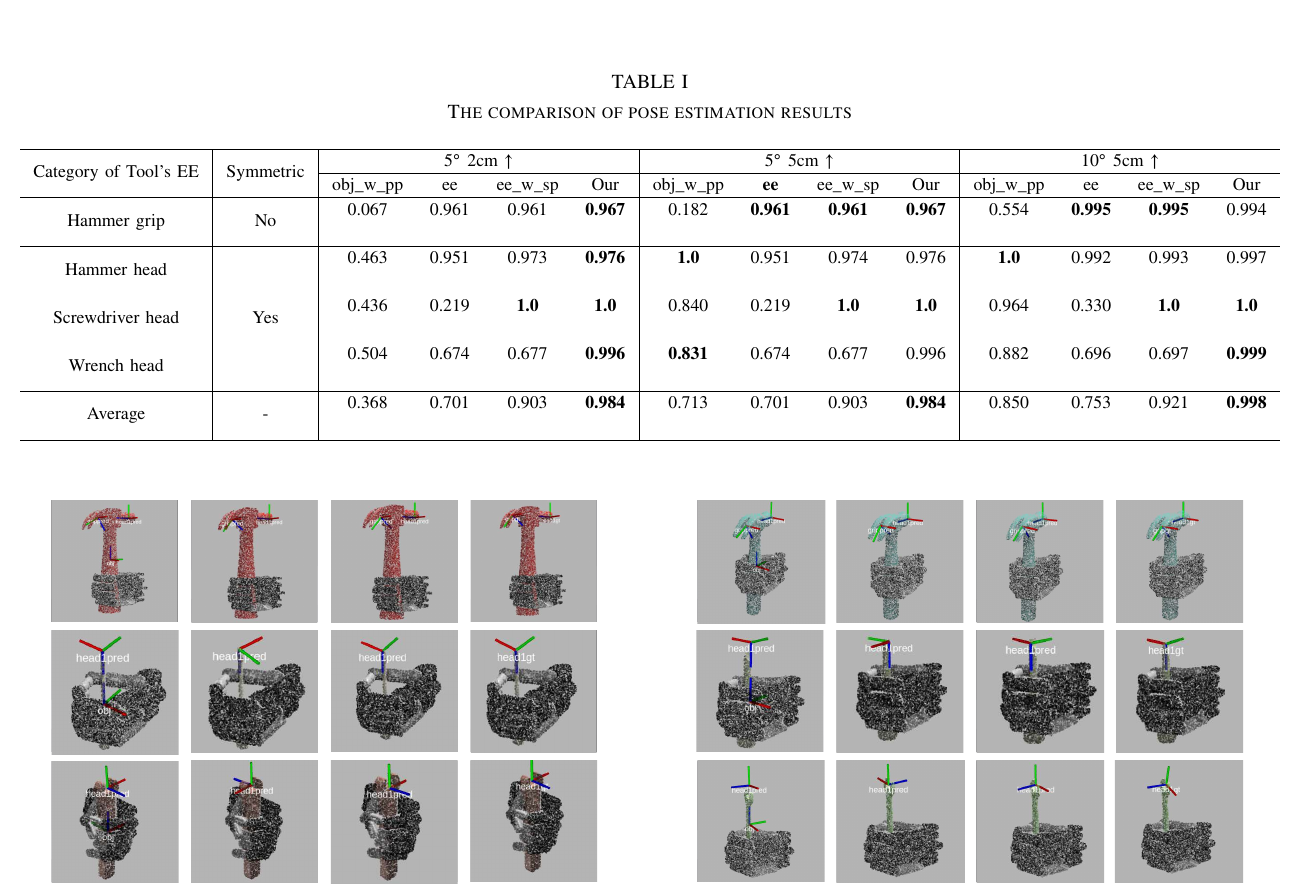
Original Figure 4: Mask R-CNN extracts the tool EE, depth back-projection yields 1028 points, and PointNet++ with pose / time conditions drives a reverse ODE to output a symmetry-aware pose. Source: authors' public manuscript. Image copyright belongs to the authors and IEEE; reproduced here for paper analysis.Original Table I and Figure 6: comparison of whole-object priors, ordinary EE pose, additional symmetry priors, and the proposed representation; the full method averages 0.984 / 0.984 / 0.998. Source: authors' public manuscript. Image / table copyright belongs to the authors and IEEE; reproduced here for paper analysis.
4. Problem setting
Input: RGB-D of handheld tools, often occluded by the hand.
The frontend outputs a functional-end affordance mask and back-projects it into a local EE cloud.
Output: category-level 6D pose of the functional end relative to the camera, rather than the whole tool’s object frame.
Categories include hammer grip, hammer head, screwdriver head, and wrench head; the latter three have prominent symmetry.
5. Method and data
TOOLEE labels functional-end segmentation and EE poses defined by actual tool use.
Mask R-CNN segments the EE in RGB, and depth yields a local cloud.
PointNet++ encodes 1028 points; MLPs fuse pose and diffusion-time conditions.
Score-based diffusion / a reverse ODE samples multiple pose candidates from Gaussian noise, then averages them for the output.
Rotation is represented with predicted symmetry properties and rotation components along x/y/z axes; metrics and outputs use learned symmetry to resolve ambiguity.
6. Experiments at a glance
The full method’s four-category means at 5°2cm, 5°5cm, and 10°5cm are 0.984 / 0.984 / 0.998.
Estimating from the whole-object cloud and applying object priors averages 0.368 / 0.713 / 0.850.
Using only the EE cloud without the proposed symmetry representation gives 0.701 / 0.701 / 0.753.
Screwdriver head reaches 1.0 under the symmetry-aware protocol; wrench head achieves 0.996 / 0.996 / 0.999 with the full method.
Qualitative real-tool manipulation uses a UR10 + Shadow Hand, without a reported task success rate.
7. Quick assessment
Research value: redefines the state variable the robot needs; functional-end pose corresponds more directly to contact than whole-object pose.
Strengths: the dataset, affordance segmentation, generative pose estimation, and symmetry representation form a complete pipeline.
Limitations: functional-end segmentation errors directly damage the downstream cloud; few categories are tested, and real-robot evidence is qualitative.
Suggested readers: researchers in tool use, affordances, category-level pose, hand-object occlusion, and contact manipulation.
Available src/paper-notes/tooleenet-iros2024/deep.md
In-depth paper notes
Support reproduction, comparison, related-work writing, and identifying opportunities for further research.
Deep Reading Notes: ToolEENet
1. Key assessment
ToolEENet’s primary contribution is its task definition. When a robot hammers a nail, drives a screw, or grips a nut, contact depends on the hammer-head, screwdriver-head, or wrench-head functional frame, rather than an arbitrary whole-tool center. Handle length and shape vary greatly within a category, while functional-end geometry and usage poses are more consistent; category-level functional-end pose therefore better supports skill transfer.
The network uses diffusion generation and a symmetry-aware representation, but the largest experimental gains come from replacing whole-object clouds with EE-centric clouds and aligning symmetry metrics / representations. All gains should not be attributed broadly to diffusion.
2. TOOLEE data and coordinate definitions
TOOLEE jointly annotates:
Tool functional-end affordance segmentation;
6D EE poses defined by tool use;
Tool and functional-end categories;
Symmetry properties.
EE frames emphasize contact direction. A hammer head’s working direction, a screwdriver tip’s axis, and a wrench opening’s gripping direction should be semantically consistent. These frames more directly generate end-effector targets than geometric principal axes do.
This also introduces subjectivity: one tool may support multiple affordances / uses, and the EE frame depends on the task. The paper mainly covers one typical use, without a systematic treatment of multiple affordances, double-ended tools, or task-conditioned pose.
3. Method pipeline
Original Figure 4. Green: EE cloud construction; red: conditional pose diffusion. Outputs explicitly include per-axis symmetry labels. Source: authors' public manuscript. Image copyright belongs to the authors and IEEE; reproduced here for paper analysis.
3.1 Functional-end segmentation
Mask R-CNN predicts tool and EE affordance masks in RGB. Projecting the mask into depth yields a local 3D cloud O, randomly sampled to 1028 points.
Localization serves two purposes:
Reduce pose interference from hand occlusion and within-category handle variation;
Make geometry more consistent within each functional category.
Frontend errors also become a major bottleneck: a mask that misses one side or includes the hand shifts the local cloud’s center, affecting both translation and symmetry axes.
3.2 Conditional pose diffusion
PointNet++ encodes the functional-end cloud into a 1024-dimensional feature. The current pose p(t) and diffusion time t pass through separate MLPs and combine with cloud features; the score network predicts the reverse-process update direction.
Training adds SDE noise to true poses and learns the conditional score ∇plogP(p∣O). Inference initializes Gaussian noise, generates multiple candidate poses along a reverse ODE, and applies mean pooling to the candidates.
A geometric issue remains: rotations cannot be averaged arbitrarily like Euclidean vectors. Per-axis rotation / symmetry representations reduce conflicts among equivalent solutions, but directly mean-pooling a multimodal distribution may still bias the result. A more robust implementation should use a Fréchet mean on SO(3) or retain multiple candidates for task-constraint selection.
3.3 Symmetry-aware pose representation
The output predicts symmetry properties (Sx,Sy,Sz) alongside per-axis rotation components. Evaluation and pose disambiguation use estimated symmetry, preventing unobservable axial spin of screwdriver heads and similar functional ends from being penalized incorrectly.
The paper compares four settings:
obj_w_pp: whole-object-cloud pose followed by object-category priors to transform it to the EE;
ee: EE-centric clouds with an ordinary pose representation;
ee_w_sp: EE clouds with additional GT / category symmetry priors;
our: EE clouds with a learned symmetry-aware representation.
These comparisons separate contributions from input centering, symmetry priors, and automatic symmetry prediction.
4. Experimental results
Original Table I compares four settings. Figure 6 shows seen / novel objects on the left / right; each group has four columns: whole-object prior, ordinary EE, full method, and GT, without a separate ee_w_sp column. Overlaid axes visualize poses. Source: authors' public manuscript. Image / table copyright belongs to the authors and IEEE; reproduced here for paper analysis.
Mean results:
Setting
5°2cm
5°5cm
10°5cm
obj_w_pp
0.368
0.713
0.850
ee
0.701
0.701
0.753
ee_w_sp
0.903
0.903
0.921
ToolEENet
0.984
0.984
0.998
By category:
Hammer grip (asymmetric): the full method achieves 0.967 / 0.967 / 0.994, close to ordinary EE already;
Hammer head: 0.976 / 0.976 / 0.997;
Screwdriver head (symmetric): the full method achieves 1.0 / 1.0 / 1.0, while ordinary EE reaches only 0.219 at strict thresholds;
Wrench head: 0.996 / 0.996 / 0.999.
The symmetry representation therefore contributes most to screwdriver heads. A hammer-head affordance mask may cover only a region near the handle, making the cloud incompletely symmetric and reducing the gain from extra symmetry modeling.
One caveat is that estimated symmetry properties participate in metric disambiguation. If an asymmetric object is incorrectly classified as symmetric, evaluation may become more permissive. Symmetry-classification accuracy and a confusion matrix should be reported separately to establish that pose gains do not arise from evaluation-tolerance leakage.
5. Real-robot experiments
A UR10 and Shadow Hand demonstrate functional-end poses and contact manipulation with tools held in hand. This shows that real RGB-D, hand occlusion, and partial clouds can yield usable coordinates.
However, the paper provides qualitative images / video without reporting:
Error propagation from affordance-mask IoU to pose;
Success rates for hammering, screwdriving, and other tasks;
Contact-position / direction errors;
Generalization beyond the tool categories;
An end-to-end comparison with whole-object pose plus hand-eye calibration.
The real experiments should therefore be read as proof of concept rather than industrial reliability of functional-end pose.
6. Critical analysis
Strengths
Output variables match downstream contact tasks;
Local functional-end geometry reduces within-category whole-tool variation;
Four settings separate the effects of EE-centric inputs and symmetry;
Public data, code, and project page support extension to more tool categories.
Limitations
Few tools / affordances are covered; real multifunction tools are not modeled sufficiently;
Strong dependence on Mask R-CNN segmentation, without erroneous-mask robustness experiments;
Averaging multiple pose candidates may discard the multimodality diffusion could preserve;
Symmetry prediction enters the metric and needs independent classification validation;
Publish and fix each category’s EE frame, symmetry axes, and usage semantics;
Evaluate GT masks, predicted masks, and varying occlusion separately;
Record PointNet++ input count, SDE schedule, reverse-ODE steps, and candidate count;
Cluster / average candidates on SO(3) rather than directly averaging Euclidean rotation parameters;
Report symmetry-prediction accuracy separately;
Add downstream contact-point error, contact-normal error, and task success rate;
Extend to double-ended tools, multiple affordances, and language-conditioned tool use.
8. Overall assessment
ToolEENet’s insight extends beyond its benchmark numbers: the usual object-centered 6D pose may not be the state a robot task actually needs. Functional-end localization and task-semantic frames provide the main value, while diffusion and symmetry representations stabilize estimation from incomplete, ambiguous local clouds. The key next step is to translate strong pose-threshold scores into reproducible contact-task success rates.