Reading Notes
Overview / Deep Dive
Available src/paper-notes/ultra-precision-6dof-iccv2025/coarse.md
Paper overview notes
Quickly assess the paper's scope, problem setting, core method, experimental findings, and whether to read it in depth.
Overview Notes: Ultra-Precision 6DoF Pose Estimation Using 2-D Interpolated Discrete Fourier Transform
1. Basic information
- Year / venue: 2025 / ICCV; reading mode: coarse.
- Task: ultra-precise 6DoF measurement using periodic patterns and industrial cameras.
- Original paper: ICCV Open Access.
2. Positioning in one sentence
Rather than learning general object recognition, this paper uses 2D-IpDFT to precisely estimate periodic-pattern frequencies and phases, then recovers 6DoF pose through an imaging / pattern model for controlled metrology applications such as lithography and nanomanipulation.
2.1 Guide to the paper’s figures and tables
| Figure / table | What to examine |
|---|---|
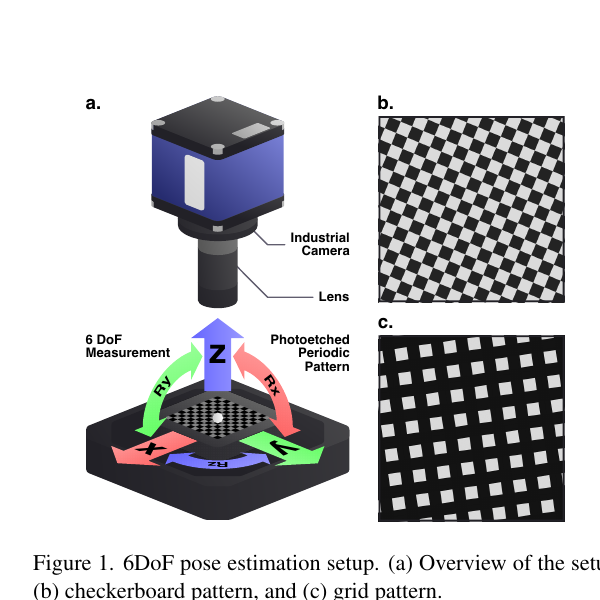
| Figure 1 | A measurement loop with a fixed industrial camera, an optical periodic pattern, and a six-axis stage; this explains why direct BOP comparisons are inappropriate. |
3. Method overview
- A 2D interpolated DFT accounts for spectral leakage from positive / negative frequencies when estimating frequency and phase.
- Analytical relationships connect frequencies and phases to translation / rotation under orthographic and quasi-orthographic camera models.
- Experiments use an industrial camera and photoetched checkerboard / grid patterns; the object prior is therefore a high-quality controlled pattern, rather than natural-object shape.
4. Experimental overview
- Simulations analyze SNR, visible pattern periods, and defocus, followed by validation on low-cost hardware.
- Authors’ claim: nanometer-level translation and microradian-level rotation accuracy, with greater robustness to defocus / spectral leakage.
- My assessment: valuable for precision engineering, but applicability depends on optics, calibration, and pattern manufacturing; it does not establish performance on occluded, cluttered, or textureless natural objects.
5. Strengths, risks, and insights
- Strength: the analytical model corresponds directly to experimental error sources, with metrics closer to the application than generic vision benchmarks.
- Risk: controlled patterns, near-orthographic imaging, and stable illumination are strong prerequisites.
- Insight: evaluate 6D pose at application-specific precision scales; micro / nanoscale metrology and robotic grasping should not rely only on the same benchmark terminology.