Universal Features Guided Zero-Shot Category-Level Object Pose Estimation
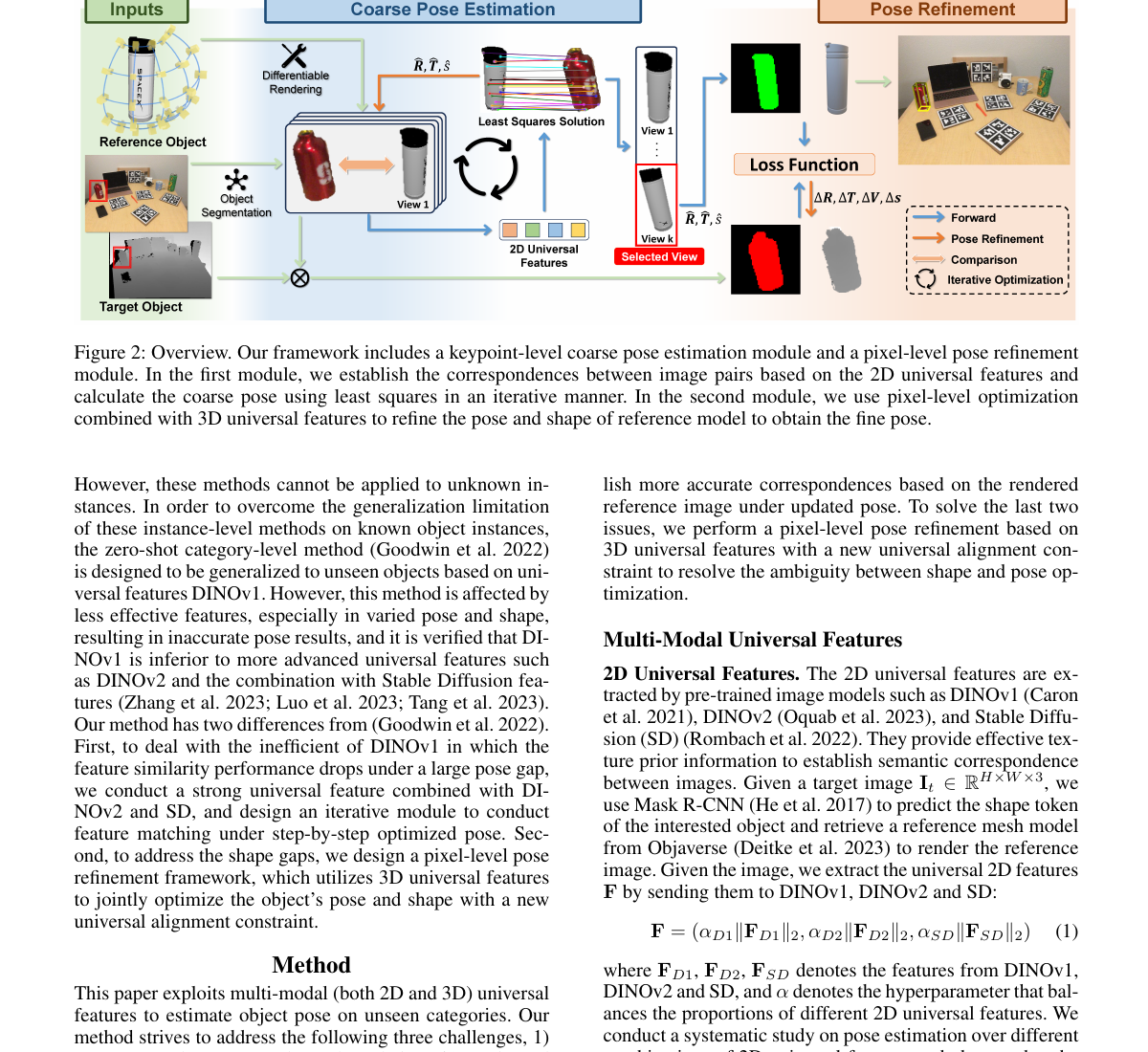
Universal Features Pose uses general-purpose 2D features for sparse semantic correspondences and coarse pose, then general-purpose 3D features for dense alignment, shape optimization, and pose refinement, enabling zero-shot category-level estimation without additional fine-tuning.
Institute of Software, Chinese Academy of Sciences / University of Chinese Academy of Sciences / The Hong Kong University of Science and Technology / Aerospace Information Research Institute, Chinese Academy of Sciences
object mask / cropdepth-derived object point cloudreference object observationscamera intrinsics
Reading Notes
Overview / Deep Dive
Available src/paper-notes/universal-features-zero-shot-pose/coarse.md
Paper overview notes
Quickly assess the paper's scope, problem setting, core method, experimental findings, and whether to read it in depth.
Overview: Universal Features Guided Zero-Shot Category-Level Object Pose Estimation
One-sentence summary
Universal 2D / 3D features drive an RGB-D pipeline from sparse-correspondence coarse pose to dense-alignment refinement, using a reference object to support category-level 6D pose for categories outside training.
Problem, inputs, and outputs
Input: target RGB-D, target mask / cloud, reference-object observations, and camera intrinsics.
Output: a target similarity transform and 6D pose; shape optimization also reduces reference–target shape differences.
Key boundary: zero-shot means no additional training / fine-tuning for the new target category, rather than single-image pose without references or geometric priors.
Method at a glance
Universal 2D features establish sparse semantic correspondences between reference / target RGB views for iterative coarse-pose estimation.
Universal 3D features process clouds aligned by the coarse pose to establish denser, more geometric correspondences.
Joint shape deformation and pose refinement reduce drift from within-category shape differences and partial occlusion.
Experimental anchors
REAL275: reported 3D IoU@0.5 is 63.49 and 5°5cm is 33.23.
Wild6D: 3D IoU@0.5 is 67.16, 5°5cm is 60.58, and 10°5cm is 80.47.
Comparisons include Zero-Pose; Table 1’s Speed entry is 3.83 s / frame, not FPS. Section 4.2 uses one GeForce RTX 4090.
Reading assessment
The contribution combines foundation-style features’ cross-category semantics with traditional iterative geometric alignment. Masks, depth quality, and reference coverage still set practical limits.
Available src/paper-notes/universal-features-zero-shot-pose/deep.md
In-depth paper notes
Support reproduction, comparison, related-work writing, and identifying opportunities for further research.
Deep Reading Notes: Universal Features Guided Zero-Shot Category-Level Object Pose Estimation
1. Basic information
Authors / affiliations: Wentian Qu et al.; Institute of Software, Chinese Academy of Sciences; University of Chinese Academy of Sciences; Hong Kong University of Science and Technology; Aerospace Information Research Institute.
Reading mode: deep; numbers come from the main paper’s tables. Table 1 reports Speed in s / frame; Section 4.2 uses one GeForce RTX 4090.
2. Positioning in one sentence
This reference-guided RGB-D zero-shot category-level pose approach first uses universal 2D features for cross-category semantic matching, then universal 3D features and shape optimization for geometric alignment, yielding a more precise pose.
2.1 Guide to the paper’s figures and tables
Figure / table
What to examine
Method page
Coarse-to-fine is more than a cascade: sparse 2D correspondences find the correct basin, and dense 3D alignment tightens geometric errors
Table 1
Read REAL275 and Wild6D together; strict pose thresholds on unseen categories provide the strongest evidence
Tables 2–3
Separate gains from iteration, pose refinement, and DINOv2 / Stable Diffusion feature combinations
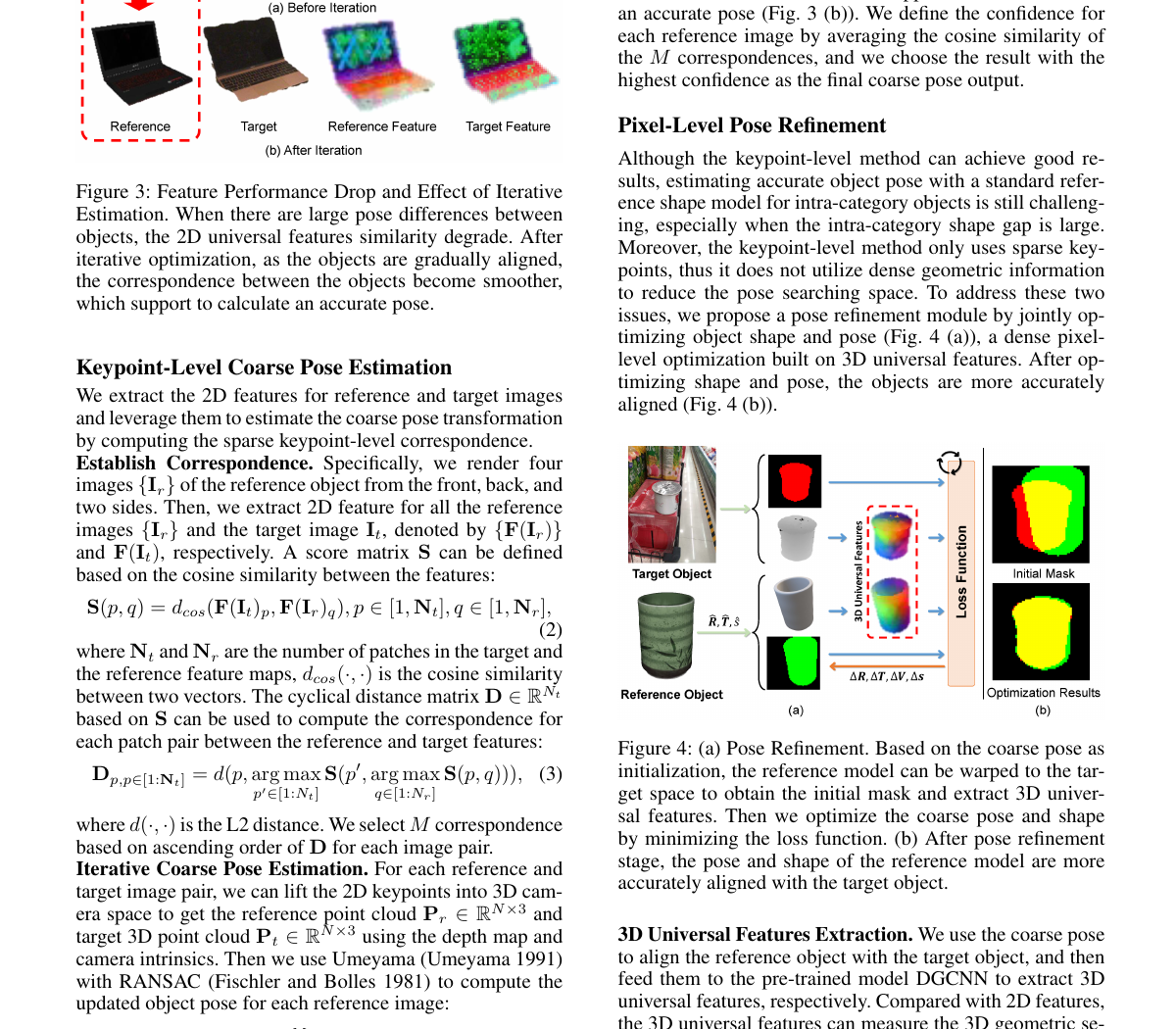
Excerpt from the original method-figure page: coarse-to-fine alignment driven by universal features. Source: official AAAI PDF. Image copyright belongs to the authors and publisher; reproduced here for paper analysis.Original Figures 3–4 and method text: iterative coarse alignment improves cross-view feature correspondences, followed by pixel-level joint refinement of reference shape and pose. This crop contains no experimental / ablation result tables; numerical results in the text come separately from the original tables. Source: official AAAI PDF. Image copyright belongs to the authors and publisher; reproduced here for paper analysis.
3. Problem setting and boundaries
The task is category-level 6D pose, but test categories may be absent from training: a stronger setting than unseen instances, with greater reliance on universal representations.
Inference still uses RGB-D, masks, a reference object, and intrinsics; this is not pure-RGB, prior-free open-world pose.
Shape differences, symmetry, and occlusion can trap one-shot correspondence fitting in a wrong solution, motivating coarse-to-fine processing and iterative correspondence reconstruction.
4. Method breakdown
Stage
Mechanism
Problem addressed
2D coarse alignment
Sparse semantic correspondences from universal 2D features + iterative fitting
Find approximate relative pose without category-specific features for new categories
3D dense alignment
Dense universal-3D-feature correspondences on aligned target / reference clouds
Move from semantic similarity toward more reliable geometric consistency
Shape optimization
Deform the reference toward the target
Reduce pose bias from different shapes within a category
Pose refinement
Optimize again using improved shape and correspondences
The key assumptions are that universal features preserve enough cross-instance semantics and the coarse pose puts subsequent 3D matches in a reasonable neighborhood. This is more interpretable than direct large-scale regression, but failed masks / depth can still reinforce incorrect alignment.
5. Experiments and numbers
Dataset
Key reported values
Interpretation
REAL275
IoU@0.5 63.49; 5°5cm 33.23; 10°5cm 57.74
Compared with Zero-Pose in the same table; strict 5°5cm gains are more informative
Wild6D
IoU@0.5 67.16; 5°5cm 60.58; 10°5cm 80.47
Target-category and real-capture variation make cross-category generalization more important
In ablations, the full combination of two iterations, shape deformation, and refinement reaches 5°5cm scores of 33.23 / 60.58 on REAL275 / Wild6D. This supports a feedback loop in which coarse pose improves correspondences and correspondences improve pose, beyond feature concatenation.
6. Strengths, risks, and insights
Strengths: combines zero-shot semantic generalization with verifiable geometric optimization; the main table covers two datasets; ablations separate features, iteration, and refinement.
Risks: reference scale / visibility, object masks, depth noise, and extreme symmetry remain external bottlenecks; frontend errors are not systematically quantified as confidence.
Reusable idea: use foundation features to propose correspondences or uncertainty, while a geometrically constrained optimizer determines the final pose, avoiding direct confusion between semantic similarity and rigid correspondence.